
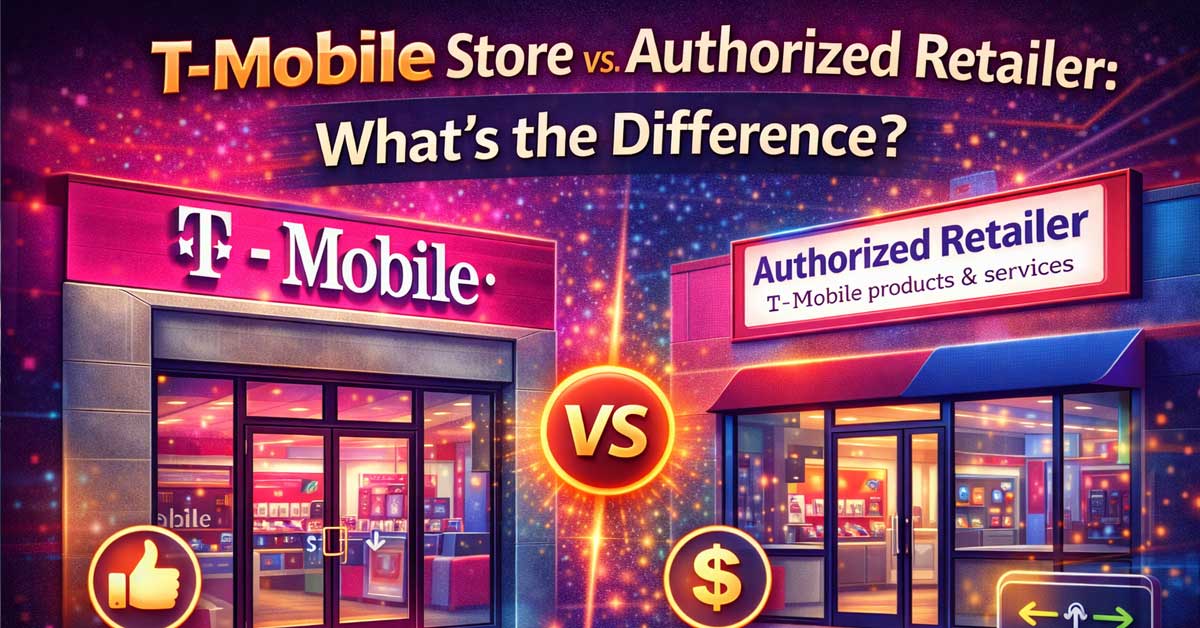

They look nearly identical — but walking into the wrong one can cost you
You’ve seen both on the same street corner. Same magenta colors, same T-Mobile signage, same phones in the window. But a corporate T-Mobile store and an authorized retailer are fundamentally different businesses, and which one you walk into matters more than most people realize — especially when something goes wrong.
The Core Difference
Corporate T-Mobile stores are owned and operated directly by T-Mobile. The employees work for T-Mobile, follow T-Mobile’s policies, and have full access to T-Mobile’s systems and account tools.
Authorized retailers are independently owned third-party businesses that have a contract to sell T-Mobile products and services. The employees work for the retailer — not T-Mobile. The store owner sets their own employment policies, their own commission structures, and in many cases their own fees.
From the outside, the two can be nearly impossible to tell apart. Both use T-Mobile branding. Both sell the same phones. Both can activate new lines. The difference is in what happens after the sale.
How to Tell Which One You’re In
The signage rarely makes this obvious, but there are a few reliable ways to check.
Look for small print near the entrance or on receipts that says something like “Authorized Retailer” or “Independently Owned and Operated.” Retailers are required to disclose this — but they’re not required to make it prominent.
Check T-Mobile’s website before you go. The store locator at t-mobile.com distinguishes between corporate locations and authorized retailers if you look at the store details carefully.
Ask directly. Walk in and ask whether the store is corporate or an authorized retailer. Employees are required to tell you if asked.
What Authorized Retailers Can and Can’t Do
This is where the practical differences show up most clearly.
Authorized retailers can:
- Sell phones and accessories
- Activate new lines of service
- Process upgrades
- Accept trade-ins (though their valuations may differ)
- Handle basic account changes
Authorized retailers often cannot:
- Process certain account credits or adjustments
- Handle complex billing disputes
- Access the same internal tools that corporate stores use
- Override decisions made by T-Mobile directly
- Accept returns under T-Mobile’s standard return policy in all cases
That last point is significant. If you buy a phone at an authorized retailer and want to return it, you may be subject to that store’s return policy rather than T-Mobile’s. Some retailers have stricter windows, charge restocking fees, or handle returns differently than a corporate store would.
The Fee Problem
This is the most common complaint people have after visiting an authorized retailer without realizing it.
Authorized retailers are permitted to charge fees that corporate stores don’t. Setup fees, activation fees, upgrade fees, and accessory bundle requirements are all tactics some retailers use to increase revenue per transaction. These fees are technically disclosed — but often buried in paperwork or mentioned quickly at the end of a transaction.
A corporate T-Mobile store charges T-Mobile’s standard activation fee and nothing else on top. An authorized retailer might charge that same fee plus an additional $20, $30, or more in store-specific charges that T-Mobile itself has no control over and won’t necessarily refund.
If you’re quoted a price that seems higher than what T-Mobile advertises online, ask for an itemized breakdown before agreeing to anything.
Trade-Ins and Promotions
Promotions are another area where things can get complicated. T-Mobile runs national promotions — trade-in deals, free line offers, device credits — and authorized retailers are supposed to honor them. In practice, execution varies.
Some retailers apply promotions correctly. Others add conditions, require accessory purchases, or structure deals in ways that reduce the value of the promotion. If you’re walking in specifically for a advertised T-Mobile deal, a corporate store is the safer place to redeem it. The employees work for T-Mobile directly and are accountable to T-Mobile’s standards in a way that third-party staff simply aren’t.
Trade-in valuations can also differ. Some authorized retailers have their own trade-in processes that run separately from T-Mobile’s official program, which can result in different — sometimes lower — values for your device.
Customer Service and Problem Resolution
If something goes wrong with your account, your bill, or your device, corporate stores have significantly more ability to help you.
Corporate employees can see your full account history, escalate issues internally, apply credits, and make changes that authorized retailer staff don’t have system access to perform. When an authorized retailer employee can’t solve your problem, their only option is to tell you to call T-Mobile customer service or visit a corporate store — which means you’ve made a trip for nothing.
For anything beyond a straightforward purchase or upgrade, a corporate store is worth the extra drive if there’s one within a reasonable distance.
When an Authorized Retailer Is Fine
Authorized retailers aren’t bad — many are run well, staff knowledgeable people, and provide perfectly smooth transactions. They exist because T-Mobile can’t put a corporate store everywhere, and for large portions of the country they’re the only physical T-Mobile presence available.
An authorized retailer is a reasonable choice when:
- You’re doing a simple, straightforward purchase with no trade-in or promotion
- There’s no corporate store nearby
- You’ve visited that specific retailer before and had a good experience
- You’ve read the fees and terms and are comfortable with them
Stick with a corporate store when:
- You’re redeeming a specific advertised promotion
- You have a trade-in with significant value
- You’re dealing with a billing issue or account problem
- You’ve had a bad experience at that retailer before
- You want T-Mobile’s standard return policy to apply without question
The Bottom Line
The magenta sign doesn’t tell you who owns the store or who the employees work for. An authorized retailer can give you a perfectly good experience — but it can also charge fees a corporate store wouldn’t, apply promotions differently, and leave you without recourse when something goes wrong.
Before your next visit, take thirty seconds to check T-Mobile’s store locator and confirm whether your nearest location is corporate or third-party. It’s a small step that can save a real headache, especially when you’re spending several hundred dollars on a new device or locking in a multi-line account.
Same sign, different business. Know which one you’re walking into before you walk in.

Meet Ry, “TechGuru,” a 36-year-old technology enthusiast with a deep passion for tech innovations. With extensive experience, he specializes in gaming hardware and software, and has expertise in gadgets, custom PCs, and audio.
Besides writing about tech and reviewing new products, he enjoys traveling, hiking, and photography. Committed to keeping up with the latest industry trends, he aims to guide readers in making informed tech decisions.