
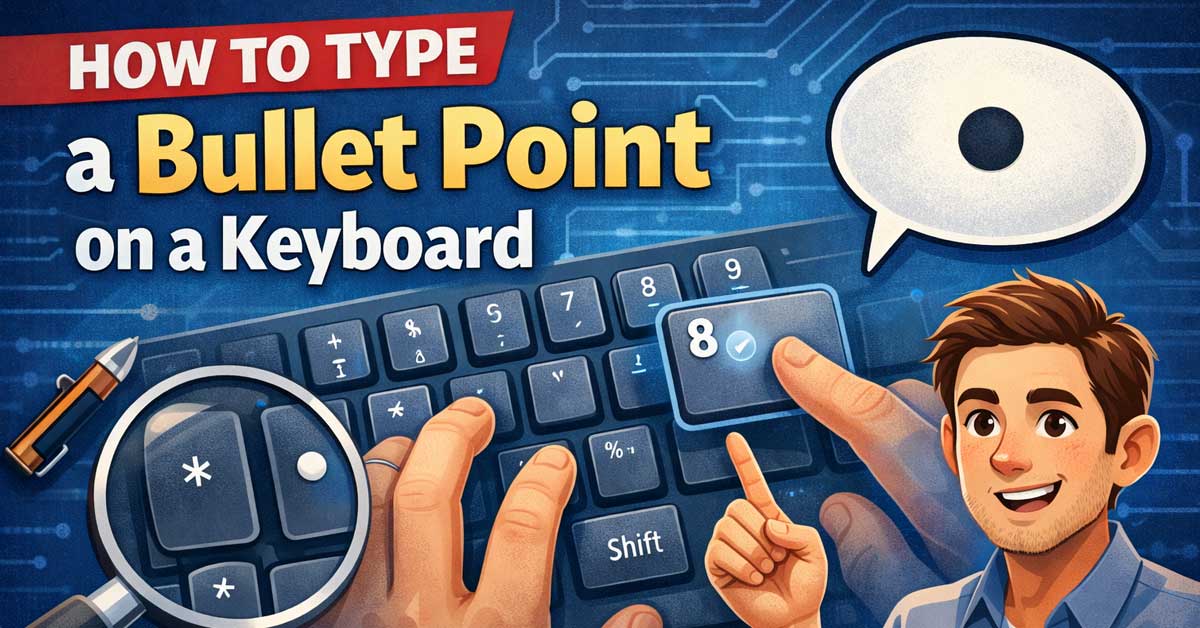

Not on any standard key — here’s every method on every platform
The bullet point symbol • (Unicode U+2022) isn’t on any standard keyboard but is one of the most commonly needed punctuation marks for lists, notes, and formatted text.
Every platform has a reliable method to produce it, and on most of them the fastest approach takes under two seconds once you know it.
This article covers the filled bullet •, the hollow bullet ◦, and the various list-related symbols that people commonly need alongside it.
Windows
Method 1: Alt Code
Hold Alt and type 0149 on the numeric keypad. Release Alt and • appears.
- Num Lock must be on
- Use the numeric keypad only — not the number row
- Doesn’t work on laptops without a dedicated numpad
For a hollow bullet ◦: hold Alt and type 9702 on the numpad.
Method 2: Character Map
Search for Character Map in the Start menu. Find • in the General Punctuation block or search by name “bullet.” Copy and paste. Works on any Windows machine.
Method 3: System-Wide Text Expansion
Use PhraseExpress, AutoHotkey, or Espanso to map a trigger like \bull or ;; to • system-wide.
A simple AutoHotkey script:
::\bull::•
Works in every application without remembering Alt codes.
Mac
Method 1: Keyboard Shortcut
Press Option + 8 to type • instantly.
This is the method to remember on Mac. Works in every application with no setup required — documents, notes, email, messages, everything.
Method 2: Character Viewer
Press Control + Command + Space to open the Character Viewer. Search “bullet” and double-click • to insert.
Method 3: Text Replacement
Go to System Settings → Keyboard → Text Replacements and map a trigger like \bull to •. Works system-wide.
iPhone and iPad
Method 1: Symbols Page
Tap ?123 to switch to numbers and symbols. On some iOS keyboard configurations, • appears directly on this page. Look for it in the punctuation symbols — it’s often present without needing a second tap.
Method 2: Long Press the Hyphen Key
Tap and hold the hyphen (-) key on the iOS keyboard. A popup appears showing dash variants — on many iOS keyboards, • appears as one of the long-press options on the hyphen. Slide to it and release.
Method 3: Text Replacement
Go to Settings → General → Keyboard → Text Replacement. Add • as the phrase and a trigger like \bull or ;; as the shortcut. Auto-expands in any text field after setup.
Android
Method 1: Symbols Keyboard
Tap ?123 to switch to numbers and symbols on Gboard. Look for • on the symbols pages — it’s present on most Android keyboard symbol layouts without needing a search.
Method 2: Long Press the Hyphen or Period
On Gboard, try long pressing the hyphen (-) or period (.) key — bullet variants sometimes appear in the long-press popup.
Method 3: Gboard Symbol Search
In Gboard, tap the G logo and search “bullet.” The bullet point character appears as an insertable option.
Method 4: Text Replacement
In Gboard settings, go to Dictionary → Personal Dictionary and add • with a shortcut like \bull.
Chromebook
Method 1: Unicode Input
Press Ctrl + Shift + U, type 2022, then press Enter or Space. • appears at your cursor immediately.
For hollow bullet ◦: Ctrl + Shift + U, type 25e6, Enter.
Method 2: Special Characters Picker
Press Search + Shift + Space to open the emoji and special characters panel. Search “bullet” and select •.
Linux
Method 1: Unicode Input
Press Ctrl + Shift + U, type 2022, then press Enter. Works consistently across most Linux distributions.
Method 2: Compose Key
With a Compose key configured, the sequence Compose + . + . (Compose and two periods) produces • on many Linux configurations.
Microsoft Word (Any Platform)
Method 1: Built-In Bullet List
For an actual bulleted list in Word, the fastest approach isn’t typing the character — it’s using Word’s list formatting. Press Ctrl + Shift + L to apply the default bullet list style to the current paragraph. Or click the bullet list button in the Home tab.
This creates properly formatted list items with correct indentation and spacing — better than manually typing bullet characters for actual lists.
Method 2: Alt Code
Hold Alt and type 0149 on the numpad — same as the standard Windows method.
Method 3: Alt + X
Type 2022 then immediately press Alt + X. Word converts the code to • instantly.
Method 4: AutoCorrect
Go to Insert → Symbol → More Symbols. Find •, insert it, and click AutoCorrect to set a trigger like \bull that Word converts automatically.
Method 5: Symbol Menu
Go to Insert → Symbol → More Symbols. In the General Punctuation subset, find •. Double-click to insert.
Google Docs
Option + 8 on Mac works in Google Docs exactly as it does everywhere else. Alt codes work on Windows inside Docs.
For a bulleted list in Docs, press Ctrl + Shift + 8 to apply bullet list formatting — this is the proper list approach rather than manually inserting bullet characters.
Go to Insert → Special Characters, search “bullet,” and click to insert for occasional inline use.
HTML and Web Development
<!-- Bullet point using entity -->
• <!-- • named entity -->
• <!-- decimal -->
• <!-- hex -->
• <!-- direct character -->
<!-- Common use in HTML lists — use proper list elements instead -->
<ul>
<li>Item one</li>
<li>Item two</li>
</ul>
<!-- Inline bullet as separator -->
Home • About • Contact
The named entity • is the cleanest option in HTML source. For actual lists, use <ul> and <li> elements rather than bullet characters — they’re semantically correct and accessible.
Markdown
Markdown uses hyphens, asterisks, or plus signs to create bullet lists — not the actual bullet character:
- Item one
- Item two
- Item three

* Also works
* For bullet lists

+ And this too
+ Creates bullets
When rendered, these produce properly formatted bullet points. Using the actual • character in Markdown creates plain text with a bullet symbol rather than a formatted list item.
LaTeX
% Bullet lists in LaTeX use the itemize environment
\begin{itemize}
  \item First item
  \item Second item
  \item Third item
\end{itemize}

% For the bullet character inline
$\bullet$     % in math mode
\textbullet   % in text mode

% Custom bullet symbol
\begin{itemize}
  \renewcommand\labelitemi{$\cdot$}
  \item Item with custom bullet
\end{itemize}
Common Bullet Variants
Different contexts call for different bullet styles. Here are the most commonly needed variants with their methods:
| Symbol | Name | Unicode | Windows Alt | Mac |
|---|---|---|---|---|
| • | Bullet | U+2022 | Alt + 0149 | Option + 8 |
| ◦ | White Bullet | U+25E6 | Alt + 9702 | Character Viewer |
| ▪ | Black Small Square | U+25AA | Character Map | Character Viewer |
| ▫ | White Small Square | U+25AB | Character Map | Character Viewer |
| ‣ | Triangular Bullet | U+2023 | Character Map | Character Viewer |
| ⁃ | Hyphen Bullet | U+2043 | Character Map | Character Viewer |
| – | En Dash (list use) | U+2013 | Alt + 0150 | Option + hyphen |
Lists vs. Inline Bullet Characters
Worth noting the distinction because the right approach depends on your context:
For formatted lists in word processors, websites, and documents — use the application’s built-in list formatting (Ctrl + Shift + L in Word, Ctrl + Shift + 8 in Google Docs, <ul><li> in HTML, \begin{itemize} in LaTeX). This creates properly formatted, accessible, consistently styled lists.
For inline bullet separators — navigation menus, breadcrumbs, or text like “Item 1 • Item 2 • Item 3” — use the actual • character through whichever method suits your platform.
For plain text files, notes, and chat — either the • character or a hyphen/dash works equally well. The • character looks more polished; the hyphen is universally typeable without any special method.
Quick Reference Table
| Platform | Fastest Method | Shortcut |
|---|---|---|
| Windows | Alt code (numpad) | Alt + 0149 |
| Mac | Keyboard shortcut | Option + 8 |
| iPhone / iPad | Symbols page or long press hyphen | ?123 page or hold – |
| Android | Symbols keyboard or Gboard search | ?123 page |
| Chromebook | Unicode input | Ctrl + Shift + U, 2022 |
| Linux | Unicode input | Ctrl + Shift + U, 2022 |
| Microsoft Word | Built-in list | Ctrl + Shift + L |
| Google Docs | Built-in list | Ctrl + Shift + 8 |
| HTML | Named entity | • |
| Markdown | Hyphen | – (rendered as bullet) |
The Bottom Line
On Mac, Option + 8 is the fastest and most memorable method — one key combination, works everywhere, nothing to remember beyond Option and the 8 key. On Windows, Alt + 0149 with a numpad covers every application. On mobile, the symbols page on both iPhone and Android puts • within one or two taps without any setup.
For anyone who types bullet points frequently in plain text, chat, or note-taking, a text expansion shortcut is worth setting up once — mapping ;; or \bull to • makes the character as easy to type as any letter.
Option + 8 on Mac. Alt + 0149 on Windows. Symbols page on mobile. And for lists in documents, use the list formatting rather than the character — it looks better and behaves better.

Meet Ry, “TechGuru,” a 36-year-old technology enthusiast with a deep passion for tech innovations. With extensive experience, he specializes in gaming hardware and software, and has expertise in gadgets, custom PCs, and audio.
Besides writing about tech and reviewing new products, he enjoys traveling, hiking, and photography. Committed to keeping up with the latest industry trends, he aims to guide readers in making informed tech decisions.