
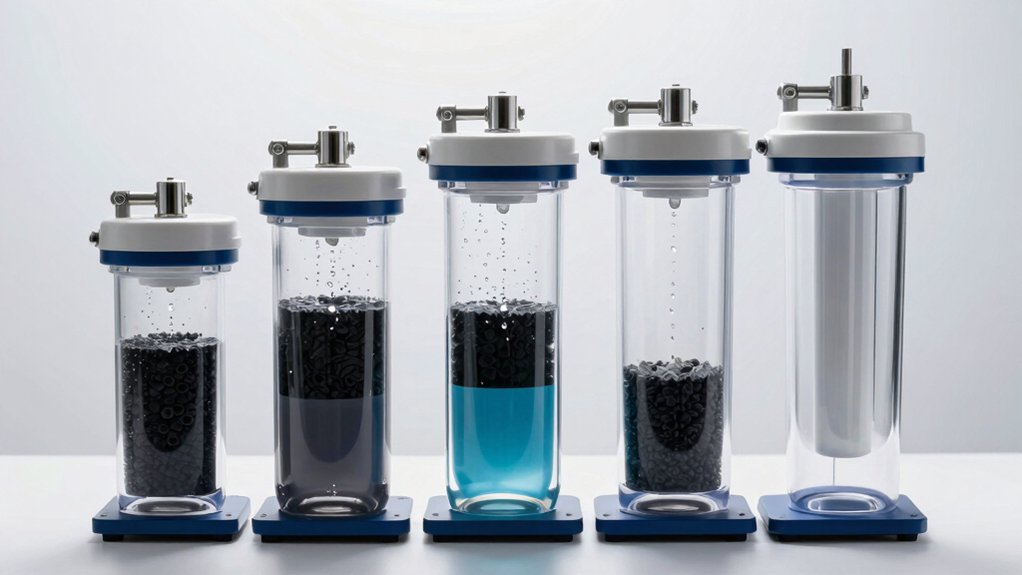

You’ll encounter five proven water filtration systems designed to reduce heavy metals like lead, arsenic, and chromium from your household water. Each system uses different filtration stages—sediment filters, activated carbon, KDF media, and specialized cartridges—to target specific contaminants. Before you choose one, you need to understand how these systems work and which setup fits your home’s needs, whether you want whole-house protection or targeted under-sink filtration.
| Express Water 3-Stage Whole House Filter System | Best Overall | Heavy Metal Reduction: Lead, arsenic, chromium, mercury, cadmium | Filtration Stages: 3-stage (sediment, polyphosphate, carbon) | Installation Type: Whole house, free-standing bracket | VIEW LATEST PRICE | Read Our Analysis | |
| HQUA WF3-01 Whole House Water Filtration System | Most Comprehensive | Heavy Metal Reduction: Lead, mercury, copper, nickel, chromium | Filtration Stages: 3-stage (sediment, carbon block, GAC+KDF) | Installation Type: Whole house, bracket-mounted or free-standing | VIEW LATEST PRICE | Read Our Analysis | |
| ICEPURE Under Sink Water Filter System (3-Year) | Best for Kitchens | Heavy Metal Reduction: Heavy metals (unspecified types) | Filtration Stages: Multi-stage (0.5 micron carbon block) | Installation Type: Under-sink, direct connect | VIEW LATEST PRICE | Read Our Analysis | |
| Whole House Water Filter System – Heavy Metal Removal | Best Value | Heavy Metal Reduction: Lead, arsenic, chromium, mercury | Filtration Stages: 3-stage (sediment, KDF, activated carbon) | Installation Type: Whole house, free-standing | VIEW LATEST PRICE | Read Our Analysis | |
| iSpring Whole House Water Filter System (WGB31B-PFKS) | Advanced PFAS Protection | Heavy Metal Reduction: Lead, mercury, and other heavy metals | Filtration Stages: 3-stage (sediment, GAC+KDF PFAS, GAC+KDF) | Installation Type: Whole house, DIY installation | VIEW LATEST PRICE | Read Our Analysis |
More Details on Our Top Picks
Express Water 3-Stage Whole House Filter System
Best Overall
View Latest PriceWhy choose a whole house filtration system instead of point-of-use filters at individual faucets? The Express Water 3-Stage system protects your entire home’s water supply. You’ll remove significant chlorine, heavy metals like lead and arsenic, and chromium at every tap. The polyphosphate stage reduces scale buildup in pipes and appliances. The stainless steel bracket holds three filters with individual pressure gauges and release buttons for straightforward maintenance. Replace filters every 6–12 months or at 100,000 gallons, depending on your water quality and usage. The system flows at 0.25 gallons per second at standard household pressure. Note: this system doesn’t reduce TDS; for that, consider a reverse osmosis alternative.
- Heavy Metal Reduction:Lead, arsenic, chromium, mercury, cadmium
- Filtration Stages:3-stage (sediment, polyphosphate, carbon)
- Installation Type:Whole house, free-standing bracket
- Filter Capacity/Life:100,000 gallons or 6–12 months
- Flow Rate:0.25 gallons per second (45–80 PSI)
- TDS Reduction:No TDS reduction
- Additional Feature:Stainless steel bracket construction
- Additional Feature:Individual pressure release buttons
- Additional Feature:Polyphosphate anti-scale protection
HQUA WF3-01 Whole House Water Filtration System
Most Comprehensive
View Latest PriceIf you’re concerned about heavy metals, chloramine, sediment, and odor in your household water supply, the HQUA WF3-01 3-Stage Whole House Water Filtration System delivers multi-layer treatment that addresses these contaminants throughout your entire home. The system uses three Big Blue filters with a sediment filter, carbon block filter, and compound GAC+KDF filter to reduce lead, mercury, copper, and other heavy metals. You’ll get up to 100,000 gallons of filtered water with built-in 180-day countdown timers to track cartridge replacement schedules. The unit operates at maximum flow rates of 15 GPM and withstands pressure ranges from 25 to 116 psi. Install pressure gauges to monitor filter clogging, and use included maintenance valves for easy servicing and drain access.
- Heavy Metal Reduction:Lead, mercury, copper, nickel, chromium
- Filtration Stages:3-stage (sediment, carbon block, GAC+KDF)
- Installation Type:Whole house, bracket-mounted or free-standing
- Filter Capacity/Life:100,000 gallons
- Flow Rate:15 GPM (25–116 PSI)
- TDS Reduction:No TDS reduction mentioned
- Additional Feature:180-day countdown timer alerts
- Additional Feature:Housing cleaning brush included
- Additional Feature:Maximum 15 GPM flow rate
ICEPURE Under Sink Water Filter System (3-Year)
Best for Kitchens
View Latest PriceThe ICEPURE Under Sink Water Filter System works best for you if you’re looking for a straightforward, no-fuss filtration setup that doesn’t require professional installation or countertop modifications. You’ll install it directly under your sink in under three minutes using its plug-and-play design. The system removes heavy metals, chlorine, and sediments through its 0.5-micron carbon block filter. It delivers 2.5 GPM flow rate and filters up to 22,000 gallons over three years. You’ll connect it to cold-water lines with 1/2″ or 3/8″ NPT threads. Filter replacement takes just two seconds, making maintenance simple and cost-effective for kitchens, bathrooms, and offices.
- Heavy Metal Reduction:Heavy metals (unspecified types)
- Filtration Stages:Multi-stage (0.5 micron carbon block)
- Installation Type:Under-sink, direct connect
- Filter Capacity/Life:22,000 gallons or 3 years
- Flow Rate:2.5 GPM (at 60 PSI)
- TDS Reduction:No TDS reduction mentioned
- Additional Feature:2-second filter cartridge change
- Additional Feature:NSF/ANSI 42 certified
- Additional Feature:Coconut shell carbon filtration
Whole House Water Filter System – Heavy Metal Removal
Best Value
View Latest PriceHomeowners concerned about lead, arsenic, and chromium contamination in their tap water’ll find that a whole house water filter system addresses these heavy metal threats before water reaches any faucet in the home. The EXPRESS WATER model WH300SCKS uses three filtration stages—sediment, KDF media, and activated carbon—to remove impurities through a redox process. Install this freestanding system before your water softener to protect pipes and appliances from dirt and silt. Replace filters every six to twelve months or after one hundred thousand gallons, whichever comes first. Monitor performance using built-in pressure gauges. Note that this system doesn’t reduce total dissolved solids; consider a reverse osmosis system for that purpose.
- Heavy Metal Reduction:Lead, arsenic, chromium, mercury
- Filtration Stages:3-stage (sediment, KDF, activated carbon)
- Installation Type:Whole house, free-standing
- Filter Capacity/Life:100,000 gallons or 6–12 months
- Flow Rate:0.25 gallons per second (45–80 PSI)
- TDS Reduction:No TDS reduction
- Additional Feature:KDF redox conversion technology
- Additional Feature:Designed for softener integration
- Additional Feature:Deluxe stainless steel construction
iSpring Whole House Water Filter System (WGB31B-PFKS)
Advanced PFAS Protection
View Latest PriceLooking to remove PFAS chemicals and heavy metals from your whole-house water supply? The iSpring WGB31B-PFKS uses three filtration stages to target different contaminants. Stage 1 removes sediment; Stage 2 reduces up to 99% of PFAS like PFOA and PFOS; Stage 3 tackles chlorine, lead, mercury, and hydrogen sulfide. The system handles 50,000 gallons or 12 months before filter replacement. Install it yourself using the standard 1″ NPT inlet/outlet connection that fits most household plumbing. Note that this system doesn’t reduce total dissolved solids, so pair it with an iSpring Reverse Osmosis system if you need that capability.
- Heavy Metal Reduction:Lead, mercury, and other heavy metals
- Filtration Stages:3-stage (sediment, GAC+KDF PFAS, GAC+KDF)
- Installation Type:Whole house, DIY installation
- Filter Capacity/Life:50,000 gallons or 12 months
- Flow Rate:Standard household flow (1″ inlet/outlet)
- TDS Reduction:No TDS reduction
- Additional Feature:SGS-tested 99% PFAS reduction
- Additional Feature:Individually sealed filter cartridges
- Additional Feature:Lifetime U.S. tech support
Factors to Consider When Choosing Water Filtration for Heavy Metals
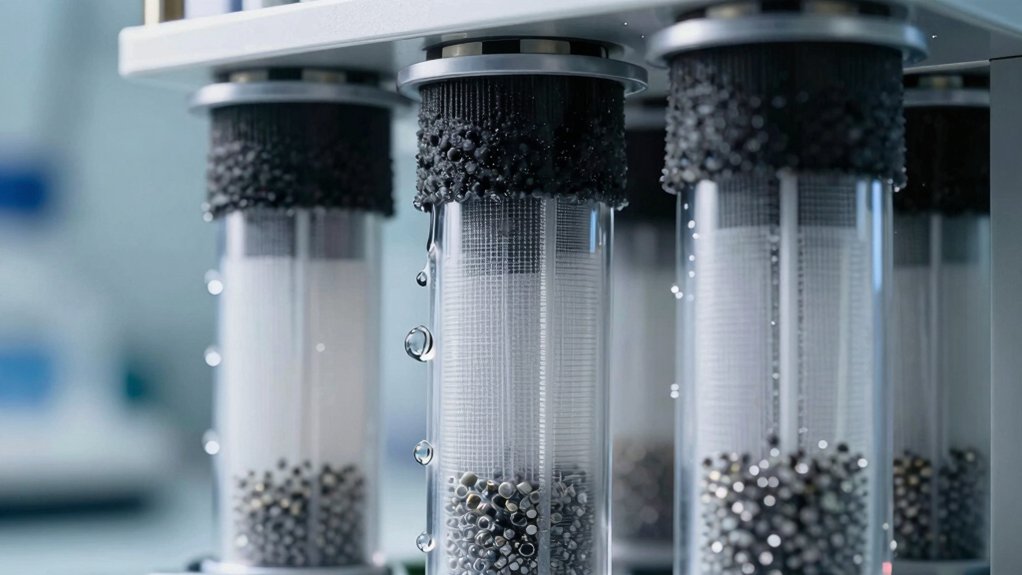
You’ll need to evaluate five key factors when selecting a heavy metal filtration system: the filtration technology type (such as activated carbon, reverse osmosis, or ion exchange), the flow rate and capacity that matches your household’s daily water usage, the filter replacement schedule and associated costs, the installation requirements and ongoing maintenance demands, and the certification standards that verify the system removes specific contaminants. Compare these factors against your water test results to identify which contaminants you’re targeting, then cross-reference each system option to ensure it addresses your particular heavy metal concerns. Document your findings in a comparison chart that ranks systems by technology type, cost, maintenance frequency, and third-party certifications from organizations like NSF International or WQA before making your final selection.
Filtration Technology Type
When selecting a water filtration system for heavy metal removal, you’ll need to evaluate several filtration technologies based on how they target contaminants and perform under your specific water conditions. Carbon-based blocks with ion exchange media effectively remove dissolved metals like lead and arsenic. KDF media uses redox reactions to convert contaminants into harmless byproducts. Granular activated carbon (GAC) improves taste and odor while targeting dissolved metals. Multi-stage systems combining sediment filtration, carbon blocks, and ion-exchange or KDF media provide broader contaminant coverage than single-stage options. Consider your water’s contamination profile and flow rate requirements—systems typically operate at 0.25 to 15 GPM depending on technology type. Match the technology to your primary contaminants for optimal removal efficiency.
Flow Rate And Capacity
How much water do you need to filter daily, and how long can your filter handle that demand? Flow rate and capacity directly determine your system’s effectiveness. Flow rate—measured in gallons per minute (GPM)—controls how quickly water passes through the filter media. Whole-house systems typically handle 15 GPM, while under-sink filters manage 2.5 GPM. Higher flow rates require larger filter stages to maintain adequate contact time for metal removal. Capacity, measured in gallons, indicates how long the media functions before replacement. Common capacities range from 22,000 to 100,000 gallons. Most systems require replacement every 6–12 months. Match your household’s simultaneous water usage to the system’s flow rate, then calculate replacement frequency based on daily consumption against stated capacity to plan maintenance costs.
Filter Replacement Schedule
Understanding your system’s flow rate and capacity sets the foundation for planning maintenance, and establishing a filter replacement schedule ensures your defenses against heavy metals stay effective. Most 3-stage systems require filter changes every 6–12 months or after 100,000 gallons, depending on your water usage and inlet quality. Check your manufacturer’s capacity specifications and match them to your household consumption to prevent premature filter exhaustion. Use built-in timers or gauges to track performance drops from heavy metal and sediment loading. Monitor for noticeable pressure drops or contaminant breakthrough, which signal that filtration media—including KDF, GAC, or ion exchange materials—has become saturated. Replace filters promptly to maintain consistent protection against lead, arsenic, chromium, and cadmium at every faucet throughout your home.
Installation And Maintenance
Selecting a water filtration system that you can easily install and maintain depends on matching three core features to your household setup: monitoring capability, cartridge accessibility, and physical compatibility. First, verify that your system includes visible pressure gauges or cartridge countdowns so you’ll know when replacement’s due. Second, confirm the cartridge uses quick-change buttons or release mechanisms—this cuts downtime considerably during swaps. Third, check that inlet and outlet connections match your plumbing, typically 1″ or ¾” NPT sizes, and that the frame works in your space via wall brackets or free-standing placement. Finally, confirm gasketed housings and leak-preventive connections protect against water damage, and that maintenance accessories like cleaning brushes come included for optimal performance.
Certification And Testing Standards
Why should you verify certifications before buying a heavy metal filtration system? Certifications validate that manufacturers’ claims are tested and proven. Look for NSF/ANSI 53, which specifically certifies heavy metals reduction in drinking water systems. NSF/ANSI 42 and 44 certify overall filtration performance. Check that certifications cover your entire system—filters plus housing—not just individual components. Review test reports showing specific reduction percentages for metals you need removed: lead, arsenic, chromium, or mercury. Examine the filtration media used, such as KDF, GAC, or ion exchange, and understand how each reduces heavy metals through redox or exchange mechanisms. Confirm maintenance intervals required to sustain performance. This verification process ensures your system delivers measurable, reliable protection.
Final Thoughts
You’ll choose the right heavy metal filtration system by matching your needs to available options. Whole-house systems like Express Water and HQUA protect your entire home; under-sink filters like ICEPURE work for drinking water only. Check your water quality report, determine your budget, and select a system with appropriate filtration stages. Replace cartridges on schedule to maintain effectiveness. You can test your water afterward to confirm heavy metal reduction.

Meet Ry, “TechGuru,” a 36-year-old technology enthusiast with a deep passion for tech innovations. With extensive experience, he specializes in gaming hardware and software, and has expertise in gadgets, custom PCs, and audio.
Besides writing about tech and reviewing new products, he enjoys traveling, hiking, and photography. Committed to keeping up with the latest industry trends, he aims to guide readers in making informed tech decisions.