
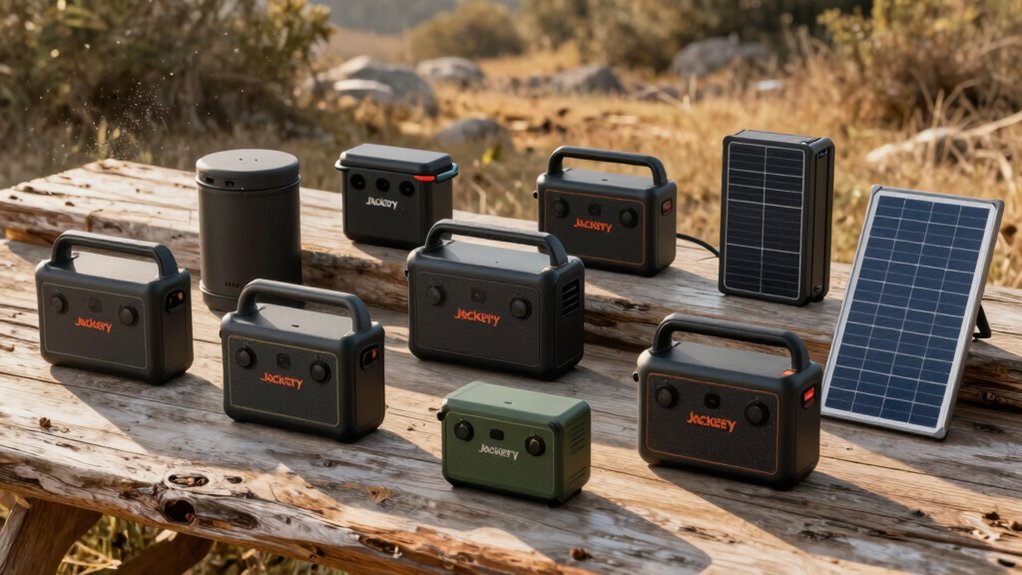

When you’re planning an off-grid setup, you’ll need to evaluate Jackery power stations based on capacity, output power, and charging speed. You can choose compact models like the Explorer 300 for lightweight portability or larger units like the Explorer 2000 v2 for sustained power demands. Each option pairs with SolarSaga panels for renewable charging. Understanding your specific power requirements and space constraints will determine which station works best for your situation—but first, you need to know what distinguishes each model.
| Jackery Portable Power Station Explorer 300 (293Wh) |

| Budget-Friendly Pick | Battery Capacity: 293Wh lithium-ion | AC Output Power: 300W continuous (500W peak) | Weight: 7.1 lbs | VIEW LATEST PRICE | Read Our Analysis |
| Jackery Explorer 1000 v2 Portable Power Station |

| Best Value | Battery Capacity: 1,070Wh LiFePO4 | AC Output Power: 1,500W continuous (3,000W surge) | Weight: 23.8 lbs | VIEW LATEST PRICE | Read Our Analysis |
| Jackery Explorer 2000 v2 Portable Power Station |

| Best Overall | Battery Capacity: 2,042Wh LiFePO4 | AC Output Power: 2,200W continuous | Weight: 39.5 lbs | VIEW LATEST PRICE | Read Our Analysis |
| Jackery Solar Generator 300 with 40W Solar Panel |

| Best For Beginners | Battery Capacity: 293Wh LiFePO4 | AC Output Power: 300W continuous (600W peak) | Weight: 7.5 lbs (Explorer 300 component) | VIEW LATEST PRICE | Read Our Analysis |
| Jackery Solar Generator 1000 v2 with 200W Panel |

| Most Versatile | Battery Capacity: 1,070Wh LiFePO4 | AC Output Power: 1,500W continuous (3,000W surge) | Weight: 23.8 lbs | VIEW LATEST PRICE | Read Our Analysis |
| Jackery HomePower 3000 Portable Power Station with Solar Panels |

| Professional Grade | Battery Capacity: 3,072Wh LiFePO4 | AC Output Power: 3,600W continuous (7,200W surge) | Weight: 59.52 lbs | VIEW LATEST PRICE | Read Our Analysis |
| Jackery HomePower 3600 Plus Portable Power Station |
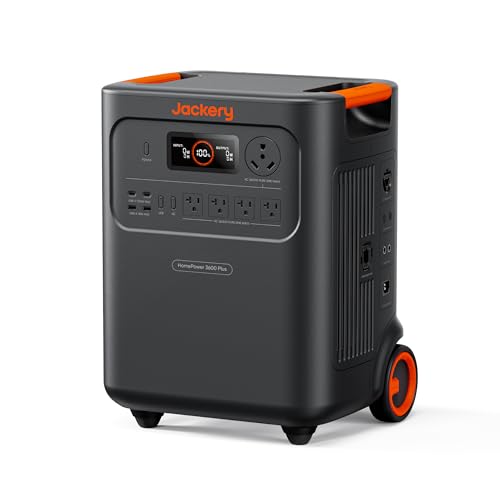
| Most Expandable | Battery Capacity: 3,584Wh LiFePO4 (expandable to 21kWh) | AC Output Power: 3,600W continuous (7,200W parallel) | Weight: 77.16 lbs | VIEW LATEST PRICE | Read Our Analysis |
| Jackery HomePower 3000 Portable Power Station Solar Generator |

| Best Durability | Battery Capacity: 3,072Wh LiFePO4 | AC Output Power: 3,600W continuous (7,200W surge) | Weight: 59.52 lbs | VIEW LATEST PRICE | Read Our Analysis |
| Jackery Explorer 500 Portable Power Station Solar Generator |
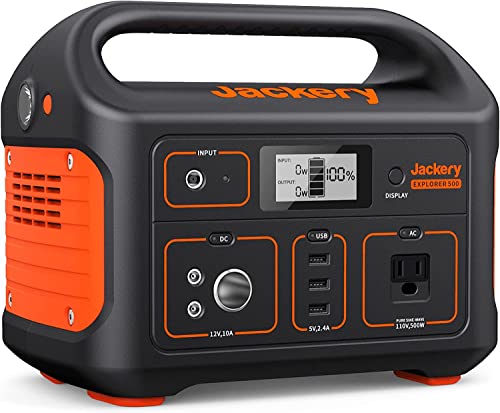
| Portable Powerhouse | Battery Capacity: 518Wh lithium-ion | AC Output Power: 500W continuous (1,000W peak) | Weight: 13.3 lbs | VIEW LATEST PRICE | Read Our Analysis |
| Jackery Solar Generator 5000 Plus Portable Power Station |

| Premium Heavy-Duty | Battery Capacity: 5,000Wh LiFePO4 (expandable to 60kWh) | AC Output Power: 7,200W to 14,400W (expandable) | Weight: Not specified in expandable base unit | VIEW LATEST PRICE | Read Our Analysis |
More Details on Our Top Picks
Jackery Portable Power Station Explorer 300 (293Wh)
Looking for a lightweight power station you can carry to your campsite or keep on hand during an outage? The Jackery Explorer 300 weighs just 7.1 pounds and delivers 300W continuous power with a 293Wh battery. You’ll get two AC outlets, USB-C with 60W power delivery, and a fast-charge USB port. Recharge it fully in two hours using a wall outlet, or pair it with the optional SolarSaga 100 panel for off-grid charging. Runtime reaches five hours under typical use. Its pure sine wave outlets safely power laptops, phones, and small appliances without noise or fumes, making it reliable for camping, travel, and emergency backup.
- Battery Capacity:293Wh lithium-ion
- AC Output Power:300W continuous (500W peak)
- Weight:7.1 lbs
- Battery Type & Lifespan:Lithium-ion; 2-year warranty
- Charging Speed (AC Wall):2 hours to 80%
- Included Solar Panel Option:Not included (compatible with SolarSaga 100)
- Additional Feature:Pure sine wave AC outlets
- Additional Feature:2-hour wall recharge capability
- Additional Feature:Compatible with SolarSaga panels
Jackery Explorer 1000 v2 Portable Power Station
Need a portable power station that charges fully in just one hour while maintaining battery health over a decade of use? The Explorer 1000 v2 delivers 1,500W continuous power with a 1,070Wh LiFePO4 battery. Enable emergency charging in the Jackery App to reach full capacity in one hour, or use default mode for 1.7 hours to optimize longevity. The battery retains over 70% capacity after 4,000 cycles. Three AC outlets, two USB-C ports with 100W fast charging, and one USB-A port let you charge multiple devices simultaneously. At 23.8 lbs with a foldable handle, it’s portable for camping, RVs, and off-grid setups. Solar panels pair with this unit for renewable charging options.
- Battery Capacity:1,070Wh LiFePO4
- AC Output Power:1,500W continuous (3,000W surge)
- Weight:23.8 lbs
- Battery Type & Lifespan:LiFePO4; 10+ years (70% after 4,000 cycles)
- Charging Speed (AC Wall):1.7 hours full charge (default); 1 hour with emergency mode via app
- Included Solar Panel Option:Not included (compatible with Jackery solar panels)
- Additional Feature:ChargeShield 2.0 smart charging
- Additional Feature:1-hour emergency fast charging
- Additional Feature:10+ year battery lifespan
Jackery Explorer 2000 v2 Portable Power Station
The Jackery Explorer 2000 v2 delivers 2042Wh of LiFePO4 capacity with 2200W of continuous AC output, making it ideal if you’re setting up a reliable home backup system or powering essential appliances during extended off-grid stays. You’ll charge it fully in 102 minutes using AC power or approximately 6 hours with 400W solar panels. The unit weighs 39.5 lbs and measures 13.2″ L x 10.4″ W x 11.5″ H, making it 41% lighter than comparable models. Its 20ms UPS switching provides seamless power during outages, while the LiFePO4 battery lasts up to 10 years. You can operate three AC outlets simultaneously and utilize the USB-C PD 100W port for device charging.
- Battery Capacity:2,042Wh LiFePO4
- AC Output Power:2,200W continuous
- Weight:39.5 lbs
- Battery Type & Lifespan:LiFePO4; up to 10 years (70% after 4,000 cycles)
- Charging Speed (AC Wall):102 minutes full charge (66 minutes to 80% emergency super charging via app)
- Included Solar Panel Option:Not included (compatible with solar panels)
- Additional Feature:20ms seamless UPS switching
- Additional Feature:66-minute super fast charging
- Additional Feature:CTB cell-to-body technology
Jackery Solar Generator 300 with 40W Solar Panel
If you’re camping, hunting, or living off-grid without access to consistent power, the Jackery Solar Generator 300 delivers portable energy in a lightweight package. This 293Wh power station weighs just 7.5 pounds and outputs 300W continuously with 600W peak surge capacity. You’ll find two AC outlets, one 120W car port, one 100W USB-C port, and two USB-A ports for charging devices. The included 40W solar panel charges the battery to 80% in approximately 7.5 hours. Its LiFePO4 battery supports over 4,000 charge cycles and lasts more than 10 years, making it reliable for extended off-grid use.
- Battery Capacity:293Wh LiFePO4
- AC Output Power:300W continuous (600W peak)
- Weight:7.5 lbs (Explorer 300 component)
- Battery Type & Lifespan:LiFePO4; >10 years (70% after 4,000 cycles)
- Charging Speed (AC Wall):Charging speed not specified
- Included Solar Panel Option:40W solar panel included
- Additional Feature:40W air solar panel included
- Additional Feature:LiFePO4 chemistry battery
- Additional Feature:CPAP-compatible functionality
Jackery Solar Generator 1000 v2 with 200W Panel
Looking for a portable power station that charges in under two hours while delivering 1500W of continuous power? The Jackery Solar Generator 1000 v2 combines a 1070Wh LiFePO4 battery with a 200W solar panel. You’ll charge fully in 1.7 hours via AC outlet or 6 hours using solar. The unit outputs 3000W surge power and weighs 23.8 lbs. Multiple ports—two USB-C, one USB-A, DC car port, and three AC outlets—let you power AC units, fridges, and electric pots simultaneously. The battery retains over 70% capacity after 4,000 cycles, supporting 10+ years of use. This setup works for camping, road trips, RVs, and emergency backup.
- Battery Capacity:1,070Wh LiFePO4
- AC Output Power:1,500W continuous (3,000W surge)
- Weight:23.8 lbs
- Battery Type & Lifespan:LiFePO4; 10+ years (70% after 4,000 cycles)
- Charging Speed (AC Wall):1.7 hours full charge (default); 1 hour with emergency mode via app
- Included Solar Panel Option:200W solar panel included
- Additional Feature:200W monocrystalline panel included
- Additional Feature:ChargeShield 2.0 technology
- Additional Feature:30dB quiet overnight mode
Jackery HomePower 3000 Portable Power Station with Solar Panels
Jackery’s HomePower 3000 delivers 3600W of continuous output with a 3072Wh LiFePO4 battery that’ll keep essential home systems running for extended periods—making it an ideal choice if you’re seeking reliable backup power during outages or planning to reduce grid dependency. The unit charges fully in 1.7 hours using hybrid AC/DC methods or 2.2 hours with AC alone. You’ll operate refrigerators, routers, security cameras, and medical equipment without interruption. The dual 100W USB-C ports enable fast charging for phones and tablets. Two included 200W solar panels recharge the battery to 80% capacity in nine hours, providing sustainable energy independence. Built-in UPS technology ensures seamless transitions during outages, maintaining continuous power delivery. At 59.52 pounds, you’ll transport this compact unit easily.
- Battery Capacity:3,072Wh LiFePO4
- AC Output Power:3,600W continuous (7,200W surge)
- Weight:59.52 lbs
- Battery Type & Lifespan:LiFePO4; up to 10 years (70% after 4,000 cycles)
- Charging Speed (AC Wall):2.2 hours full charge (AC alone)
- Included Solar Panel Option:2x 200W solar panels included (shipped separately)
- Additional Feature:Dual 100W PD ports
- Additional Feature:Built-in TT-30 RV port
- Additional Feature:15-hour typical load runtime
Jackery HomePower 3600 Plus Portable Power Station
The HomePower 3600 Plus delivers 3600W of AC output and expandable capacity up to 21kWh per unit, making it well-suited for households of three people who need reliable power for essential appliances like pumps, heaters, and dryers in off-grid situations. You’ll recharge fully in two hours using the hybrid AC+DC method, or choose alternatives: AC alone in 2.5 hours, solar in four hours, or a gas generator in 2.5 hours. The unit weighs 77.16 pounds with wheeled luggage-style design for transport. Its ceramic membrane battery cells resist thermal runaway and operate reliably in -4°F conditions, providing 6,000 cycles and a 10-year lifespan for dependable off-grid power.
- Battery Capacity:3,584Wh LiFePO4 (expandable to 21kWh)
- AC Output Power:3,600W continuous (7,200W parallel)
- Weight:77.16 lbs
- Battery Type & Lifespan:LiFePO4; 10 years (6,000 cycles)
- Charging Speed (AC Wall):2 hours full charge (hybrid AC/DC); 2.5 hours AC alone
- Included Solar Panel Option:Solar panel not specified in base unit
- Additional Feature:Dual 120V & 240V output
- Additional Feature:Expandable to 43kWh
- Additional Feature:Operates in -4°F conditions
Jackery HomePower 3000 Portable Power Station Solar Generator
Need a power station that keeps critical devices running during outages without interruption? The HomePower 3000 delivers 3600W output with a 3072Wh LiFePO4 battery and UPS switching under 20ms for essential equipment like security cameras and medical refrigerators. You’ll recharge fully in 1.7 hours using hybrid AC/DC charging or 2.2 hours with AC alone. Pair it with two SolarSaga 200W panels to reach 80% capacity in nine hours. The unit weighs 59.52 pounds, measures 16.4 x 12.8 x 12 inches, and includes multiple ports: AC outlets, USB-C with dual 100W PD, USB-A, and a 12V TT-30 RV port. ChargeShield 2.0 protection ensures 4,000 charge cycles to roughly 70% capacity retention.
- Battery Capacity:3,072Wh LiFePO4
- AC Output Power:3,600W continuous (7,200W surge)
- Weight:59.52 lbs
- Battery Type & Lifespan:LiFePO4; 4,000 cycles to 70% capacity
- Charging Speed (AC Wall):2.2 hours full charge (AC alone)
- Included Solar Panel Option:Solar panel option available (2x 200W panels compatible)
- Additional Feature:ChargeShield 2.0 AI algorithms
- Additional Feature:TT-30 RV port included
- Additional Feature:1-2 day refrigerator runtime
Jackery Explorer 500 Portable Power Station Solar Generator
If you’re planning camping trips, road adventures, or need a reliable backup power source for emergencies, the Explorer 500 delivers 518Wh of lithium-ion battery capacity in a compact, basketball-sized package that weighs just 13.3 pounds. You’ll access power through one 110V AC outlet (500W continuous, 1000W peak), three USB-A ports, two DC ports, and one car port. The built-in MPPT charge controller enables pass-through charging, so you can recharge the battery while powering devices simultaneously. A Battery Management System monitors individual cells to extend lifespan. You receive the unit, AC adapter, car charger cable, and user manual. Jackery backs this model with a two-year manufacturer warranty, and Amazon offers a thirty-day return window.
- Battery Capacity:518Wh lithium-ion
- AC Output Power:500W continuous (1,000W peak)
- Weight:13.3 lbs
- Battery Type & Lifespan:Lithium-ion; 2-year warranty
- Charging Speed (AC Wall):Charging speed not specified
- Included Solar Panel Option:Solar panel optional accessory
- Additional Feature:Pass-through charging capability
- Additional Feature:Basketball-sized compact form
- Additional Feature:Battery management system included
Jackery Solar Generator 5000 Plus Portable Power Station
Want a power station that handles whole-home backup and scales with your growing energy needs? The Jackery Solar Generator 5000 Plus delivers 5000Wh capacity expandable to 60kWh, supporting 7200W to 14400W output. You’ll run heavy appliances like dryers and ovens alongside critical devices via 0ms UPS mode. The LiFePO4 battery provides 1+ day backup at base capacity, extending to 15 days when fully expanded. Control charging and discharge through the smart app via WiFi or Bluetooth. Enable automatic off-peak charging to optimize costs. This system operates quietly under 30dB and produces zero emissions, making it ideal for off-grid homes requiring reliable, scalable power.
- Battery Capacity:5,000Wh LiFePO4 (expandable to 60kWh)
- AC Output Power:7,200W to 14,400W (expandable)
- Weight:Not specified in expandable base unit
- Battery Type & Lifespan:LiFePO4; lifespan not specified with cycle count
- Charging Speed (AC Wall):Charging time not specified
- Included Solar Panel Option:Solar panel option available (expandable system)
- Additional Feature:0ms UPS automatic response
- Additional Feature:Expandable to 60kWh capacity
- Additional Feature:Smart App WiFi control
Factors to Consider When Choosing Jackery Power Stations
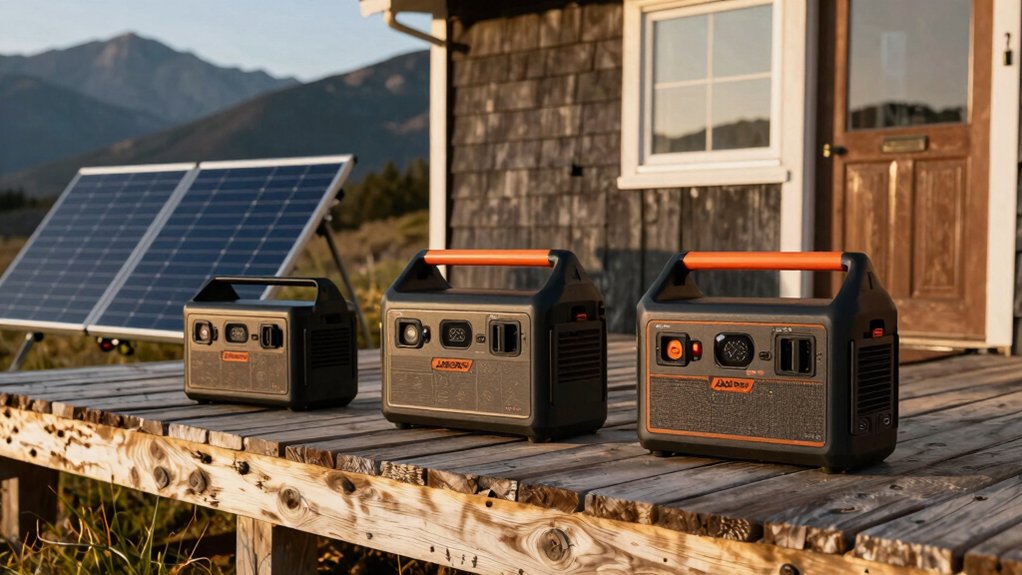
You’ll want to evaluate five core factors when selecting a Jackery power station: battery capacity and runtime (which determine how long your devices run between charges), power output requirements (measured in watts, based on your appliances’ needs), charging speed options (how quickly the unit recharges via solar panels or wall outlets), portability and weight (whether you can move it between locations), and port variety and compatibility (ensuring it connects to your specific devices). Start by listing the devices you plan to power, their wattage requirements, and how many hours daily you’ll need them running, then match these figures against each model’s specifications. Finally, consider your charging method preference—solar, AC wall outlet, or car charging—since this directly impacts how independent you’ll be from external power sources.
Battery Capacity And Runtime
Three main factors determine how long a Jackery power station will run your devices: the battery capacity measured in watt-hours (Wh) or kilowatt-hours (kWh), the wattage your devices draw, and the battery chemistry used. Higher Wh ratings deliver longer runtimes for identical loads. For example, a 3072Wh model runs longer than a 1070Wh unit powering the same appliances. You’ll also need to calculate your actual power consumption—if your devices draw 300W, a higher-capacity station extends runtime notably. LiFePO4 chemistry offers advantages here: these batteries typically support 4,000+ cycles and maintain stable capacity over years. When evaluating models, check manufacturer specs for runtime estimates under specific loads. Expandable units let you add capacity as your off-grid needs grow.
Power Output Requirements
Matching your power station’s output capacity to your actual power needs is essential for reliable off-grid living. First, list all appliances you’ll run simultaneously and note their wattage requirements. Next, identify which devices have high startup demands, like refrigerators or AC units, since these require peak surge wattage beyond their continuous running watts. Compare your total continuous wattage against models like the Explorer 300 (300W continuous, 500W peak) for light loads, or the HomePower 3000 (3600W continuous, 7200W peak) for heavy appliances. Finally, verify the number of AC outlets available—models with three pure sine wave ports let you power multiple devices at once. Align your chosen model’s ratings with your combined running watts and startup surges to avoid overload.
Charging Speed Options
Once you’ve matched your power station’s output to your appliances, you’ll want to contemplate how quickly you can recharge it for your next cycle of off-grid use. Jackery models offer multiple charging methods to fit different situations. AC wall outlets deliver standard recharges in roughly 1.7 hours, while emergency fast charging reaches 100% in about 1 hour. USB-C PD ports (60W or 100W) let you charge devices simultaneously while recharging the unit. Solar panels provide flexible charging—200–400W panels achieve 80% in 6–9 hours, while smaller panels need 2.8–7.5 hours. Combining methods dramatically accelerates recharging: hybrid AC plus solar charging completes a full cycle in 1.7–2 hours. Smart App control and ChargeShield technology optimize speed while protecting battery longevity across all input sources.
Portability And Weight
Because you’ll need to transport your power station between locations, weight and physical dimensions should substantially influence your purchasing decision. Compact models weighing 7.1 pounds suit backpacking and travel, while larger 3kWh units at 60 pounds require wheels or luggage-style handles. Evaluate your specific transport needs: if you’re moving equipment frequently, choose lighter capacity models like 293Wh units. For stationary setups with occasional relocation, heavier models with integrated wheels become practical. Check whether handles are integrated for one-handed carrying or if the design accommodates modular solar panels that add transportability concerns. Match the power station’s weight and dimensions to your vehicle space and physical capability. This direct assessment prevents purchasing units you can’t realistically move.
Port Variety And Compatibility
What outlets and ports does your power station actually need?
Most Jackery models include AC outlets, USB-C, USB-A, and 12V DC ports. The Explorer 300 offers 2 AC outlets, while larger units provide 3 or more AC ports plus multiple USB options. USB-C PD ports enable fast charging for phones and laptops. DC car ports connect directly to 12V devices and automotive equipment.
Consider your devices first. Count how many items you’ll power simultaneously. Standard appliances require AC outlets at 120V. Small electronics use USB ports. Specialized equipment may need the 12V DC output.
Check compatibility before purchasing. Verify that your devices match the available ports. Some higher-capacity models include solar charging ports, allowing you to recharge while powering equipment simultaneously. Select a unit with sufficient port variety for your specific off-grid needs.
Expandability And Scalability
How much growth capacity do you need in your power system? Consider expandable models like the HomePower 3600 Plus, which scales from single units up to 43 kWh through multi-unit configurations. Match your expansion strategy with output requirements: start at 3,600W and upgrade to 7,200W or higher for whole-home backup. Use dual-voltage outputs (120V and 240V in parallel) to power larger appliances efficiently across multiple units. Pair expandable batteries with modular solar panels—stack multiple 200W panels to recharge faster as your system grows. Choose LiFePO4-based systems, which maintain capacity through thousands of charge cycles, supporting long-term scalability. Plan your setup by calculating current power needs, then selecting a base unit that allows future expansion without replacement.
Durability And Warranty Coverage
Once you’ve mapped out your expansion strategy, you’ll want to verify that your chosen unit can withstand years of regular use and deliver reliable performance through its lifespan. Most Jackery models use LiFePO4 or lithium-ion batteries rated for 4,000+ charge cycles, retaining approximately 70% capacity over time. Check warranty coverage, which typically ranges from 2 to 5 years, with some units offering extended protection up to 5 years. Look for UL1778 certification and CTB technology, which ensure safety and stability. Built-in UPS features with ≤20 millisecond transitions protect critical devices during outages. Verify longevity claims—many models are designed for 10-year lifespans and function reliably indoors and outdoors across various temperatures. These factors directly impact your investment’s long-term value.
Budget And Use Case Match
Why you’ll choose one Jackery model over another largely depends on balancing price against your specific power needs. If you’re budget-conscious and need reliable off-grid power, select higher-capacity models between 1070Wh and 3072Wh for extended runtimes. For home emergencies, prioritize units with UPS capability under 20ms and LiFePO4 chemistry, accepting higher costs for reliability. Travelers on tight budgets should choose lightweight options under 15 pounds to reduce carrying strain. Assess your charging speed requirements: models with USB-C Power Delivery, multiple USB-A ports, DC car connections, and multiple AC outlets support faster device recharging. Consider solar compatibility—units with included panels cost more upfront but eliminate long-term charging expenses for off-grid scenarios. Match capacity, weight, ports, and solar needs to your budget tier.
Final Thoughts
You’ll choose your Jackery power station based on your specific needs. Match capacity (293Wh to 3,600Wh) with your device requirements. Consider portability—lightweight models for camping, wheeled units for permanent setups. Pair stations with SolarSaga panels for off-grid charging. Check output wattage against your appliances’ demands. You’ll evaluate budget constraints and expansion possibilities. Select your model, purchase compatible solar panels, and establish your off-grid power system.

Meet Ry, “TechGuru,” a 36-year-old technology enthusiast with a deep passion for tech innovations. With extensive experience, he specializes in gaming hardware and software, and has expertise in gadgets, custom PCs, and audio.
Besides writing about tech and reviewing new products, he enjoys traveling, hiking, and photography. Committed to keeping up with the latest industry trends, he aims to guide readers in making informed tech decisions.