


When you’re building or upgrading your NAS system, selecting the right NVMe SSD makes a significant difference in performance and reliability. You’ll want to evaluate drives that are specifically designed for NAS environments, not standard consumer SSDs. The four options we’re examining here each offer distinct advantages in speed, capacity, and compatibility. Understanding what sets them apart will help you choose the drive that fits your storage needs—so let’s examine each one.
| Western Digital 2TB WD Red NVMe SSD for NAS |

| Best Overall Performance | Form Factor: M.2 2280 | Interface/Protocol: PCIe Gen3 | Warranty: Not specified | VIEW LATEST PRICE | Read Our Analysis |
| Synology M.2 2280 NVMe SSD SNV3410 400GB (SNV3410-400G) |

| Enterprise-Grade Caching | Form Factor: M.2 2280 | Interface/Protocol: NVMe | Warranty: 5-year warranty | VIEW LATEST PRICE | Read Our Analysis |
| Gigastone 1TB M.2 NVMe SSD 2-Pack NAS Certified |
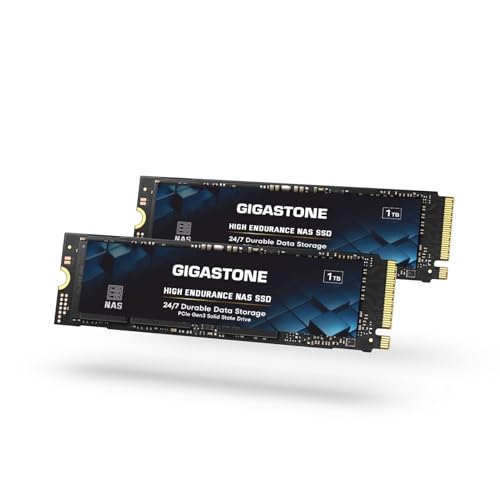
| Best Value Pick | Form Factor: M.2 2280 | Interface/Protocol: PCIe Gen3 | Warranty: 5-year replacement warranty | VIEW LATEST PRICE | Read Our Analysis |
| TEAMGROUP MP44Q 1TB PCIe 4.0 NVMe SSD |

| Fastest Speed Option | Form Factor: M.2 2280 | Interface/Protocol: PCIe Gen4 | Warranty: 5-year warranty | VIEW LATEST PRICE | Read Our Analysis |
More Details on Our Top Picks
Western Digital 2TB WD Red NVMe SSD for NAS
Are you running a NAS device that demands fast access speeds and multi-user reliability? The Western Digital 2TB WD Red NVMe SSD delivers the performance you need. This Gen3 PCIe M.2 2280 drive reaches speeds up to 3,400 MB/s, handling virtualization and collaborative editing seamlessly. You’ll experience robust system responsiveness and exceptional I/O performance across multitasking applications. The drive features endurance designed specifically for demanding NAS environments, ensuring long-term reliability in multi-user scenarios. Its model number WDS200T1R0C provides a scalable storage solution compatible with NAS devices supporting capacities up to 4TB. Install this drive to tackle intensive NAS workloads with confidence and consistent performance.
- Form Factor:M.2 2280
- Interface/Protocol:PCIe Gen3
- Warranty:Not specified
- Endurance Rating:High endurance for demanding NAS environments
- Primary Use Case:Virtualization and collaborative editing
- NAS Compatibility:Compatible with NAS devices
- Additional Feature:Up to 3,400 MB/s speed
- Additional Feature:Scales up to 4TB capacity
- Additional Feature:Multi-user scenario reliability
Synology M.2 2280 NVMe SSD SNV3410 400GB (SNV3410-400G)
When you’re running a Synology NAS that demands high-speed caching and sustained performance across multiple users, the SNV3410 400GB delivers the enterprise-grade reliability you need. This M.2 2280 NVMe SSD handles up to 70,000 4K random write IOPS, making it suitable for demanding 24/7 caching workloads. Install it directly into your NAS’s built-in M.2 slot or use an M2D18, M2D20, or E10M20-T1 adapter for flexibility. The five-year warranty covers endurance concerns. Check Synology’s knowledge center or YouTube channel for specific setup instructions tailored to your NAS model.
- Form Factor:M.2 2280
- Interface/Protocol:NVMe
- Warranty:5-year warranty
- Endurance Rating:High endurance for demanding caching workloads
- Primary Use Case:Enterprise NAS caching workloads
- NAS Compatibility:Synology NAS systems
- Additional Feature:70,000 4K random write IOPS
- Additional Feature:Enterprise-grade caching workloads
- Additional Feature:Adapter compatibility (M2D18/M2D20/E10M20-T1)
Gigastone 1TB M.2 NVMe SSD 2-Pack NAS Certified
If you’re running a NAS system that demands consistent, high-speed performance across 24/7 operations, the Gigastone 1TB M.2 NVMe SSD 2-Pack delivers the endurance and reliability you need. These drives reach 2,200 MB/s sequential speeds and feature SLC caching to accelerate responsiveness. They’re compatible with Synology, QNAP, and Asustor NAS models for flexible deployment. The M.2 2280 form factor fits standard NAS slots, and advanced ECC technology protects your data during intensive tasks like video editing and database storage. You’ll get a 5-year replacement warranty plus lifetime technical support, ensuring long-term protection for your investment.
- Form Factor:M.2 2280
- Interface/Protocol:PCIe Gen3
- Warranty:5-year replacement warranty
- Endurance Rating:24/7 high endurance with high TBW
- Primary Use Case:NAS data cache and fast boot
- NAS Compatibility:Synology, QNAP, Asustor models
- Additional Feature:SLC caching accelerates responsiveness
- Additional Feature:2-pack bundle included
- Additional Feature:Lifetime free technical support
TEAMGROUP MP44Q 1TB PCIe 4.0 NVMe SSD
The TEAMGROUP MP44Q 1TB offers three distinct advantages if you’re upgrading storage across multiple device types: it’s compatible with laptops, desktops, NUCs, and NAS systems thanks to its standard M.2 2280 form factor. You’ll get read speeds reaching 7,000 MB/s and write speeds up to 5,900 MB/s through its PCIe 4.0 interface. The drive uses 3D QLC NAND with SLC cache architecture for reliable performance. Its graphene heat dissipation label manages thermal output effectively. You’ll also access Intelligent S.M.A.R.T. monitoring software to track drive health, and you’re covered by a comprehensive 5-year warranty for protection against defects.
- Form Factor:M.2 2280
- Interface/Protocol:PCIe Gen4
- Warranty:5-year warranty
- Endurance Rating:SLC cache architecture for durability
- Primary Use Case:Laptop, desktop, NUC, and NAS expansion
- NAS Compatibility:Compatible with NAS systems
- Additional Feature:7,000 MB/s read speed
- Additional Feature:Graphene heat dissipation label
- Additional Feature:Intelligent S.M.A.R.T. monitoring software
Factors to Consider When Choosing a NAS Grade NVME SSD
When selecting a NAS-grade NVMe SSD, you’ll need to evaluate five key factors: your performance and speed requirements based on your workload, the storage capacity and scalability needs of your system, the reliability and endurance ratings that match your usage patterns, the compatibility with your specific NAS hardware and firmware, and the type of workload you’ll run (such as video streaming, database operations, or backup storage). Start by identifying your current storage demands and growth projections, then cross-reference your NAS system’s specifications to confirm which SSDs it supports. Finally, match the drive’s endurance rating and performance benchmarks to your intended use case to ensure you’re investing in hardware that’ll handle your workload without premature failure.
Performance and Speed Requirements
How do you know which speed metrics actually matter for your NAS setup? Start by identifying your primary workload. For sequential transfers like backups, prioritize peak read/write speeds—look for drives offering 7,000 MB/s read and 5,900 MB/s write performance. For caching-heavy environments with multiple users, focus on random IOPS instead, targeting 70,000 4K random write IOPS or higher. Next, verify your NAS supports PCIe Gen4 to access these speeds; Gen3 drives cap out lower. Then check the SLC cache capacity—larger caches maintain sustained performance during extended 24/7 operation. Finally, confirm your NAS accepts M.2 2280 form factor drives. Match these specifications to your specific usage patterns to ensure you’re not overspending on unnecessary performance.
Capacity and Scalability Needs
What capacity you’ll need depends on your NAS’s role in your infrastructure—whether it’s primarily for caching, primary storage, or scaling future growth. For caching workloads with multiple users, 1 TB drives or larger create sufficient pools for frequently accessed data. Evaluate your current storage demands and project growth over the next two to three years. If you’re expanding RAID arrays without frequent drive replacements, higher-capacity drives reduce maintenance costs. Consider your tiering strategy too: multi-drive setups benefit from consistent capacity across drives to maintain caching efficiency. Choose total capacity that accommodates both immediate needs and anticipated expansion, preventing performance bottlenecks as your data grows.
Reliability and Endurance Ratings
Durability fundamentals matter considerably when you’re selecting an NVMe SSD for NAS environments because these drives operate continuously under demanding conditions. Check the drive’s TBW (total bytes written) or DWPD (drive writes per day) ratings to understand how much data it can handle before degradation occurs. Enterprise-grade SSDs typically offer higher endurance ratings than consumer models, making them better suited for 24/7 NAS operation. Review the warranty period—most NAS-optimized drives include 5-year endurance warranties that guarantee the drive sustains expected workloads. Verify that the SSD features advanced wear leveling and ECC error correction to maintain data integrity. Additionally, assess cooling requirements, as thermal throttling during sustained writes can reduce both performance and effective lifespan in your NAS setup.
Compatibility With NAS Systems
When you’re choosing an NAS-grade NVMe SSD, you’ll need to verify that your drive matches your NAS system’s physical and technical requirements before making a purchase. First, check your NAS model’s supported interface—most use M.2 2280 with PCIe Gen3 or Gen4. Next, confirm available slots or whether you’ll need an adapter like M2D18, M2D20, or E10M20-T1. Review your NAS manufacturer’s compatibility list to ensure the specific drive model works with your system. Finally, verify the drive’s intended role—some SSDs function as read/write cache, boot drives, or tiering solutions rather than general storage. Matching these specifications prevents installation problems and ensures optimal performance in your multi-user environment.
Workload Type Considerations
Beyond ensuring your NVMe SSD physically fits your NAS, you’ll need to match the drive’s performance characteristics to your actual workload demands. Identify whether your workload is random or sequential. Random I/O workloads—like multi-user caching and mixed environments—require high IOPS ratings, such as 70,000 4K IOPS or higher. Sequential workloads prioritize throughput over IOPS. Next, evaluate your usage pattern. 24/7 continuous operation demands drives with high TBW endurance ratings and robust ECC protection to maintain performance over years. Bursty or cache-heavy scenarios benefit from SLC caching technology, which accelerates responsiveness during peak demands. Finally, confirm the drive supports your NAS’s specific protocols and expansion options, ensuring compatibility with your RAID configuration and available M.2 slots.
Thermal Management Solutions
Because NAS environments demand continuous 24/7 operation, you’ll need to prioritize thermal management when selecting your NVMe SSD. Look for drives equipped with dedicated heat spreaders made from copper or graphite—these actively pull heat away from the controller and memory chips. Check product specifications for SMART-based thermal monitoring, which automatically adjusts performance to prevent overheating. Consider your NAS enclosure design: M.2 drives in standard bays benefit from thick heatsinks, while PCIe add-in cards may require separate cooling solutions. Verify operating temperature ranges listed in datasheets; reliable NAS SSDs typically maintain safe performance between 0–70°C. Some premium models feature graphene-enhanced cooling for sustained workloads. Finally, confirm your NAS supports adequate airflow or fan adjustments to complement the drive’s cooling capabilities.
Warranty and Support Coverage
How much protection should your NAS-grade SSD actually have? You’ll want to examine warranty length first, as five-year coverage typically indicates stronger reliability and endurance ratings suited for multi-user workloads. Check what the manufacturer requires to validate your warranty—most enforce official NAS use case compliance and specific documentation processes. Longer warranties often reduce your total cost of ownership by covering potential failures during critical deployment years. Beyond the warranty period itself, verify whether the manufacturer offers lifetime technical support or replacement policies. Access dedicated support resources like knowledge centers, setup guides, and video tutorials that help you troubleshoot issues quickly. Review these coverage details before purchasing to ensure you’re protected throughout your NAS system’s operational lifespan.
Budget and Cost Effectiveness
What’s the real cost of choosing a cheaper NAS-grade NVMe SSD? Budget drives often force you to select smaller capacities or accept lower endurance ratings, which means you’ll need more drives to meet your capacity and IOPS requirements. Calculate your total cost of ownership by adding upfront purchase price, power consumption, cooling expenses, and potential performance throttling costs. Enterprise-grade drives with longer warranties and higher endurance ratings reduce replacement frequency and downtime risk in 24/7 deployments, offsetting their higher initial price. Look for mid-range options featuring SLC caching or DRAM buffers—they deliver strong performance for caching workloads without premium pricing. Balance your immediate budget against long-term wear costs and operational efficiency to determine the most cost-effective solution for your specific NAS deployment.
Final Thoughts
You’ll want to pick a NAS-grade NVMe SSD that matches your storage needs and system compatibility. Consider capacity first—decide between 400GB, 1TB, or 2TB based on your requirements. Next, check your NAS model’s slot compatibility and speed requirements. Compare read/write speeds, endurance ratings, and cooling features. Finally, verify warranty support and SMART monitoring capabilities before purchasing.

Meet Ry, “TechGuru,” a 36-year-old technology enthusiast with a deep passion for tech innovations. With extensive experience, he specializes in gaming hardware and software, and has expertise in gadgets, custom PCs, and audio.
Besides writing about tech and reviewing new products, he enjoys traveling, hiking, and photography. Committed to keeping up with the latest industry trends, he aims to guide readers in making informed tech decisions.