
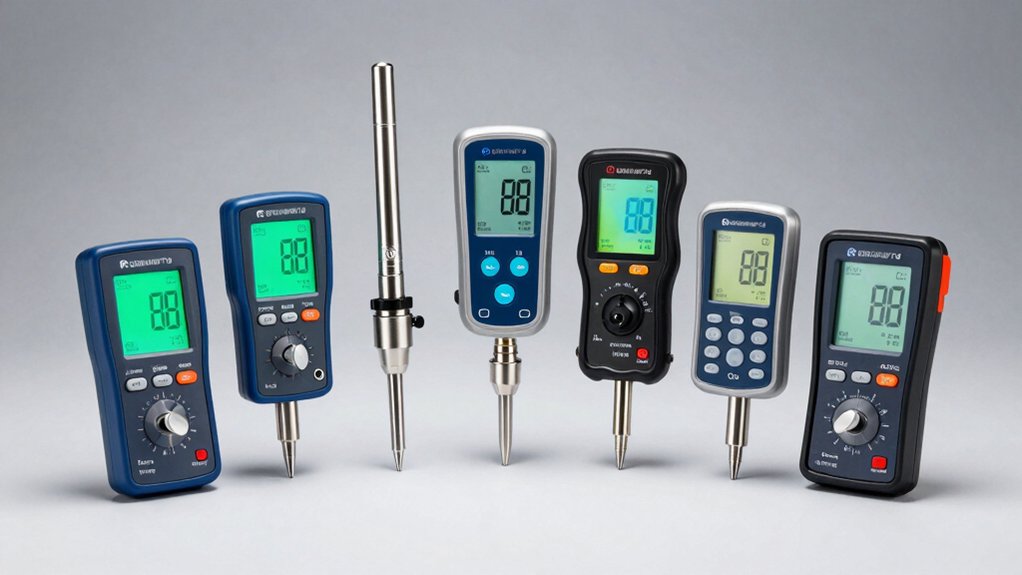

When you’re testing water quality, you need an EC meter that delivers reliable results without complications. You’ll want to focus on specific features: titanium probes for durability, accurate temperature compensation, and clear displays. The six models we’re examining—ranging from basic TDS testers to advanced 4-in-1 systems—each address different testing needs. But before you pick one, you should understand what separates the dependable options from the rest.
| 2025 4-in-1 TDS Meter Digital Water Tester |

| Most Reliable Brand | Measurement Parameters: TDS, EC, Temperature (°C, °F) | Measurement Range: 0–9999 ppm | Display Type: Backlit LCD (25% larger) | VIEW LATEST PRICE | Read Our Analysis |
| HoneForest TDS Meter Digital Water Tester |
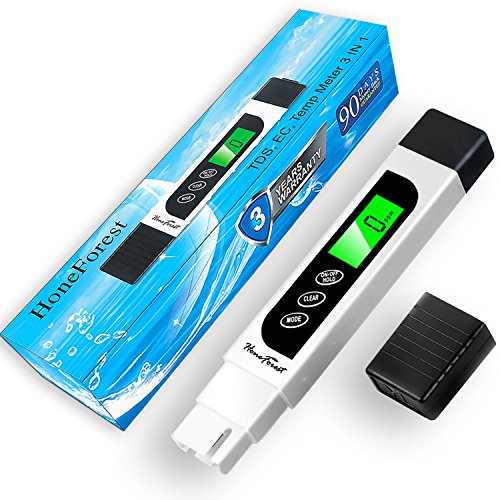
| Best Value Pick | Measurement Parameters: TDS, EC, Temperature (°F/°C) | Measurement Range: 0–9990 ppm | Display Type: Backlit LCD | VIEW LATEST PRICE | Read Our Analysis |
| Water Tester for Drinking Water- TDS Meter |

| Best Warranty | Measurement Parameters: TDS only | Measurement Range: Not specified | Display Type: Large backlit LCD | VIEW LATEST PRICE | Read Our Analysis |
| VIVOSUN Digital pH and TDS Meter Kits |

| Professional Grade Kit | Measurement Parameters: pH, TDS, EC, Temperature (°C/°F) | Measurement Range: TDS 0–9990 ppm; EC 0–9990 µs/cm | Display Type: Digital LCD | VIEW LATEST PRICE | Read Our Analysis |
| 2025 All-New 4 in 1 TDS Water Meter |

| Best Overall | Measurement Parameters: TDS, EC, Temperature (°C, °F) | Measurement Range: 0–9999 ppm | Display Type: Backlit LCD (25% larger) | VIEW LATEST PRICE | Read Our Analysis |
| 4 in 1 TDS Water Quality Meter Tester |

| Most Versatile | Measurement Parameters: TDS, EC, Temperature (°C/°F) | Measurement Range: 0–9990 ppm | Display Type: Backlit LCD (25% larger) | VIEW LATEST PRICE | Read Our Analysis |
More Details on Our Top Picks
2025 4-in-1 TDS Meter Digital Water Tester
Are you testing water quality across multiple applications—whether for drinking water, aquariums, hydroponics, or RO/DI systems—and need one device that handles all of it? The MEXYBE Model A2 delivers four measurements in one meter: TDS, EC, and temperature in both Celsius and Fahrenheit. Its titanium alloy probe and high-precision chip provide accurate readings across a 0-9999 ppm range. The backlit LCD—25% larger than previous models—displays results clearly even in dim conditions. Auto-lock freezes readings, while auto-off after two minutes conserves battery. Use the included TDS chart on the back to interpret your PPM values and determine water quality for your specific application.
- Measurement Parameters:TDS, EC, Temperature (°C, °F)
- Measurement Range:0–9999 ppm
- Display Type:Backlit LCD (25% larger)
- Probe Material:Titanium alloy
- Auto-Off Function:2 minutes
- Primary Applications:Drinking water, RO/DI systems, aquariums, hydroponics, pools, spas
- Additional Feature:25% larger backlit LCD display
- Additional Feature:Titanium alloy probe construction
- Additional Feature:Convenient TDS interpretation chart
HoneForest TDS Meter Digital Water Tester
The HoneForest TDS Meter works best if you need quick, reliable water testing across multiple settings—whether you’re checking drinking water quality, maintaining an aquarium, monitoring your RO system, or testing a pool. Turn on the meter, gently stir it in your water sample, and readings auto-lock within seconds. The 3-in-1 device measures total dissolved solids up to 9990 ppm, electrical conductivity, and temperature in both Fahrenheit and Celsius on a backlit LCD screen. Its titanium alloy probe handles regular use, and the meter automatically shuts off after two minutes of inactivity to preserve battery life. You’ll receive the meter, instruction manual, and portable leather bag for storage and transport.
- Measurement Parameters:TDS, EC, Temperature (°F/°C)
- Measurement Range:0–9990 ppm
- Display Type:Backlit LCD
- Probe Material:Premium titanium alloy
- Auto-Off Function:2 minutes
- Primary Applications:Drinking water, RO/DI systems, aquariums, hydroponics, pools, spas
- Additional Feature:Premium titanium alloy probe
- Additional Feature:Portable leather carrying bag
- Additional Feature:Quick auto-lock readings
Water Tester for Drinking Water- TDS Meter
Looking for a straightforward way to check whether your drinking water, filtered water, or aquarium setup meets acceptable quality standards? The Craft911 TDS-A2-2502 measures total dissolved solids quickly and accurately. Its titanium alloy probe withstands regular use, while the intelligent chip ensures consistent readings. Turn on the meter, dip it into your water sample, and read results on the large backlit LCD display within seconds. The auto-lock function holds your measurement, allowing you to document findings easily. This meter works for RO filters, hydroponics systems, and general water quality testing. Craft911 backs the device with a 3-year warranty and 90-day money-back guarantee, giving you reliable performance without financial risk.
- Measurement Parameters:TDS only
- Measurement Range:Not specified
- Display Type:Large backlit LCD
- Probe Material:Premium titanium alloy
- Auto-Off Function:Not specified
- Primary Applications:Drinking water, filter water, RO filters, aquariums, hydroponics
- Additional Feature:3-year warranty coverage
- Additional Feature:90-day money-back guarantee
- Additional Feature:Intelligent chip stability performance
VIVOSUN Digital pH and TDS Meter Kits
Want a single kit that measures pH, TDS, EC, and temperature without buying separate devices? The VIVOSUN Digital pH and TDS Meter Kits combines both tools in one purchase. You get a 0.01 pH pen-type meter with ±2% accuracy and a 3-in-1 TDS meter. The pH range extends from 0–14, while TDS measures 0–9990 ppm. Temperature readings span 0.1–80.0°C. The kit includes three calibration buffers and a protective case. Use this for aquariums, pools, hydroponics, or home water testing. The UL certification ensures reliability for your water quality checks.
- Measurement Parameters:pH, TDS, EC, Temperature (°C/°F)
- Measurement Range:TDS 0–9990 ppm; EC 0–9990 µs/cm
- Display Type:Digital LCD
- Probe Material:Not specified
- Auto-Off Function:Not specified
- Primary Applications:Hydroponics, pools, aquariums
- Additional Feature:Dual meter kit system
- Additional Feature:Includes 3 calibration buffers
- Additional Feature:UL certified equipment
2025 All-New 4 in 1 TDS Water Meter
MEXYBE’s 2025 All-New 4 in 1 TDS Water Meter works best for you if you need to test water quality across multiple applications without buying separate devices. This meter measures TDS, EC, and temperature in both Celsius and Fahrenheit across a 0-9999 ppm range. The 25% larger backlit LCD display makes readings easy to see in any lighting condition. Use it to monitor drinking water, RO/DI systems, aquariums, hydroponics, wells, pools, and spas. The premium titanium alloy probe delivers precise results, while auto-lock and hold functions simplify testing. Factory calibration ensures accuracy from day one, and the included back-of-device chart provides quick PPM reference without consulting external guides.
- Measurement Parameters:TDS, EC, Temperature (°C, °F)
- Measurement Range:0–9999 ppm
- Display Type:Backlit LCD (25% larger)
- Probe Material:Premium titanium alloy
- Auto-Off Function:2 minutes
- Primary Applications:Drinking water, RO/DI systems, aquariums, hydroponics, wells, pools, spas
- Additional Feature:Live 24/7 expert support
- Additional Feature:2 LR44 batteries included
- Additional Feature:Factory calibrated accuracy
4 in 1 TDS Water Quality Meter Tester
The Divolight 4 in 1 TDS meter works best for anyone who needs quick, accurate water testing across multiple applications without switching between devices. This pre-calibrated tester measures TDS, EC, and temperature in ranges up to 9990 ppm, making it suitable for drinking water, aquariums, hydroponics, and laboratory use. The 25% larger backlit LCD display shows readings in both Celsius and Fahrenheit scales. You’ll find the auto-lock feature captures instant results, while the hold function saves readings for later review. The device powers off automatically after two minutes, conserving battery life. Simply remove the protective cap, insert the probe into your water sample, and wait for the digital readout to stabilize before recording your measurement.
- Measurement Parameters:TDS, EC, Temperature (°C/°F)
- Measurement Range:0–9990 ppm
- Display Type:Backlit LCD (25% larger)
- Probe Material:Not specified
- Auto-Off Function:2 minutes
- Primary Applications:Drinking water, pools, ponds, aquariums, hydroponics, laboratory use
- Additional Feature:Pre-calibrated ready-to-use device
- Additional Feature:Includes calibration solutions
- Additional Feature:Hold function saves readings
Factors to Consider When Choosing an EC Meter for Water Testing
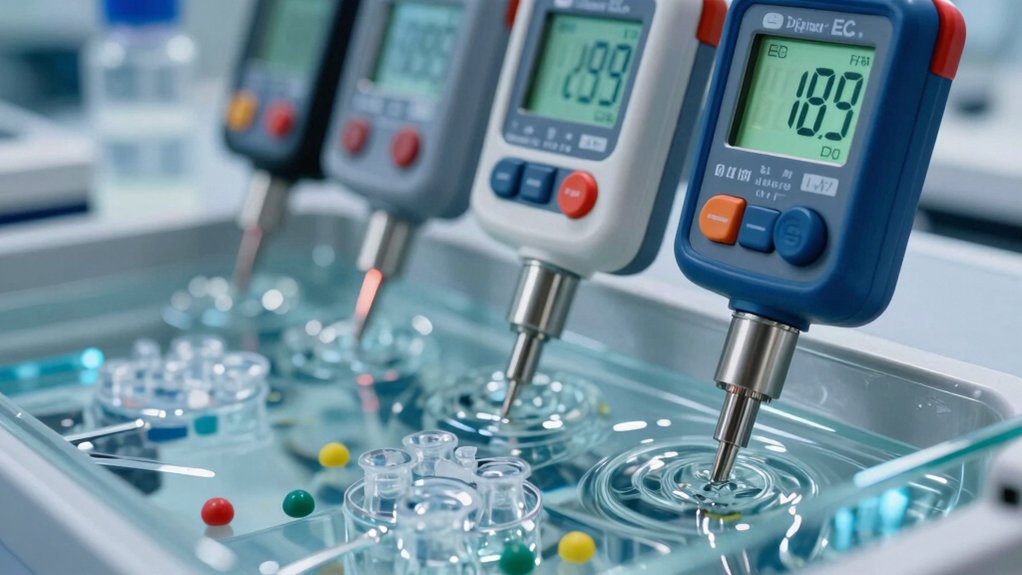
When you’re selecting an EC meter, you’ll need to evaluate five key factors that directly impact your testing results and long-term investment. First, check the measurement range and accuracy to ensure the meter handles your water’s conductivity levels, then assess the display quality for easy reading in various lighting conditions, examine the probe material for durability in your specific testing environment, determine whether you need multi-parameter capabilities beyond EC measurement, and finally review the calibration and maintenance requirements to confirm you can keep the meter functioning properly. Each of these considerations affects how well the meter will perform and how much time you’ll spend maintaining it.
Measurement Range And Accuracy
How do you know if an EC meter’s measurement range matches your testing needs? First, identify your water source and expected conductivity level. Tap water typically ranges from 50–1500 µS/cm, while highly saline samples may exceed 5000 µS/cm. Choose a meter with a range that covers your samples plus some buffer. Consumer-grade meters offer 0–9990 µS/cm, which suits most applications. Next, check the meter’s resolution—0.1 or 1.0 µS/cm increments allow you to detect small changes in low-conductivity waters. Finally, verify the meter includes automatic temperature compensation (ATC) since EC readings shift with temperature variations. This ensures accurate readings across different sample temperatures without manual adjustment.
Display Quality And Readability
Once you’ve confirmed your meter’s measurement range and accuracy, you’ll want to examine its display quality—because even the most precise readings won’t help if you can’t see them clearly. Look for a large backlit LCD screen that reduces glare and improves visibility in outdoor or dim conditions. A 25% larger display compared to older models lets you interpret EC values quickly at a glance. High-contrast digits help you spot small changes between readings, which matters when testing nutrient-rich or saline samples. Choose a meter with auto-lock and hold functions that keep readings visible after you remove the probe, making data recording easier. Reference charts printed on the device back help you interpret values for different water contexts without consulting external guides.
Probe Material And Durability
What’s the first thing you’ll notice when comparing EC meters? The probe material. You’ll find two main options: titanium alloy and stainless steel. Titanium alloy resists corrosion better across different water chemistries, making it ideal for long-term use. Stainless steel works adequately but corrodes faster in aggressive conditions.
Look for probes with reinforced junctions and protective coatings. These features prevent biofouling and mineral buildup, reducing calibration drift over time. Check how the probe handles frequent insertion and removal—durability matters here.
Consider the probe’s compatibility with standard calibration solutions and chemical cleaning agents. Pre-calibrated factory settings help maintain accurate readings. Choose a meter with a probe designed for your specific water conditions. This decision directly affects how often you’ll need replacement and repair costs.
Multi-Parameter Testing Capabilities
Why settle for a single measurement when you can get multiple readings in one device? Multi-parameter EC meters measure electrical conductivity, total dissolved solids (TDS), and temperature simultaneously, streamlining your water quality assessment. Look for models offering EC ranges of 0–9990 µS/cm paired with TDS readings of 0–9990 ppm. Temperature readings in both Celsius and Fahrenheit provide flexibility for different applications. Built-in features like auto-lock stabilize readings during testing, while hold functions preserve data for later review. Select meters with titanium alloy probes for durability across multiple measurements. Factory calibration ensures accuracy across all three parameters. Larger backlit LCD screens and reference charts on the device help you interpret results quickly without consulting external guides.
Calibration And Maintenance Requirements
Beyond measuring multiple parameters simultaneously, you’ll need to keep your EC meter accurate through proper calibration and upkeep. Calibrate your meter regularly using standard solutions with known conductivity values, such as 0.1 S/m or 1413 μS/cm, at defined temperatures. Factory-calibrated meters still require user verification with fresh solutions. Check your meter monthly or quarterly, depending on usage intensity and testing criticality. Select meters with automatic temperature compensation to adjust readings for sample temperature variations. Between calibrations, rinse electrodes with deionized water and clean them occasionally to prevent drift and preserve response quality. After battery changes or if readings shift noticeably, recalibrate immediately. Consistent maintenance reduces measurement errors and extends your meter’s reliable lifespan.
Application-Specific Use Cases
Choosing the right EC meter depends entirely on where and how you’ll use it, since different water-testing environments have distinct demands. For hydroponics, select meters with high-precision microchip sensors to accurately monitor nutrient solution conductivity in low ranges. Aquarium setups require stable readings and temperature compensation to handle water temperature fluctuations affecting salinity measurements. If you’re monitoring RO/DI systems, choose meters with clear pass/fail indicators signaling when membrane performance declines. Pools and spas need wide measurement ranges and water-resistant housing to withstand varying sanitizer levels and splash exposure. Multi-parameter meters offering simultaneous TDS, EC, and temperature readings simplify testing across drinking water, aquariums, and hydroponics applications. Match your meter’s capabilities to your specific testing environment for reliable, actionable results.
Build Quality And Design
When you’re selecting an EC meter, the physical construction and design features you choose directly affect how reliably your meter performs and how long it’ll last. Choose a probe made from titanium alloy or stainless steel, which resists corrosion in wet environments better than standard materials. A large, backlit LCD screen lets you read measurements clearly during low-light conditions and extended testing sessions. Look for factory calibration and pre-calibrated sensors that maintain consistent EC readings without frequent recalibration. Select a meter with an auto-lock hold function and auto-off feature to prevent accidental data loss. Finally, verify the housing has reliable seals and offers a compact, handheld design that resists moisture and travels easily to different testing locations.
Battery Life And Auto-Off
Since you’ll be testing water in various locations and conditions, battery life and auto-off features directly impact how often you’ll need to replace batteries and how long your meter stays functional in the field. Look for models with auto-off timers that activate after two minutes of inactivity, which preserves battery power during downtime. Check whether your meter comes pre-installed with a battery for immediate use, eliminating setup delays. Examine the LCD backlight specification, as illuminated displays drain batteries faster during extended use. Consider models featuring battery-saving presets that optimize power consumption during measurements. Finally, verify that the meter uses standard button-cell or coin-cell batteries, ensuring easy replacement and minimal downtime when power runs low.
Final Thoughts
You’ll want to select an EC meter that matches your specific water-testing needs. Compare the six models listed by checking their probe durability, temperature compensation accuracy, and measurement ranges. Verify calibration methods and data-hold features suit your workflow. Test each meter’s display clarity under your lighting conditions. Purchase from reputable sellers offering warranty support. Start with your most critical water source to ensure the meter performs reliably before expanding use.

Meet Ry, “TechGuru,” a 36-year-old technology enthusiast with a deep passion for tech innovations. With extensive experience, he specializes in gaming hardware and software, and has expertise in gadgets, custom PCs, and audio.
Besides writing about tech and reviewing new products, he enjoys traveling, hiking, and photography. Committed to keeping up with the latest industry trends, he aims to guide readers in making informed tech decisions.