
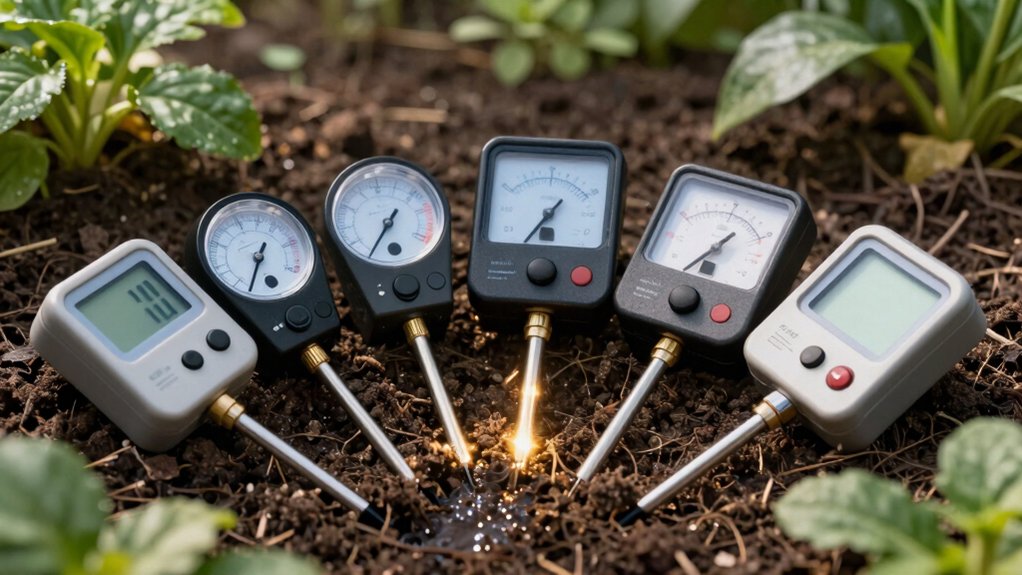

You’ve probably noticed your plants aren’t thriving, but you’re not sure why. The problem often starts with your soil’s pH level. A quality soil pH meter tells you exactly what’s happening beneath the surface—measuring moisture, pH, and light to reveal what your plants need. You’ll find several reliable options available, each with different features and price points. Here’s what separates the best meters from the rest.
| SONKIR Soil pH Meter 3-in-1 Gardening Tool |

| Simplest 3-in-1 | Measurement Parameters: Soil moisture, pH, sunlight (3-in-1) | Power Source: Battery-free | Display Type: Analog dial panel | VIEW LATEST PRICE | Read Our Analysis |
| YAMRON 4-in-1 Digital Soil Moisture & pH Meter |

| Most Advanced Digital | Measurement Parameters: Soil moisture, pH, temperature, sunlight (4-in-1) | Power Source: AAA 1.5V x 4 batteries required | Display Type: Large LCD screen with white backlight | VIEW LATEST PRICE | Read Our Analysis |
| Soil Test Kit 3-in-1 Moisture pH Fertility Meter |

| Best Dial Design | Measurement Parameters: Soil moisture, pH, fertility (3-in-1) | Power Source: Battery-free | Display Type: Large, clear dial | VIEW LATEST PRICE | Read Our Analysis |
| Soil Moisture Meter 4-in-1 Plant Tester with pH & Sunlight |

| Best Large Display | Measurement Parameters: Soil moisture, pH, fertility, sunlight (4-in-1) | Power Source: Battery-free | Display Type: 1.95″ oversized dial | VIEW LATEST PRICE | Read Our Analysis |
| HSLGOVE 7-in-One Soil Test Kit with Moisture Meter |

| Most Comprehensive Readings | Measurement Parameters: Soil moisture, pH, fertility, temperature, sunlight, air humidity, air temperature (7-in-1) | Power Source: 3 batteries required | Display Type: Dual-dial design plus LCD screen | VIEW LATEST PRICE | Read Our Analysis |
More Details on Our Top Picks
SONKIR Soil pH Meter 3-in-1 Gardening Tool
Why buy three separate tools when you can get one device that measures soil moisture, pH level, and sunlight exposure all at once? The SONKIR MS02 combines all three functions into a single, portable meter designed for gardens, lawns, and farms. To use it, insert the probe into your soil and wait a few minutes for accurate readings. Use the function button to switch between testing moisture, pH, and light levels. Note that you’ll need adequately moist soil for the indicator to move, so water dry soil beforehand. This meter requires no batteries and works both indoors and outdoors, making it practical for various gardening situations.
- Measurement Parameters:Soil moisture, pH, sunlight (3-in-1)
- Power Source:Battery-free
- Display Type:Analog dial panel
- Probe Insertion Depth:Insert into soil (specific depth not stated)
- Measurement Time:Wait a few minutes for accurate results
- Intended Use Environment:Indoor and outdoor gardens, lawns, farms
- Additional Feature:No battery required
- Additional Feature:Portable, compact design
- Additional Feature:Sturdy, scientific design
YAMRON 4-in-1 Digital Soil Moisture & pH Meter
The YAMRON 4-in-1 meter works best for gardeners who need multiple measurements in one device, since it measures soil moisture, pH, temperature, and sunlight intensity simultaneously. Insert the probe about 4 inches into soil at five different locations, then wait 10 seconds for readings at each spot. Average these values to get accurate final results. Water your test area first and wait 10 minutes before testing to avoid equipment damage. The rotating 45° display head lets you read measurements without bending down. Four AAA batteries power the large LCD screen with white backlight, which displays all parameters clearly for both indoor and outdoor gardens.
- Measurement Parameters:Soil moisture, pH, temperature, sunlight (4-in-1)
- Power Source:AAA 1.5V x 4 batteries required
- Display Type:Large LCD screen with white backlight
- Probe Insertion Depth:Approximately 4 inches (10 cm)
- Measurement Time:10 seconds for readings
- Intended Use Environment:Indoor and outdoor gardens, farms, potted plants, succulents
- Additional Feature:Large LCD backlit display
- Additional Feature:45° rotating head design
- Additional Feature:Temperature measurement included
Soil Test Kit 3-in-1 Moisture pH Fertility Meter
If you’re looking for a single tool that measures multiple soil conditions without batteries or complicated steps, Aenncci’s 3-in-1 soil tester delivers what you need. This compact meter tests moisture, pH, and fertility simultaneously through a single probe design that minimizes root damage. Insert the probe more than two-thirds of its length into soil, ideally four inches deep. Press the function button to switch between the three modes and read results from the large, clear dial within seconds. Wipe the probe clean after each test. The battery-free design makes storage simple, and the tester works for gardens, lawns, farms, and indoor plants.
- Measurement Parameters:Soil moisture, pH, fertility (3-in-1)
- Power Source:Battery-free
- Display Type:Large, clear dial
- Probe Insertion Depth:Greater than two-thirds of length; recommended 4+ inches
- Measurement Time:Results available within seconds
- Intended Use Environment:Indoor and outdoor gardens, lawns, farms
- Additional Feature:Single-probe minimizes root damage
- Additional Feature:Large, clear dial
- Additional Feature:Battery-free operation
Soil Moisture Meter 4-in-1 Plant Tester with pH & Sunlight
Want one tool that measures moisture, pH, nutrients, and sunlight all at once? The Soil Moisture Meter 4-in-1 Plant Tester combines all four functions into a single device with no battery required. Insert the probe 2.5 to 3 inches into moist soil, then switch the button to view each reading on the oversized 1.95-inch dial. You’ll get immediate results for moisture levels, pH balance, nutrient content, and sunlight exposure. This meter works indoors and outdoors across lawns, farms, and potted plants. Avoid testing hard soil, clay, or slurry mixtures. Store the device in a drawer when not in use.
- Measurement Parameters:Soil moisture, pH, fertility, sunlight (4-in-1)
- Power Source:Battery-free
- Display Type:1.95″ oversized dial
- Probe Insertion Depth:2.5–3 inches
- Measurement Time:Quick, immediate results
- Intended Use Environment:Indoor and outdoor gardens, lawns, farms, houseplants, pots
- Additional Feature:1.95″ oversized dial display
- Additional Feature:One-button operation
- Additional Feature:Nutrient/fertility detection included
HSLGOVE 7-in-One Soil Test Kit with Moisture Meter
For beginners who need to monitor multiple soil and environmental conditions at once, the HSLGOVE 7-in-One Soil Test Kit combines moisture, pH/fertility, temperature, light, and humidity measurements into a single device. You insert the probe at least three inches into soil, press the function button to select your measurement, and receive results within three to five minutes on either the dial or LCD screen. The dual-dial design displays soil temperature clearly, while the LCD shows air temperature and humidity. You’ll replace all three batteries when needed and toggle between readings using the control button. This kit works for indoor and outdoor gardens, farms, lawns, flowers, potted plants, and vegetables—making it practical for monitoring conditions before planting and during seedling growth.
- Measurement Parameters:Soil moisture, pH, fertility, temperature, sunlight, air humidity, air temperature (7-in-1)
- Power Source:3 batteries required
- Display Type:Dual-dial design plus LCD screen
- Probe Insertion Depth:3+ inches
- Measurement Time:Results in 3–5 minutes
- Intended Use Environment:Indoor and outdoor gardens, farms, lawns, flowers, potted plants, vegetables
- Additional Feature:Dual-dial plus LCD display
- Additional Feature:Air temperature/humidity monitoring
- Additional Feature:Soil temperature measurement included
Factors to Consider When Choosing a pH Meter for Garden Soil Testing
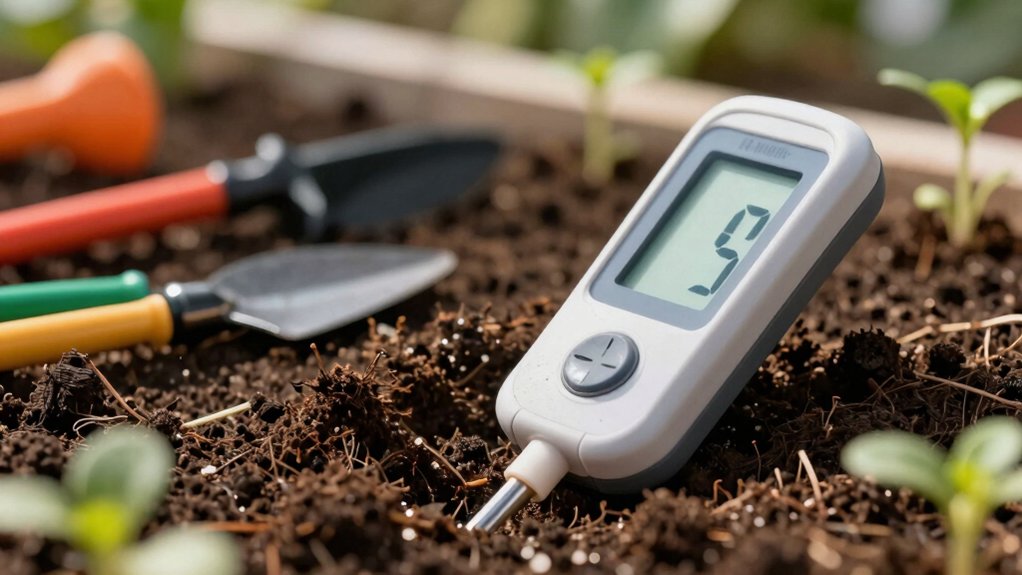
When selecting a pH meter for your garden, you’ll want to evaluate measurement accuracy and precision to ensure reliable soil readings, battery requirements that fit your maintenance schedule, and display type that you can read easily in various lighting conditions. Next, examine the probe design for durability since you’ll be inserting it into soil repeatedly, and check whether the meter offers multi-function capabilities beyond pH testing, such as moisture or nutrient measurement, to maximize your investment. These factors work together to determine whether a meter will serve your gardening needs effectively over time.
Measurement Accuracy And Precision
How do you know if your pH meter’s reading truly reflects your soil’s actual pH level? Accuracy measures how close your reading is to the true value, while precision shows how consistently your meter repeats results. To verify accuracy, calibrate your meter using standard solutions before testing. To improve precision, test at five or more garden locations and average the results. This approach reduces errors from soil micro-variations. Avoid testing in very wet or dry soil, as moisture extremes compromise readings. Insert the probe to the correct depth specified by your manufacturer. Modern meters with advanced sensing elements provide faster, more reliable pH measurements. Proper technique and multiple measurements ensure you get dependable data for your gardening decisions.
Battery Requirements And Power
What powers your soil pH meter, and does it matter for your gardening routine? Yes, it does. You’ll encounter two main options: battery-powered models and battery-free designs. Battery-powered meters typically require AAA batteries—sometimes four or more—and offer features like backlit LCD displays and low-battery alerts. You’ll need to replace batteries periodically based on usage frequency and measurement depth. Battery-free models use mechanical dials and passive probes, eliminating replacement costs but offering fewer digital features. When selecting a meter, verify the exact battery type required and commit to replacing all cells simultaneously when performance declines. Consider your gardening schedule: frequent testers benefit from battery-free designs, while occasional users can manage battery replacements easily.
Display Type And Readability
Display type directly affects how quickly and accurately you’ll read your soil’s pH level during testing. Choose a meter with a larger LCD or dial display to reduce reading errors and speed up field testing. If you’ll test during early morning or dusk, select a backlit or illuminated display for visibility in low-light conditions. Verify the display clearly shows units and scales—pH 0–14 and moisture percentage—so you won’t misinterpret results. Consider a rotating head or angled screen that lets you view measurements without excessive bending while inserting probes into soil. Numeric readouts or visual data should be straightforward to interpret, enabling you to make quick decisions about watering schedules and soil amendments.
Probe Design And Durability
Your pH meter’s probe design directly determines how accurately it measures soil conditions and how long it’ll last under regular garden use. Choose a single-probe design to minimize root disturbance and improve measurement stability compared to multi-probe or detachable options. Select probes with insertion depths between 2.5 and 4 inches—this range reaches representative root zones without striking compacted soil layers that skew readings. Prioritize durable materials like metal alloys, which withstand clay, loam, and sandy textures better than plastic alternatives. Robust construction reduces damage from soil particles and frequent insertion, ensuring consistent performance over time. Fast-response probes deliver results within seconds to minutes, allowing you to make timely decisions about watering schedules or soil amendments without unnecessary waiting.
Multi-Function Capability Range
Why settle for a single-function pH meter when you can combine multiple measurements in one device? Look for models that measure at least moisture, pH, and light to get a complete soil picture. Consider 4-in-1 or 7-in-1 designs if you need temperature and fertility readings too. These expanded features help you make better watering, fertilizing, and planting decisions based on real data. Check whether your chosen meter provides actionable guidance—specific recommendations tied to its combined readings rather than raw numbers alone. Verify that integrated sensors use a single probe design to minimize soil disturbance and root damage. Compare accuracy ratings across brands to ensure reliable measurements. Match the multi-function range to your gardening needs: basic models work for general maintenance, while advanced options suit serious growers managing diverse plants.
Ease Of Operation Method
How can you choose a pH meter that won’t slow you down in the garden?
Look for models with simple one-button operation or a single switch to toggle between moisture, pH, and fertility readings. This design lets you switch functions quickly without fumbling through multiple controls. Select testers that require no battery or minimal maintenance, keeping your tool reliable across different soil types and conditions.
Check the insertion depth guideline, which should clearly mark 2.5–4 inches to reach your plant’s root zone accurately. Verify the device displays results on an easy-to-read dial or digital screen so you interpret measurements immediately without extra tools.
Choose a tester with one durable probe that minimizes root damage while delivering consistent measurements. This approach streamlines your testing process and reduces setup time in the field.
Soil Compatibility And Limitations
What soil conditions‘ll actually work with your pH meter? Most meters function best in general soils but struggle in highly calcareous or saline conditions, so check compatibility specs before purchasing. Dry soils produce unreliable readings, requiring you to moisten soil adequately before testing. Insert your probe 2–4 inches deep to reach the root zone and obtain representative measurements. Soil texture matters: clay and sandy soils affect sensor contact differently, so test multiple locations and average results for accuracy. Some meters measure only solid soil, not liquids, limiting their use for compost tea or slurry testing. Understanding these limitations helps you select a meter matching your specific garden conditions and testing needs.
Final Thoughts
You’ve now reviewed five reliable soil pH meters that’ll help you optimize your garden’s growing conditions. Select a model based on your needs—3-in-1 options measure pH, moisture, and light, while 7-in-1 models add temperature and fertility data. Test soil at 2.5–4 inches deep across multiple garden spots. Calibrate your meter before use, then adjust watering, nutrients, and plant placement based on your readings for measurably better growth.

Meet Ry, “TechGuru,” a 36-year-old technology enthusiast with a deep passion for tech innovations. With extensive experience, he specializes in gaming hardware and software, and has expertise in gadgets, custom PCs, and audio.
Besides writing about tech and reviewing new products, he enjoys traveling, hiking, and photography. Committed to keeping up with the latest industry trends, he aims to guide readers in making informed tech decisions.