
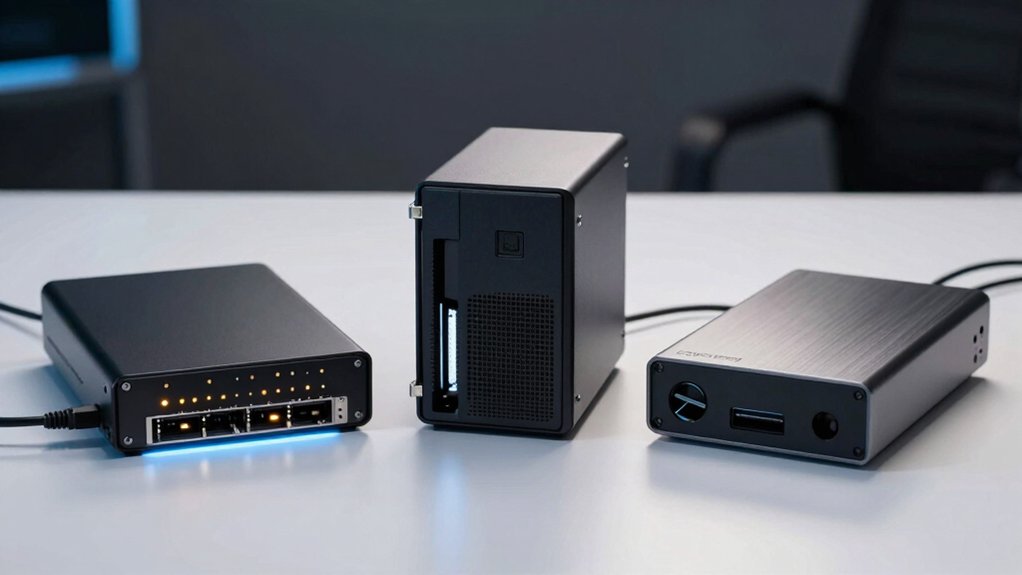

You’re looking for a NAS that’ll handle Jellyfin streaming without breaking a sweat. Start by identifying what you need: a processor strong enough for transcoding, sufficient RAM for multiple streams, and fast network connectivity. Three systems stand out for delivering reliable performance. Each one offers distinct advantages depending on your setup and budget, so let’s examine what makes them worth considering.
| UGREEN NAS DXP2800 2-Bay Desktop Network Storage |

| Best All-Around Performance | Network Connectivity: Single 2.5GbE port | Maximum Storage Capacity: Up to 80TB | RAM: 8GB DDR5 | VIEW LATEST PRICE | Read Our Analysis |
| TERRAMASTER F2-425 Plus NAS Storage (2-Bay) |

| Fastest Streaming Speed | Network Connectivity: Dual 5GbE ports with link aggregation | Maximum Storage Capacity: Up to 84TB | RAM: 8GB DDR | VIEW LATEST PRICE | Read Our Analysis |
| QNAP TR-004 4 Bay USB Type-C Storage (Diskless) |
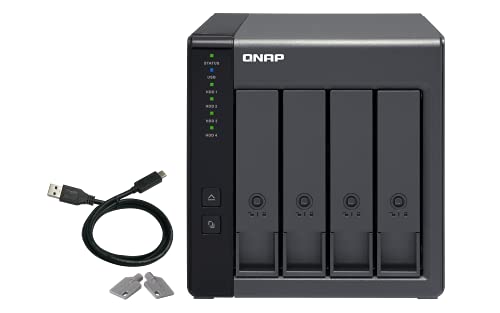
| Budget Expandable Storage | Network Connectivity: USB Type-C connection | Maximum Storage Capacity: Up to 48TB (4×12TB drives) | RAM: No integrated RAM | VIEW LATEST PRICE | Read Our Analysis |
More Details on Our Top Picks
UGREEN NAS DXP2800 2-Bay Desktop Network Storage
Are you a content creator or enthusiast who’s tired of managing files scattered across multiple devices? The UGREEN NAS DXP2800 solves this problem with its Intel N100 quad-core CPU and 8GB DDR5 RAM, delivering fast performance for streaming. You’ll transfer 1GB files in three seconds using the 2.5GbE network port. The device supports up to 80TB storage capacity across two bays and includes two M.2 NVMe slots for expansion. Its AI-powered photo album automatically organizes your content by recognizing faces, scenes, and objects. Setup takes minutes through the user-friendly app, and you’ll access files from Windows, macOS, Android, iOS, and web browsers. A two-year warranty backs your purchase with 24/7 support included.
- Network Connectivity:Single 2.5GbE port
- Maximum Storage Capacity:Up to 80TB
- RAM:8GB DDR5
- SSD Expansion Slots:2× M.2 NVMe slots
- Warranty:2 years with 24/7 support
- Operating System/Platform Support:Windows, macOS, Android, iOS, web browsers
- Additional Feature:AI-Powered Photo Album Recognition
- Additional Feature:4K HDMI Output
- Additional Feature:One-Time Purchase Model
TERRAMASTER F2-425 Plus NAS Storage (2-Bay)
If you’re building a Jellyfin server for a small creative team or home office that demands fast streaming without bottlenecks, the TerraMaster F2-425 Plus delivers the performance you’ll need. Its dual 5GbE ports hit sequential speeds up to 1020 MB/s, handling 4K and 8K transcoding smoothly. The Intel N95 quad-core processor paired with 8GB RAM runs Docker containers and virtual machines alongside your media library. You’ll install drives into Push-Lock trays without tools, then configure storage using the three M.2 SSD slots for cache or additional pools. The 2-year warranty and TOS 6 compatibility ensure long-term reliability for continuous streaming environments.
- Network Connectivity:Dual 5GbE ports with link aggregation
- Maximum Storage Capacity:Up to 84TB
- RAM:8GB DDR
- SSD Expansion Slots:3× M.2 SSD slots
- Warranty:2 years
- Operating System/Platform Support:Windows, Mac, Linux, Android, iOS
- Additional Feature:Dual 5GbE LAN Ports
- Additional Feature:4K/8K Transcoding Support
- Additional Feature:Direct Data Drive Mounting
QNAP TR-004 4 Bay USB Type-C Storage (Diskless)
When you’re looking to expand your existing QNAP NAS without upgrading to a larger system, the TR-004 offers a straightforward external storage solution that connects via USB Type-C. You can add four 3.5-inch SATA drives and configure them using hardware RAID options including RAID 0, 1, 5, JBOD, or individual disk setups. The TR-004 functions as separate external storage rather than integrating directly with your NAS, making it ideal for backup purposes. However, verify your NAS model supports QTS 4.3.6 or later, as certain older models aren’t compatible. Remember that drives moved between devices won’t automatically transfer data recognition, requiring manual file management.
- Network Connectivity:USB Type-C connection
- Maximum Storage Capacity:Up to 48TB (4×12TB drives)
- RAM:No integrated RAM
- SSD Expansion Slots:None
- Warranty:Standard manufacturer warranty
- Operating System/Platform Support:Windows, macOS, Linux
- Additional Feature:Hardware RAID Support Options
- Additional Feature:Lockable Drive Bays
- Additional Feature:External NAS Backup Expansion
Factors to Consider When Choosing a NAS for Jellyfin
When you’re selecting a NAS for Jellyfin, you’ll need to evaluate your processor’s transcoding capability, your RAM capacity for simultaneous streams, your network speed to handle bandwidth demands, your total storage needs for your media library, and your system’s video codec support. Start by determining how many concurrent users you’ll support, then match that requirement to a processor with adequate cores and clock speed, ensure you have at least 4GB of RAM but preferably 8GB or more, confirm your network connection is gigabit or faster, calculate your storage based on file sizes and bitrates, and verify the NAS supports H.264 and H.265 transcoding. Each factor directly impacts your streaming performance, so you’ll want to prioritize them based on your specific use case—whether you’re streaming to 2 local devices or 10 remote users.
Processor Performance Requirements
What CPU specs do you actually need for Jellyfin streaming? Start by identifying your usage level. For light single-stream setups, an Intel N100-class processor works adequately. For multiple concurrent streams or 4K content, you’ll need a quad-core CPU running at 3–4 GHz with strong single-thread performance. Next, prioritize hardware transcoding capabilities—video encode/decode accelerators significantly reduce CPU load during transcoding. Finally, consider memory bandwidth alongside core count; an 8GB RAM NAS can handle several simultaneous streams if your processor has sufficient cores and instructions-per-cycle efficiency. Match your CPU choice to your expected user count and content quality to ensure smooth playback and responsive library browsing without bottlenecks.
RAM And Multitasking Capability
While your CPU handles the processing workload, RAM determines how smoothly Jellyfin manages multiple tasks at the same time. You’ll want at least 8GB of DDR5 RAM as your baseline for handling several simultaneous users and background indexing operations. Going beyond 8GB significantly reduces buffering during high-demand transcoding sessions when multiple streams run concurrently. Faster DDR5 memory with higher bandwidth cuts data access latency during streaming and library searches, directly improving multitasking efficiency. With sufficient RAM, your system avoids relying on slower swap memory, which keeps performance steady during peak usage periods. Choose a NAS supporting RAM upgrades so you can increase capacity as your library and user count grow.
Network Speed Considerations
How does your NAS move data to your devices? Network speed determines how quickly your Jellyfin streams reach clients. A 1 GbE connection works for single users, but multiple 4K streams require faster speeds. Upgrade to 2.5 GbE or 5 GbE interfaces to handle simultaneous playback without buffering. Link aggregation using dual ports nearly doubles your throughput, supporting concurrent reads and writes from multiple clients. Pair fast networking with internal SSD caching or NVMe storage to sustain consistent speeds. Network stability matters equally—prioritize low-latency, jitter-free connections to prevent pauses during playback. Packet loss causes interruptions, so maintain reliable wired connections over wireless. Test your setup with multiple simultaneous streams to confirm performance meets your household demands.
Storage Capacity Planning
Once you’ve confirmed your network can handle multiple simultaneous streams, you’ll need to plan storage capacity—the foundation that determines how much content your Jellyfin server actually holds. Start by calculating your current library size, then add 20-30% for future growth. Next, account for RAID overhead: RAID 1 cuts usable space in half, while RAID 6 reduces it by roughly 33%. Consider mixing HDDs for bulk storage with SSDs for frequently accessed content and transcoding cache. Check drive warranties and reliability ratings—longer warranties indicate better durability for continuous-operation NAS environments. Finally, verify your chosen NAS supports expansion bays or drive upgrades, allowing you to add capacity later without rebuilding your system entirely.
Transcoding And Video Support
What role does your CPU play in streaming quality? Your NAS’s processor directly determines transcoding performance. Quad-core CPUs like the Intel N100 or N95 handle basic to mid-range transcoding, allowing you to convert videos in real-time for different devices and bandwidth levels. For 4K or 8K content, you’ll need stronger processors with sufficient memory backing them up. Check if your NAS supports hardware acceleration through GPU or dedicated transcoding features—these dramatically reduce CPU strain. Dual network interfaces rated at 2.5GbE or higher prevent streaming bottlenecks when handling multiple concurrent transcode sessions. M.2 NVMe cache slots improve responsiveness by speeding up read/write operations during transcoding workloads. Verify Docker or virtualization app availability on your chosen NAS, enabling optimized Jellyfin transcode containers.
Expansion Slot Availability
Since expansion slots directly determine how much faster storage you can add to your NAS, you’ll want to prioritize models with multiple M.2 NVMe slots—ideally two or three—to accelerate both Jellyfin metadata caching and transcoding operations.
Verify that your NAS supports NVMe drives with adequate PCIe lanes to prevent bottlenecks during high-concurrency transcoding. Check whether the unit offers mixed slot usage, allowing you to designate one M.2 slot for cache and another for storage, effectively increasing usable capacity.
Confirm that expansion slots can operate simultaneously with multiple network paths, such as link-aggregation, to maintain consistent streaming performance under load. This ensures your metadata caching and video transcoding workflows don’t suffer when multiple users stream concurrently.
Power Consumption And Efficiency
Power efficiency directly affects your operating costs and system reliability, so you’ll want to evaluate several hardware factors before choosing a NAS for Jellyfin. Start by comparing CPU architecture and TDP ratings; newer quad-core processors with lower power draw idle efficiently while handling transcoding tasks. Next, assess RAM capacity—additional memory reduces energy-draining disk swapping during streaming workloads. Consider your network setup: while dual 2.5GbE or 5GbE interfaces consume more power than Gigabit NICs, they decrease CPU wait times on high-throughput operations. Evaluate storage options carefully: SSDs use less power than HDDs, though HDDs offer higher capacity per watt for sustained workloads. Finally, verify disk spin-down policies are enabled to minimize idle consumption across your drive setup.
Final Thoughts
You’ll choose your Jellyfin NAS based on your streaming needs and budget. The UGREEN DXP2800 handles basic 4K streaming efficiently. The TERRAMASTER F2-425 Plus offers better performance for multiple simultaneous viewers. The QNAP TR-004 provides maximum expandability if you need serious storage capacity. Prioritize CPU strength, RAM upgradability, and NVMe caching across all options. Match your selection to your viewer count and resolution requirements.

Meet Ry, “TechGuru,” a 36-year-old technology enthusiast with a deep passion for tech innovations. With extensive experience, he specializes in gaming hardware and software, and has expertise in gadgets, custom PCs, and audio.
Besides writing about tech and reviewing new products, he enjoys traveling, hiking, and photography. Committed to keeping up with the latest industry trends, he aims to guide readers in making informed tech decisions.