
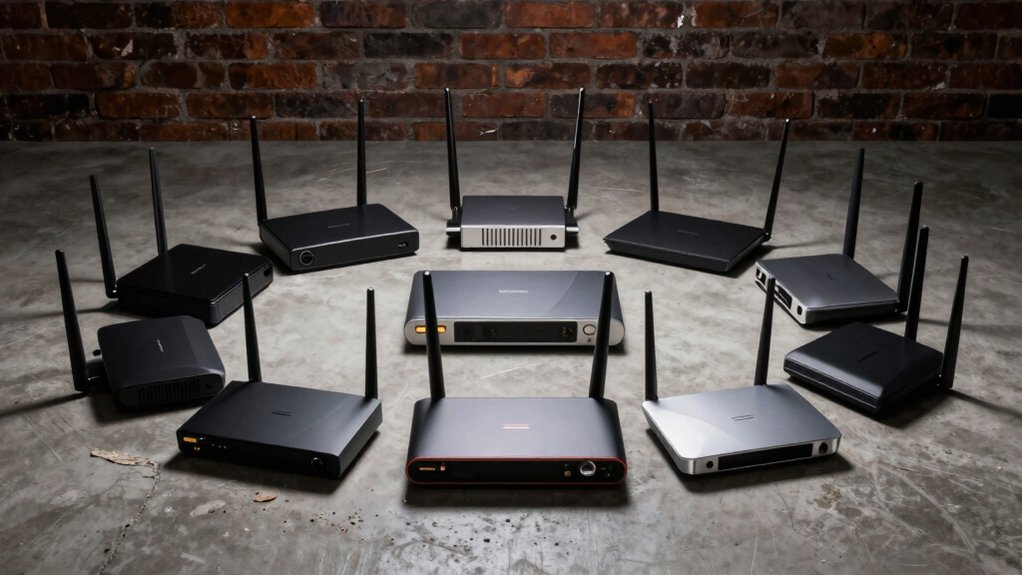

If thick walls weaken your WiFi signal, you need a router built to handle obstacles. Standard routers won’t cut it—you’ll drop connections and face dead zones throughout your home. The solution lies in selecting a high-performance model with strong beamforming, multiple antennas, and advanced band support. You have several proven options, from WiFi 6 to the latest WiFi 7 technology. Here’s what separates the routers that actually work from the rest.
| TP-Link Archer AX21 WiFi 6 Router Dual Band |

| Best Budget WiFi 6 | WiFi Standard: WiFi 6 (802.11ax) | Total Wireless Speed: AX1800 (1.8 Gbps) | Coverage Area: Long-range coverage (unspecified sq. ft.) | VIEW LATEST PRICE | Read Our Analysis |
| TP-Link AXE5400 WiFi 6E Router (Archer AXE75) |

| Best Overall Performance | WiFi Standard: WiFi 6E | Total Wireless Speed: AXE5400 (5.4 Gbps) | Coverage Area: Whole-home coverage (unspecified sq. ft.) | VIEW LATEST PRICE | Read Our Analysis |
| TP-Link BE6500 WiFi 7 Router (BE400) |

| Fastest WiFi 7 | WiFi Standard: WiFi 7 | Total Wireless Speed: BE6500 (6.45 Gbps) | Coverage Area: Up to 2,400 sq. ft. | VIEW LATEST PRICE | Read Our Analysis |
| TP-Link AX3000 Wi-Fi 6 Wall Router (Archer R5) |

| Best Wall-Mounted | WiFi Standard: WiFi 6 (802.11ax) | Total Wireless Speed: AX3000 (3 Gbps) | Coverage Area: Whole-home mesh capability (unspecified sq. ft.) | VIEW LATEST PRICE | Read Our Analysis |
| NETGEAR Nighthawk WiFi 7 Router (BE9300) |

| Best Gaming Router | WiFi Standard: WiFi 7 | Total Wireless Speed: BE9300 (9.3 Gbps) | Coverage Area: Up to 2,500 sq. ft. | VIEW LATEST PRICE | Read Our Analysis |
| 2026 WiFi Extender AC1200 Dual Band Signal Booster |

| Best Budget Extender | WiFi Standard: WiFi 5 (AC1200) | Total Wireless Speed: AC1200 (1.2 Gbps) | Coverage Area: Up to 10,000 sq. ft. | VIEW LATEST PRICE | Read Our Analysis |
| NETGEAR WiFi 6 Router AX1800 (R6700AX) |

| Best Value WiFi 6 | WiFi Standard: WiFi 6 | Total Wireless Speed: AX1800 (1.8 Gbps) | Coverage Area: Up to 1,500 sq. ft. | VIEW LATEST PRICE | Read Our Analysis |
| Wooden WiFi Router Storage Box Wall Mountable |

| Best Aesthetic Solution | WiFi Standard: Not applicable (storage box) | Total Wireless Speed: Not applicable (storage box) | Coverage Area: Not applicable (storage box) | VIEW LATEST PRICE | Read Our Analysis |
| ASUS RT-AX1800S WiFi 6 Extendable Router |

| Best Extendable System | WiFi Standard: WiFi 6 (802.11ax) | Total Wireless Speed: AX1800 (1.8 Gbps) | Coverage Area: Coverage varies by conditions (unspecified sq. ft.) | VIEW LATEST PRICE | Read Our Analysis |
| TP-Link AX3000 PoE Mesh WiFi 6 System |

| Best Mesh Coverage | WiFi Standard: WiFi 6 | Total Wireless Speed: AX3000 (3 Gbps) | Coverage Area: Seamless coverage for homes (unspecified sq. ft.) | VIEW LATEST PRICE | Read Our Analysis |
More Details on Our Top Picks
TP-Link Archer AX21 WiFi 6 Router Dual Band
If you’re looking for affordable WiFi 6 performance that won’t drain your budget, the TP-Link Archer AX21 delivers dual-band coverage through thick walls without premium pricing. This router reaches 1.8 Gbps total bandwidth across its 5 GHz and 2.4 GHz bands. Four high-gain antennas with beamforming technology focus your signal to penetrate obstacles effectively. Setup takes minutes—connect the Ethernet cable, plug in the power adapter, and use the Tether app to configure your network. The router supports all major ISPs and includes a 2-year warranty. You’ll also get 24/7 technical support and advanced security features like WPA3 encryption. Easy Mesh compatibility lets you expand coverage by adding additional routers.
- WiFi Standard:WiFi 6 (802.11ax)
- Total Wireless Speed:AX1800 (1.8 Gbps)
- Coverage Area:Long-range coverage (unspecified sq. ft.)
- Security Protocol:WPA/WPA2/WPA3
- Ethernet Ports:5 Gigabit ports
- Mesh Compatibility:Easy Mesh support
- Additional Feature:Works with all ISPs
- Additional Feature:Alexa voice control compatible
- Additional Feature:24/7 technical support
TP-Link AXE5400 WiFi 6E Router (Archer AXE75)
Looking to eliminate dead zones in your home without replacing your entire setup? The TP-Link AXE5400 WiFi 6E Router delivers speeds up to 5400 Mbps across three bands, including the new 6GHz band for reduced interference and lower latency. Its eight antennas and quad-core CPU penetrate thick walls effectively. The router supports OneMesh, allowing you to expand coverage with compatible extenders for seamless whole-home connection. WPA3 security protects your network, while HomeShield provides IoT device identification and basic parental controls. With five ports for wired connections and compatibility with major ISPs, you’ll need a modem to activate service. The 2-year warranty includes 24/7 support for setup and troubleshooting.
- WiFi Standard:WiFi 6E
- Total Wireless Speed:AXE5400 (5.4 Gbps)
- Coverage Area:Whole-home coverage (unspecified sq. ft.)
- Security Protocol:WPA3/WPA2/WPA2-Enterprise
- Ethernet Ports:5 ports
- Mesh Compatibility:OneMesh compatible
- Additional Feature:New 6GHz band support
- Additional Feature:2025 PCMag Editors’ Choice
- Additional Feature:HomeShield IoT protection service
TP-Link BE6500 WiFi 7 Router (BE400)
The TP-Link BE6500 delivers the fastest WiFi 7 speeds available for thick-walled homes where signal penetration matters most. Its 6-stream dual-band system reaches 5764 Mbps on 5GHz and 688 Mbps on 2.4GHz, ensuring stable connections through obstacles. Six high-performance antennas with beamforming technology direct signals where you need them. The router covers up to 2,400 square feet and handles 90 simultaneous devices. You’ll get ultra-fast wired connectivity with one 2.5 Gbps WAN/LAN port and two additional 2.5 Gbps connections. Set up is straightforward through the Tether app or web interface. HomeShield protection secures your network, while EasyMesh compatibility lets you expand coverage seamlessly.
- WiFi Standard:WiFi 7
- Total Wireless Speed:BE6500 (6.45 Gbps)
- Coverage Area:Up to 2,400 sq. ft.
- Security Protocol:Secure-by-Design with advanced security core
- Ethernet Ports:1x 2.5 Gbps WAN/LAN, 1x 2.5 Gbps LAN, 3x 1 Gbps LAN
- Mesh Compatibility:EasyMesh compatible
- Additional Feature:Multi-Link Operation technology
- Additional Feature:2.5 Gbps wired connectivity
- Additional Feature:Supports 90 devices simultaneously
TP-Link AX3000 Wi-Fi 6 Wall Router (Archer R5)
Want a router that disappears into your wall? The TP-Link Archer R5 mounts directly on any wall using included adhesive pads or a bracket, freeing up desk space. Its dual-band Wi-Fi 6 technology delivers lag-free performance across multiple devices simultaneously. Smart Beamforming Antennas automatically adjust to connected devices for optimal signal strength. You’ll get two Gigabit Ethernet ports for wired connections and whole-home mesh capability to eliminate dead zones. The built-in VPN server lets you access your home network securely from anywhere. Use the free Tether App to configure and manage your network from your phone. TP-Link HomeShield provides real-time threat detection and device protection throughout your network.
- WiFi Standard:WiFi 6 (802.11ax)
- Total Wireless Speed:AX3000 (3 Gbps)
- Coverage Area:Whole-home mesh capability (unspecified sq. ft.)
- Security Protocol:TP-Link HomeShield with threat detection
- Ethernet Ports:2 Gigabit Ethernet WAN/LAN ports
- Mesh Compatibility:EasyMesh compatible
- Additional Feature:Ultra-thin wall-mountable design
- Additional Feature:Dual 3M adhesive pads
- Additional Feature:Built-in VPN server
NETGEAR Nighthawk WiFi 7 Router (BE9300)
If you’re serious about gaming performance across thick walls, the NETGEAR Nighthawk WiFi 7 Router delivers the speed and coverage you need. This tri-band router transmits 9.3Gbps wireless speed—2.4 times faster than WiFi 6—optimizing gaming, streaming, and video conferencing. It covers 2,500 sq. ft. and supports 100 devices simultaneously. The 2.5 Gigabit internet port handles multi-gig speeds, while high-performance antennas penetrate barriers effectively. You’ll need a separate cable modem to connect to your internet service. Setup happens easily through the Nighthawk app. Built-in NETGEAR Armor security (30-day trial included) protects against malware and hackers. This router works with any internet provider.
- WiFi Standard:WiFi 7
- Total Wireless Speed:BE9300 (9.3 Gbps)
- Coverage Area:Up to 2,500 sq. ft.
- Security Protocol:NETGEAR Armor security suite
- Ethernet Ports:5 ports (1x 2.5 Gbps)
- Mesh Compatibility:Not specified
- Additional Feature:9.3Gbps wireless speed
- Additional Feature:Supports 100 devices
- Additional Feature:2.5 Gigabit internet port
2026 WiFi Extender AC1200 Dual Band Signal Booster
Looking for affordable signal coverage in dead zones? The 2026 WiFi Extender AC1200 extends your wireless network through walls and floors up to 10,000 square feet. You’ll find three operational modes: Repeater, Access Point, or Ethernet Port connection. Setup takes one tap using WPS compatibility with 99% of standard routers. The dual-band system delivers 1200 Mbps across 2.4 GHz and 5 GHz frequencies, supporting multiple devices simultaneously for streaming, gaming, and downloads. Four high-gain external antennas target bedroom, basement, garage, and garden dead zones. WPA/WPA2 security protocols protect your network. You receive a one-year warranty and thirty-day return policy.
- WiFi Standard:WiFi 5 (AC1200)
- Total Wireless Speed:AC1200 (1.2 Gbps)
- Coverage Area:Up to 10,000 sq. ft.
- Security Protocol:WPA/WPA2
- Ethernet Ports:Not applicable (extender)
- Mesh Compatibility:Compatible with standard routers (not mesh)
- Additional Feature:4 high-gain external antennas
- Additional Feature:Three operation modes available
- Additional Feature:10,000 sq ft coverage
NETGEAR WiFi 6 Router AX1800 (R6700AX)
The NETGEAR R6700AX delivers excellent value for homeowners needing WiFi 6 coverage across 1,500 square feet without overspending on premium features. This dual-band router supports up to 20 devices simultaneously using its dual-core processor. You’ll connect four wired devices through Gigabit Ethernet ports while relying on WiFi 6 technology for wireless connections. The router requires a separate modem compatible with your internet service provider. Install it centrally in your home to maximize signal penetration through walls. Enable WPA3 security in settings to protect your network. Use the NETGEAR Genie app for remote management and monitoring across your coverage area.
- WiFi Standard:WiFi 6
- Total Wireless Speed:AX1800 (1.8 Gbps)
- Coverage Area:Up to 1,500 sq. ft.
- Security Protocol:WPA2/WPA3 with NETGEAR Armor
- Ethernet Ports:4x 1 Gigabit ports
- Mesh Compatibility:Not specified
- Additional Feature:Covers 1,500 square feet
- Additional Feature:Supports 20 devices
- Additional Feature:4 Gigabit Ethernet ports
Wooden WiFi Router Storage Box Wall Mountable
Gadget Garage’s wooden storage box transforms your visible router and modem into an aesthetic solution that complements your home décor while maintaining reliable WiFi signal transmission. The box accommodates routers up to 11 inches tall and features interior dimensions of 15.88″ W x 13.38″ H x 5.5″ D. Mount it using the included template with bubble level, screws, and screwdriver. The hook-and-loop fasteners organize cables inside. Choose from five wood finishes to match your space. Assembly is required. The smooth pine construction with paint finish hides equipment while preserving signal strength, making it suitable for dining rooms, kitchens, living rooms, and garages.
- WiFi Standard:Not applicable (storage box)
- Total Wireless Speed:Not applicable (storage box)
- Coverage Area:Not applicable (storage box)
- Security Protocol:Not applicable (storage box)
- Ethernet Ports:Not applicable (storage box)
- Mesh Compatibility:Not applicable (storage box)
- Additional Feature:Natural pine wood construction
- Additional Feature:5 wood finish options
- Additional Feature:Built-in cable management
ASUS RT-AX1800S WiFi 6 Extendable Router
Need stronger WiFi signals throughout your home without replacing your entire network? The ASUS RT-AX1800S delivers 1800 Mbps total data rate across dual bands using WiFi 6 technology. Its four external retractable antennas penetrate walls effectively, while 80MHz bandwidth support maintains consistent speeds. The router features five Gigabit ports for stable wired connections and AiMesh compatibility, letting you expand coverage by adding compatible ASUS routers. You’ll get subscription-free security through AiProtection Classic, parental controls, and a built-in VPN. The dual-core processor with 256MB RAM handles multiple devices simultaneously. Installation takes minutes using the included cable and quick start guide. The three-year warranty provides long-term protection for your investment.
- WiFi Standard:WiFi 6 (802.11ax)
- Total Wireless Speed:AX1800 (1.8 Gbps)
- Coverage Area:Coverage varies by conditions (unspecified sq. ft.)
- Security Protocol:AiProtection Classic (Trend Micro)
- Ethernet Ports:5 Gigabit ports (1 WAN, 4 LAN)
- Mesh Compatibility:AiMesh compatible
- Additional Feature:AiMesh compatible extendable
- Additional Feature:3-year warranty included
- Additional Feature:Subscription-free network security
TP-Link AX3000 PoE Mesh WiFi 6 System
Looking for seamless mesh coverage that works through dense walls without complicated wiring? The Deco X50-PoE delivers WiFi 6 speeds up to 3 Gbps across your home. Mount units on ceilings or walls using PoE+ power through existing Ethernet cables, eliminating visible wires. Each unit includes two 2.5 Gigabit Ethernet ports for wired devices. The integrated AI mesh optimizes network load and enables seamless roaming between nodes. Set up via the Deco app with remote control capabilities. HomeShield provides security, parental controls, and QoS management. Compatible with all ISPs and Deco models, this 1-pack system replaces your router, access point, and range extender in one solution.
- WiFi Standard:WiFi 6
- Total Wireless Speed:AX3000 (3 Gbps)
- Coverage Area:Seamless coverage for homes (unspecified sq. ft.)
- Security Protocol:WPA/WPA2/WPA3 with TP-Link HomeShield
- Ethernet Ports:2x 2.5 Gigabit Ethernet ports
- Mesh Compatibility:Compatible with all Deco models for mesh network
- Additional Feature:PoE+ power support
- Additional Feature:Ceiling/wall-mountable installation
- Additional Feature:Two 2.5 Gigabit Ethernet Ports
Factors to Consider When Choosing a WiFi Router for Thick Walls
When you’re selecting a WiFi router for thick walls, you’ll need to evaluate five key factors: signal penetration strength (measured in decibels), antenna configuration and design (which affects how signals travel through obstacles), frequency band selection (2.4GHz penetrates walls better than 5GHz), beamforming technology features (which directs signals toward devices), and coverage area specifications (which indicate real-world range in larger spaces). Start by comparing the router’s transmit power and antenna count, then check whether it supports beamforming and dual-band or tri-band frequencies to ensure signals reach through your walls effectively. Finally, match the manufacturer’s coverage claims to your home’s square footage and wall density to confirm the router will perform in your specific conditions.
Signal Penetration Strength
What makes a WiFi signal travel through thick walls effectively? You’ll want to prioritize transmit power and beamforming technology, which focus signals directly through obstacles rather than dispersing them broadly. Consider selecting routers with dual-band or tri-band capabilities, as 2.4 GHz frequencies penetrate walls better than 5 GHz and 6 GHz bands. Look for front-end enhancements (FEM) that strengthen signal output at the hardware level. Additionally, choose routers featuring OFDMA and MU-MIMO technologies to maintain usable throughput when signals pass through barriers. If your home has particularly dense walls, you’ll benefit from mesh systems that place multiple nodes throughout your space, reducing distance-related signal loss and bringing coverage closer to difficult-to-reach rooms.
Antenna Configuration And Design
While transmit power and beamforming lay the groundwork for signal strength, your router’s antenna setup determines how effectively those signals actually reach through dense walls. Multi-antenna configurations like 4×4 or higher enable superior beamforming and spatial diversity, allowing signals to navigate around thick barriers more efficiently than single-antenna models. You’ll want to position antennas both vertically and horizontally to create varied coverage patterns that penetrate different wall orientations. External antennas with higher gain direct more power toward distant rooms, outperforming internal designs. Wall-mountable antenna options give you flexibility to adjust positioning based on your home’s layout. Consider routers offering adjustable antenna angles so you can optimize coverage behind your thickest walls without relocating the entire unit.
Frequency Band Selection
How do you choose between speed and penetration when selecting your router’s frequency bands? Start by assessing your wall thickness and distance from the router. For thick walls, prioritize 2.4 GHz performance since it penetrates barriers better than 5 GHz or 6 GHz, even though speeds are lower. If you need faster performance in certain areas, consider tri-band or WiFi 6E routers that dedicate separate bands to reduce congestion. Check the router’s specifications for beamforming and MU-MIMO technology, which improve multi-device efficiency behind walls. When comparing models, verify 2.4 GHz transmission power and antenna gain ratings. Don’t chase maximum bandwidth alone; instead, match your router’s band allocation to your actual layout and device density.
Beamforming Technology Features
Most modern routers use beamforming to concentrate wireless signals directly toward your connected devices instead of broadcasting equally in all directions, which is especially valuable when you’re dealing with thick walls. When you choose a router, verify it supports beamforming alongside WPA3 or WPA2 security standards. Look for models pairing beamforming with MU-MIMO or OFDMA technology to handle multiple devices simultaneously without performance drops. Check that your router has multiple antennas—more antennas enable better real-time beam adjustment as you move throughout your home. In thick-walled spaces, beamforming delivers noticeably stronger 5 GHz signals to distant rooms by directing energy efficiently. However, remember that 2.4 GHz remains more effective at penetrating dense barriers, so select routers offering both bands with active beamforming on each.
Coverage Area Specifications
When you’re shopping for a router designed to handle thick walls, don’t rely solely on the manufacturer’s stated coverage area—those square-footage claims assume open spaces without obstacles. Instead, reduce the stated range by 30–50% to account for wall interference. For example, a router advertising 3,000 square feet of coverage realistically delivers 1,500–2,100 square feet through walls.
Next, measure your home’s actual dimensions and layout. Identify rooms separated by thick walls or multiple barriers. Compare your space against adjusted coverage specs, not advertised ones.
Finally, consider that coverage varies by frequency band. Lower bands penetrate walls better but offer slower speeds. Higher bands travel shorter distances but support faster connections. Choose a router whose realistic range matches your home’s layout and your distance from the unit.
Device Capacity Support
Your router’s ability to handle multiple connected devices simultaneously becomes critical in thick-wall homes, where signal degradation can quickly overwhelm standard equipment. Look for routers with Wi-Fi 6/6E technology, which uses OFDMA and MU-MIMO to efficiently serve many devices at once. Tri-band or multi-band systems, including 6 GHz support, allocate bandwidth across devices with reduced interference. Select models featuring strong front-end modules, multiple high-gain antennas, and advanced beamforming to maintain performance through walls. Mesh or EasyMesh systems distribute load across nodes, preventing bottlenecks in large homes. Finally, prioritize routers with QoS features and device prioritization settings. These tools let you manage bandwidth allocation, ensuring critical devices maintain performance when walls cause signal loss.
Mesh Network Compatibility
While device capacity ensures your router can handle multiple connections, mesh network compatibility determines whether you can expand that coverage throughout your thick-walled home. Look for routers supporting OneMesh or EasyMesh standards, which let you add compatible extenders or nodes without replacing your entire system. This expandability matters because single routers struggle penetrating dense walls effectively.
When evaluating mesh options, check if the router offers PoE or multi-gig backhaul capabilities. These features maintain high throughput when signals travel through barriers between nodes. Centralized management systems are equally important—they ensure consistent security settings, QoS priorities, and firmware updates across all nodes simultaneously.
As you move between rooms, mesh roaming keeps your connection strong by automatically switching between the strongest node. This seamless transition prevents dropped connections in thick-walled spaces where coverage gaps typically occur.
Security Protocol Standards
What security standards does your router actually support? Check whether your router uses WPA3, the strongest current standard offering individualized data encryption and enhanced protection against offline password guessing. If your older devices don’t support WPA3, WPA2 with AES encryption serves as a reliable fallback option. Beyond basic protocols, look for additional security features like TP-Link HomeShield or NETGEAR Armor, which provide network and IoT protection by detecting threats and isolating compromised devices. Verify that your router supports VPN server and client options such as OpenVPN, PPTP, or L2TP for secure remote access. Finally, confirm the manufacturer offers regular firmware updates and maintains a secure-by-design pledge to protect against emerging vulnerabilities.
Final Thoughts
You’ll want to prioritize WiFi 6 or 7 routers with strong beamforming and multi-antenna designs when dealing with thick walls. Compare your options by checking wall-adjusted coverage estimates, security features like WPA3, and mesh compatibility for expanding coverage. Test your chosen router in your home’s problem areas before finalizing your purchase. If single units underperform, add compatible mesh nodes to reach all spaces effectively.

Meet Ry, “TechGuru,” a 36-year-old technology enthusiast with a deep passion for tech innovations. With extensive experience, he specializes in gaming hardware and software, and has expertise in gadgets, custom PCs, and audio.
Besides writing about tech and reviewing new products, he enjoys traveling, hiking, and photography. Committed to keeping up with the latest industry trends, he aims to guide readers in making informed tech decisions.