
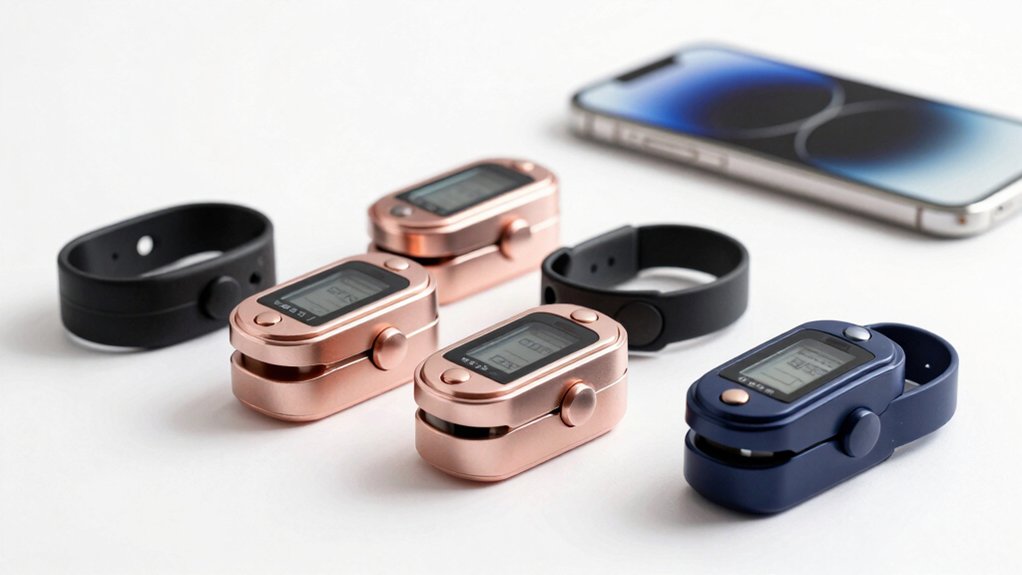

When you’re shopping for a Bluetooth pulse oximeter, you need to evaluate several key features that’ll determine whether the device actually fits your health monitoring needs. You’ll want real-time SpO2 and heart rate readings, reliable app connectivity, battery life, and display quality. But which specific models deliver on these requirements? The answer depends on your priorities and budget.
| Wellue Bluetooth Pulse Oximeter with Blood Oxygen Monitor |

| Sports & Aviation Essential | SpO2 Measurement Range: 70–100% | Pulse Rate Range: 30–250 bpm | Data Storage & App Sync: 12 historical measurements; syncs when app open | VIEW LATEST PRICE | Read Our Analysis |
| Vibeat Fingertip Pulse Oximeter with Bluetooth & APP |

| Smart App Integration | SpO2 Measurement Range: 70–100% | Pulse Rate Range: 30–250 bpm | Data Storage & App Sync: Latest 12 datasets on device; automatic app storage | VIEW LATEST PRICE | Read Our Analysis |
| Innovo Deluxe Fingertip Pulse Oximeter Blood Oxygen Monitor |

| Most Accurate Readings | SpO2 Measurement Range: 70–100% | Pulse Rate Range: 30–250 bpm | Data Storage & App Sync: Not specified | VIEW LATEST PRICE | Read Our Analysis |
| EMAY Sleep Oxygen Monitor with Recording Capability |

| Best for Sleep Tracking | SpO2 Measurement Range: 35–100% | Pulse Rate Range: 30–250 bpm | Data Storage & App Sync: 40 hours built-in memory; record without real-time sync | VIEW LATEST PRICE | Read Our Analysis |
| iHealth Rechargeable Fingertip Pulse Oximeter with Bluetooth |
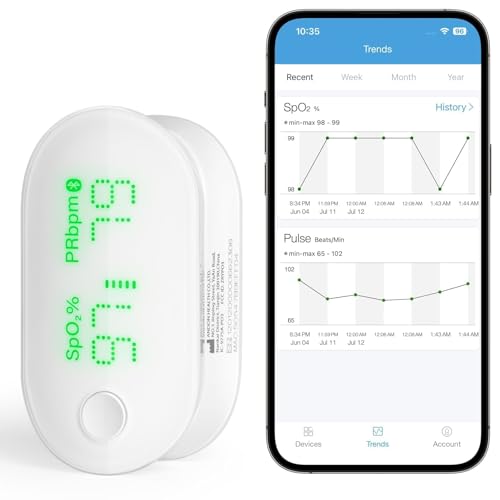
| Premium Rechargeable Option | SpO2 Measurement Range: 70–99% | Pulse Rate Range: Not specified | Data Storage & App Sync: Multi-user tracking with hourly, daily, weekly, yearly trends | VIEW LATEST PRICE | Read Our Analysis |
More Details on Our Top Picks
Wellue Bluetooth Pulse Oximeter with Blood Oxygen Monitor
The Wellue PC-60FW is a sports and aviation essential for athletes and pilots who need real-time oxygen monitoring. This fingertip device measures your blood oxygen saturation (SpO2) and pulse rate in just 8 seconds with ±2% accuracy. You’ll get readings on the built-in display, which flashes and beeps alerts when levels exceed your preset limits. The free app for Android and iOS syncs data automatically while open, storing your last 12 measurements for easy access. Two included AAA batteries power the unit for approximately 2 hours of continuous use. You can wear it on a lanyard or carry it in the included pouch. Note that it’s designed for sports and aviation use only, not as a medical device.
- SpO2 Measurement Range:70–100%
- Pulse Rate Range:30–250 bpm
- Data Storage & App Sync:12 historical measurements; syncs when app open
- Battery Type & Life:2 AAA batteries; ~2 hours
- Display Type:LED digital display with alerts
- Included Accessories:2 AAA batteries, carry pouch, lanyard
- Additional Feature:Perfusion Index measurement support
- Additional Feature:Smart reminder alert beeps
- Additional Feature:12-group built-in memory storage
Vibeat Fingertip Pulse Oximeter with Bluetooth & APP
Are you an athlete or frequent traveler who needs reliable oxygen monitoring on the go? The Vibeat Fingertip Pulse Oximeter delivers fast readings through infrared technology with ±2% accuracy. Simply clip it on your finger—no button pressing required—and view SpO2, pulse rate, perfusion index, and pulse waveform data on the OLED screen. Connect via Bluetooth to the Vihealth APP to access real-time readings, graphical reports, and heart rate trends. Set custom alerts for blood oxygen and pulse thresholds; the device beeps and flashes when values exceed limits. The built-in battery eliminates charging concerns during travel, and included AAA batteries plus lanyard and pouch make it immediately portable for business trips and airplane use.
- SpO2 Measurement Range:70–100%
- Pulse Rate Range:30–250 bpm
- Data Storage & App Sync:Latest 12 datasets on device; automatic app storage
- Battery Type & Life:2 AAA batteries; life not specified
- Display Type:OLED screen
- Included Accessories:2 AAA batteries, lanyard, pouch
- Additional Feature:Infrared photoplethysmography sensor tech
- Additional Feature:No button press required
- Additional Feature:Pulse waveform visualization included
Innovo Deluxe Fingertip Pulse Oximeter Blood Oxygen Monitor
Want the most accurate readings during outdoor activities or at home? The Innovo Deluxe iP900AP measures your blood oxygen saturation and pulse rate with upgraded sensors that perform reliably even at low perfusion levels. You’ll see results on an OLED display with six viewing angles, plus features like plethysmograph and Perfusion Index readings. The device includes motion correction technology and audible alarms. Simply place your finger under the LED, stay still, and wait for wave height to stabilize. If your Perfusion Index drops below 0.2%, warm your finger and reposition it. The oximeter comes ready to use with two AAA batteries and a lanyard, delivering readings within ±2% accuracy for SpO2 measurements between 70–100%.
- SpO2 Measurement Range:70–100%
- Pulse Rate Range:30–250 bpm
- Data Storage & App Sync:Not specified
- Battery Type & Life:2 AAA batteries; ~30 hours
- Display Type:OLED display with six directional choices
- Included Accessories:2 AAA batteries, lanyard
- Additional Feature:Six multidirectional display choices
- Additional Feature:Movement correction technology
- Additional Feature:Up to 30-hour battery life
EMAY Sleep Oxygen Monitor with Recording Capability
If you sleep through the night without checking your oxygen levels, you’ll appreciate EMAY’s sleep oxygen monitor, which records continuous SpO2 and heart rate data for up to 40 hours without requiring a real-time app connection. The device features a large rotating LCD display that eliminates neck twisting during use. You’ll measure SpO2 levels from 35-100% and pulse rates from 30-250 bpm. After recording, you sync your data to the free iOS or Android app to review second-by-second information and export summary reports for your physician. Two included AAA batteries power the monitor for its full 40-hour recording window. Note that this device targets sports and aviation use, not medical diagnosis.
- SpO2 Measurement Range:35–100%
- Pulse Rate Range:30–250 bpm
- Data Storage & App Sync:40 hours built-in memory; record without real-time sync
- Battery Type & Life:2 AAA batteries; 40 hours
- Display Type:Large rotating digital LCD display
- Included Accessories:2 AAA batteries
- Additional Feature:40-hour continuous recording capability
- Additional Feature:Record without app connection
- Additional Feature:Rotating digital LCD display
iHealth Rechargeable Fingertip Pulse Oximeter with Bluetooth
The iHealth PO3 serves athletes and fitness enthusiasts who need a premium rechargeable option for tracking blood oxygen levels during training. You’ll measure SpO2, pulse rate, and pulse strength on its large LED screen while viewing your plethysmograph waveform in real-time. Connect via Bluetooth to the free iHealth MyVitals app on iOS or Android to record data for multiple users and track trends by hour, day, week, or year. The built-in rechargeable battery fully charges in three hours and supports up to 300 uses per charge using the included micro-USB cable. Take readings when stationary before or after exercise for accurate results. This device suits sports and recreational use only.
- SpO2 Measurement Range:70–99%
- Pulse Rate Range:Not specified
- Data Storage & App Sync:Multi-user tracking with hourly, daily, weekly, yearly trends
- Battery Type & Life:Built-in rechargeable lithium polymer; 300 uses per charge
- Display Type:Large digital LED screen with in-app waveform
- Included Accessories:Operation manual, quick start guide, charging cable
- Additional Feature:Rechargeable lithium polymer battery
- Additional Feature:Multi-user trend tracking capability
- Additional Feature:U.S. telemedicine program trusted
Factors to Consider When Choosing a Bluetooth Pulse Oximeter
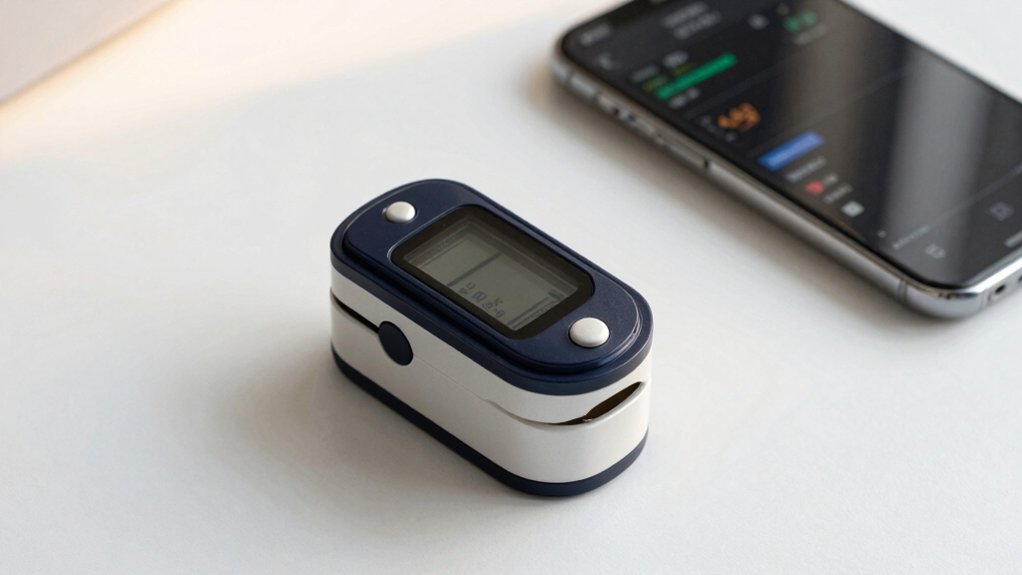
When you’re shopping for a Bluetooth pulse oximeter, you’ll want to evaluate five key factors: accuracy and measurement range to ensure reliable readings, battery life and power options so your device stays functional when you need it, app connectivity and data storage to track your health trends over time, display quality and user interface for easy reading and navigation, and portability and intended use cases to match your lifestyle. Start by checking the device’s accuracy specifications against clinical standards, then review how long the battery lasts between charges and whether it uses rechargeable or disposable batteries. Finally, confirm that the oximeter connects to an app compatible with your smartphone, stores your data securely, has a clear readable display, and fits your daily routine whether you need it at home, work, or while traveling.
Accuracy And Measurement Range
How reliable are your pulse oximeter readings, and what does that reliability actually mean for your health decisions?
Most devices report SpO2 accuracy within ±2% across the 70–100% range, meaning readings typically vary by two percentage points. Pulse rate accuracy follows ±2 bpm or ±2% (whichever is greater) over 30–250 bpm. You’ll find that measurements outside the standard 70–100% SpO2 range either don’t display or become less trustworthy.
Check your device’s perfusion index (PI) readings—low perfusion increases measurement error and causes unstable results. Allow 8–30 seconds for stabilization before relying on displayed numbers. Understanding these limits helps you interpret readings accurately and know when to seek clinical confirmation for critical health decisions.
Battery Life And Power Options
What you choose between disposable and rechargeable power sources depends on your usage frequency and convenience preferences. Most devices run on two AAA batteries, lasting between 2 and 40 hours depending on your model and how often you use features like continuous logging and app syncing. Rechargeable models offer several hundred uses per charge through USB or micro-USB connections, eliminating battery replacement costs over time. Consider your daily monitoring schedule: frequent users benefit from rechargeable options, while occasional users prefer disposable batteries for simplicity. Note that background features—real-time syncing, alerts, and voice beeps—drain power faster. Additionally, sensor perfusion and finger temperature affect battery performance. Review your device’s specifications to match power capacity with your intended usage patterns.
App Connectivity And Data Storage
App connectivity determines how your pulse oximeter shares data with your smartphone or tablet, and you’ll want to understand what each model offers before purchasing. Some devices transfer readings in real time while the app remains open, while others store your last twelve measurements locally for later review. Check whether the app provides trend analysis, graphical plots, and downloadable reports for your doctor. Consider data portability—some apps export raw data easily, while others limit sharing capabilities. Verify if the device syncs automatically or requires manual uploads. Review the app’s compatibility with your phone’s operating system. Understanding these features ensures you’ll select an oximeter that fits your monitoring needs and health management routine.
Display Quality And User Interface
Once you’ve confirmed your device syncs with your phone’s app, you’ll want to examine the oximeter’s display itself, since you’ll rely on it to read your oxygen levels and pulse rate quickly and accurately. Look for OLED or large LED screens that clearly show SpO2, PR, and PI readings. Check if the display rotates or adjusts to different angles, helping you read it from various hand positions. Verify the device has brightness controls to accommodate different lighting environments. On-screen alert indicators and audible beeps notify you when readings fall outside safe thresholds. A graphical waveform display helps you assess whether your reading’s stable. Test the easy-start function to confirm it captures readings with minimal user adjustment, reducing potential errors during operation.
Portability And Intended Use Cases
How you’ll use your Bluetooth pulse oximeter—whether for travel, daily monitoring, or athletic activity—should shape your portability choices. Consider the device’s form factor: compact USB-drive-sized units suit travel and workouts, while larger models work better for bedside monitoring. Check battery type and life span. Two AAA batteries offer easy replacement during trips; rechargeable batteries reduce weight but require charging access. For aviation or sports, prioritize lightweight designs with 8–40 hour battery life to minimize bulk. Evaluate accessories: lanyards keep devices accessible during activity, pouches protect them while commuting, and carry cases add durability for frequent travel. Review onboard memory capacity—storing 12–40 readings lets you monitor trends without constant app access, essential when charging isn’t available. Match these factors to your primary use case for optimal convenience.
Final Thoughts
You can choose a Bluetooth pulse oximeter by comparing key features: real-time SpO2 and heart rate readings, app connectivity, battery life, and display quality. Check if the device stores data without app connection and offers alerts for abnormal values. Consider portability with included accessories like lanyards. Review each model’s specifications and battery type—rechargeable versus disposable—based on your monitoring needs and activity level.

Meet Ry, “TechGuru,” a 36-year-old technology enthusiast with a deep passion for tech innovations. With extensive experience, he specializes in gaming hardware and software, and has expertise in gadgets, custom PCs, and audio.
Besides writing about tech and reviewing new products, he enjoys traveling, hiking, and photography. Committed to keeping up with the latest industry trends, he aims to guide readers in making informed tech decisions.