
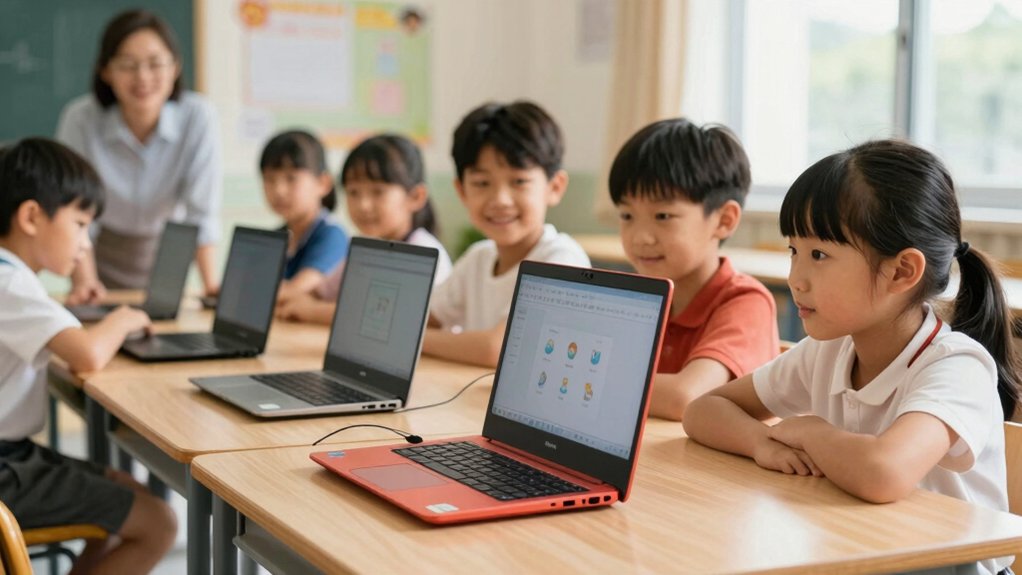

You’ll start by comparing the nine options for kids’ Chromebooks, focusing on screen size, durability, and price. Check for 11.6–14 inch displays, anti-glare panels, 10–14+ hour battery life, and rugged builds. Confirm Chrome OS with Google Play access, Safe Browsing, and privacy features. Note storage per model (8–128 GB) and USB-C charging, then evaluate warranties and classroom-tested reliability from HP, Lenovo, Dell, and ASUS. Use this framework to choose and test concrete models, then decide what to buy next.
| HP Chromebook 14 Laptop with Chrome OS 14″ Display |
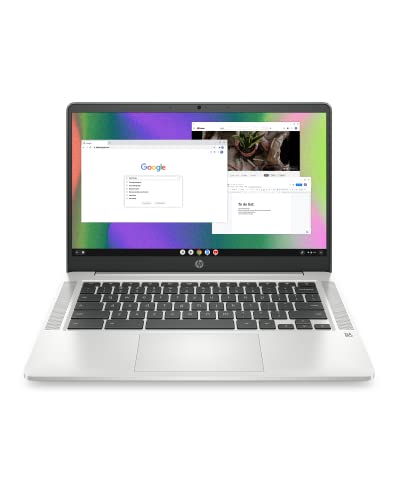
| All-Day Everyday | OS: Chrome OS | Display Size (inches): 14 | Storage (GB eMMC/UFS): 64 | VIEW LATEST PRICE | Read Our Analysis |
| Lenovo IdeaPad 3i Chromebook – 15.6 |

| Balanced Performance | OS: Chrome OS | Display Size (inches): 15.6 | Storage (GB eMMC/UFS): 64 | VIEW LATEST PRICE | Read Our Analysis |
| HP Chromebook 14 Laptop with 8GB RAM 128GB UFS (Chrome OS) |

| Premium Chrome OS | OS: Chrome OS | Display Size (inches): 14 | Storage (GB eMMC/UFS): 128 | VIEW LATEST PRICE | Read Our Analysis |
| Dell Chromebook 11 3100 11.6″ Chromebook (Renewed) |

| Renewed Value | OS: Chrome OS | Display Size (inches): 11.6 | Storage (GB eMMC/UFS): 16 | VIEW LATEST PRICE | Read Our Analysis |
| ASUS Chromebook CR11 Ruggedized 11.6″ Laptop CR1104CGA-AS44 |
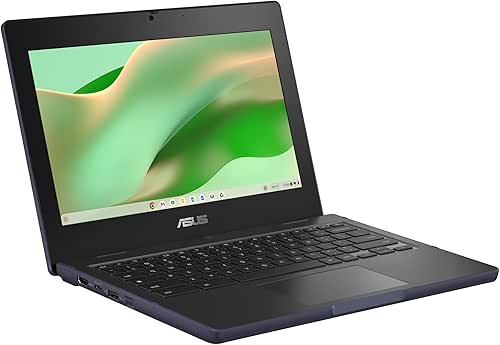
| Rugged Classroom | OS: Chrome OS | Display Size (inches): 11.6 | Storage (GB eMMC/UFS): 64 | VIEW LATEST PRICE | Read Our Analysis |
| Acer Chromebook 315 CB315-4H-C8XU with Chrome OS |

| Premium IPS Display | OS: Chrome OS | Display Size (inches): 15.6 | Storage (GB eMMC/UFS): 64 | VIEW LATEST PRICE | Read Our Analysis |
| HP 14″ HD Chromebook with Intel N4120 4GB RAM |

| Student-Friendly Power | OS: Chrome OS | Display Size (inches): 14 | Storage (GB eMMC/UFS): 64 | VIEW LATEST PRICE | Read Our Analysis |
| Lenovo 500e Chromebook 2-in-1 11.6″ Touch (Renewed) |

| Versatile 2-in-1 | OS: Chrome OS | Display Size (inches): 11.6 | Storage (GB eMMC/UFS): 32 | VIEW LATEST PRICE | Read Our Analysis |
| Lenovo IdeaPad Slim 3 Chromebook: 14″ Abyss Blue |

| AI-Enhanced Battery Life | OS: Chrome OS | Display Size (inches): 14 | Storage (GB eMMC/UFS): 64 | VIEW LATEST PRICE | Read Our Analysis |
More Details on Our Top Picks
HP Chromebook 14 Laptop with Chrome OS 14″ Display
The HP Chromebook 14 Laptop with Chrome OS is a solid choice for kids who need long battery life and simple, secure access to learning apps. You start by noting its 14″ HD display and long battery life up to 14 hours. You confirm the processor, RAM, and storage: Intel Celeron N4120, 4 GB RAM, 64 GB eMMC. You enable Chrome OS features and Google Play access, then verify Wi-Fi and Bluetooth connectivity. You assess durability with ENERGY STAR and EPEAT Silver ratings, and plan for a 1-year warranty. You use the 0 to 50% Fast Charge as a quick power option.
- OS:Chrome OS
- Display Size (inches):14
- Storage (GB eMMC/UFS):64
- RAM (GB):4
- Processor (CPU family):Intel Celeron N4120
- Weight (lb):3.24
- Additional Feature:4K-ready graphics
- Additional Feature:All-day up to 14h
- Additional Feature:HP Fast Charge
Lenovo IdeaPad 3i Chromebook – 15.6
If you’re shopping for a Kid-friendly Chromebook, consider the Lenovo IdeaPad 3i Chromebook with a 15.6″ Full HD display for straightforward, durable everyday use. You power it on and sign in with a Google account. The device runs Chrome OS, offers 8GB RAM and 64GB eMMC storage for documents, apps, and photos. Use the 15.6″ 1920×1080 display for clarity, and rely on the Intel Celeron N4500 for smooth multitasking. Connect peripherals with USB-C or USB 3.2 ports. Expect up to 10 hours battery life, a 720p camera, and privacy shutter features for security.
- OS:Chrome OS
- Display Size (inches):15.6
- Storage (GB eMMC/UFS):64
- RAM (GB):8
- Processor (CPU family):Intel Celeron N4500
- Weight (lb):3.48
- Additional Feature:15.6″ Full HD display
- Additional Feature:8GB RAM
- Additional Feature:Privacy shutter
HP Chromebook 14 Laptop with 8GB RAM 128GB UFS (Chrome OS)
This HP Chromebook 14 with 8GB RAM and 128GB UFS is a strong pick for kids who need a reliable, fast-starting notebook for daily school tasks. You power it on, use Chrome OS, and access apps via the Google Play and web stores. Check the 14-inch display, 1366 x 768, anti-glare, for classroom visibility. The 8GB RAM handles multiple tabs, while 128GB UFS storage keeps files local and responsive. Use the 45 W USB-C adapter for quick charging, and rely on dual USB ports for peripherals. Benefit from 1-year hardware warranty and built-in security features.
- OS:Chrome OS
- Display Size (inches):14
- Storage (GB eMMC/UFS):128
- RAM (GB):8
- Processor (CPU family):Intel N100
- Weight (lb):3.2
- Additional Feature:Ocean-bound plastics
- Additional Feature:EPEAT Gold certified
- Additional Feature:45 W USB-C adapter
Dell Chromebook 11 3100 11.6″ Chromebook (Renewed)
Consider the Dell Chromebook 11 3100 (11.6″ Chromebook, Renewed) when you need a durable, kid-friendly device for schoolwork and browsing. You get a 11.6″ display, Chrome OS, and a Celeron N4020 processor with 4 GB RAM and 16 GB storage. The device weighs about 2.85 pounds and lasts around 14 hours per charge. Use the 1366×768 screen for basic tasks, web browsing, and apps from the Chrome Web Store. Connect via Bluetooth for peripherals. Note Renewed status, English US keyboard, and no optical drive. Verify battery and port conditions, then set up Chrome OS profile and kid-safe controls.
- OS:Chrome OS
- Display Size (inches):11.6
- Storage (GB eMMC/UFS):16
- RAM (GB):4
- Processor (CPU family):Celeron N4020
- Weight (lb):2.85
- Additional Feature:Renewed status
- Additional Feature:11.6″ display
- Additional Feature:14h battery life
ASUS Chromebook CR11 Ruggedized 11.6″ Laptop CR1104CGA-AS44
The ASUS Chromebook CR11 Ruggedized Laptop is the best choice for classrooms that require durable, kid-friendly devices with reliable connectivity. You choose this model for durability and easy maintenance. It features an 11.6″ display, rugged rubber edges, and US military-grade durability, plus a spill-resistant keyboard. It runs ChromeOS on an Intel Celeron N100 with 4GB RAM and 64GB eMMC. For connectivity, use Wi‑Fi 6E and Bluetooth 5.3, plus two USB-C, two USB-A, HDMI 1.4, and a 3.5mm jack. Use the 180° lay-flat screen, privacy webcam, and antimicrobial keyboard guard for daily classes.
- OS:Chrome OS
- Display Size (inches):11.6
- Storage (GB eMMC/UFS):64
- RAM (GB):4
- Processor (CPU family):Intel Celeron N100
- Weight (lb):2.91
- Additional Feature:Ruggedized durability
- Additional Feature:11.6″ 180° lay-flat
- Additional Feature:Spill-resistant keyboard
Acer Chromebook 315 CB315-4H-C8XU with Chrome OS
For students who need a simple, reliable device for schoolwork, the Acer Chromebook 315 CB315-4H-C8XU with Chrome OS is a practical choice. You set it up by powering on, connecting to Wi‑Fi, and signing into your Google account. The 15.6″ Full HD IPS display delivers clear text and images for reading and notes. It runs Chrome OS, updates automatically, and supports Google Apps and Play apps for work and study. With 4GB RAM and 64GB storage, save documents offline and use Drive for backup. Use the two USB-C ports for charging and displays, and keep battery life around 10 hours.
- OS:Chrome OS
- Display Size (inches):15.6
- Storage (GB eMMC/UFS):64
- RAM (GB):4
- Processor (CPU family):Intel Celeron N4500
- Weight (lb):3.53
- Additional Feature:15.6″ Full HD IPS
- Additional Feature:Wi‑Fi 6 AX201
- Additional Feature:Google Assistant Certification
HP 14″ HD Chromebook with Intel N4120 4GB RAM
If you’re choosing a Chromebook for a student who needs dependable basic performance, this HP 14” model with the N4120 processor and 4GB RAM is a solid option. It runs Chrome OS, supports Zoom, and includes 64GB eMMC storage. Use this by checking the 14″ HD display for readability, then confirm the 4 USB ports (two USB-A, one USB-C, HDMI, headphone). For multitasking, expect four cores handle simple apps and tabs. Consider upgrades only if needed; 4GB RAM handles typical school tasks. Use the Chrome OS ecosystem for apps and Google services, and leverage offline access when possible.
- OS:Chrome OS
- Display Size (inches):14
- Storage (GB eMMC/UFS):64
- RAM (GB):4
- Processor (CPU family):Intel Celeron N4120
- Weight (lb):3.2
- Additional Feature:Four-finger gestures touchpad
- Additional Feature:Chrome OS with Zoom
- Additional Feature:1x HDMI port
Lenovo 500e Chromebook 2-in-1 11.6″ Touch (Renewed)
Look for a durable, kid-friendly 2-in-1 that handles classroom use and on-the-go learning with a 360-degree hinge. The Lenovo 500e Chromebook 2-in-1, 11.6″ Touch (Renewed) offers Chrome OS and a 11.6″ HD touch display. It runs on an Intel Celeron N3450U with 4 GB RAM and 32 GB storage, suitable for basic tasks. You’ll get a rugged design, four-mode flexibility, and a world-facing camera, though no pen is included. Battery life is listed at five hours, and it weighs about four pounds. Use the 360-degree hinge to switch modes for notes, browsing, and video calls.
- OS:Chrome OS
- Display Size (inches):11.6
- Storage (GB eMMC/UFS):32
- RAM (GB):4
- Processor (CPU family):Intel Celeron N3450U
- Weight (lb):4.0
- Additional Feature:360-degree hinge
- Additional Feature:World-facing camera
- Additional Feature:Renewed (No Pen)
Lenovo IdeaPad Slim 3 Chromebook: 14″ Abyss Blue
The Lenovo IdeaPad Slim 3 Chromebook with a 14″ Abyss Blue chassis is a solid choice when you need a kid-friendly laptop that balances portability with essential privacy features. You explore hardware specs: 14″ HD display, Abyss Blue finish, and a lightweight 2.87 lb body. You identify privacy there: built-in HD camera privacy shutter and a mute key. You consider performance: MediaTek Kompanio 520, WiFi 6, up to 13.5 hours battery. You note storage and extras: 2TB via Google AI Pro, three months NotebookLM, Waves MaxxAudio speakers, and USB-C for charging and transfer. You compare packaging and sustainability options.
- OS:Chrome OS
- Display Size (inches):14
- Storage (GB eMMC/UFS):64
- RAM (GB):4
- Processor (CPU family):MediaTek Kompanio 520
- Weight (lb):2.87
- Additional Feature:2TB storage via AI Pro
- Additional Feature:Google AI Pro 3 months
- Additional Feature:Waves MaxxAudio speakers
Factors to Consider When Choosing Chromebooks for Kids
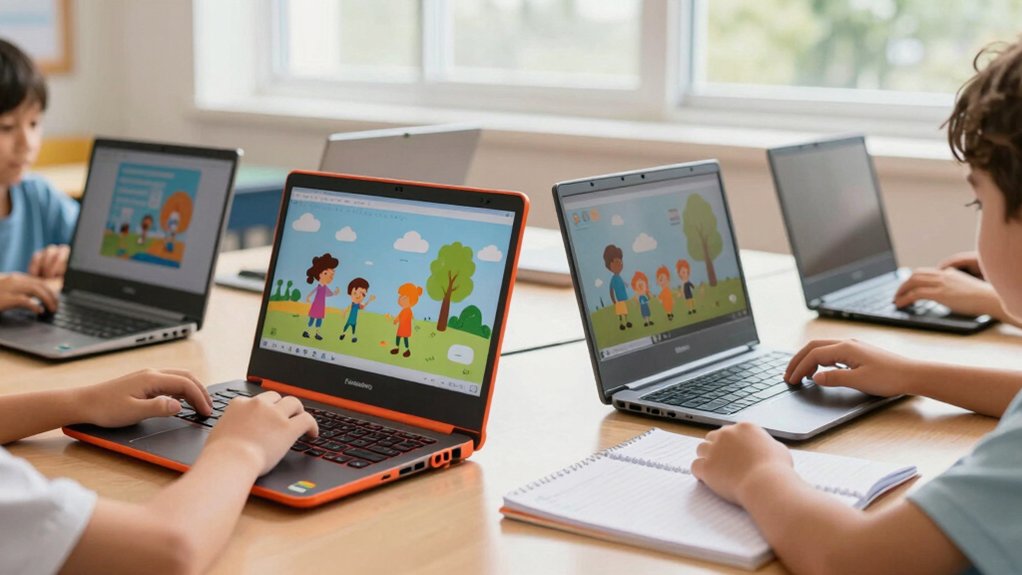
When selecting Chromebooks for kids, assess durability for active use, battery life longevity, safe browsing features, display suitability, and storage and apps by outlining practical options: choose models with reinforced chassis and spill-resistant keyboards, look for at least 8–10 hours of battery life for school days, enable safe browsing and parental controls, pick a display with at least 1080p resolution and good viewing angles, and ensure enough local storage plus access to a robust catalog of kid-friendly apps. Compare three concrete paths: rugged/educational lines for heavy handling, budget models with long-lasting batteries, and higher-end options with enhanced safety controls and expanded app stores, then verify warranty terms and update policies. Finally, document a step-by-step plan to test each option in real use, including battery tests, durability checks, and a trial of safety features before finalizing a purchase.
Durability For Kids
Durability for kids starts with choosing a chassis that’s built to last. Look for ruggedized or reinforced keyboards and bodies to withstand drops, spills, and daily wear. Check for MIL-STD or classroom-grade durability ratings; these indicate resilience to rough handling and frequent transport. Favor spill-resistant keyboards and sealed ports to reduce liquid damage during homework or snacks. Consider 360-degree hinges or convertible designs that tolerate regular opening, closing, and mode changes in a classroom setting. Use durable materials, such as ruggedized plastics or reinforced chassis, to extend device life in active, kid-focused environments. Verify manufacturer guidance on weight limits and warranty coverage, and choose models that balance protection with portability to fit your child’s daily routine.
Battery Life Longevity
Battery life matters for kids’ Chromebooks, and you can optimize it by checking three practical areas first. Start with all-day battery claims, aiming for 10–14+ hours per charge to reduce mid-day recharging during classes or outings. Next, assess charging speed, prioritizing fast-charging ability—about 50% in 45 minutes—to minimize downtime between activities. Finally, confirm efficiency certifications like ENERGY STAR, which signal optimized power use over time. Consider models with lightweight hardware and efficient processors (modern Celeron/M-class CPUs) for longer endurance during web browsing and document editing. Remember real-world results vary with screen brightness, background tabs, and peripherals; seek user-reported endurance in classroom workloads to validate advertised figures. Compare several options to select the most reliable balance of longevity and usability.
Safe Browsing Features
Safe browsing on Chromebooks relies on built-in protections that kick in automatically, so you don’t have to take extra steps to stay safe. Chrome OS keeps itself updated to patch security flaws, automatically handling patches without user action. Google Safe Browsing integrations block phishing and malware sites as you browse, reducing risky encounters. Sandboxed and per-application isolation limits the impact of harmful web content or downloaded files, so problematic pages stay contained. Use Google Family Link and supervised profiles to enforce restricted access, time limits, and site whitelisting for kids, adjusting rules as needed. Automatic Google Play policies and app vetting reduce exposure to risky apps when kids use downloaded apps, and you should review app permissions before installation.
Display Suitability
To choose a Chromebook that fits kids’ needs, start with display considerations that affect daily work. Choose a larger display, such as 14–15.6 inches, for easier reading and multi-window multitasking during assignments. Ensure the resolution is high-definition or Full HD (1920×1080) to deliver sharper text and clearer instructional videos. Look for an anti-glare or matte screen to reduce reflections in bright classrooms or at home. Consider a touchscreen or 2-in-1 convertible only if the display stays legible and responsive in laptop mode for note-taking. Favor taller aspect ratios and IPS panels to maintain accurate viewing angles from various seating positions, which aids group activities and demonstrations. Assess how each option aligns with daily tasks, then choose the combination that minimizes eye strain and maximizes productivity.
Storage And Apps
When choosing a Chromebook for kids, start by balancing storage options with offline needs and app access. Begin with base storage of 32 GB or 64 GB eMMC, and consider 128 GB UFS for faster access and more local apps. Higher storage lets you install educational apps and keep offline copies of documents, videos, and web resources, reducing cloud dependence. Chrome OS supports Google Play Store apps and web apps, so plan for both; local storage preserves offline access when internet is unreliable. Many kid-focused models offer cloud storage integration, such as Google Drive, to supplement on-device space for assignments and projects. For long-term use, pair larger storage with 8 GB RAM to improve multitasking and curb reinstallation needs.
Portability And Weight
Portability and weight directly affect daily school use, so start by selecting a Chromebook that fits comfortably in a kid’s backpack and hands. Look for models weighing about 2.8 to 3.5 pounds, which are easy to carry between classes. Choose compact 11.6–14 inch screens to reduce bulk, making the device fit without protruding in a backpack pocket. Check the profile thickness, aiming for roughly 0.7 to 0.8 inches, to minimize inside bulk and improve daily handling. Prioritize durable, lightweight designs with reinforced keyboards or ruggedized builds to withstand classroom use. Consider foldable or 2‑in‑1 form factors for flexible study setups, enabling use on desks, laps, or transit. Verify fit by handling the device and confirming it meets weight, size, and durability expectations.
Final Thoughts
Here’s how to choose quickly: identify budget and durability needs, then compare models by display size, battery life, and storage. For basic web, homework, and offline apps, aim for 8–128 GB storage and USB-C charging for futureproofing. If rugged use is likely, pick the ASUS CR11 or other rugged option. Check Google Play access and Safe Browsing, verify warranty length, and confirm 11.6–14 inch screens fit your space. Finally, select from HP, Lenovo, Dell, or ASUS based on price and reliability.

Meet Ry, “TechGuru,” a 36-year-old technology enthusiast with a deep passion for tech innovations. With extensive experience, he specializes in gaming hardware and software, and has expertise in gadgets, custom PCs, and audio.
Besides writing about tech and reviewing new products, he enjoys traveling, hiking, and photography. Committed to keeping up with the latest industry trends, he aims to guide readers in making informed tech decisions.