
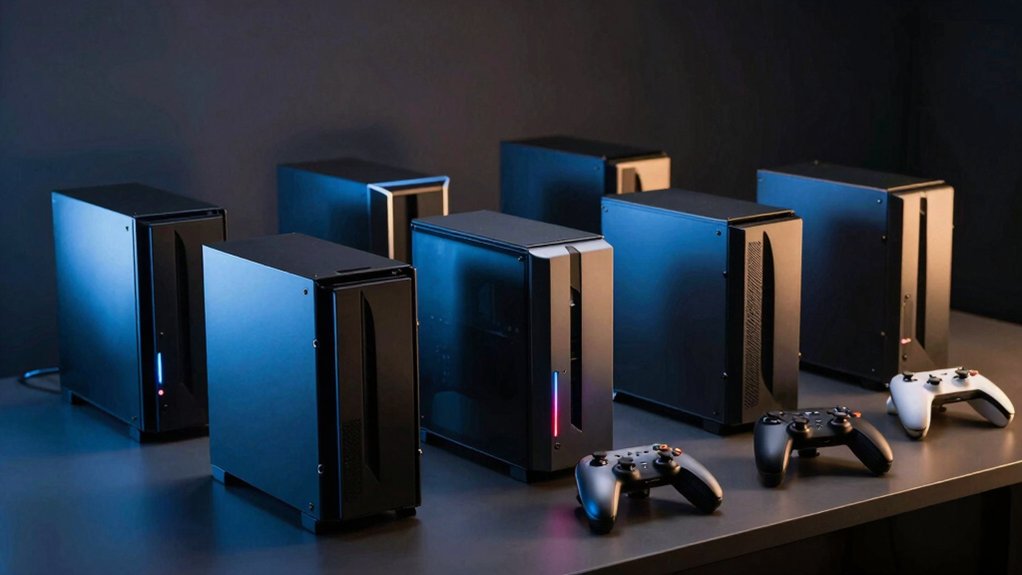

You’re looking to build a SteamOS gaming setup that actually performs. Choosing the right mini PC means evaluating processor power, RAM capacity, cooling systems, and display outputs for your specific needs. Five standout models offer different strengths—from the GMKtec K11’s 4K flexibility to budget-friendly alternatives—each tailored to various gaming demands. The question isn’t which one’s best, but which matches your priorities.
| KAMRUI Pinova P2 Mini PC 16GB RAM 512GB SSD |

| Compact Entry-Level | Processor: AMD Ryzen 4300U (4-core/4-thread, up to 3.7GHz) | RAM: 16GB DDR4 (expandable to 64GB) | Storage: 512GB M.2 SSD (expandable to 4TB) | VIEW LATEST PRICE | Read Our Analysis |
| GMKtec K11 Gaming PC AMD Ryzen 9 8945HS |

| Best Performance | Processor: AMD Ryzen 9 8945HS (8-core/16-thread, up to 5.4GHz) | RAM: 32GB DDR5 (expandable to 128GB) | Storage: 1TB PCIe 4.0 SSD (expandable to 8TB) | VIEW LATEST PRICE | Read Our Analysis |
| BOSGAME P4 Light Gaming Mini PC Ryzen 7 5825U |

| Best All-Rounder | Processor: AMD Ryzen 7 5825U (8-core/16-thread, up to 4.5GHz) | RAM: 32GB DDR4 (expandable to 64GB) | Storage: 1TB PCIe 3.0 NVMe SSD (dual M.2 slots) | VIEW LATEST PRICE | Read Our Analysis |
| DreamQuest Mini Plus Mini PC Windows 11 Pro |
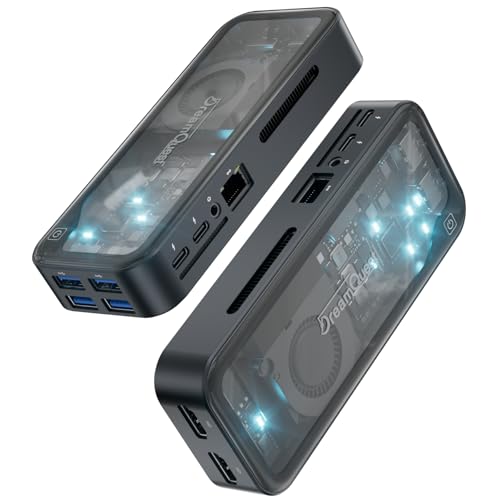
| Budget-Friendly Pick | Processor: Intel N95 12th Gen Alder Lake (up to 3.4GHz) | RAM: 12GB DDR5 | Storage: 512GB M.2 SSD (upgradeable to 2TB) | VIEW LATEST PRICE | Read Our Analysis |
| GMKtec M5 Ultra Gaming Mini PC Ryzen 7 |

| Best Connectivity | Processor: AMD Ryzen 7 7730U (8-core/16-thread, up to 4.5GHz) | RAM: 32GB DDR4 (expandable to 64GB) | Storage: 1TB PCIe 3.0 SSD (expandable to 4TB) | VIEW LATEST PRICE | Read Our Analysis |
More Details on Our Top Picks
KAMRUI Pinova P2 Mini PC 16GB RAM 512GB SSD
Why settle for a bulky gaming setup when you can fit powerful performance into a device smaller than a paperback book? The KAMRUI Pinova P2 delivers with its AMD Ryzen 4300U processor and 16GB DDR4 RAM, handling multitasking and HD video editing. You’ll get 512GB of NVMe storage, expandable to 4TB across two M.2 slots. For display connectivity, use the HDMI 2.0, DisplayPort 1.4, or USB-C port to connect up to three 4K monitors simultaneously. The integrated Radeon graphics support casual gaming. Upgrade your RAM to 64GB or add storage as needed using the dual SO-DIMM and dual M.2 slots for future-proofing your setup.
- Processor:AMD Ryzen 4300U (4-core/4-thread, up to 3.7GHz)
- RAM:16GB DDR4 (expandable to 64GB)
- Storage:512GB M.2 SSD (expandable to 4TB)
- Display Output:4K triple display (HDMI 2.0, DP 1.4, USB-C)
- Wireless Connectivity:WiFi, Bluetooth
- Warranty/Support:12-month satisfaction service, lifetime technical support
- Additional Feature:VESA mount/wall mounting
- Additional Feature:Upgradeable to 64GB RAM
- Additional Feature:Quad-core Zen 2 processor
GMKtec K11 Gaming PC AMD Ryzen 9 8945HS
The GMKtec K11 is built for gamers and professionals who need serious computing power in a compact form factor. You’ll get an AMD Ryzen 9 8945HS processor with 8 cores running up to 5.4 GHz, paired with 32GB DDR5 RAM and 1TB SSD storage. The system supports up to four 4K displays simultaneously through HDMI 2.1, DisplayPort 2.1, and USB4. Choose from three performance modes: Quiet at 35W, Balance at 54W, or Performance at 65W. The dual cooling fans keep noise at approximately 35dB. You can expand RAM to 128GB and storage to 8TB, making it adaptable for future demands.
- Processor:AMD Ryzen 9 8945HS (8-core/16-thread, up to 5.4GHz)
- RAM:32GB DDR5 (expandable to 128GB)
- Storage:1TB PCIe 4.0 SSD (expandable to 8TB)
- Display Output:4K quad display (HDMI 2.1, DP 2.1, USB4)
- Wireless Connectivity:WiFi 6, Bluetooth 5.2
- Warranty/Support:1-year limited warranty, professional after-sales team
- Additional Feature:Oculink port for eGPU
- Additional Feature:Three customizable performance modes
- Additional Feature:Dual NIC networking support
BOSGAME P4 Light Gaming Mini PC Ryzen 7 5825U
If you’re looking for a compact machine that handles light creative work alongside gaming without breaking your desk space, BOSGAME’s P4 deserves your attention. The Ryzen 7 5825U processor powers Photoshop, Premiere, and light CAD tasks while supporting PS3 emulation. You’ll get 32GB RAM expandable to 64GB, dual 2.5GbE LAN ports, and WiFi 6E connectivity. Triple display outputs deliver 4K@60Hz across HDMI 2.0, DisplayPort, and Type-C connections. Dual NVMe M.2 slots let you expand storage beyond the 1TB base drive. The 3-year professional support and 24/7 online service provide reliable backing for your investment.
- Processor:AMD Ryzen 7 5825U (8-core/16-thread, up to 4.5GHz)
- RAM:32GB DDR4 (expandable to 64GB)
- Storage:1TB PCIe 3.0 NVMe SSD (dual M.2 slots)
- Display Output:4K triple display (HDMI 2.0, DP, USB-C)
- Wireless Connectivity:WiFi 6E, Bluetooth 5.2
- Warranty/Support:3-year factory support, 24/7 online service
- Additional Feature:PS3 emulator support
- Additional Feature:WiFi 6E tri-band
- Additional Feature:Dual 2.5GbE LAN ports
DreamQuest Mini Plus Mini PC Windows 11 Pro
For gamers seeking a compact machine that won’t compromise on performance or connectivity, the DreamQuest Mini Plus delivers with its 12th Gen Intel Alder Lake N95 processor, 12GB DDR5 RAM, and 512GB SSD—all housed in a form factor small enough to fit beside your monitor or TV. You’ll connect displays through two HDMI ports or dual USB-C ports supporting 4K at 60Hz. The machine includes WiFi 6, Bluetooth 5.3, and four USB 3.2 ports for peripherals. Storage expands up to 2TB via the M.2 slot. Windows 11 Pro comes preloaded, though you can install Linux or Ubuntu if preferred. Wake-on-LAN and RTC Wake options let you power the system remotely or on schedule. A one-year warranty covers hardware failures.
- Processor:Intel N95 12th Gen Alder Lake (up to 3.4GHz)
- RAM:12GB DDR5
- Storage:512GB M.2 SSD (upgradeable to 2TB)
- Display Output:4K dual HDMI + dual USB-C (triple-screen capable)
- Wireless Connectivity:WiFi 6, Bluetooth 5.3
- Warranty/Support:1-year warranty
- Additional Feature:Dual USB-C power delivery
- Additional Feature:Wake-on-LAN capability
- Additional Feature:Intel Alder Lake N95
GMKtec M5 Ultra Gaming Mini PC Ryzen 7
Want a compact gaming system that doesn’t sacrifice processing power? The GMKtec M5 Ultra delivers an AMD Ryzen 7 7730U processor with 8 cores and 16 threads, reaching 4.50GHz in Performance Mode. You’ll get 32GB DDR4 RAM and a 1TB SSD, expandable to 64GB and 4TB respectively. The integrated Radeon graphics handle 4K video editing and demanding design software. Dual 2.5G LAN ports, WiFi 6E, and multiple USB connections ensure fast networking. You can connect three displays simultaneously at 4K@60Hz via HDMI 2.0 and DisplayPort. This system performs 35% better than older Ryzen 5 variants and suits gaming, productivity, and server applications.
- Processor:AMD Ryzen 7 7730U (8-core/16-thread, up to 4.5GHz)
- RAM:32GB DDR4 (expandable to 64GB)
- Storage:1TB PCIe 3.0 SSD (expandable to 4TB)
- Display Output:4K triple display (HDMI 2.0, DP, USB-C)
- Wireless Connectivity:WiFi 6E, Bluetooth 5.2
- Warranty/Support:1-year limited warranty, professional after-sales team
- Additional Feature:2.5G dual NIC LAN
- Additional Feature:WiFi 6E tri-band
- Additional Feature:Hyper Ice Chamber cooling
Factors to Consider When Choosing a Mini PC for Steam OS
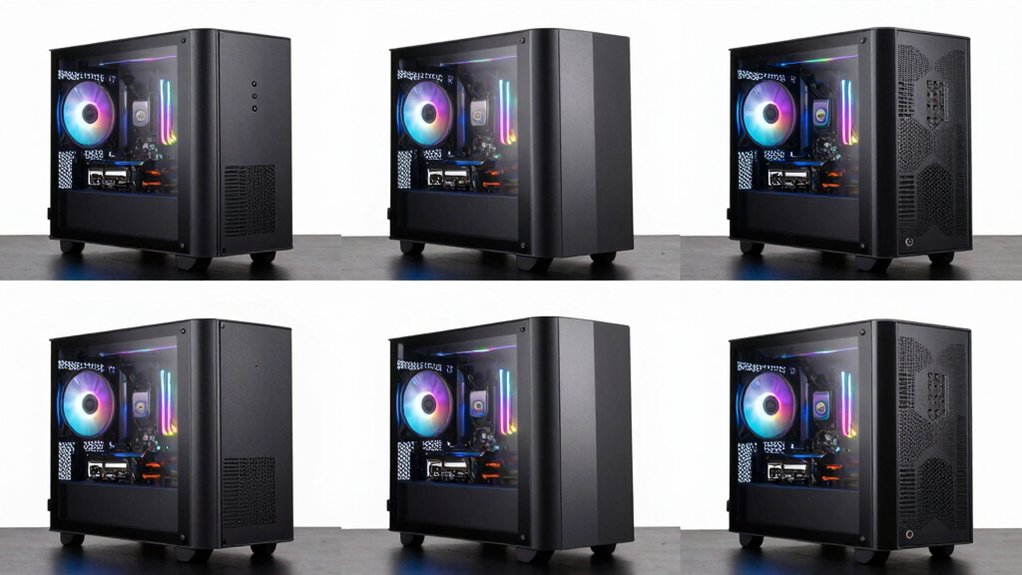
When you’re choosing a mini PC for Steam OS, you need to evaluate four core elements that directly affect your gaming experience: processor performance determines how quickly your system handles game logic and AI, graphics capability renders the visuals you see on screen, memory and storage expansion allow you to install multiple games without constantly deleting files, and cooling system efficiency keeps your hardware from throttling during extended play sessions. Start by matching your processor choice to the games you want to play—demanding titles like Cyberpunk 2077 require at least a Ryzen 5 or better, while indie games run fine on entry-level processors. Next, examine the GPU separately from the CPU because even powerful processors need dedicated graphics cards to deliver smooth frame rates, check your target games’ requirements, confirm the mini PC’s RAM matches or exceeds recommendations (16GB is the current standard), verify storage capacity or upgrade options, and research the cooling solution to ensure it maintains performance without excessive noise.
Factors to Consider When Choosing Mini Pc for Steam Os
Choosing the right mini PC for SteamOS demands you evaluate several key hardware components that directly impact your gaming performance. First, prioritize a CPU with 6–8 cores and strong single-core performance, like modern Ryzen or Intel APUs, for smooth gameplay and streaming capability. Next, ensure you’ve got at least 16GB RAM, though 32GB future-proofs your system for demanding titles. Then, select fast NVMe SSD storage of 512GB or larger to minimize load times and boost responsiveness. You’ll also need capable integrated or discrete GPU support with compatible Proton drivers. Finally, check for expandability options—M.2 slots, USB ports, HDMI/DisplayPort outputs—and reliable cooling systems that maintain stable performance during extended gaming sessions.
Processor Performance And Power
How much processing power does your mini PC actually need for SteamOS gaming? Start by identifying your target frame rates and game types. For competitive titles, you’ll want sustained turbo clocks of 4+ GHz with at least four CPU cores. Choose a Ryzen 6000/7000-series or Intel Alder Lake/Raptor Lake processor, which offer superior IPC and efficiency compared to older generations. Check the CPU’s TDP rating—aim for 35–65W in performance modes to maintain higher clocks without throttling during extended gaming sessions. Verify the integrated GPU capability; Radeon or Intel Xe graphics handle light to moderate gaming efficiently. Match your cooling solution to the processor’s thermal requirements to prevent performance drops during play.
Graphics Capability For Gaming
What graphics performance level do you actually need in your SteamOS mini PC? First, determine your target resolution and frame rate. For 1080p gaming at 60 frames per second, you’ll need a GPU with at least 5 shader cores and clock speeds above 1.5 GHz. Next, choose between integrated graphics (iGPU) or discrete graphics (dGPU). Integrated Radeon GPUs handle lighter titles adequately, while discrete options deliver better performance for demanding games. Check your display output compatibility: guarantee HDMI 2.0 or DisplayPort support for 4K/60Hz capability. Finally, verify VRAM allocation. Dedicated VRAM or high-speed DDR5 integration improves texture-heavy game performance. Consider cooling capacity too—higher GPU workloads require effective heat dissipation for sustained gaming sessions.
Memory And Storage Expansion
When you’re building out your SteamOS mini PC, you’ll want to prioritize memory and storage early in your selection process. Start by looking for systems with at least 16GB of RAM as your baseline, though models supporting up to 64GB through dual SO-DIMM slots offer better future flexibility. Verify that RAM upgrades don’t require removing the OS drive or disassembling critical components. Next, check for dual storage options: an M.2 NVMe slot for your OS and a secondary SATA or NVMe slot for games and files. Confirm maximum expansion limits upfront—typically 64GB RAM and 4TB total storage. This dual-channel configuration maintains memory bandwidth essential for gaming and streaming. Expandable storage prevents costly replacements later.
Cooling System Efficiency
Once you’ve confirmed your memory and storage setup, the cooling system becomes your next priority because it directly impacts whether your mini PC maintains peak performance during extended gaming sessions. Look for dual or multi-fan configurations paired with copper heat sinks, which cool components more effectively than single-fan designs. Check that your chosen model features 360-degree airflow and strategically placed vents throughout the chassis to maximize heat dissipation in tight spaces. Verify the cooling solution’s TDP rating matches your CPU and GPU specifications to prevent thermal throttling during sustained use. Test how quietly the system operates under gaming loads—efficient cooling typically runs quieter while maintaining stable performance. This balance ensures your mini PC delivers consistent frame rates without overheating or excessive fan noise.
Display Output And Connectivity
Because you’ll likely want to connect multiple monitors or external displays to your mini PC, you’ll need to prioritize display output options during your selection process. Look for units with multiple 4K-capable ports—HDMI 2.0/2.1, DisplayPort 1.4/2.1, or USB-C with DisplayPort support—to drive several displays simultaneously at 4K resolution. Verify each output has dedicated video bandwidth to sustain 4K@60Hz without throttling. Check that your USB-C ports support DisplayPort alternate mode and power delivery, enabling daisy-chaining and external displays from a single connector. Before purchasing, confirm the system’s BIOS and drivers support multi-display setups, including independent 4K output per port. This ensures stable SteamOS performance across all connected displays without compatibility issues or performance degradation.
Final Thoughts
You’ll choose the best mini PC for Steam OS by evaluating your specific needs. Compare RAM capacity, storage options, and cooling systems across the five models. Check your budget and desired performance level. Verify multi-display support for your setup. Review upgrade paths for future gaming library expansion. Match your priorities—whether that’s 4K flexibility, quiet operation, or storage capacity—to each PC’s strengths. Make your selection based on these concrete factors.

Meet Ry, “TechGuru,” a 36-year-old technology enthusiast with a deep passion for tech innovations. With extensive experience, he specializes in gaming hardware and software, and has expertise in gadgets, custom PCs, and audio.
Besides writing about tech and reviewing new products, he enjoys traveling, hiking, and photography. Committed to keeping up with the latest industry trends, he aims to guide readers in making informed tech decisions.