


You need a remote temperature monitoring system that fits your operation’s specific demands. Start by identifying your key requirements: the locations you’re monitoring, your budget, and whether you need cellular, WiFi, or wireless connectivity. Each system offers different alert methods, data storage options, and integration capabilities. Understanding these core factors helps you narrow down which solution works best for your setup, but the real challenge lies in matching features to your actual operational needs—and we’ll walk you through exactly how.
| RV Pet Temperature Monitor with Cellular Alerts |

| Best for RVs | Temperature Range: Not specified | Alert Notification Methods: Text and email (up to 5 contacts) | Wireless Connectivity Type: Cellular (no WiFi required) | VIEW LATEST PRICE | Read Our Analysis |
| YoLink Smart Wireless Thermometer Hygrometer (3-Pack) |

| Best Long-Range | Temperature Range: -20°C to 54°C (-4°F to 129°F) | Alert Notification Methods: Text, email, or push notifications | Wireless Connectivity Type: LoRa (long-range, low-power) | VIEW LATEST PRICE | Read Our Analysis |
| Indoor Outdoor Wireless Thermometer with Humidity Monitor |
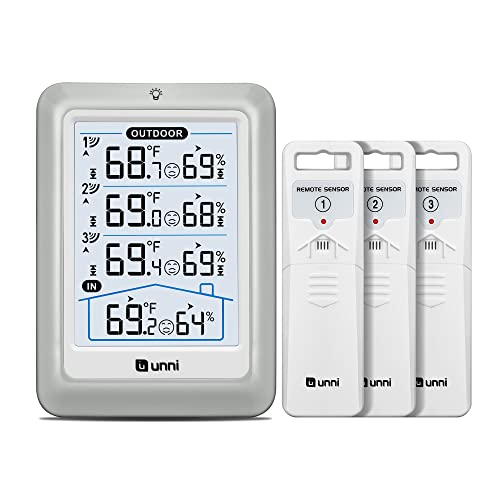
| Best Budget Pick | Temperature Range: Indoor +14.2°F to +122°F; Outdoor -40°F to +158°F | Alert Notification Methods: Outdoor temperature and humidity alert | Wireless Connectivity Type: Wireless (330 ft range) | VIEW LATEST PRICE | Read Our Analysis |
| Network Temperature Humidity Monitor with MQTT & BACnet |

| Professional Grade | Temperature Range: Not specified | Alert Notification Methods: Email notifications and IFTTT automation | Wireless Connectivity Type: Modbus TCP, SNMP, BACnet, MQTT, Ethernet | VIEW LATEST PRICE | Read Our Analysis |
| MOCREO WiFi Remote Thermometer with Temperature Sensors |

| Best Overall | Temperature Range: -4°F to 131°F | Alert Notification Methods: App push, email, and 95dB hub beep | Wireless Connectivity Type: LoRa and WiFi (H5Pro Hub) | VIEW LATEST PRICE | Read Our Analysis |
| Ethernet Server Room Temperature Monitor with PoE |

| Best for Data Centers | Temperature Range: Not specified (Swiss-grade probe) | Alert Notification Methods: Email (SMTP), SNMP trap, MQTT, visual and audible alarms | Wireless Connectivity Type: Ethernet (PoE or DC power) | VIEW LATEST PRICE | Read Our Analysis |
| YoLink Smart Freezer Thermometer 3-Pack with App Alerts |

| Best Expandable System | Temperature Range: -4°F to 122°F (-20°C to 50°C) | Alert Notification Methods: Text, email, or push notifications | Wireless Connectivity Type: LoRa (long-range, low-power) | VIEW LATEST PRICE | Read Our Analysis |
| Frigga V5J 4G/5G Temperature Data Logger with Probe |

| Best for Shipping | Temperature Range: External probe -328°F to +212°F (-200°C to +100°C); Internal -22°F to +158°F | Alert Notification Methods: Mobile push, email, or text | Wireless Connectivity Type: 4G/5G LTE with 2G fallback | VIEW LATEST PRICE | Read Our Analysis |
| SensorPush HT1 Smart Temperature & Humidity Sensor |

| Best Compact Option | Temperature Range: Up to 140°F | Alert Notification Methods: App-based notifications (with optional G1 Gateway) | Wireless Connectivity Type: Bluetooth (with optional WiFi Gateway) | VIEW LATEST PRICE | Read Our Analysis |
More Details on Our Top Picks
RV Pet Temperature Monitor with Cellular Alerts
For RV owners who need reliable pet monitoring while traveling, the RV Pet Temperature Monitor with Cellular Alerts offers essential three-in-1 functionality that tracks temperature, humidity, and power status without requiring WiFi connectivity. The device features a rechargeable internal battery that runs for three days, ensuring continuous monitoring even during power outages. You can customize high and low temperature and humidity thresholds, then add up to five contacts to receive unlimited text and email alerts. The intuitive mobile app lets you access readings remotely from anywhere. Set up takes minutes: activate the device in the app and plug it into a standard wall outlet. The industrial sensor records readings every ten seconds and stores data on servers for one year, downloadable as CSV files.
- Temperature Range:Not specified
- Alert Notification Methods:Text and email (up to 5 contacts)
- Wireless Connectivity Type:Cellular (no WiFi required)
- Data Storage & Export:1 year server storage; CSV download
- Power Source:Rechargeable internal battery (3 days runtime)
- Temperature Accuracy:Industrial sensor (specific accuracy not stated)
- Additional Feature:Cellular technology, no WiFi
- Additional Feature:Monitors up to 5 contacts
- Additional Feature:1-year server data storage
YoLink Smart Wireless Thermometer Hygrometer (3-Pack)
Need dependable monitoring where WiFi doesn’t reach? The YoLink Smart Wireless Thermometer Hygrometer 3-Pack uses LoRa technology to transmit data up to 1/4 mile without WiFi. You’ll receive the hub, three sensors, and access to customizable temperature and humidity alerts. Set threshold notifications via text, email, or push alerts on your phone. The sensors measure temperatures from -20°C to 54°C with ±0.36°F accuracy and humidity from 0% to 100% with ±3% accuracy. Each sensor runs on two AA batteries lasting approximately five years. Use the system in fridges, greenhouses, barns, or outdoor spaces where traditional WiFi monitoring fails.
- Temperature Range:-20°C to 54°C (-4°F to 129°F)
- Alert Notification Methods:Text, email, or push notifications
- Wireless Connectivity Type:LoRa (long-range, low-power)
- Data Storage & Export:Real-time app updates; no specific export mentioned
- Power Source:Two AA batteries (~5 years lifespan)
- Temperature Accuracy:±0.36°F (0°C to 54°C); ±0.72°F (-20°C to 0°C)
- Additional Feature:LoRa range up to 1/4 mile
- Additional Feature:5-year battery design lifespan
- Additional Feature:IFTTT & Alexa integration
Indoor Outdoor Wireless Thermometer with Humidity Monitor
Want reliable temperature monitoring without breaking your budget? This wireless thermometer delivers real-time indoor and outdoor data across 330 feet. The 4.5-inch display shows temperature, humidity, and daily MAX/MIN records with adjustable backlight settings. You’ll receive three outdoor sensors that update every 30 seconds, covering ranges from -40°F to +158°F outdoors and 20-95% humidity. The unit includes alerts for outdoor temperature and humidity changes, a comfort indicator, and switchable °C/°F display. USB power keeps the backlight active, while wall-mount or tabletop placement offers flexibility. Pre-calibrated sensors ensure ±1.8°F temperature accuracy and ±5% humidity accuracy, making it ideal for home or small business operations.
- Temperature Range:Indoor +14.2°F to +122°F; Outdoor -40°F to +158°F
- Alert Notification Methods:Outdoor temperature and humidity alert
- Wireless Connectivity Type:Wireless (330 ft range)
- Data Storage & Export:Daily MAX/MIN records; no export mentioned
- Power Source:USB powered
- Temperature Accuracy:±1.8°F
- Additional Feature:4.5-inch adjustable backlight display
- Additional Feature:330 ft wireless transmission range
- Additional Feature:Daily MAX/MIN auto-reset
Network Temperature Humidity Monitor with MQTT & BACnet
This professional-grade network monitor delivers simultaneous temperature and humidity data across multiple industry protocols. You’ll configure it using a graphical interface tool compatible with Windows, Linux, or macOS. The device supports Modbus TCP, SNMP, BACnet, and MQTT, sending data to AWS, Azure, or Tuya IoT platforms. You can set customizable email alerts when thresholds exceed limits. It draws power through PoE, eliminating separate wiring. The monitor fits standard 86×86 junction boxes and features flame-retardant construction. Remote upgrades streamline maintenance without site visits. FCC, CE-EMC, and ROHS certifications confirm compliance with industry standards.
- Temperature Range:Not specified
- Alert Notification Methods:Email notifications and IFTTT automation
- Wireless Connectivity Type:Modbus TCP, SNMP, BACnet, MQTT, Ethernet
- Data Storage & Export:Cloud integration (AWS, Azure, Tuya); no local storage specified
- Power Source:PoE power supply
- Temperature Accuracy:±0.2°C (Swiss-grade probe)
- Additional Feature:PoE centralized power supply
- Additional Feature:AWS, Azure, Tuya integration
- Additional Feature:Patented flame-retardant design
MOCREO WiFi Remote Thermometer with Temperature Sensors
MOCREO’s WiFi Remote Thermometer leads the category for operations requiring reliable freezer and refrigerator monitoring across distances up to 1640 feet, with three alert methods—app notifications, emails, and a 95dB hub beep—ensuring you’ll catch temperature problems before they damage inventory or compromise food safety. The system measures temperatures from -4°F to 131°F with ±0.9°F accuracy. You’ll receive alerts for power outages, WiFi disconnects, and low battery conditions. The hub connects via Ethernet or 2.4 GHz WiFi, supports eight sensor types, and expands to monitor your entire facility. Export two years of data in CSV format for compliance documentation. Battery-powered sensors last up to two years above 32°F, requiring no subscription fees.
- Temperature Range:-4°F to 131°F
- Alert Notification Methods:App push, email, and 95dB hub beep
- Wireless Connectivity Type:LoRa and WiFi (H5Pro Hub)
- Data Storage & Export:2 years CSV export; online charts
- Power Source:Three AAA batteries (up to 2 years)
- Temperature Accuracy:±0.9°F
- Additional Feature:1/3 mile open-air range
- Additional Feature:IP66 waterproof rated
- Additional Feature:2-year CSV data export
Ethernet Server Room Temperature Monitor with PoE
Need precise, round-the-clock monitoring for your data center’s critical environment? This Swiss-grade system combines a 3.5-inch TFT display with an external probe delivering ±0.2°C accuracy. Install it in your server room using magnetic or screw-mount options, then configure temperature and humidity thresholds through front-panel buttons or the web interface. The device connects via Ethernet with PoE or 12-48V DC power, sending alerts through email, SNMP, or MQTT when conditions breach limits. Onboard relays automatically control fans, AC units, or warning lights. Store up to 100,000 data records locally with 2-minute sampling intervals, then export CSV files for audits and compliance documentation. Your data never leaves the facility.
- Temperature Range:Not specified (Swiss-grade probe)
- Alert Notification Methods:Email (SMTP), SNMP trap, MQTT, visual and audible alarms
- Wireless Connectivity Type:Ethernet (PoE or DC power)
- Data Storage & Export:Up to 100,000 local records; CSV export
- Power Source:PoE or DC 12-48V
- Temperature Accuracy:±0.2°C typical
- Additional Feature:100,000 local records storage
- Additional Feature:Swiss-grade probe accuracy (±0.2°C)
- Additional Feature:Onboard relay automation output
YoLink Smart Freezer Thermometer 3-Pack with App Alerts
Looking to monitor temperatures across multiple locations without WiFi limitations? The YoLink Smart Freezer Thermometer 3-Pack delivers LoRa wireless connectivity with real-time app alerts. You’ll receive one hub and three sensors, enabling coverage up to 1/4 mile in open air. Set custom temperature thresholds to trigger text, email, or push notifications instantly. The sensors maintain accuracy within ±0.36°F across standard ranges, operating from -4°F to 122°F. Install two AA batteries per sensor for approximately five years of runtime. Use IFTTT integration to automate responses when temperatures exceed your limits, or query current readings through Alexa. This setup works effectively for refrigerators, freezers, greenhouses, and remote outdoor locations where WiFi coverage doesn’t exist.
- Temperature Range:-4°F to 122°F (-20°C to 50°C)
- Alert Notification Methods:Text, email, or push notifications
- Wireless Connectivity Type:LoRa (long-range, low-power)
- Data Storage & Export:Real-time app updates; no specific export mentioned
- Power Source:Two AA batteries (~5 years lifespan)
- Temperature Accuracy:±0.36°F (32°F to 129°F); ±0.72°F (-20°F to 32°F)
- Additional Feature:LoRa long-range wireless protocol
- Additional Feature:~5-year battery lifespan
- Additional Feature:IFTTT & Alexa compatible
Frigga V5J 4G/5G Temperature Data Logger with Probe
The Frigga V5J tracks temperature during transit across sea, air, and ground routes. You’ll receive a single-use logger with an external probe measuring -328°F to +212°F, ideal for liquid nitrogen storage and dry ice shipments. The device connects via 4G/5G LTE with 2G fallback, uploading data hourly for up to 60 days per charge. You’ll get instant mobile, email, or text alerts when temperatures deviate from your set ranges. The cloud platform stores all data with dual PDF reports, ensuring no loss. Access 24/7 support via email and view your manual through the warranty card’s QR code.
- Temperature Range:External probe -328°F to +212°F (-200°C to +100°C); Internal -22°F to +158°F
- Alert Notification Methods:Mobile push, email, or text
- Wireless Connectivity Type:4G/5G LTE with 2G fallback
- Data Storage & Export:Cloud storage with USB backup PDF download
- Power Source:Built-in battery (up to 60 days on full charge)
- Temperature Accuracy:±0.5°C (-20°C to +40°C); ±1°C outside range
- Additional Feature:Built-in 4G/5G LTE connectivity
- Additional Feature:Ultra-low temperature (-328°F) probe
- Additional Feature:Dual PDF report system
SensorPush HT1 Smart Temperature & Humidity Sensor
Want compact remote monitoring without installation headaches? The SensorPush HT1 delivers quick setup in seconds with reliable hardware lasting 1-2 years per battery. You’ll monitor temperature, humidity, heat index, dew point, and VPD continuously across freezers, wine cellars, grow tents, and RVs. The sensor records data locally for 20 days and stores unlimited information in-app. For remote access beyond 100 meters, add the optional G1 WiFi Gateway to view data anywhere. Export your recorded data for analysis in other software. With ±0.3°C accuracy and a compact 1.57-inch design, this U.S.-made option handles diverse monitoring needs efficiently.
- Temperature Range:Up to 140°F
- Alert Notification Methods:App-based notifications (with optional G1 Gateway)
- Wireless Connectivity Type:Bluetooth (with optional WiFi Gateway)
- Data Storage & Export:20 days onboard logging; unlimited cloud storage with export option
- Power Source:Lithium battery (1-2 years typical)
- Temperature Accuracy:±0.3°C
- Additional Feature:Heat index monitoring capability
- Additional Feature:20 days onboard data logging
- Additional Feature:Optional G1 WiFi Gateway
Factors to Consider When Choosing a Remote Temperature Monitoring System for Industrial Use

When selecting a remote temperature monitoring system for industrial operations, you’ll need to evaluate several critical factors: accuracy and sensor quality to ensure your data reflects real conditions, connectivity and range options that match your facility’s layout, and integration capabilities with your existing equipment and software. You should also assess the system’s power supply reliability, since downtime directly impacts your operations, and confirm that it offers robust data storage and export features so you can access historical records and generate compliance reports when needed. These five elements work together to determine whether a system will effectively support your facility’s specific monitoring requirements and operational goals.
Accuracy and Sensor Quality
How do you know if a remote temperature monitoring system will give you reliable readings in your industrial facility? Check the sensor’s accuracy specifications first. Industrial-grade sensors typically offer ±0.2 °C accuracy or ±0.36 to ±0.72 °F, depending on the model and temperature range. Verify humidity accuracy too—industrial sensors generally report ±2% RH, while others range from ±3–5% RH. Outside specified ranges, tolerances widen significantly, so confirm your facility’s conditions fall within rated parameters. Consider external probes and rugged enclosures with IP ratings for harsh environments; these enhance stability and repeatability. Review calibration capabilities and whether the system automatically resets MAX/MIN records. Swiss-grade pre-calibrated probes provide tighter specifications for critical applications. Match sensor quality to your operational requirements and environmental conditions.
Connectivity and Range Options
Your remote temperature monitoring system’s ability to transmit data reliably depends on which connectivity method you choose for your facility’s layout and existing infrastructure. Evaluate three primary options. Cellular systems with built-in SIMs deliver real-time alerts without WiFi dependency and maintain operation during power outages. LoRa-based solutions transmit signals up to 1/4 mile in open air, making them ideal for hard-to-reach indoor and outdoor areas. Ethernet, PoE, or WiFi options integrate directly into your local network and cloud platforms but require stable power and existing infrastructure. Consider your facility’s coverage needs, power availability, and integration requirements. Many operations benefit from hybrid setups combining hub-and-sensor configurations with gateway compatibility to extend range and enable multi-channel alerting across different environments.
Integration With Existing Systems
What protocols does your facility currently use to communicate between devices and systems? You’ll need to verify the monitoring system supports your existing standards—Modbus TCP, SNMP v1/v2/v3, BACnet, or MQTT. Confirm data format compatibility to ensure seamless exchange with your BMS, SCADA, or cloud platforms. Check whether the solution integrates with automation tools like Home Assistant or IFTTT for coordinated HVAC and alarm control. Assess standard interfaces such as Ethernet, PoE, and RS-485 bridging capabilities for your specific deployment environment. Review whether remote upgrade features are available for your infrastructure layout. Finally, evaluate the configuration dashboard—you’ll want centralized threshold management, event triggers, and alert routing to multiple recipients to streamline your operations workflow.
Power Supply and Reliability
When you’re selecting a remote temperature monitoring system for industrial use, ensuring uninterrupted power supply isn’t optional—it’s essential to keeping your operations running. Look for systems offering redundant power options like Power over Ethernet (PoE), DC power, or battery backup to protect against outages and instability. Battery-powered devices work best in hard-to-reach locations; prioritize models with multi-year battery life to minimize maintenance visits and downtime. For outdoor or industrial settings, verify the equipment has rugged enclosures and weatherproof ratings that maintain power integrity in harsh conditions. Pair your power setup with onboard data logging, which preserves critical information during network interruptions and enables quick recovery after power failures. These layers of redundancy safeguard your monitoring continuity.
Data Storage and Export Capabilities
Data storage fundamentally shapes how you’ll access, analyze, and retain your temperature readings over time. You can choose between local storage, which keeps data on-site for offline access, or cloud-based systems that centralize readings for remote viewing. Local systems typically store up to 100,000 records, supporting compliance and disaster recovery. Cloud options offer longer retention periods—often one year standard, with paid renewals available for extended access. Most systems export data in CSV format, enabling historical analysis and auditing across your operations. Read frequency ranges from every 10 to 30 seconds, directly affecting data detail and file size. Evaluate your retention needs, compliance requirements, and analysis frequency before selecting a storage method that matches your operational demands.
Alert Customization and Notifications
While data storage preserves your historical readings, alert customization determines how quickly you’ll respond to temperature deviations before they damage your operations. Set thresholds for high and low temperatures that match your specific needs. Choose your notification methods: text, email, push notifications, or SMS. Many systems deliver alerts through multiple channels simultaneously. Designate which contacts receive critical warnings—assign different alerts to maintenance staff, managers, or facility operators based on their roles. Enable power-loss and network-disconnect alerts to maintain awareness during outages. For advanced automation, configure programmable triggers using IFTTT, webhooks, or MQTT protocols to automatically activate HVAC systems or log data to external dashboards. This layered approach ensures you catch problems early and respond appropriately without delay.
Scalability for Multiple Locations
How will your temperature monitoring system handle growth across multiple facilities? You need a platform that supports centralized management with consistent alerting across all locations. Look for solutions offering multi-location data aggregation, uniform thresholds, and unified dashboards to track temperature and humidity trends warehouse-wide.
Verify the system uses scalable networking protocols like LoRa, MQTT, BACnet, or SNMP. These allow you to add sensors and gateways easily as your operations expand without replacing infrastructure.
Check alert capabilities including bulk user provisioning and role-based access controls. You’ll want per-location contact lists to manage large teams efficiently.
Confirm data retention policies scale with volume. The platform should support CSV exports and long-term historical storage across numerous sites to meet your growing storage needs.
Final Thoughts
You’ve reviewed nine remote temperature monitoring systems suited for different needs. Now evaluate your specific requirements: decide if you need cellular, WiFi, or LoRa connectivity; determine your budget range; identify the number of locations you’ll monitor; and check integration needs with existing systems. Match these requirements to the systems outlined. Test your top choice before full deployment to confirm it meets your operational demands and alert preferences.

Meet Ry, “TechGuru,” a 36-year-old technology enthusiast with a deep passion for tech innovations. With extensive experience, he specializes in gaming hardware and software, and has expertise in gadgets, custom PCs, and audio.
Besides writing about tech and reviewing new products, he enjoys traveling, hiking, and photography. Committed to keeping up with the latest industry trends, he aims to guide readers in making informed tech decisions.