
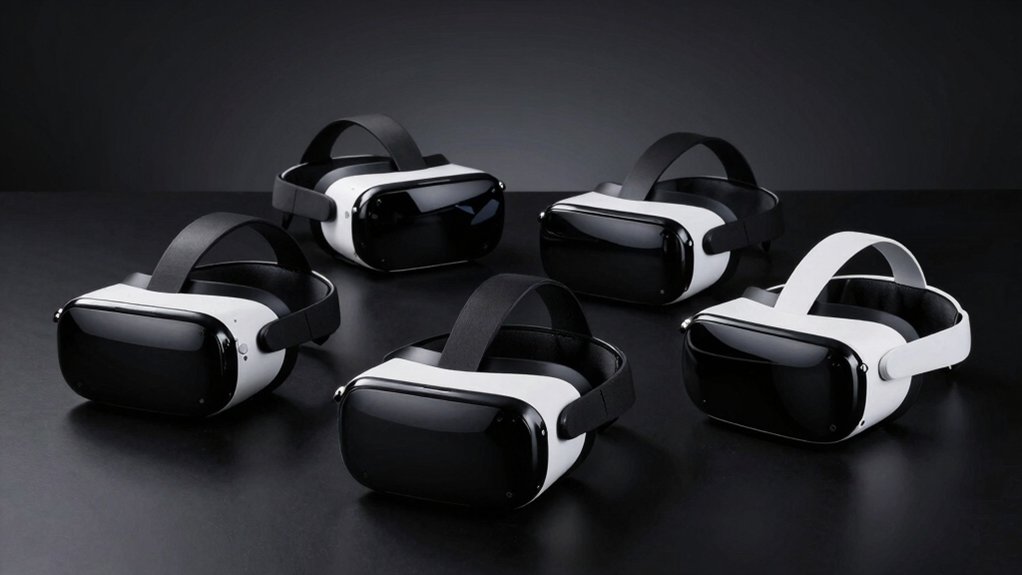

When you’re selecting a VR headset for drone flying, you’ll need to evaluate several key features: display resolution, field of view, latency, and compatibility with your drone model. Each headset offers different advantages—some prioritize crystal-clear visuals, while others focus on wide viewing angles or seamless connectivity. Understanding what these specifications mean for your specific flying needs will determine whether you get the immersive FPV experience you’re after. Here’s what you should know.
| VR FPV Hobby Drone with Dual Cameras & Goggles |

| Best All-in-One Bundle | Display Resolution: 1080p | Field of View: Not specified | Compatibility: VR FPV Hobby Drone (included with system) | VIEW LATEST PRICE | Read Our Analysis |
| FPV Goggles for Camera Drones with HD Display |

| Highest Resolution Display | Display Resolution: Up to 2560×1600 (1280×1600 per eye) | Field of View: 200 degrees | Compatibility: DJI Mini/Air/Mavic series, Autel, Potensic, Fimi, Hubsan, Skydio, Xiaomi, Parrot | VIEW LATEST PRICE | Read Our Analysis |
| FPV Drone with Dual Camera and VR Glasses |

| Best for Beginners | Display Resolution: 720p | Field of View: Not specified | Compatibility: FPV Drone (included with system) | VIEW LATEST PRICE | Read Our Analysis |
| Patented Unibody Lens FPV Goggles for DJI Drones |

| Best Premium Goggles | Display Resolution: 1600×1200 per eye | Field of View: 120 degrees | Compatibility: DJI Mini/Air/Mavic series, Autel, Potensic, Fimi, Hubsan, Skydio, Xiaomi, Parrot | VIEW LATEST PRICE | Read Our Analysis |
| MoGo Travel v1.b. Black/Blue 2D VR 360 Degrees Drones Netflix VoD AR apps |

| Most Versatile Option | Display Resolution: Up to 2560×1440 | Field of View: 360 degrees | Compatibility: Drones, Netflix, AR apps, 360-degree content | VIEW LATEST PRICE | Read Our Analysis |
More Details on Our Top Picks
VR FPV Hobby Drone with Dual Cameras & Goggles
If you’re new to drone flying and want an immersive first-person view without the steep learning curve, the VR FPV Hobby Drone with Dual Cameras & Goggles delivers real-time video transmission directly to your VR goggles, letting you experience flight from the drone’s perspective. You’ll control the drone via app or remote while viewing 1080p video from either camera. The optical flow positioning system keeps it stable, and headless mode simplifies directional control. One-key takeoff and landing functions reduce complexity. Propeller guards protect the brushless motor. With dual batteries included, you’ll extend your flight time. The drone weighs 176 grams and operates up to 200 meters away, making it ideal for learning FPV fundamentals.
- Display Resolution:1080p
- Field of View:Not specified
- Compatibility:VR FPV Hobby Drone (included with system)
- Connectivity:Wi-Fi, APP Control, remote control
- Weight:176 grams (drone only)
- Return Policy:Amazon 30-day return policy
- Additional Feature:One Key Takeoff/Landing
- Additional Feature:Electrically Adjustable Camera Angle
- Additional Feature:Propeller Guards Protect Motors
FPV Goggles for Camera Drones with HD Display
You’re looking for FPV goggles that deliver sharp, clear visuals without the split-screen limitations of standard VR headsets—the DroneMask 2 offers a solution built specifically for this need. The patented unibody lens system provides 4x resolution compared to standard split-screen headsets, displaying up to 2560×1600 pixels across a 200-degree field of view. You’ll connect via HDMI to your smartphone, eliminating the need for third-party apps. The goggles work with DJI drones (Mini 2 through Mavic 3), Autel, Potensic, Fimi, and numerous other models. Adjustable focal length and soft padding accommodate eyeglass wearers. Screen-access holes let you modify settings mid-flight while maintaining sun glare protection.
- Display Resolution:Up to 2560×1600 (1280×1600 per eye)
- Field of View:200 degrees
- Compatibility:DJI Mini/Air/Mavic series, Autel, Potensic, Fimi, Hubsan, Skydio, Xiaomi, Parrot
- Connectivity:HDMI, USB-C, Android/iOS
- Weight:1.3 kg
- Return Policy:Amazon 30-day return guarantee
- Additional Feature:Unibody Lens Patented System
- Additional Feature:Eyeglasses Compatible Design
- Additional Feature:Screen-Access Holes Mid-Flight
FPV Drone with Dual Camera and VR Glasses
The SuperRC X226 delivers immersive first-person view flying through its included VR glasses and dual-camera system, making it an ideal choice for pilots who want real-time aerial perspective without purchasing separate equipment. The drone features brushless motors, optical flow positioning for stable hovering, and 360° flip capability for performing stunts. You’ll control the aircraft up to 200 meters away using its 6-channel design with gyroscope stabilization. The dual camera setup lets you switch between aerial and ground-level shots instantly. Two built-in lithium-ion batteries extend your flight time considerably. The 100-meter image transmission provides real-time video feed directly to your VR glasses. Video records at 720p MP4 format, and the package includes a memory card and reader for easy file management. Setup requires minimal effort since the X226 arrives ready to fly.
- Display Resolution:720p
- Field of View:Not specified
- Compatibility:FPV Drone (included with system)
- Connectivity:VR monitor (wireless transmission)
- Weight:0.2 kg (drone only)
- Return Policy:Amazon 30-day return policy
- Additional Feature:360° Flips/Stunt Support
- Additional Feature:Dual Camera One-Click Switching
- Additional Feature:Two Built-In Batteries
Patented Unibody Lens FPV Goggles for DJI Drones
DroneMask 1 delivers full-screen immersion through its patented unibody lens system, making it an ideal choice for drone pilots who prioritize visual clarity and resolution four times greater than traditional FPV goggles. You’ll experience a 120-degree field of view with up to 1600×1200 resolution per eye on its 6-inch LCD display. The goggles work with DJI Mini 2, Mini 3, Mini 4, Air 2, Air 3, Mavic 3, and other major drone brands. Simply connect any smartphone via USB to your standard controller—no third-party apps required. The adjustable focal length accommodates eyeglasses wearers, while ultra-soft padding and breathable fabric ensure comfort during extended flights. At just 100 grams, the lightweight design reduces fatigue. Built-in sensors track your head movements for intuitive control and enhanced concentration while blocking sun glare.
- Display Resolution:1600×1200 per eye
- Field of View:120 degrees
- Compatibility:DJI Mini/Air/Mavic series, Autel, Potensic, Fimi, Hubsan, Skydio, Xiaomi, Parrot
- Connectivity:USB, Android platform
- Weight:100 grams
- Return Policy:Amazon 30-day return guarantee
- Additional Feature:Four Times Greater Resolution
- Additional Feature:Sun Glare Blocking Technology
- Additional Feature:Ultra-Soft Face Padding
MoGo Travel v1.b. Black/Blue 2D VR 360 Degrees Drones Netflix VoD AR apps
If you’re piloting drones via FPV, streaming Netflix, or exploring AR and 360-degree content on your smartphone, the MoGo Travel v1.b. offers a compact, foldable solution that magnifies your phone’s screen to create a pseudo 18-inch display from just 10 inches away. The patent-pending aspherical lenses magnify without requiring a special app, preserving all screen pixels per eye while reducing eye strain through prismatic design. Its foldable construction fits travel bags easily. You can wear eyeglasses by adjusting side straps or using the insertion trick for larger frames. The adjustable headband accommodates different head sizes. Note that side areas show distortion and color aberration, so keep primary viewing centered. This device suits drone piloting, HD movies, and AR applications—not gaming or reading tasks.
- Display Resolution:Up to 2560×1440
- Field of View:360 degrees
- Compatibility:Drones, Netflix, AR apps, 360-degree content
- Connectivity:USB, Windows compatible
- Weight:Not specified
- Return Policy:Amazon 30-day return
- Additional Feature:Foldable Design for Travel
- Additional Feature:6x Smartphone Screen Magnification
- Additional Feature:Patent-Pending Aspherical Prismatic Oculars
Factors to Consider When Choosing VR Headsets for Drones
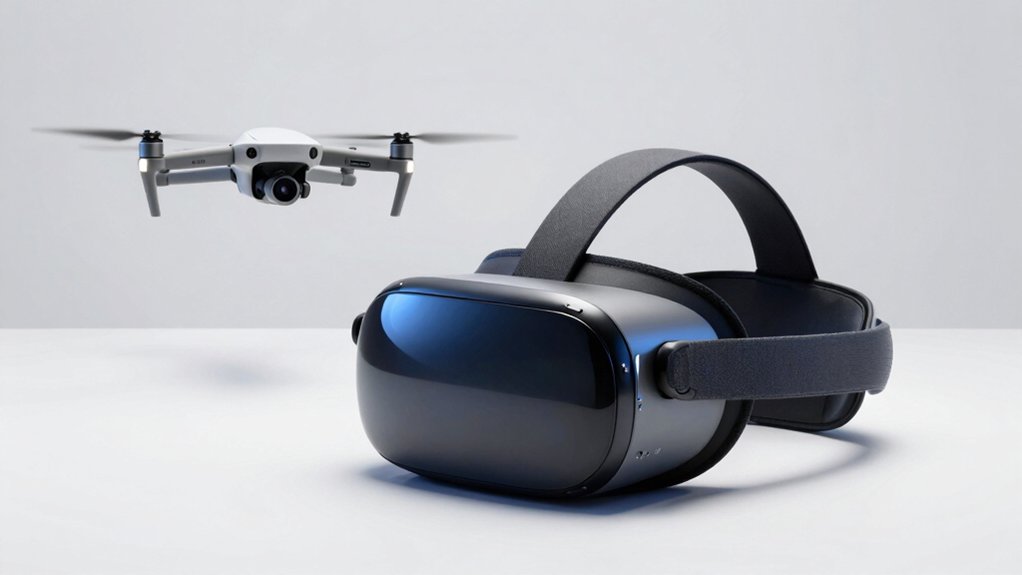
When selecting a VR headset for drone flying, you’ll need to evaluate display resolution and clarity to guarantee sharp visuals during flight, check comfort and fit design so you can wear the device for extended periods without fatigue, and verify compatibility with your specific drone model. You should also assess the field of view range—wider angles give you better spatial awareness while flying—and review connectivity and control options to confirm the headset integrates properly with your drone’s control system. These five factors work together to determine whether a headset will genuinely improve your piloting experience or create frustration through poor performance or incompatibility.
Display Resolution And Clarity
How much detail can you actually see when you’re flying your drone at high speed? Resolution directly impacts your ability to spot obstacles and maintain control. Look for headsets offering at least 1280×1600 pixels per eye to minimize pixelation during flight. Higher resolutions, such as 2560×1600 per eye, provide sharper images and reduce visual artifacts that split-screen displays create. Check the display type—LCD and LED screens handle outdoor lighting better than alternatives, improving color accuracy and contrast when you’re flying in bright conditions. Independent per-eye resolution delivers full-screen immersion, which helps you track fast movements without distortion. Prioritize clarity over other features, since you’ll rely on crisp visuals to identify terrain and obstacles quickly while operating your drone.
Comfort And Fit Design
While display resolution keeps your visuals sharp during flight, comfort and fit design determines whether you’ll actually want to wear your headset for extended sessions. Adjustable focal length and headstraps let you customize the fit for your specific eye position and head shape. Look for eyeglasses compatibility if you wear prescription lenses, eliminating the need to remove them and reducing facial pressure. Choose headsets with ultra-soft face padding and breathable fabric to prevent discomfort during long flights. Prioritize lightweight designs around 100 grams to minimize strain on your nose and neck. Select models featuring unibody lens systems and glare reduction technology to decrease eye fatigue. These design elements work together to keep you comfortable while maintaining focus on your flying experience.
Compatibility With Drone Models
Which VR headset’ll actually work with your drone? Start by checking the manufacturer’s compatibility list. Your headset must explicitly support your specific drone model—whether that’s a DJI Mini 3, Air series, Mavic 3, or Autel Evo. Next, verify connection type. Confirm the headset accepts HDMI or USB inputs matching your drone’s transmission system for real-time FPV feeds. Third, test controller compatibility. Ensure the headset works with standard controllers and smartphone connectivity without requiring third-party apps. Fourth, consider future-proofing. Select headsets advertising multi-brand and multi-generation support. Finally, check firmware requirements. Review any necessary software updates needed for newer drone compatibility. Following these steps prevents pairing issues and ensures seamless integration with your current and future drone equipment.
Field Of View Range
What role does field of view play in your drone flying experience? FOV determines how much you’ll see peripherally while flying. You’ll find headsets ranging from 120 to 200 degrees. Narrower FOVs around 120–130 degrees reduce distortion and eye fatigue but limit your situational awareness. Wider FOVs at 200 degrees provide near-wraparound vision for better peripheral visibility, though edge distortion may occur with poor optics. Consider your priority: if you need sharp, distortion-free visuals, choose 120–130 degrees. If you want maximum immersion and spatial awareness, select 160–200 degrees with quality lens correction. Also evaluate display resolution per eye—higher resolutions like 1600×1200 enhance sharpness at any FOV level, improving your overall flying experience.
Connectivity And Control Options
How you’ll connect your VR headset to your drone and controller directly impacts your flying capability and ease of use. Most FPV headsets offer HDMI or USB-C connectivity options that link directly to your controller for real-time video transmission. If you prefer smartphone integration, select models support Android and iOS platforms without requiring third-party apps—simply connect your phone to a standard controller. This dual approach gives you flexibility based on your existing equipment. Check compatibility lists carefully, as they typically cover major drone brands including DJI, Autel, Potensic, Fimi, and Hubsan. Verify your specific drone model appears on the headset’s compatibility documentation before purchasing. This ensures seamless integration and prevents connectivity issues during flight operations.
Battery Life And Power
Battery life determines how long you’ll actually use your VR headset during a flying session, so you’ll want to match or exceed your drone’s flight time to avoid interruptions. Check the headset’s battery capacity in mAh and compare it directly to your drone’s endurance rating. Look for models with built-in dual-battery designs or USB charging compatibility with portable power banks, which extend operational time away from mains power. Review battery management features like low-power alerts that notify you before the display shuts down. Keep in mind that higher-resolution displays and heavier units consume more power, reducing flight duration per charge. Prioritize efficient display panels that balance image quality with battery conservation. Test actual runtime during initial flights to confirm the headset sustains your typical session length.
Real-Time Image Transmission
Why you’ll want to prioritize real-time image transmission quality depends on how responsive you need your flying experience to be. Check the headset’s latency rating—lower values mean faster feed updates and better control responsiveness. Verify bandwidth capacity to ensure smooth video streaming without stuttering or dropouts. Examine transmission range specifications; most quality systems reach approximately 200 meters reliably. Assess antenna quality in both the headset and drone transmitter, as superior antennas reduce interference and environmental signal loss. Evaluate the video encoder used—better encoders maintain image clarity while minimizing lag. If you’re using multi-camera setups, confirm the system supports synchronized streaming across all cameras without noticeable switching delays. Test the headset’s focal length adjustment features to maintain clarity throughout your flight sessions.
Durability And Build Quality
When you’re investing in a VR headset for drone operations, you’ll want to examine the materials and construction methods that determine how well it’ll withstand the demands of outdoor flying. Look for rugged housings and impact-resistant materials that protect internal displays and electronics from drops or bumps. Check that the headset includes integrated protective features like propeller guards and reinforced lens housings to reduce crash damage. Select models with modular designs allowing you to replace damaged components such as lenses or housings easily. Verify the headset has secure cable management with strain relief and robust mounting points to prevent wear from frequent movement. Finally, confirm water and dust resistance ratings around critical openings to maintain reliability across varying weather conditions.
Final Thoughts
You’ve now reviewed five VR headsets designed specifically for drone flying. To make your choice, prioritize your needs: determine your budget, check drone compatibility (especially DJI models), and decide between smartphone-enabled or standalone options. Evaluate the field of view and resolution for your flying style. Consider portability if you’ll travel frequently. Compare battery life and latency specs. Test connectivity options before purchasing. Your ideal headset balances performance, durability, and practical features for your specific flying situations.

Meet Ry, “TechGuru,” a 36-year-old technology enthusiast with a deep passion for tech innovations. With extensive experience, he specializes in gaming hardware and software, and has expertise in gadgets, custom PCs, and audio.
Besides writing about tech and reviewing new products, he enjoys traveling, hiking, and photography. Committed to keeping up with the latest industry trends, he aims to guide readers in making informed tech decisions.