
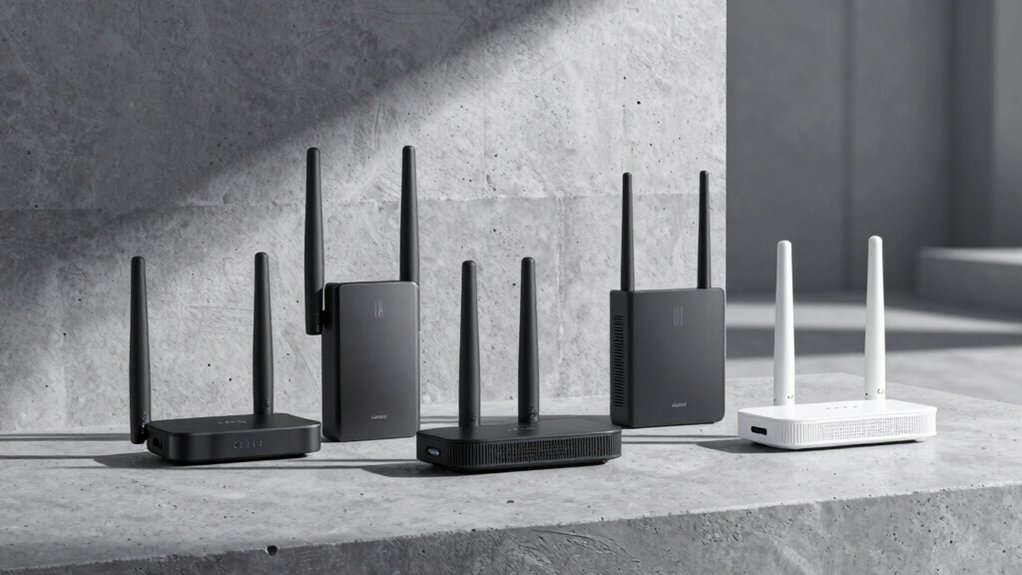

Concrete walls block WiFi signals effectively, leaving dead zones throughout your home. You’ll need an extender designed specifically for this challenge—one with strong external antennas, dual-band capability, and proven wall-penetration performance. This guide covers ten models that deliver reliable coverage in concrete environments, plus the key specifications you should evaluate before purchasing.
| TP-Link AC1200 WiFi Extender (RE315) |

| Budget-Friendly Pick | Coverage Area: Up to 1,500 sq ft | Maximum Device Support: 30-32 devices | Security Protocols: WPA/WPA2 (CISA Secure-by-Design pledge) | VIEW LATEST PRICE | Read Our Analysis |
| TP-Link AC1900 WiFi Range Extender RE550 |

| Best Overall | Coverage Area: Up to 2,100 sq ft | Maximum Device Support: 32 devices | Security Protocols: WPA/WPA2 (CISA Secure-by-Design pledge) | VIEW LATEST PRICE | Read Our Analysis |
| WiFi Extender 1200Mbps Dual Band Signal Booster |

| Most Coverage | Coverage Area: Up to 10,000 sq ft | Maximum Device Support: 55 devices | Security Protocols: WPA/WPA2 | VIEW LATEST PRICE | Read Our Analysis |
| 2026 WiFi Extender Signal Booster 300Mbps |

| Best For Renters | Coverage Area: Up to 9,999 sq ft | Maximum Device Support: 60+ devices | Security Protocols: WEP/WPA/WPA2 | VIEW LATEST PRICE | Read Our Analysis |
| WiFi Extender Signal Booster up to 5000 sq.ft |

| Best Value | Coverage Area: Up to 5,000 sq ft | Maximum Device Support: 50 devices | Security Protocols: WEP/WPA/WPA2 | VIEW LATEST PRICE | Read Our Analysis |
| 2026 AX3000 WiFi 6 Range Extender with Gigabit Ethernet |

| Best Performance | Coverage Area: Up to 13,888 sq ft | Maximum Device Support: 100+ devices | Security Protocols: WEP/WPA/WPA2/802.1X | VIEW LATEST PRICE | Read Our Analysis |
| WiFi Extender Signal Booster 2.4G (10888 Sq Ft) |

| Best Wall Penetration | Coverage Area: 10,888 sq ft | Maximum Device Support: 80 devices | Security Protocols: WEP/WPA/WPA2 | VIEW LATEST PRICE | Read Our Analysis |
| WiFi Extender Signal Booster Dual Band 1200Mbps |

| Most Versatile | Coverage Area: Up to 12,888 sq ft | Maximum Device Support: 99% of routers compatible (device count not specified) | Security Protocols: WEP/WPA/WPA2 | VIEW LATEST PRICE | Read Our Analysis |
| NETGEAR WiFi Mesh Range Extender AC1200 (EX5000) |

| Best For Small Spaces | Coverage Area: Up to 1,000 sq ft | Maximum Device Support: 15 devices | Security Protocols: WEP/WPA/WPA2 | VIEW LATEST PRICE | Read Our Analysis |
| WiFi Extender Signal Booster for Whole Home |

| Fastest Setup | Coverage Area: 13,000 sq ft | Maximum Device Support: 65+ devices | Security Protocols: WPA/WPA2-PSK encryption | VIEW LATEST PRICE | Read Our Analysis |
More Details on Our Top Picks
TP-Link AC1200 WiFi Extender (RE315)
If you’re struggling with weak WiFi signals behind concrete walls and need a budget-friendly solution that works with your existing router, the TP-Link AC1200 (RE315) delivers practical coverage expansion without requiring a complete mesh system overhaul. You’ll get 1.2Gbps total bandwidth across dual bands—867 Mbps on 5GHz and 300 Mbps on 2.4GHz—covering up to 1,500 square feet and 32 devices. External antennas and Adaptive Path Selection help you maintain stronger connections as you move through your home. Setup takes minutes using the Tether app, which includes an intelligent signal indicator to pinpoint the optimal placement location. The wired Ethernet port lets you connect devices directly for faster, more reliable speeds when needed. Note that the extender expands coverage without increasing your core internet speed, and performance depends on existing signal quality.
- Coverage Area:Up to 1,500 sq ft
- Maximum Device Support:30-32 devices
- Security Protocols:WPA/WPA2 (CISA Secure-by-Design pledge)
- Ethernet Port:One Ethernet port
- Setup Method:Tether app (Android/iOS)
- Operating Frequency Bands:Dual-band (5GHz/2.4GHz)
- Additional Feature:Adaptive Path Selection technology
- Additional Feature:One-Touch setup convenience
- Additional Feature:Covers up to 1500 sq ft
TP-Link AC1900 WiFi Range Extender RE550
Want to strengthen WiFi signals throughout a home or office with concrete walls that typically block wireless coverage? The TP-Link AC1900 RE550 delivers dual-band performance with 1.9 Gbps total bandwidth to reach up to 2,100 square feet and support 32 devices. Position its three adjustable external antennas to optimize coverage through dense walls. Use the Tether app to locate the best placement spot and connect automatically to your strongest signal. The Gigabit Ethernet port lets you hardwire devices for reliable speeds, while AP mode converts your wired connection into a WiFi hotspot. Note that actual speeds may reach only 50 percent of your base router’s speed, so expect coverage improvement rather than speed increases.
- Coverage Area:Up to 2,100 sq ft
- Maximum Device Support:32 devices
- Security Protocols:WPA/WPA2 (CISA Secure-by-Design pledge)
- Ethernet Port:Gigabit Ethernet port
- Setup Method:Tether app
- Operating Frequency Bands:Dual-band (5GHz/2.4GHz)
- Additional Feature:Three adjustable external antennas
- Additional Feature:Gigabit Ethernet port included
- Additional Feature:AP mode conversion capability
WiFi Extender 1200Mbps Dual Band Signal Booster
Looking to strengthen your WiFi signal through concrete walls without replacing your entire router? The WiFi Extender 1200Mbps Dual Band Signal Booster delivers reliable coverage across 10,000 square feet using dual-band technology on 5GHz and 2.4GHz frequencies. You’ll connect up to 55 devices simultaneously through its four antennas. Set it up in one of three modes: WiFi repeater to extend your existing network, AP mode to create a new access point, or use the Ethernet port for wired connections. The device supports WPA/WPA2 security protocols to protect your network. Its compact dimensions (2.16 x 3.54 x 6.81 inches) let you position it strategically near concrete barriers for optimal signal penetration.
- Coverage Area:Up to 10,000 sq ft
- Maximum Device Support:55 devices
- Security Protocols:WPA/WPA2
- Ethernet Port:Ethernet port included
- Setup Method:Not specified
- Operating Frequency Bands:Dual-band (5GHz/2.4GHz)
- Additional Feature:Supports up to 55 devices
- Additional Feature:Four antenna design
- Additional Feature:Three work modes included
2026 WiFi Extender Signal Booster 300Mbps
The 2026 WiFi Extender Signal Booster 300Mbps works well for homeowners who need to reach dead zones in concrete-walled spaces without replacing their entire network. You’ll plug the device in, connect it to your existing wireless network in seconds, and extend coverage up to 9999 square feet throughout bedrooms, basements, garages, and gardens. It supports 60+ devices simultaneously, maintaining stable internet performance across smartphones, laptops, tablets, and smart home equipment. The unit includes an Ethernet port and access point capabilities, allowing you flexibility in how you deploy it. WEP/WPA/WPA2 security protocols protect your data while expanding your network reach.
- Coverage Area:Up to 9,999 sq ft
- Maximum Device Support:60+ devices
- Security Protocols:WEP/WPA/WPA2
- Ethernet Port:Ethernet port included
- Setup Method:Plug and play
- Operating Frequency Bands:Single-band (2.4GHz)
- Additional Feature:Covers up to 9999 sq ft
- Additional Feature:Supports 60+ devices
- Additional Feature:Access point capabilities
WiFi Extender Signal Booster up to 5000 sq.ft
If you’re struggling with weak WiFi signals in your home’s concrete-walled rooms, you’ll need an extender that covers substantial square footage while maintaining stable performance across multiple devices. This model delivers coverage up to 5000 sq ft with 360° full signal reach, supporting up to 50 devices simultaneously. It operates in two modes: AP mode for wired network expansion and Repeater mode for extending existing wireless signals. Setup takes minutes through one-tap WPS or browser configuration on iOS and Android. The dual-band technology provides up to 300 Mbps on 2.4 GHz, while an Ethernet connection option prevents speed drops. Its compact plug-wall design fits any outlet, making installation straightforward for concrete-challenged homes.
- Coverage Area:Up to 5,000 sq ft
- Maximum Device Support:50 devices
- Security Protocols:WEP/WPA/WPA2
- Ethernet Port:Ethernet port included
- Setup Method:WPS button or browser-based configuration
- Operating Frequency Bands:Dual-band (2.4GHz/5GHz)
- Additional Feature:360° full coverage design
- Additional Feature:WPS one-tap setup
- Additional Feature:Compact plug-wall form
2026 AX3000 WiFi 6 Range Extender with Gigabit Ethernet
For those battling weak WiFi signals in homes with concrete walls, the 2026 AX3000 WiFi 6 Range Extender delivers coverage across up to 13,888 square feet while supporting over 100 connected devices simultaneously. The unit features four antennas that expand your wireless range and reduce dead zones throughout your space. You’ll connect it via dual-band technology on 2.4G and 5.8G frequencies. A Gigabit Ethernet port provides wired connectivity up to 10 times faster than wireless, ideal for PCs, smart TVs, and gaming consoles. Setup takes about three minutes using your smartphone or browser—no app required. Security protocols include WEP, WPA, WPA2, and 802.1X encryption. The extender supports smartphones, streaming devices, smart home equipment, and web browsing seamlessly.
- Coverage Area:Up to 13,888 sq ft
- Maximum Device Support:100+ devices
- Security Protocols:WEP/WPA/WPA2/802.1X
- Ethernet Port:Gigabit Ethernet port
- Setup Method:Smartphone app or PC browser (no app required)
- Operating Frequency Bands:Dual-band (2.4GHz/5.8GHz) WiFi 6
- Additional Feature:WiFi 6 acceleration technology
- Additional Feature:Supports 100+ devices
- Additional Feature:10x faster wired connectivity
WiFi Extender Signal Booster 2.4G (10888 Sq Ft)
Need reliable coverage throughout a large home or multi-story building without investing in an entirely new network system? This 2.4G extender covers 10,888 square feet using high-gain antennas, targeting living rooms, bedrooms, garages, and patios. You’ll support up to 80 simultaneous devices—smartphones, smart TVs, tablets, security cameras, and printers. The 300M single-band performance penetrates furniture and thin walls effectively. Setup takes minutes using the 1-Tap WPS button for quick router pairing. Smart indicator lights guide your installation process. This device maintains consistent signal stability during browsing, streaming, video calls, and smart home operations, reducing dead zones in multi-story residences.
- Coverage Area:10,888 sq ft
- Maximum Device Support:80 devices
- Security Protocols:WEP/WPA/WPA2
- Ethernet Port:Not mentioned
- Setup Method:WPS button (1-tap)
- Operating Frequency Bands:Single-band (2.4GHz)
- Additional Feature:High-gain antenna design
- Additional Feature:Smart indicator lights
- Additional Feature:Penetrates common household walls
WiFi Extender Signal Booster Dual Band 1200Mbps
Looking to eliminate dead zones throughout your home without replacing your entire router setup? This dual-band extender delivers 300 Mbps on 2.4GHz and up to 1200 Mbps on 5.8GHz, covering up to 12,888 square feet with enhanced wall penetration. Setup takes one tap using WPS technology—simply plug it in and let it auto-pair with your existing router. The device operates in three modes: repeater for expanded coverage, access point for converting wired connections, or ethernet bridge with dual ports for direct TV and PC connections. Enterprise-grade security includes WEP, WPA, and WPA2 encryption. Compatible with 99% of routers and smart devices, it handles streaming, video calls, and gaming without requiring complex configuration.
- Coverage Area:Up to 12,888 sq ft
- Maximum Device Support:99% of routers compatible (device count not specified)
- Security Protocols:WEP/WPA/WPA2
- Ethernet Port:Dual Ethernet ports
- Setup Method:WPS button (1-tap) or auto-pair
- Operating Frequency Bands:Dual-band (2.4GHz/5.8GHz)
- Additional Feature:Dual Ethernet ports
- Additional Feature:Three-mode operation versatility
- Additional Feature:Enterprise-grade security architecture
NETGEAR WiFi Mesh Range Extender AC1200 (EX5000)
The NETGEAR EX5000 works best if you’re trying to cover dead zones in homes with concrete walls while keeping your setup simple and affordable. This dual-band extender covers up to 1,000 square feet and connects 15 devices simultaneously at speeds up to 1200 Mbps. Setup takes minutes: press the WPS button to connect to your existing router, then use the NETGEAR WiFi Analyzer app to find the optimal placement location in your home. The compact wall-plug design fits discretely behind furniture. It supports WPA/WPA2 security protocols and works with any wireless router or gateway, making it a straightforward solution for extending coverage through concrete barriers without replacing your primary network.
- Coverage Area:Up to 1,000 sq ft
- Maximum Device Support:15 devices
- Security Protocols:WEP/WPA/WPA2
- Ethernet Port:Not mentioned
- Setup Method:WPS button or NETGEAR WiFi Analyzer app
- Operating Frequency Bands:Dual-band (2.4GHz/5GHz)
- Additional Feature:Compact wall plug design
- Additional Feature:WPS button connection
- Additional Feature:NETGEAR WiFi Analyzer app
WiFi Extender Signal Booster for Whole Home
If you’re struggling with weak WiFi signals in a multi-story home or dealing with concrete walls that block your router’s reach, the Hyzoms WiFi Extender Signal Booster delivers coverage across 13,000 square feet—120% wider than standard routers. Setup takes just 8 seconds using either the 1-button WPS activation or browser-based configuration. The device features four high-gain antennas and a bionic chip that penetrate concrete walls and reduce dead zones throughout your space. You’ll achieve 5X faster speeds, supporting 4K streaming and lag-free gaming on PS5 or Xbox. An ethernet port prioritizes wired connections for devices requiring stable performance, while the extender simultaneously connects 65+ devices including cameras, smart home equipment, and gaming consoles. WPA/WPA2-PSK encryption provides bank-level security protection for your family’s data.
- Coverage Area:13,000 sq ft
- Maximum Device Support:65+ devices
- Security Protocols:WPA/WPA2-PSK encryption
- Ethernet Port:Ethernet port included
- Setup Method:WPS button (8-second setup) or browser configuration
- Operating Frequency Bands:Single-band (2.4GHz)
- Additional Feature:Bionic Chip technology
- Additional Feature:Supports 4K streaming
- Additional Feature:Military-grade WPA2-PSK encryption
Factors to Consider When Choosing WiFi Extenders for Concrete Walls
When selecting a WiFi extender for concrete walls, you’ll need to evaluate signal penetration capability first, since concrete blocks radio waves more effectively than standard drywall, and you should verify that your chosen model includes dual-band technology to maintain both 2.4GHz and 5GHz frequencies for optimal performance across different devices. Next, examine the antenna configuration—external antennas typically offer better penetration than internal ones—and calculate your coverage area requirements by measuring the distance from your router through concrete barriers to determine the extender’s necessary range in square footage. Finally, assess your device capacity needs by counting how many smartphones, tablets, laptops, and smart home devices you’ll connect simultaneously, since concrete-wall installations often serve larger homes and require extenders rated for higher user loads.
Signal Penetration Capability
Because concrete walls considerably block WiFi signals, you’ll need to understand how different frequencies and equipment features affect a signal’s ability to pass through these barriers. Lower frequencies like 2.4 GHz penetrate concrete better than 5 GHz, though they deliver slower speeds. Higher frequencies get absorbed quickly by dense materials.
Choose extenders with multiple external antennas and higher transmit power for stronger through-wall performance. Check the device’s stated coverage area in square feet to gauge practical reach through barriers, though real-world penetration will likely be less than advertised.
Consider models offering AP mode or wired backhaul options. These configurations bypass wireless attenuation entirely, maintaining stable performance through concrete by connecting your extender directly to your router via ethernet rather than relying on WiFi signals alone.
Dual-Band Technology Benefits
Why does a dual-band extender matter when you’re dealing with concrete walls? These devices transmit on both 2.4 GHz and 5 GHz frequencies simultaneously, giving you flexibility in challenging environments. The 2.4 GHz band penetrates concrete barriers more effectively, reaching distant rooms that 5 GHz signals can’t access. Meanwhile, the 5 GHz band handles high-speed data traffic without interference, improving overall reliability. You’re essentially splitting your network into two pathways—one for coverage, one for speed. When selecting a dual-band unit, check that it supports strong 2.4 GHz performance with multiple external antennas. This combination ensures steady coverage throughout your space while maintaining reasonable speeds where the signal reaches effectively.
Antenna Configuration Impact
External antennas make a measurable difference in how well your extender pushes signal through concrete barriers, and you’ll want to understand how they work before making a purchase. More antennas generally deliver better coverage because they enable improved signal paths through thick walls. Look for units with four or more external antennas for consistent performance across large spaces. Consider antenna type: directional antennas focus signal in one direction, while omni-directional antennas spread coverage evenly. Position your extender’s antennas strategically—align them vertically and horizontally, or orient them toward problem areas. Place the unit near doorways or hallways to maximize wall penetration. Multi-antenna setups provide redundancy, meaning signal can reach you through multiple pathways when concrete blocks direct routes.
Coverage Area Requirements
How much square footage does your concrete-walled space actually need to cover? Calculate your total area by measuring your space’s length and width, then multiplying those numbers. For concrete environments, aim for extenders advertising 10,000–13,888 square feet of coverage to compensate for signal loss through dense walls. If your space falls under 5,000 square feet, a standard extender may suffice. Between 5,000 and 10,000 square feet, select models emphasizing long-range performance. Beyond 10,000 square feet, prioritize extenders with multiple external antennas and higher transmit power. Consider your layout’s complexity—spaces with numerous concrete walls require larger coverage areas than open designs. Match the extender’s advertised range to your calculated footage, adding buffer capacity for wall penetration losses.
Device Capacity Needs
Before you purchase a WiFi extender for your concrete-walled space, you’ll need to count the total number of devices you plan to connect simultaneously. List every smartphone, tablet, laptop, smart TV, security camera, and IoT device in your household. Most homes require extenders supporting 32–100+ devices. Next, identify usage patterns—determine if devices connect all at once or in clusters throughout the day. Choose an extender rated for at least 50 more devices than your current count to handle future additions. Prioritize models with strong concurrent connection support, including multiple antennas and QoS features that maintain performance across many devices. For high-demand endpoints like streaming devices or work computers, select extenders offering Ethernet backhaul options. Wi-Fi 6/AX standards handle dense device loads better than older AC models, especially through concrete barriers.
Security Protocol Standards
What’s the strongest encryption standard your extender currently supports? You’ll find most extenders offer WEP, WPA, WPA2, or WPA3, with WPA2 and WPA3 providing the best data protection. Choose WPA3 if your extender and router support it, as it delivers superior encryption for concrete-wall setups where signals travel through multiple barriers. Next, verify the extender uses modern 802.11ax, ac, or n standards alongside robust encryption protocols. These standards enable stronger security features and wider router compatibility. Additionally, look for extenders with Secure-by-Design pledges, indicating ongoing firmware updates and vulnerability management. Finally, consider models with AP mode capability—this lets you create isolated access points with separate security settings, adding another protection layer in homes with challenging layouts.
Wired Ethernet Connectivity
While encryption protects your data traveling through the air, a wired Ethernet connection bypasses wireless interference altogether—making it your strongest option for concrete-wall environments. When selecting an extender, prioritize models featuring Gigabit Ethernet ports rather than standard Fast Ethernet. A Gigabit port delivers speeds up to 1,000 Mbps, ensuring devices connected via cable maintain consistent performance. Check whether your extender supports both AP mode and Ethernet bridge functionality. This versatility lets you either convert wired connections into wireless signals or establish dedicated backhaul networks across rooms. Connect your extender to your router using an Ethernet cable routed through walls or along baseboards. This configuration isolates your wired traffic from wireless congestion, allowing TVs, gaming consoles, and computers to sustain reliable throughput despite concrete barriers weakening the wireless signal.
Final Thoughts
You’ll improve concrete wall WiFi coverage by selecting extenders with 4+ antennas, dual-band support, and gigabit Ethernet ports. Position your device halfway between your router and dead zone, or use wired backhaul to eliminate signal loss. Choose models offering 10,000+ sq ft coverage with WPA3 security. Test placement using your phone’s signal strength app, then adjust antenna angles for optimal penetration through concrete barriers.

Meet Ry, “TechGuru,” a 36-year-old technology enthusiast with a deep passion for tech innovations. With extensive experience, he specializes in gaming hardware and software, and has expertise in gadgets, custom PCs, and audio.
Besides writing about tech and reviewing new products, he enjoys traveling, hiking, and photography. Committed to keeping up with the latest industry trends, he aims to guide readers in making informed tech decisions.