
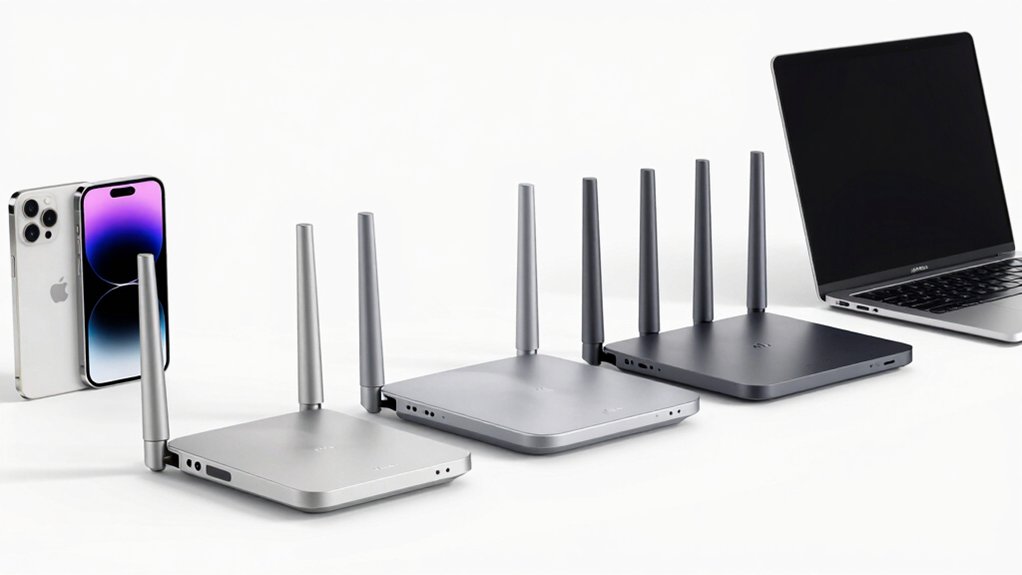

If you use Apple devices, you need a router that works reliably with your ecosystem. You’ll want strong security features like WPA3, easy setup through iOS or macOS, and dependable performance across your home. The right router can make a significant difference in how smoothly your devices connect and stay connected. We’ve identified seven routers that Apple users consistently choose for their specific needs and features.
| Apple AirPort Extreme Base Station ME918LL/A (Renewed) |
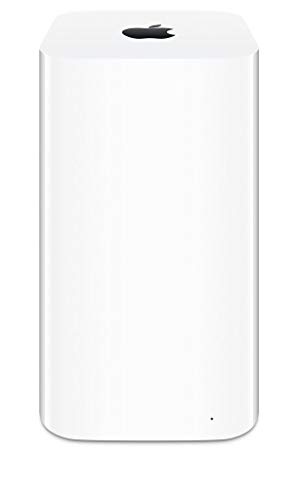
| Apple-Optimized Classic | WiFi Standard: 802.11ac (WiFi 5) | Maximum Speed: 1.3 Gbps | Coverage Area: Not specified | VIEW LATEST PRICE | Read Our Analysis |
| TP-Link AX1800 WiFi 6 Router (Archer AX21) |

| Best Value | WiFi Standard: 802.11ax (WiFi 6) | Maximum Speed: 1.8 Gbps | Coverage Area: Not specified | VIEW LATEST PRICE | Read Our Analysis |
| NETGEAR Nighthawk WiFi 7 Router (BE9300) |

| Best Overall | WiFi Standard: WiFi 7 | Maximum Speed: 9.3 Gbps | Coverage Area: Up to 2,500 sq ft | VIEW LATEST PRICE | Read Our Analysis |
| NETGEAR 4-Stream WiFi 6 Router (R6700AX) |

| Budget-Friendly Pick | WiFi Standard: WiFi 6 | Maximum Speed: 1.8 Gbps | Coverage Area: Up to 1,500 sq ft | VIEW LATEST PRICE | Read Our Analysis |
| TP-Link Roam 6 AX1500 Portable Wi-Fi Router |

| Best For Travel | WiFi Standard: WiFi 6 | Maximum Speed: 1.5 Gbps | Coverage Area: Not specified | VIEW LATEST PRICE | Read Our Analysis |
| GL.iNet GL-SFT1200 Portable WiFi Travel Router |
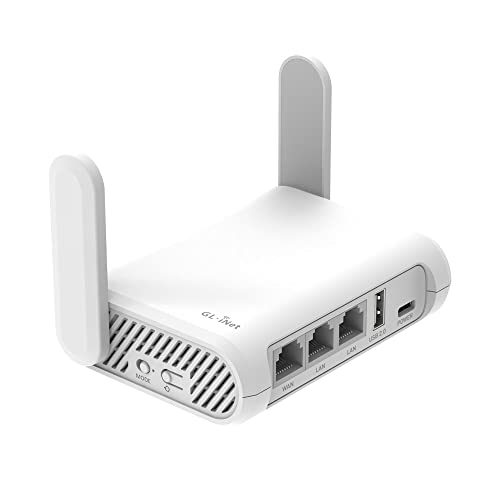
| Portable Privacy Focus | WiFi Standard: WiFi 5 | Maximum Speed: 1.167 Gbps | Coverage Area: Not specified | VIEW LATEST PRICE | Read Our Analysis |
| Google Nest Wifi AC2200 Mesh Router System |

| Best Mesh System | WiFi Standard: WiFi 5 | Maximum Speed: 2.2 Gbps | Coverage Area: Up to 2,200 sq ft (single), up to 4,400 sq ft (multi-unit) | VIEW LATEST PRICE | Read Our Analysis |
More Details on Our Top Picks
Apple AirPort Extreme Base Station ME918LL/A (Renewed)
If you’re an Apple user who wants a router that integrates seamlessly with your devices while offering strong performance, the Apple AirPort Extreme Base Station ME918LL/A is worth considering. This certified refurbished unit delivers 802.11ac Wi-Fi at speeds up to 1.3 Gbps with simultaneous dual-band support. You’ll get six antennas positioned at the top for improved coverage and connection strength. The router lets you share USB external hard drives across your network securely, accessible from any Mac or PC. You can also connect a wireless printer directly to the device. Setup works easily with Macs and iOS devices. The unit comes with all original accessories and carries a 90-day warranty.
- WiFi Standard:802.11ac (WiFi 5)
- Maximum Speed:1.3 Gbps
- Coverage Area:Not specified
- Dual-Band Support:Simultaneous dual-band 802.11ac
- Security Features:Secure network access, secure Internet access
- Setup & Management:Easy setup with Macs and iOS devices
- Additional Feature:USB disk sharing/network drive
- Additional Feature:Wireless printer integration
- Additional Feature:Certified refurbished/90-day warranty
TP-Link AX1800 WiFi 6 Router (Archer AX21)
The TP-Link Archer AX21 delivers WiFi 6 performance at an accessible price point, making it an excellent choice for Apple users who want faster speeds without premium costs. This dual-band router generates 1.8 Gbps total bandwidth across 5 GHz and 2.4 GHz bands. You’ll need a separate modem to use it. The four high-gain antennas and beamforming technology direct signals to distant devices, extending coverage throughout your home. OFDMA allows simultaneous data transmission to multiple devices, reducing lag during heavy usage. TP-Link backs this router with CISA Secure-by-Design standards and VPN server support. Update firmware regularly through the Tether app for optimal performance and security patches.
- WiFi Standard:802.11ax (WiFi 6)
- Maximum Speed:1.8 Gbps
- Coverage Area:Not specified
- Dual-Band Support:Dual-Band (5 GHz and 2.4 GHz)
- Security Features:TP-Link CISA Secure-by-Design pledge, VPN Server support
- Setup & Management:Tether app for firmware updates
- Additional Feature:OFDMA simultaneous multi-device data
- Additional Feature:Beamforming for distant devices
- Additional Feature:VPN server support included
NETGEAR Nighthawk WiFi 7 Router (BE9300)
Want to future-proof your home network while keeping pace with Apple’s ecosystem demands? The BE9300 delivers WiFi 7 speeds up to 9.3 Gbps, making it 2.4x faster than WiFi 6 alternatives. Its tri-band design handles gaming, streaming, and video conferencing simultaneously without lag. You’ll get coverage across 2,500 square feet with high-performance antennas in a compact footprint. The 2.5 Gigabit internet port supports multi-gig speeds from modern cable or fiber plans. Setup is straightforward through the Nighthawk app. NETGEAR Armor provides security protection against hackers and malware. Note: you’ll need a separate cable modem, and this router is available for U.S. use only.
- WiFi Standard:WiFi 7
- Maximum Speed:9.3 Gbps
- Coverage Area:Up to 2,500 sq ft
- Dual-Band Support:Tri-Band
- Security Features:NETGEAR Armor with malware/identity theft protection
- Setup & Management:Nighthawk app for easy setup and management
- Additional Feature:2.5 Gigabit internet port
- Additional Feature:NETGEAR Armor security included
- Additional Feature:Up to 2,500 sq ft
NETGEAR 4-Stream WiFi 6 Router (R6700AX)
Looking for a router that covers your entire home without breaking your budget? The NETGEAR 4-Stream WiFi 6 Router delivers reliable performance across 1,500 square feet. This router supports up to 20 devices simultaneously, making it ideal for households with multiple Apple products. It features AX1800 speeds and WiFi 6 technology for smooth streaming and video conferencing. You’ll need a separate cable modem to get started. The router includes four gigabit ethernet ports for wired connections to computers and gaming consoles. Built-in security features protect your network automatically. This model works with any internet service provider up to 1 Gbps.
- WiFi Standard:WiFi 6
- Maximum Speed:1.8 Gbps
- Coverage Area:Up to 1,500 sq ft
- Dual-Band Support:Dual-Band
- Security Features:Built-in security measures with regular updates
- Setup & Management:Compatible with major ISPs, expert phone support
- Additional Feature:Supports up to 20 devices
- Additional Feature:Four Gigabit Ethernet ports
- Additional Feature:Compatible with any ISP
TP-Link Roam 6 AX1500 Portable Wi-Fi Router
Need a router you can slip into your travel bag without sacrificing speed or security? The TP-Link Roam 6 delivers Wi-Fi 6 speeds up to 1,201 Mbps on 5 GHz and 300 Mbps on 2.4 GHz while fitting in your pocket. Power it via USB-C with any 5V/3A source, including power banks. Set it up through the Tether App or web interface in minutes. Choose from Router Mode to share public Wi-Fi, or AP/RE/Client Mode to extend coverage. You’ll get OpenVPN and WireGuard support for encrypted connections, plus simultaneous support for 60 devices. It includes dual gigabit ports for wired connectivity and firmware updates keep performance optimized.
- WiFi Standard:WiFi 6
- Maximum Speed:1.5 Gbps
- Coverage Area:Not specified
- Dual-Band Support:Dual-Band (5 GHz and 2.4 GHz)
- Security Features:OpenVPN/WireGuard VPN support, CISA Secure-by-Design pledge
- Setup & Management:Tether App or web management, multiple connection modes
- Additional Feature:USB-C powered/travel-ready design
- Additional Feature:Supports 60 devices simultaneously
- Additional Feature:Multiple connection mode versatility
GL.iNet GL-SFT1200 Portable WiFi Travel Router
The GL.iNet GL-SFT1200 Opal serves travelers and remote workers who need a compact router that transforms public WiFi into a secure private network. This 145-gram device connects via ethernet, USB, or WiFi to convert unsecured hotel and airport networks into private ones. It supports OpenVPN and WireGuard with 30+ VPN providers pre-configured. The dual-band AC1200 delivers 300 Mbps on 2.4 GHz and 867 Mbps on 5 GHz. Setup takes minutes through the user manual or video guide. The physical toggle switch lets you enable VPN protection instantly. WPA3 encryption and firewall protection safeguard your Apple devices automatically.
- WiFi Standard:WiFi 5
- Maximum Speed:1.167 Gbps
- Coverage Area:Not specified
- Dual-Band Support:Dual-Band (2.4 GHz and 5 GHz)
- Security Features:OpenVPN/WireGuard pre-installed, WPA2-PSK/WPA3 firewall
- Setup & Management:User Manual and video setup guidance, OpenWrt admin panel
- Additional Feature:OpenWrt-based customizable control
- Additional Feature:30+ VPN provider compatibility
- Additional Feature:Physical VPN toggle switch
Google Nest Wifi AC2200 Mesh Router System
If you’re managing a home larger than 2,200 square feet or dealing with thick walls and challenging layouts, Google’s Nest Wifi AC2200 mesh system delivers whole-home coverage without the buffering that plagues single-router setups. You’ll get dual-band performance at 2200 Mbps across 2.4 GHz and 5 GHz frequencies. The system supports WPA2 and WPA3 security protocols, protecting your network effectively. You can connect devices via Bluetooth or Ethernet through the LAN port. Setup requires sufficient broadband from your internet provider, and you’ll need devices positioned within coverage range. For maximum effectiveness, position routers strategically throughout your space, accounting for wall materials and layout. The system integrates with Amazon Alexa for smart home control, though note compatibility limitations with certain Apple ecosystems.
- WiFi Standard:WiFi 5
- Maximum Speed:2.2 Gbps
- Coverage Area:Up to 2,200 sq ft (single), up to 4,400 sq ft (multi-unit)
- Dual-Band Support:Dual-Band (2.4 GHz and 5 GHz)
- Security Features:WPA2 and WPA3 security
- Setup & Management:Easy setup, whole-home blanket WiFi coverage
- Additional Feature:Amazon Alexa compatible
- Additional Feature:Expandable multi-router mesh system
- Additional Feature:Internal antenna design
Factors to Consider When Choosing a WiFi Router for Apple Devices
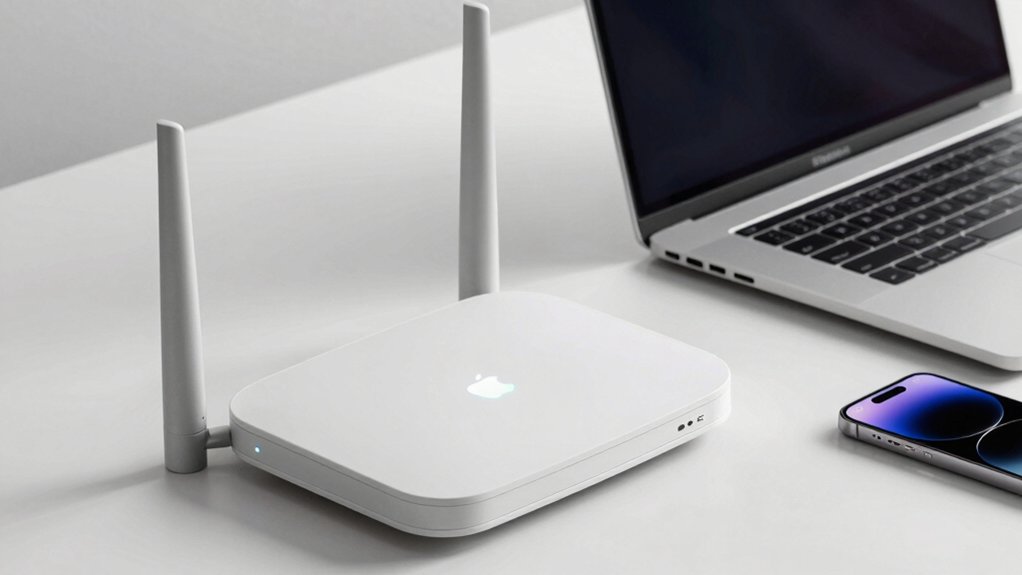
When selecting a WiFi router for your Apple devices, you’ll want to evaluate five key factors: Apple ecosystem compatibility to ensure seamless integration with your devices, Wi-Fi speed and performance standards that match your usage needs, coverage area requirements based on your home or office size, security and privacy features that protect your data, and setup and management ease so you can configure and control your network without technical difficulty. Start by checking whether the router supports the latest Wi-Fi standards and offers native support for Apple’s AirPlay, HomeKit, and iCloud features, then assess the advertised speeds against your internet plan and the square footage you need to cover. Finally, compare the router’s security protocols, such as WPA3 encryption, and the complexity of its mobile app or web interface to determine which option best fits your technical comfort level and household requirements.
Apple Ecosystem Compatibility
Since Apple devices like iPhones, iPads, and Macs rely on specific networking standards to function at their best, you’ll want to prioritize several key features when selecting a router. First, choose a router with WPA3 security support to ensure the strongest protection available for your devices. Second, look for routers offering app-based setup through iPhone or iPad, which streamlines configuration. Third, select multi-band routers—either tri-band or quad-band—to maintain reliable performance during demanding tasks like AirDrop and iCloud syncing. Fourth, consider mesh systems that support Apple-friendly roaming, enabling seamless handoffs as you move between rooms. Finally, verify IPv6 compatibility and robust network security controls to prevent connectivity issues on modern networks. These features work together to optimize your Apple ecosystem’s performance.
Wi-Fi Speed and Performance
Most WiFi routers display speeds as total bandwidth—such as AX1800, AC2200, or WiFi 7 up to 9.3 Gbps—but you’ll need to understand how these numbers actually work. These speeds split across multiple bands: 2.4 GHz offers longer range but slower speeds, while 5 GHz delivers faster speeds over shorter distances. This matters for your Apple devices, which may experience performance drops when moved away from the router. Check whether a router uses dual, tri, or quad bands, as more bands help multiple devices transfer data simultaneously without congestion. Look for technologies like OFDMA and beamforming to improve reliability across your Apple ecosystem. Remember that real-world speeds depend on distance, walls, and interference—not just maximum specifications.
Coverage Area Requirements
How much space does your home cover? Measure your square footage to match it with router coverage ratings. Most mesh systems cover 2,200–4,400 square feet per unit, so calculate whether you need one router or multiple nodes.
For larger homes or multi-story layouts, choose mesh systems with expandable nodes rather than single routers. This approach maintains reliable coverage across all floors without dead zones.
Assess your home’s construction materials. Thick walls and metal construction block signals significantly, requiring additional units or higher-gain antennas to reduce dead zones.
Select a system that supports easy expansion. Adding extra nodes later adapts your coverage as your home layout or device count changes, preventing future coverage gaps without replacing your entire setup.
Security and Privacy Features
Once you’ve confirmed your router covers your home’s layout, you’ll want to examine the security protections it offers your Apple devices. Look for routers that support WPA2 and WPA3 encryption standards, which keep your data scrambled during transmission. Check whether the router includes built-in VPN capabilities using OpenVPN or WireGuard protocols—these protect your traffic on public networks. Verify the manufacturer provides regular security updates and commits to security-by-design principles. Confirm the router has a functioning firewall and IPv6 support to defend against current network threats. Finally, ensure the firmware update process is straightforward with clear instructions, so you can maintain protection without extensive technical knowledge. These features work together to create a secure environment for all your Apple devices.
Setup and Management Ease
Because Apple device users value streamlined workflows, you’ll want to prioritize routers that minimize setup complexity and ongoing management tasks. Look for models offering dedicated mobile apps that guide you through initial configuration step-by-step, eliminating manual IP address entries or complex password protocols. Choose routers supporting automatic firmware updates, which deploy security patches without requiring your intervention. Select devices with intuitive dashboard interfaces where you can manage guest networks, device access controls, and bandwidth allocation directly from your iPhone or iPad. Verify the router displays clear status indicators and notifications about network health. Test whether connecting new Apple devices happens automatically or requires entering additional information. Routers that remember your preferences and sync settings across your devices reduce repetitive configuration work substantially.
Network Device Capacity
What’s your actual device count, and what’ll those devices be doing on your network? Count every iPhone, iPad, Mac, Apple Watch, and Apple TV you own or plan to connect. Next, identify usage patterns: streaming video requires more bandwidth than email, and gaming demands consistent performance. Choose a router rated for at least your device count plus 20 percent extra capacity. Wi-Fi 6 and Wi-Fi 7 routers handle simultaneous connections better through OFDMA and MU-MIMO technologies. Verify WPA3 security support for Apple device compatibility. In busy households with multiple video streams or gaming sessions, prioritize routers advertising efficient multi-device handling over peak speed specs alone. This ensures sustained performance across all connected Apple devices.
Final Thoughts
You’ll want to prioritize routers offering WPA3 security, WiFi 6 or newer standards, and seamless iOS/macOS integration. Evaluate your home’s size to determine if you need a mesh system for consistent coverage. Check each router’s app compatibility and device support. Compare setup processes—Apple users benefit from streamlined installation. Balance performance specs with your budget. Test return policies before purchasing to ensure your choice meets your connectivity needs.

Meet Ry, “TechGuru,” a 36-year-old technology enthusiast with a deep passion for tech innovations. With extensive experience, he specializes in gaming hardware and software, and has expertise in gadgets, custom PCs, and audio.
Besides writing about tech and reviewing new products, he enjoys traveling, hiking, and photography. Committed to keeping up with the latest industry trends, he aims to guide readers in making informed tech decisions.