
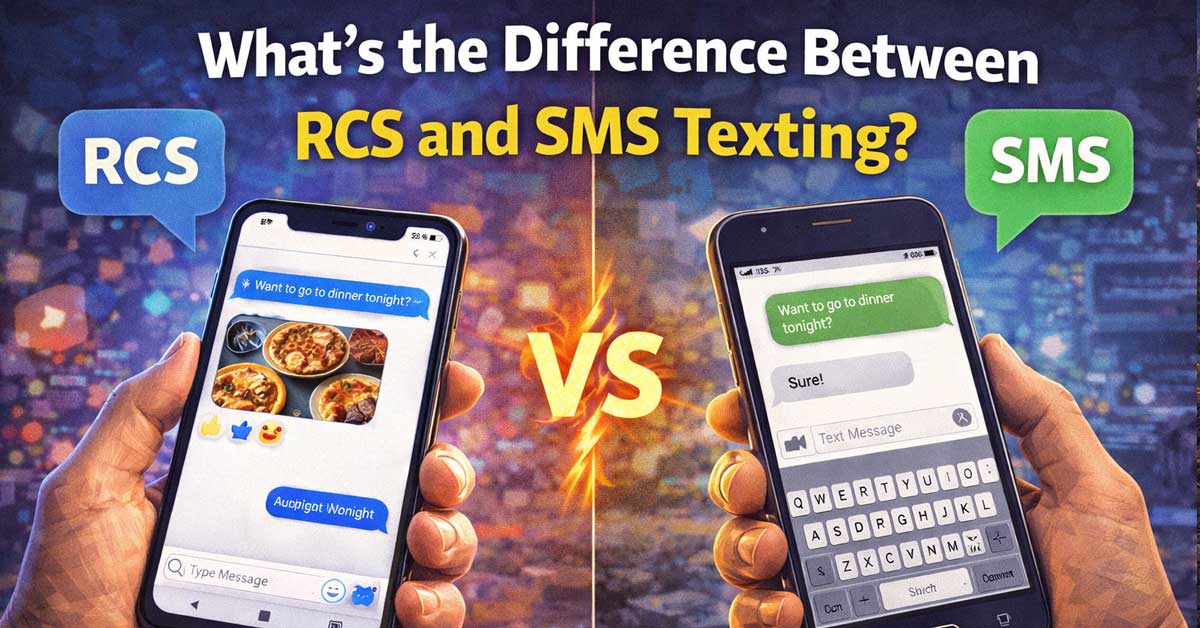

The upgrade that’s been quietly replacing traditional texting — here’s what changed and what it means
If you’ve noticed that some text conversations on your Android phone look richer than others — with read receipts, typing indicators, high-quality photos, and reactions — you’ve already seen RCS in action. If you’ve wondered why iMessage looks so different from a regular text, the same underlying technology gap explains it. SMS has been the foundation of text messaging for decades, and RCS is the modern replacement that’s been slowly rolling out across the industry. Here’s what actually separates them.
SMS: What It Is and Where It Came From
SMS — Short Message Service — was designed in the 1980s and first used commercially in 1992. The technology was built as a lightweight add-on to 2G cellular networks, using small gaps in signaling channels to carry short text messages. It was never intended to become the dominant communication medium it turned out to be.
The constraints baked into SMS reflect its age:
160 character limit per message — longer messages get split into multiple SMS segments and reassembled on the receiving end, which works inconsistently across carriers and devices.
No media support natively — photos and videos require MMS (Multimedia Messaging Service), a separate but related protocol that compresses media heavily and caps file sizes, which is why photos sent as SMS/MMS arrive looking noticeably degraded compared to the originals.
No read receipts. You send a message and have no way of knowing whether it was delivered or read beyond a basic delivered confirmation some carriers provide.
No typing indicators. No way to know the other person is composing a reply.
Carrier-routed. SMS travels through your carrier’s messaging infrastructure, not the internet. This means it works on cellular without data, but it also means carriers control the experience entirely.
No encryption in transit. Standard SMS is not encrypted between carriers. Messages can be intercepted and are visible to carriers and potentially others with network access.
Despite all of this, SMS works on every phone on every carrier in every country. That universal compatibility is why it survived decades past when its technical limitations became obvious.


💙 MAX COMFORT FOR YOUR SERVICE DOG – Superior interior padding of this service dog vest for large breeds provides security and comfort for your emotional support animal or working dog.

RCS: What It Is and How It’s Different
RCS — Rich Communication Services — is a messaging protocol developed to replace SMS with something built for the modern era. Development started in the late 2000s under the GSM Association, the industry body that coordinates mobile standards. The rollout has been slow and complicated by carrier politics, but by the mid-2020s RCS has become the default messaging protocol for Android phones on most major carriers globally.
What RCS actually adds over SMS:
No character limit. Messages are transmitted over data rather than carrier signaling channels, removing the 160-character constraint entirely.
High-quality media. Photos and videos send at full or near-full quality rather than being compressed to the point of degradation. File sizes in the tens of megabytes are supported rather than the MMS cap of around 1MB.
Read receipts. You can see when a message was delivered and when it was read, just like iMessage or WhatsApp.
Typing indicators. The three-dot indicator shows when the other person is composing a reply.
Reactions. Emoji reactions to individual messages, similar to iMessage reactions and those in other modern messaging apps.
Group messaging that actually works. RCS group chats function like modern group chats — members can be added and removed, messages display correctly, and the threading works consistently. SMS group messaging is notoriously unreliable and inconsistent across devices and carriers.
Internet-based transmission. RCS routes through data connections rather than carrier SMS infrastructure, enabling the richer feature set and larger file support.
Encryption — with caveats. Google’s implementation of RCS in Google Messages includes end-to-end encryption for RCS conversations. This is a significant security improvement over SMS. However encryption is not part of the base RCS standard — it’s an implementation choice. More on this below.
The Carrier and Platform Complications
RCS’s rollout has been messier than it should have been, largely because it requires coordination between device manufacturers, carriers, and platform developers — all of whom have competing interests.
For years, carriers implemented their own incompatible versions of RCS that only worked within their own networks. An AT&T RCS user couldn’t exchange RCS messages with a T-Mobile RCS user. This fragmentation significantly slowed adoption.
Google stepped in and built RCS directly into Google Messages with its own Universal Profile implementation that works across carriers and devices without requiring carrier cooperation. This is now the standard Android messaging experience on most devices and carriers in supported markets.
The remaining major gap is Apple. For most of RCS’s existence, Apple refused to support it — keeping iPhones locked to SMS when communicating with Android users, which is why cross-platform conversations showed the degraded experience: no read receipts, compressed photos, the infamous green bubbles.
Apple added RCS support in iOS 18, released in late 2024. This was a significant shift. iPhone and Android users can now exchange RCS messages with read receipts, higher-quality media, and typing indicators — when both devices and carriers support RCS. The green bubble vs. blue bubble distinction still exists in iMessage, but the underlying experience of cross-platform texting improved substantially.
Made from the strongest materials on the market. No more frayed seems or Hook and Loop that won't hold.

![Gotta Get Rich [Explicit]](https://m.media-amazon.com/images/I/51Ux1lFUf4L._SL500_.jpg)
Encryption: Where Things Stand
This is the most important nuance in the RCS picture and the one most commonly glossed over.
Google Messages encrypts RCS conversations end-to-end between Android users — meaning only the sender and recipient can read the messages. This is a meaningful security improvement over SMS.
Cross-platform RCS between iPhone and Android is not end-to-end encrypted as of early 2026. The GSMA standard that governs RCS interoperability between platforms does not yet include end-to-end encryption for cross-platform messages. Apple encrypts iMessage conversations but those are Apple-only. Google encrypts Google Messages RCS conversations but that encryption doesn’t extend across the Apple-Google boundary.
Work is ongoing to establish an encryption standard for cross-platform RCS, but it hasn’t shipped yet. For cross-platform conversations, RCS is more secure than SMS but not end-to-end encrypted — messages are encrypted in transit to the carrier or platform but not protected from the platform provider itself.
If end-to-end encryption for cross-platform messaging matters to you, apps like Signal and WhatsApp provide it regardless of what phone the other person uses.
When SMS Still Sends Instead of RCS
RCS doesn’t always kick in even when both parties theoretically support it. The conversation falls back to SMS when:
The recipient’s carrier doesn’t support RCS. Smaller carriers and MVNOs often haven’t implemented RCS. A message to someone on one of these carriers sends as SMS automatically.
The recipient is in a country where RCS isn’t available. RCS coverage varies by country and carrier internationally.
The recipient has RCS disabled on their device or in their messaging app settings.
You’re on a Wi-Fi call or in a low-data situation where the data connection needed for RCS isn’t reliable.
Most messaging apps handle this fallback automatically without telling you — the message sends, just with SMS limitations. Some apps indicate which protocol is active with a label in the conversation.
RCS vs. iMessage vs. WhatsApp
It’s worth placing RCS in context alongside the other messaging protocols people actually use.
iMessage is Apple’s proprietary messaging system for Apple devices. It’s end-to-end encrypted, feature-rich, and only works between Apple devices. When an iPhone texts an Android phone, it falls back to SMS or now RCS rather than iMessage.
WhatsApp is a cross-platform messaging app owned by Meta. It’s end-to-end encrypted, works on any smartphone, and is the dominant messaging platform in many countries outside the US. It requires both parties to have the app installed and an account.
RCS is a carrier-level protocol built into the default messaging app on Android and now iPhone. It works without installing a separate app and without both parties having the same account on the same platform. It’s the closest thing to a universal upgrade to SMS that doesn’t require everyone to download something new.
The tradeoff is that RCS is more fragmented and less consistently encrypted than dedicated apps like WhatsApp or Signal.
Does Any of This Matter for Regular Users?
For most people, RCS improvements are genuinely noticeable:
Photos and videos you send actually look good on the receiving end rather than arriving as compressed mush. Group chats work reliably. You know when your message was read. You can react to messages without sending a separate reply.
The security improvement matters for anyone who cares about message privacy — RCS between Android devices in Google Messages is encrypted in a way that SMS never was.
The fallback to SMS still happens often enough that you can’t fully rely on RCS features being available in every conversation. The system works best when everyone involved is on a major carrier with RCS support.
Quick Comparison
| SMS | RCS | |
|---|---|---|
| Character limit | 160 per segment | None |
| Photo quality | Heavily compressed | Full or near-full quality |
| Read receipts | No | Yes |
| Typing indicators | No | Yes |
| Reactions | No | Yes |
| Group chat | Unreliable | Works properly |
| Encryption | None in transit | E2E on Android-Android (Google Messages) |
| Works without data | Yes | No |
| Universal compatibility | Yes | Not yet — varies by carrier and country |
The Bottom Line
SMS is a 1980s protocol that the industry has been trying to replace for over a decade. RCS is that replacement — richer features, better media quality, read receipts, real group chats, and encryption on supported platforms. The rollout has been complicated by carrier fragmentation and Apple’s late adoption, but by 2025 and into 2026 RCS has become the default texting experience for most Android users and is now functional between iPhone and Android as well.
The main caveats: fallback to SMS still happens when carriers or recipients don’t support RCS, and cross-platform encryption between iPhone and Android isn’t there yet. For fully encrypted cross-platform messaging, dedicated apps like Signal remain the better choice.
SMS got the world texting. RCS is what texting should have been all along — the industry just took thirty years to get there.

Manifold book with flexible cover 400 Duplicates Safety tint on original (part 1); Yellow carbonless (part 2) Book size - 11" x 7-5/8"; Detached size - "2-3/4" x 7" 4...

Meet Ry, “TechGuru,” a 36-year-old technology enthusiast with a deep passion for tech innovations. With extensive experience, he specializes in gaming hardware and software, and has expertise in gadgets, custom PCs, and audio.
Besides writing about tech and reviewing new products, he enjoys traveling, hiking, and photography. Committed to keeping up with the latest industry trends, he aims to guide readers in making informed tech decisions.