
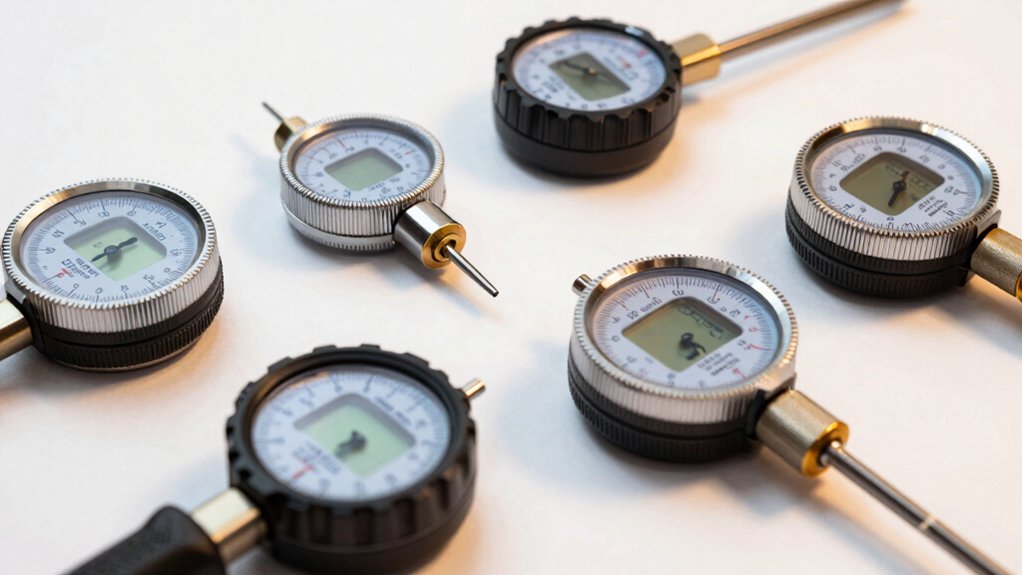

If you’re applying paint coatings in automotive, industrial, or workshop settings, you need reliable tools to measure thickness accurately. Paint coating thickness gauges let you verify that finishes meet specifications and catch application problems before they become costly mistakes. You’ve got several solid options available, each with different features and price points. Here’s what you should know to pick the right gauge for your specific needs.
| Car Coating Thickness Meter for Auto Paint |
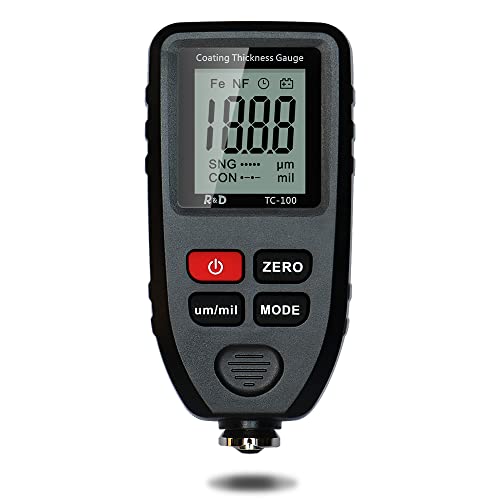
| Best For Used Cars | Measurement Range: Not specified (0–1500 μm implied) | Substrate Detection: Automatic Fe/NFe recognition | Display & Interface: Basic digital display | VIEW LATEST PRICE | Read Our Analysis |
| Paint Thickness Gauge CM-205FN for Cars Digital Meter |

| Most Accurate | Measurement Range: 0–1500 μm (0–59.1 mils) | Substrate Detection: Automatic Fe/NFe detection | Display & Interface: Backlit LCD | VIEW LATEST PRICE | Read Our Analysis |
| Digital Coating Thickness Gauge CM-218 Paint Depth Meter |

| Best All-Around Value | Measurement Range: 0–1300 μm (0–51 mils) | Substrate Detection: Ferrous and non-ferrous detection | Display & Interface: Large color display with LED backlight, 4-way rotation | VIEW LATEST PRICE | Read Our Analysis |
| Digital Coating Thickness Gauge CM-208FN for Steel |

| Professional Grade | Measurement Range: 0–78 mils (0–1980 μm) | Substrate Detection: Automatic Fe/NFe via dual technology | Display & Interface: Single-button operation with statistics mode | VIEW LATEST PRICE | Read Our Analysis |
| Coating Thickness Gauge Industrial-818 with External Probe |

| Industrial Heavy-Duty | Measurement Range: 0–5000 μm Fe / 0–3000 μm NFe | Substrate Detection: Automatic Fe/NFe identification | Display & Interface: Not specified | VIEW LATEST PRICE | Read Our Analysis |
| EC-770SE Professional Coating Thickness Gauge with Probe |
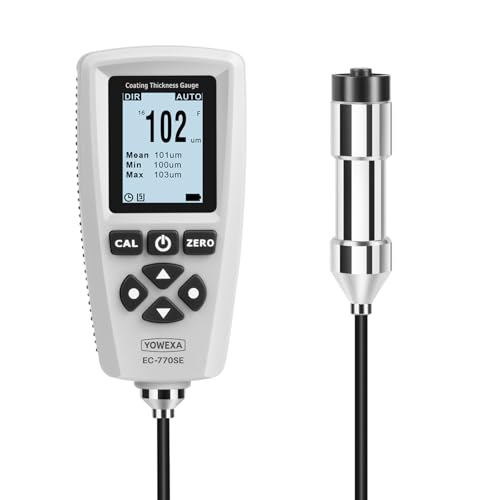
| Best Portable Option | Measurement Range: 0–2000 μm | Substrate Detection: Auto-detect Fe/NFe modes | Display & Interface: Rotating backlit display with alarms | VIEW LATEST PRICE | Read Our Analysis |
| EC-900 Professional Coating Thickness Gauge with USB |

| Most Data Storage | Measurement Range: 0–5000 μm Fe / 0–3000 μm NFe | Substrate Detection: Dual-mode Fe/Non-Fe detection | Display & Interface: Backlit display with auto-shutdown | VIEW LATEST PRICE | Read Our Analysis |
More Details on Our Top Picks
Car Coating Thickness Meter for Auto Paint
Are you buying a used car and want to spot hidden repairs or previous accidents before you commit? The RDINSCOS Car Coating Thickness Meter detects paint thickness on steel and aluminum surfaces automatically. You measure each panel systematically, comparing readings across the vehicle. Uniform thickness indicates original factory paint, while variations suggest repainting or repairs. The device includes a 9V battery, storage bag, user manual, calibration substrates, and foil for immediate use. It weighs 180 grams and fits easily in your palm. The three-year replacement warranty backs your purchase without questions asked. This meter helps you avoid overpaying for vehicles with hidden damage.
- Measurement Range:Not specified (0–1500 μm implied)
- Substrate Detection:Automatic Fe/NFe recognition
- Display & Interface:Basic digital display
- Data Storage & Export:None
- Resolution:Not specified
- Power Source:9V battery
- Additional Feature:Three-year replacement warranty
- Additional Feature:Automatic substrate recognition
- Additional Feature:Includes calibration substrates
Paint Thickness Gauge CM-205FN for Cars Digital Meter
The CM-205FN serves professionals who need fast, accurate paint readings on vehicle metal surfaces without switching between tools. You’ll measure coatings from 0–1500 μm with ±(3% + 2 μm) accuracy using automatic Fe/NFe detection. Simply place the gauge on doors, hoods, fenders, or quarter panels; it identifies the substrate and applies the correct measurement technology. Use single-point mode for spot checks or continuous mode for scanning multiple areas quickly. The backlit LCD displays results instantly. Calibrate using included plates before starting inspections. You can’t measure plastic bumpers or composites—only metal surfaces.
- Measurement Range:0–1500 μm (0–59.1 mils)
- Substrate Detection:Automatic Fe/NFe detection
- Display & Interface:Backlit LCD
- Data Storage & Export:None
- Resolution:0.1 μm
- Power Source:Not specified
- Additional Feature:Dual scanning modes available
- Additional Feature:Backlit LCD display
- Additional Feature:Professional carrying case included
Digital Coating Thickness Gauge CM-218 Paint Depth Meter
If you’re measuring paint depth across automotive, industrial, or workshop settings, you’ll find the CM-218 delivers the precision you need in a compact, user-friendly package. The gauge reads from 0–51 mils with 0.01 mil resolution and displays results in both mils and microns. It detects ferrous and non-ferrous substrates like steel, aluminum, and iron. The color display rotates 360 degrees for easy viewing from any angle. Store up to 1,500 readings across 100 groups using the smart memory function. The rechargeable 1000 mAh battery charges via USB, powering all-day fieldwork sessions.
- Measurement Range:0–1300 μm (0–51 mils)
- Substrate Detection:Ferrous and non-ferrous detection
- Display & Interface:Large color display with LED backlight, 4-way rotation
- Data Storage & Export:1500 readings across 100 groups
- Resolution:0.01 mil
- Power Source:Built-in rechargeable 1000 mAh battery with USB charging
- Additional Feature:Four-way rotatable display
- Additional Feature:Stores 1500 readings maximum
- Additional Feature:Rechargeable built-in battery
Digital Coating Thickness Gauge CM-208FN for Steel
Want to verify paint thickness accurately without damaging automotive surfaces or industrial coatings? The CM-208FN automatically detects whether you’re measuring steel or aluminum using magnetic induction and eddy current technology. Simply place the ruby-tip probe on the surface and press the button. You’ll receive readings in mils, microns, or millimeters within seconds. The gauge offers ultra-fine resolution: 0.001 mils for thin coatings and 0.1 mils for thicker applications. Use statistics mode to track average, minimum, and maximum measurements across multiple panels. Calibrate quickly with zero calibration and foil set. Connect via USB to export data for documentation and quality control analysis.
- Measurement Range:0–78 mils (0–1980 μm)
- Substrate Detection:Automatic Fe/NFe via dual technology
- Display & Interface:Single-button operation with statistics mode
- Data Storage & Export:USB connectivity for data export
- Resolution:0.001–0.1 mils (variable range)
- Power Source:Not specified
- Additional Feature:Ruby-tip probe included
- Additional Feature:Statistics mode for QC
- Additional Feature:USB PC connectivity
Coating Thickness Gauge Industrial-818 with External Probe
For industrial coating inspections on curved surfaces, welded joints, and hard-to-reach components, you’ll want to contemplate the Industrial-818 with its external precision probe. This gauge automatically identifies ferrous and non-ferrous substrates, eliminating manual setup. It measures up to 197 mil on steel and 120 mil on non-ferrous materials with 0.001 mil resolution. The ruby-tipped probe contacts delicate surfaces without damage. Store 2000 readings and export data via USB for quality documentation. Operating between -10°C and +50°C, it withstands industrial environments. Use factory, zero, or multi-point calibration to ensure accuracy across your production line.
- Measurement Range:0–5000 μm Fe / 0–3000 μm NFe
- Substrate Detection:Automatic Fe/NFe identification
- Display & Interface:Not specified
- Data Storage & Export:2000 measurements with USB export
- Resolution:0.001 mil
- Power Source:Not specified
- Additional Feature:External precision probe
- Additional Feature:Measures 0–5000 μm
- Additional Feature:Multi-point calibration supported
EC-770SE Professional Coating Thickness Gauge with Probe
The EC-770SE delivers the measurement range and dual-technology capability you’ll need for all-encompassing paint inspections across ferrous and non-ferrous surfaces. You’ll access 0–2000 µm readings with ±(2%+1 µm) accuracy using magnetic induction for steel or eddy current for aluminum and copper substrates. The external ruby-tipped probe reaches curved and recessed areas reliably. You can store 2000 readings across four groups, then export data via USB for documentation. Four-point calibration accommodates various coating types. Switch between µm, mm, and mil units based on your requirements. The IP40-rated housing withstands workshop conditions effectively.
- Measurement Range:0–2000 μm
- Substrate Detection:Auto-detect Fe/NFe modes
- Display & Interface:Rotating backlit display with alarms
- Data Storage & Export:2000 readings in four groups with USB export
- Resolution:Not specified
- Power Source:Not specified
- Additional Feature:High/low limit alarms
- Additional Feature:Four-group memory organization
- Additional Feature:IP40-rated housing
EC-900 Professional Coating Thickness Gauge with USB
If you’re measuring coatings on both ferrous and non-ferrous surfaces across automotive, marine, and industrial applications, you’ll need a dual-mode gauge that handles diverse materials without switching instruments. The EC-900 Professional Coating Thickness Gauge delivers this capability with electromagnetic induction for ferrous metals up to 5000 μm and eddy current for non-ferrous materials up to 3000 μm. Its external ruby probe resists wear during repeated measurements. Store 2000 data sets and export results via USB for quality tracking and trend analysis. The IP40 housing protects against dust and humidity in demanding work environments. Zero and multi-point calibration ensure measurement accuracy across curved surfaces with 5 mm convex and 25 mm concave capabilities.
- Measurement Range:0–5000 μm Fe / 0–3000 μm NFe
- Substrate Detection:Dual-mode Fe/Non-Fe detection
- Display & Interface:Backlit display with auto-shutdown
- Data Storage & Export:2000 data sets with USB export
- Resolution:0.1 μm
- Power Source:3×AAA batteries
- Additional Feature:Detachable external probe
- Additional Feature:Measures curved surfaces
- Additional Feature:IP40 dust protection
Factors to Consider When Choosing a Paint Coating Thickness Gauge
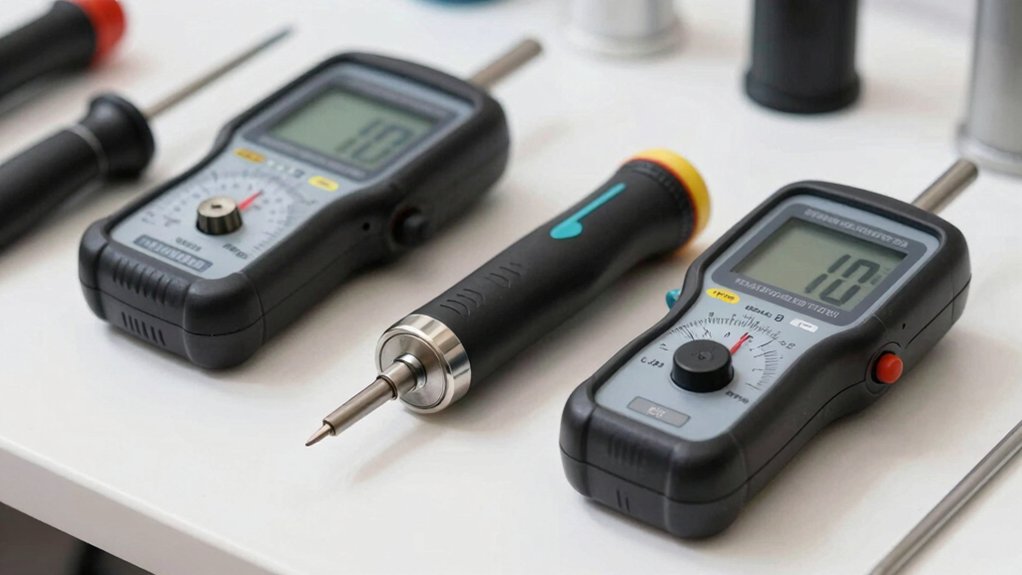
When you’re selecting a paint coating thickness gauge, you’ll need to evaluate five critical factors that directly affect your measurement accuracy and work efficiency. First, check the measurement range and resolution to ensure the gauge covers your project’s thickness requirements, then verify substrate type compatibility so you can measure on steel, aluminum, or composite surfaces you’ll encounter. Next, confirm the gauge has reliable calibration features and accuracy specifications, review its data storage and connectivity options for documenting results, and finally assess durability ratings and operating conditions to guarantee it’ll withstand your job site environment.
Measurement Range and Resolution
Most paint coating thickness gauges you’ll encounter offer measurement ranges and resolutions that directly affect their accuracy on your specific projects. Measurement range determines the maximum thickness your gauge can read—ferrous substrates typically reach 0–5000 μm, while non-ferrous materials max out around 0–3000 μm. Resolution indicates the smallest increment the device distinguishes, such as 0.01 mils or 0.1 μm. For thin coatings, select higher-resolution gauges like 0.001 mils to differentiate subtle thickness variations. Dual-technology models using magnetic induction for ferrous and eddy current for non-ferrous materials let you measure across wide thickness spectrums with one instrument. Match your gauge’s range and resolution to your coating thickness requirements before purchasing.
Substrate Type Compatibility
Which surfaces’ll your gauge need to measure? Start by identifying your substrate materials: steel, iron, aluminum, copper, or other metals. Gauges work exclusively on metal surfaces and won’t function on plastic, fiberglass, carbon fiber, composites, or wood.
Next, check whether you’ll measure on ferrous or non-ferrous substrates. Most modern gauges automatically detect and switch between these using magnetic induction and eddy current methods, eliminating manual selection. This automatic recognition streamlines your workflow on mixed surfaces.
Then verify measurement ranges match your needs. Ferrous substrates typically support thicker coatings, often reaching several thousand micrometers. Non-ferrous ranges differ significantly, so consult your device’s specifications.
Finally, consider challenging surfaces. Choose gauges with external ruby-tip probes and multi-point calibration for reliable readings on curved areas or painted-over joints where accuracy matters most.
Calibration and Accuracy Features
How accurate does your gauge need to be for your specific applications? Your choice depends on two key features: calibration options and accuracy specifications.
Select zero calibration for basic adjustments or multi-point calibration when you’re working across different coatings and substrates. Multi-point calibration using reference plates or foils gives you better precision across varied surfaces.
Check the accuracy rating, typically stated as a percentage plus a micron increment—for example, ±(3% + 2 μm). This combination determines your measurement traceability and reading repeatability. A tighter specification ensures consistent, reliable data for quality control documentation.
Verify the resolution your gauge offers. Options range from 0.01 mils to 0.001 mils, determining the finest coating thickness you can detect. Match these specifications to your project requirements before purchasing.
Data Storage and Connectivity
Two critical features—memory capacity and data export options—distinguish gauges that work for single-point projects from those that support ongoing quality control programs. Look for models storing 1500 to 2000+ data points, allowing you to collect readings across multiple surfaces before downloading. USB export capability lets you transfer measurements directly to your computer for reporting and archiving purposes. Some gauges organize data into separate groups and calculate statistics including mean, minimum, maximum, and standard deviation automatically. This functionality streamlines batch analysis and trend tracking without manual computation. When selecting a gauge, confirm it offers both sufficient memory for your project scope and compatible export methods matching your reporting systems.
Durability and Operating Conditions
When you’re selecting a paint coating thickness gauge for workshop or field use, durability and operating conditions directly affect measurement reliability and equipment lifespan.
Check the IP rating first. An IP40 rating protects against dust and moisture, essential for workshop environments. Next, verify the operating temperature range—typically -10°C to 50°C—ensuring accurate readings across seasonal changes and geographic locations.
Examine the housing construction. Rugged ABS plastic with protective rubber covers resists drops and impacts during daily use. Look for a durable ruby-tip external probe that maintains stable contact on curved or recessed surfaces without degrading.
Finally, confirm power options. Rechargeable batteries support extended field sessions without frequent replacements. These durability features prevent measurement errors and extend your equipment’s working life significantly.
Price and Warranty Protection
What’s your total investment when you purchase a paint coating thickness gauge? You’ll need to compare unit prices across all models and calculate the real cost by including warranty coverage. Look for gauges with multi-year warranties, such as three-year replacement plans, since they reduce your future repair expenses. Check what accessories come standard with each model—calibration plates, probes, and USB data transfer capabilities—because purchasing these separately increases your total ownership cost. Review warranty terms carefully to confirm they cover automatic substrate detection and calibration accuracy, which directly affect long-term reliability. Evaluate memory capacity and data export options, as these features impact your post-inspection reporting efficiency. By examining these factors systematically, you’ll identify which gauge delivers the best value for your specific budget and operational needs.
Final Thoughts
You’ve reviewed seven professional paint coating thickness gauges designed for automotive, industrial, and workshop use. Each meter offers automatic substrate detection, precise measurements, and data storage capabilities. Select your gauge based on your specific needs: ferrous metals, non-ferrous metals, or both. Consider measurement range, resolution accuracy, and probe type. Calibrate your chosen meter with provided plates or foils before each use to ensure reliable, consistent readings throughout your projects.

Meet Ry, “TechGuru,” a 36-year-old technology enthusiast with a deep passion for tech innovations. With extensive experience, he specializes in gaming hardware and software, and has expertise in gadgets, custom PCs, and audio.
Besides writing about tech and reviewing new products, he enjoys traveling, hiking, and photography. Committed to keeping up with the latest industry trends, he aims to guide readers in making informed tech decisions.