
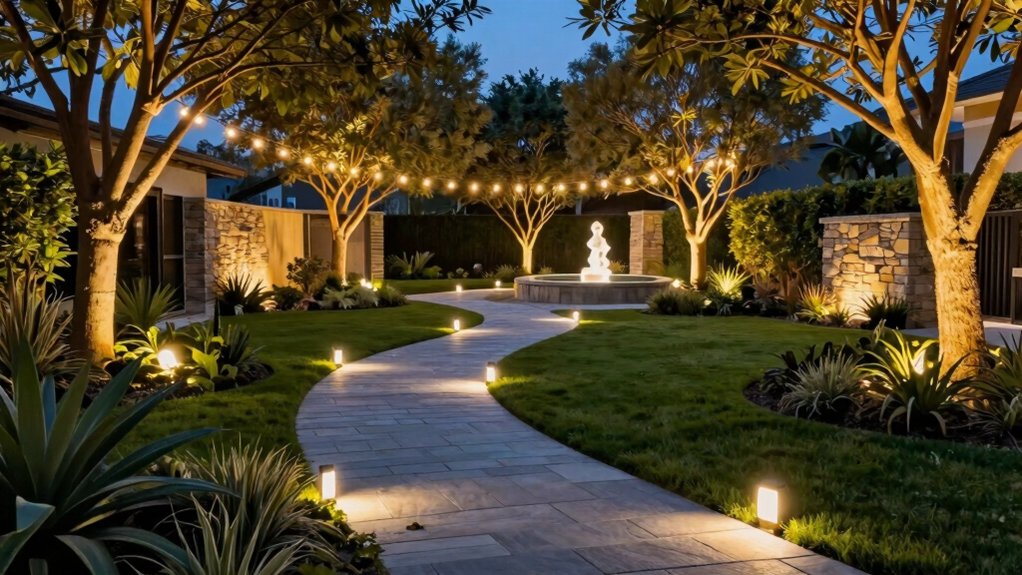

You’ll transform your outdoor space by selecting a garden lighting system that matches your specific needs. Start by identifying your priorities: do you need pathway safety, ambiance, or accent lighting? Consider your budget, climate conditions, and installation preferences next. Solar-powered options require no wiring, while electric systems offer brighter output. Each choice involves tradeoffs between cost, brightness, and maintenance—factors that’ll determine your satisfaction once darkness falls.
| DERAYSION 12 Pack Solar Pathway Lights Waterproof |

| Best Overall | Power Source: Solar-powered | Light Type: LED warm white | Installation Method: In-ground stake mount | VIEW LATEST PRICE | Read Our Analysis |
More Details on Our Top Picks
DERAYSION 12 Pack Solar Pathway Lights Waterproof
Why’d you choose solar pathway lights for your outdoor spaces? The DERAYSION 12-pack delivers practical outdoor illumination without electricity costs. Installation requires only staking the lights into ground—no wiring necessary. Each light measures 3.6 x 3.6 x 15 inches and features an automatic dusk-to-dawn sensor that activates at nightfall and deactivates at sunrise. The warm white LEDs produce 10 lumens of brightness, suitable for pathways, yards, and driveways. Weather-resistant plastic construction withstands rain, wind, and sun exposure. Solar charging during daylight hours powers continuous nighttime illumination. The 1-year manufacturer warranty and 30-day return guarantee protect your investment. Arrange all 12 lights along your garden perimeter for consistent landscape lighting coverage.
- Power Source:Solar-powered
- Light Type:LED warm white
- Installation Method:In-ground stake mount
- Weather Resistance:Waterproof and weather-resistant
- Automation:Automatic dusk-to-dawn sensor
- Quantity Per Set:12-pack
- Additional Feature:Warm white cozy ambiance
- Additional Feature:Dusk-to-dawn automatic sensor
- Additional Feature:No wiring required installation
Factors to Consider When Choosing Garden Lighting Systems
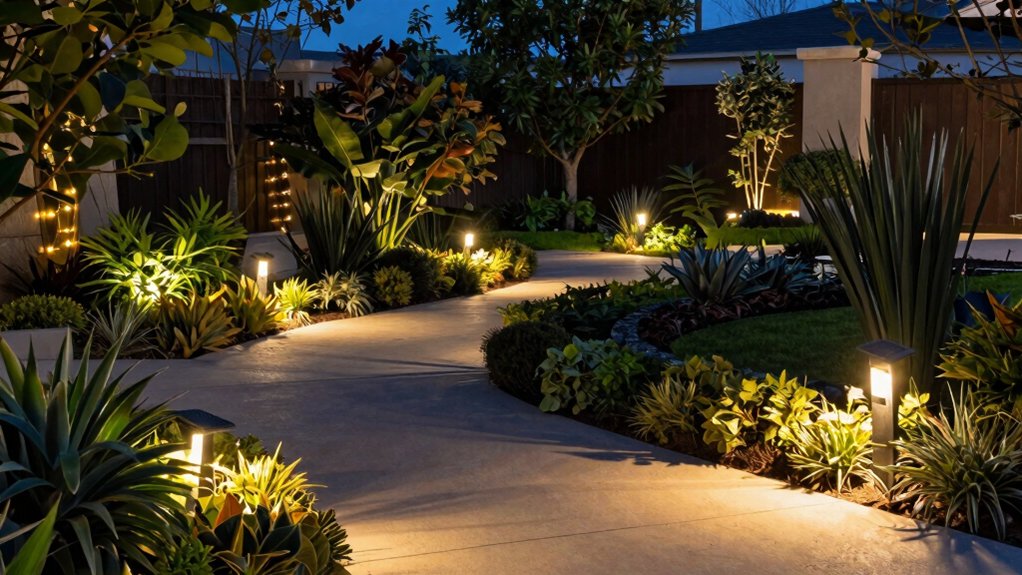
You’ll need to evaluate five key factors before selecting your garden lighting system: budget and cost considerations, weather resistance and durability, light brightness and quality, installation and maintenance requirements, and power source and energy efficiency. Start by determining how much you can spend, then assess whether the lights can withstand your local climate conditions and how bright you need them to be. Finally, compare the installation complexity, upkeep demands, and energy costs of solar, LED, or traditional electric options to match your needs and resources.
Budget and Cost Considerations
When selecting a garden lighting system, you’ll need to evaluate multiple cost factors to make a smart investment decision. First, calculate your total upfront costs by adding fixture prices, installation fees, and required accessories together. Next, determine ongoing operating expenses by comparing electricity usage for wired systems against solar charging costs. Factor in bulb replacement and maintenance expenses for your chosen system. Then, assess the durability-to-cost ratio by reviewing warranty length and expected lifespan. Consider your climate’s impact on solar efficiency and performance during cloudy seasons. Finally, identify potential savings from energy-efficient features like dusk-to-dawn sensors that reduce wasteful operation. This all-encompassing cost analysis helps you compare systems accurately and select the option that provides the best long-term value for your specific budget and garden needs.
Weather Resistance and Durability
After you’ve settled on a budget that fits your needs, the next step is ensuring your lighting investment can withstand outdoor conditions year-round. Check the IP rating on fixtures you’re considering—IP44 offers basic splash protection, while IP65 provides full dust and water resistance suitable for harsh environments. Select materials carefully: UV-rated plastics resist fading and cracking, and corrosion-resistant metals like stainless steel or aluminum last longer in wet climates. Examine the housing for sealed designs and gasketed connections that prevent moisture from entering electrical components and damaging LEDs. Finally, verify temperature tolerance specifications. Fixtures rated for extreme heat or cold maintain reliable performance throughout seasonal changes. These durability factors directly extend your system’s lifespan and reduce replacement costs over time.
Light Brightness and Quality
How do you know which brightness level suits your garden’s needs? Start by measuring lumens, which indicate total light output. Higher lumens create brighter illumination, while lower lumens provide softer lighting. Next, consider color temperature in kelvin. Warm light at 2700–3000K establishes a relaxing mood, whereas cool light at 5000K+ improves visibility for work areas. Evaluate your fixture’s LED efficiency and wattage to determine brightness per unit of power consumed. More efficient LEDs deliver greater lumens while using less energy. Then assess beam angle and fixture design, since narrow beams concentrate light on specific spots, while wide beams distribute light across larger areas. Finally, install motion-sensing or dusk-to-dawn controls to adjust brightness timing and intensity based on your actual needs.
Installation and Maintenance Requirements
What’s your garden’s power source and accessibility like? Solar-powered lights eliminate wiring and electricity needs, but you’ll need adequate sun exposure and sufficient battery capacity for nightly illumination. For installation, choose between in-ground stakes or mounting options based on your stability requirements. Some designs require no tools, while others need basic hardware. Automatic dusk-to-dawn sensors reduce energy use by controlling when lights activate, which also influences your battery maintenance schedule. Weather resistance matters markedly—select waterproof and wind-rated fixtures to extend longevity and reduce replacement frequency. Finally, consider modular or replaceable components like bulbs, solar panels, and batteries. This approach lets you replace individual parts without discarding entire units, lowering long-term costs and environmental impact.
Power Source and Energy Efficiency
Once you’ve determined your installation method and maintenance capacity, the power source you select will shape your system’s long-term performance and operating costs. Solar-powered lights use photovoltaic cells to convert sunlight into stored electrical energy, eliminating ongoing electricity bills. Dusk-to-dawn sensors automate operation, turning lights on at sunset and off at sunrise to conserve energy. Battery performance depends on sun exposure, panel quality, and weather resistance, which determine how long lights operate each night. Path lights typically use low-output options around 10 lumens for ambient illumination while maximizing efficiency. In-ground stake installations avoid wiring entirely, reducing installation energy use. Compare battery capacity ratings and charge times to match your outdoor space’s lighting needs and climate conditions.
Design and Aesthetic Appeal
Why shouldn’t your garden lighting match your outdoor décor style? It won’t create visual cohesion with your landscape. Select fixtures that align with your aesthetic—minimalist or ornate—to establish consistency throughout your yard.
Next, evaluate luminaire shape, color temperature, and finish. Choose warm white lighting between 2700–3000K to establish inviting ambiance. Match the finish to existing outdoor elements like metal railings or stone pathways.
Then, vary your fixture heights and widths strategically. Position taller lights along boundaries and shorter fixtures near planting beds to highlight architectural features and guide foot traffic.
Finally, prioritize weather-resistant materials suited to your climate. Select fixtures with integrated glare control or shielding to prevent harsh light. These details ensure your lighting enhances nighttime aesthetics while remaining durable and functional year-round.
Coverage Area and Placement Options
How you position your garden lights directly determines how much space you’ll illuminate and whether that light reaches the areas you actually need. Start by mapping your landscape—identify walkways, driveways, and focal points that require lighting. Choose in-ground stakes for pathway illumination, wall-mounted fixtures for perimeter definition, or elevated mounts for highlighting specific features. Space lights closer together for uniform brightness and fewer dark spots, though this increases fixture count and cost. Evaluate beam angles: narrow beams concentrate light on specific areas, while wide beams cover broader zones. Select placement based on your layout’s demands. Higher-lumen lights extend coverage farther, so match wattage to your space size. Account for color temperature to avoid glare and ensure even, functional illumination throughout your outdoor area.
Final Thoughts
When you’re selecting garden lighting, you’ll want to evaluate your budget, durability needs, and desired brightness level. The DERAYSION 12-pack offers an affordable, weather-resistant option requiring no wiring. Compare it against your coverage area and aesthetic preferences. Install lights along pathways at regular intervals, ensure solar panels receive direct sunlight, and check dusk-to-dawn sensors work properly. This approach transforms your outdoor space efficiently and affordably.

Meet Ry, “TechGuru,” a 36-year-old technology enthusiast with a deep passion for tech innovations. With extensive experience, he specializes in gaming hardware and software, and has expertise in gadgets, custom PCs, and audio.
Besides writing about tech and reviewing new products, he enjoys traveling, hiking, and photography. Committed to keeping up with the latest industry trends, he aims to guide readers in making informed tech decisions.