
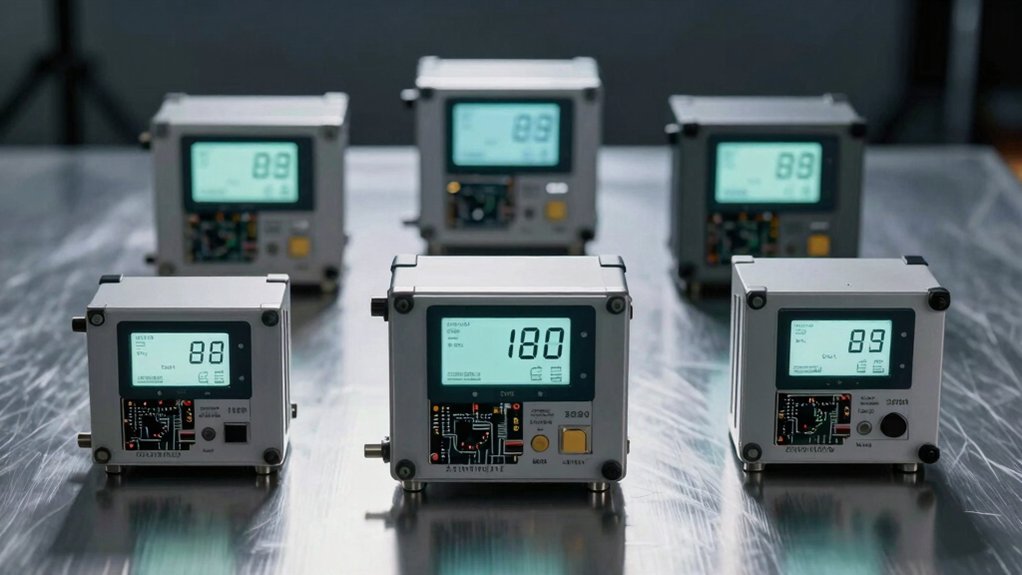

When you need precision temperature control, you’ll want a controller that matches your specific equipment and sensors. You can select from five proven models that engineers depend on for reliability across industrial applications like kilns, furnaces, and packaging systems. Each offers distinct features—auto-tuning capabilities, dual displays, and flexible output options—that’ll determine how well it performs in your setup. Understanding what each controller delivers will help you make the best choice for your needs.
| Inkbird PID Temperature Controller Kit with SSR Relay |
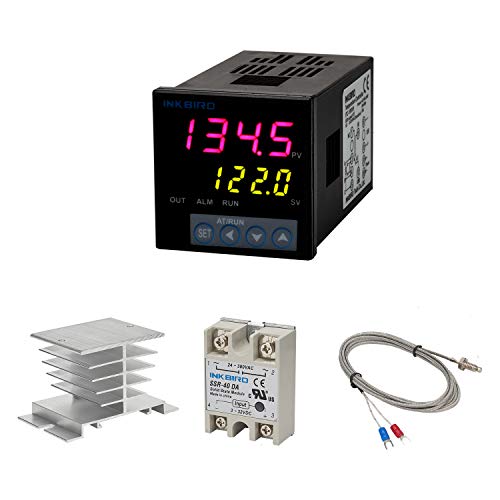
| Best Overall | Temperature Sensor Type: K-type thermocouple | Display Type: LED dual-window (Celsius/Fahrenheit) | Relay/SSR Output: SSR output for external SSR; 1 alarm relay output (AC250V, 3A) | VIEW LATEST PRICE | Read Our Analysis |
| PID Temperature Controller Kit with SSR Relay |
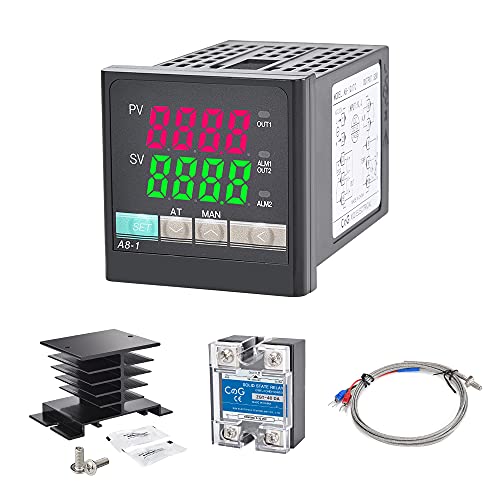
| Most Versatile | Temperature Sensor Type: K, E, J, N, W3-25, W5-26 thermocouples; PT100; Cu50 | Display Type: LED dual-window (Celsius/Fahrenheit) | Relay/SSR Output: SSR output for external SSR; 1 alarm relay output (AC220V/DC30V, 3A) | VIEW LATEST PRICE | Read Our Analysis |
| PID Temperature Controller Industrial Automation Meter with Thermocouple |

| Professional Grade | Temperature Sensor Type: K-type thermocouple; universal input (K, J, E, S, I, Pt100, Cu50) | Display Type: Dual LED (Celsius/Fahrenheit) | Relay/SSR Output: 1 SSR control output (24V, 40mA DC); 1 alarm relay output (AC250V/DC30V, 3A) | VIEW LATEST PRICE | Read Our Analysis |
| Digital PID Temperature Controller REX-C100 with Thermocouple |
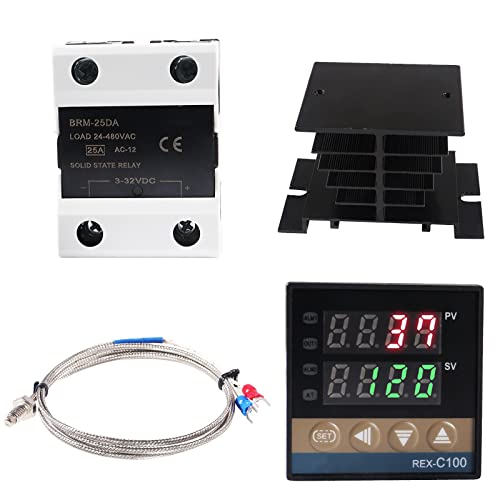
| Industrial Expert | Temperature Sensor Type: K-type thermocouple | Display Type: Not specified | Relay/SSR Output: 25DA SSR relay | VIEW LATEST PRICE | Read Our Analysis |
| PID Temperature Controller with LCD Display & Dual Output |
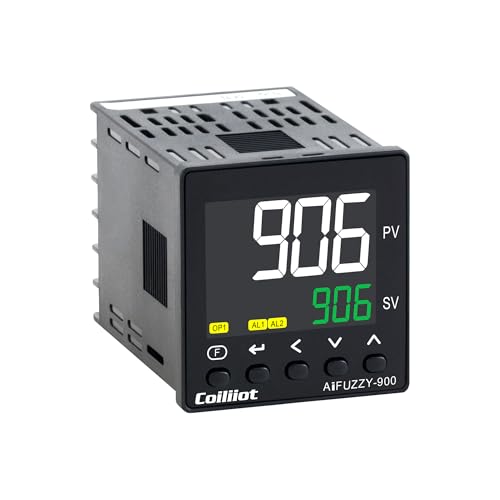
| Best Value | Temperature Sensor Type: K, E, J, N thermocouples; PT100; Cu50 | Display Type: LCD dual-display (Celsius/Fahrenheit) | Relay/SSR Output: Dual outputs (relay and SSR); dual alarm output; up to 5A resistive load | VIEW LATEST PRICE | Read Our Analysis |
More Details on Our Top Picks
Inkbird PID Temperature Controller Kit with SSR Relay
If you’re looking for a complete PID control system that doesn’t require additional purchases, the Inkbird PID Temperature Controller Kit delivers everything you need in one package. You get the controller, SSR 40DA relay, K-type thermocouple, and heat sink included. The unit operates on 100–240 volts AC and features dual LED temperature displays showing both current temperature and setpoint simultaneously in Celsius or Fahrenheit. You can connect 3-wire or 2-wire K-type thermocouples or Cu500 sensors. The alarm output provides 250 volts AC at 3 amps for resistive loads, configurable as normally open or closed. Weighing 0.4 kilograms with compact dimensions, this controller fits laboratory and industrial applications where precise temperature management matters.
- Temperature Sensor Type:K-type thermocouple
- Display Type:LED dual-window (Celsius/Fahrenheit)
- Relay/SSR Output:SSR output for external SSR; 1 alarm relay output (AC250V, 3A)
- Input Voltage:AC 100-240V
- Included Accessories:SSR 40DA, K-type thermocouple, white heat sink
- Control Technology:Standard PID control
- Additional Feature:Simultaneous dual temperature display windows
- Additional Feature:Alarm relay output (AC250V, 3A)
- Additional Feature:Compact 3.5″ x 1.88″ dimensions
PID Temperature Controller Kit with SSR Relay
The CGELE PID Temperature Controller Kit stands out when you need reliable temperature regulation across industrial and laboratory applications. This kit includes a digital controller, SSR 40DA solid state relay, K-type thermocouple sensor, and heat sink. You’ll operate it on AC 100–240V power. The dual display windows show both real-time temperature and your setpoint simultaneously in Celsius or Fahrenheit. You can connect 3-wire or 2-wire sensors supporting multiple thermocouple types, PT100, or Cu50. One alarm relay output lets you trigger a buzzer or external device when temperatures exceed limits. The SSR output controls external equipment through relay switching.
- Temperature Sensor Type:K, E, J, N, W3-25, W5-26 thermocouples; PT100; Cu50
- Display Type:LED dual-window (Celsius/Fahrenheit)
- Relay/SSR Output:SSR output for external SSR; 1 alarm relay output (AC220V/DC30V, 3A)
- Input Voltage:AC 100-240V
- Included Accessories:SSR 40DA, K-type thermocouple, black heat sink
- Control Technology:Standard PID control
- Additional Feature:Supports six thermocouple types
- Additional Feature:Selectable Celsius/Fahrenheit display
- Additional Feature:Buzzer-capable alarm output
PID Temperature Controller Industrial Automation Meter with Thermocouple
Which industrial processes demand both accuracy and versatility in temperature management? The Jaybva PID controller handles espresso machines, kilns, furnaces, and packaging equipment through its universal input design. You’ll connect K-type thermocouples, RTD sensors, or 4-20mA signals directly to the unit. The dual LED display shows readings in both Celsius and Fahrenheit simultaneously. You mount it in a standard 48mm DIN panel cutout, then activate the auto-tuning function by holding the blue button to calibrate PID parameters automatically. Configure your setpoint, then use the relay output for heating or the SSR control voltage for solid-state relays. The alarm output triggers at 250V/3A AC when temperature deviates from your target range.
- Temperature Sensor Type:K-type thermocouple; universal input (K, J, E, S, I, Pt100, Cu50)
- Display Type:Dual LED (Celsius/Fahrenheit)
- Relay/SSR Output:1 SSR control output (24V, 40mA DC); 1 alarm relay output (AC250V/DC30V, 3A)
- Input Voltage:AC/DC 100-240V
- Included Accessories:K-type thermocouple (2m cable), mounting hardware
- Control Technology:PID with auto-tuning (AT function)
- Additional Feature:Built-in auto-tuning (AT) function
- Additional Feature:DIN 1/16 form-factor mounting
- Additional Feature:Universal input signals (4-20mA/0-10V)
Digital PID Temperature Controller REX-C100 with Thermocouple
When you’re operating industrial equipment that demands reliable temperature management without constant manual adjustment, the REX-C100 digital PID controller delivers self-tuning precision for applications ranging from chemical processing to food production. This controller combines a K-type thermocouple probe with a 25DA solid state relay for accurate readings and responsive heating control. The aluminum heat sink prevents SSR overheating, while alloy silver contacts ensure low resistance and stable operation. You’ll benefit from fast response times, minimal temperature overshoot, and multiple functions including thermostatic control, temperature alarms, and switching capabilities. Installation’s straightforward on single-phase systems under 10A, making the REX-C100 ideal for injection molding, packaging, incubators, and ovens.
- Temperature Sensor Type:K-type thermocouple
- Display Type:Not specified
- Relay/SSR Output:25DA SSR relay
- Input Voltage:Not specified
- Included Accessories:K-type thermocouple probe, black heat sink
- Control Technology:Expert self-tuning PID technology
- Additional Feature:Pure aluminum heat sink base
- Additional Feature:Alloy silver contact SSR relay
- Additional Feature:Expert self-tuning PID technology
PID Temperature Controller with LCD Display & Dual Output
Need precise temperature control with built-in redundancy and flexibility? The Coiliiot PID Temperature Controller offers dual outputs—relay and SSR—so you’re not locked into one control method. You’ll get an LCD display showing your readings and setpoint, with °C/°F switching available. The controller accepts K, E, J, or N thermocouples, plus PT100 and Cu50 RTDs, giving you sensor options. It handles up to 5A resistive loads directly without extra equipment, making it suitable for ovens, kilns, and coffee machines. Auto-tuning PID keeps temperatures stable and responsive. The package includes a K-type thermocouple and mounting bracket for 1/16 DIN panels. Dual alarm outputs alert you to temperature deviations, providing the redundancy you need for critical applications.
- Temperature Sensor Type:K, E, J, N thermocouples; PT100; Cu50
- Display Type:LCD dual-display (Celsius/Fahrenheit)
- Relay/SSR Output:Dual outputs (relay and SSR); dual alarm output; up to 5A resistive load
- Input Voltage:AC 100-240V
- Included Accessories:K-type thermocouple, mounting bracket (SSR not included)
- Control Technology:Auto-tuning PID
- Additional Feature:Dual relay and SSR outputs
- Additional Feature:Direct 5A resistive load support
- Additional Feature:Dual alarm output capability
Factors to Consider When Choosing PID Controllers
You must evaluate your application’s temperature range needs and match them to the controller’s specifications, then confirm the controller supports your sensor type—whether you’re using thermocouples, RTDs, or thermistors. Next, you’ll examine the output configuration options available, such as relay, SSR, or analog outputs, to ensure they’re compatible with your heating or cooling equipment. Finally, you should assess the display quality and interface usability for your operating environment, plus verify that the voltage and power requirements align with your facility’s electrical system.
Temperature Range Compatibility
Because your process demands precise control across varying thermal conditions, temperature range compatibility stands as a critical factor when selecting a PID controller. First, identify your application’s minimum and maximum temperatures—whether you’re monitoring -199°C or reaching 1800°C. Next, match the controller’s input type to your sensor: thermocouples (TC) for extreme ranges, resistance temperature detectors (RTD) for moderate precision, or analog signals like 4-20mA and 0-10V for specific equipment. Then, verify the controller’s output stages align with your load requirements—relay outputs handle basic switching while solid-state relays (SSR) manage sensitive loads. Finally, consider dual-display designs if you’re tracking both real-time temperature and setpoints across broad ranges. This systematic approach ensures your controller won’t create bottlenecks in performance.
Sensor Type Support
Once you’ve matched your controller’s temperature range to your process conditions, the next step involves confirming that it’ll actually read your sensors correctly. Check whether your controller supports thermocouples (K, J, E, N types) or RTDs (Pt100, Cu50), since these measure temperature differently. Verify your sensor’s wire configuration—2-wire or 3-wire setups affect wiring complexity and accuracy. If you’re using multiple sensor types across different processes, look for universal input controllers that accept both thermocouples and RTDs plus standard signals like 4-20 mA or 0-10 V. Built-in thermocouple types offer immediate compatibility, while external sensor pairing provides flexibility. Match your sensor choice to your output option (relay or SSR) to ensure proper signal measurement without noise interference.
Output Configuration Options
How does your controller switch loads and trigger alarms? You’ll need to evaluate output configurations that match your application requirements. Most PID controllers offer relay outputs for standard switching tasks, while others include SSR (solid-state relay) outputs for high-power loads that require silent, fast switching. Some models provide both simultaneously, letting you control different devices independently. Check whether your controller includes a dedicated alarm output separate from process control outputs—these typically specify load ratings like AC 250V at 3A resistive. Confirm you can set alarm outputs as normally open or normally closed based on your safety needs. If your existing equipment uses external relays or SSRs, verify the controller provides an SSR control voltage output for seamless integration with your switching hardware.
Display And Interface Quality
What you see on your controller’s display determines how quickly you’ll spot problems and make adjustments during operation. Choose a dual-display setup to view both your current temperature and setpoint simultaneously, eliminating the need to switch modes repeatedly. This saves time and reduces adjustment errors. Select a controller offering toggle capability between Celsius and Fahrenheit so you can match your regional preferences and team standards. Verify the display supports your required temperature range—common ranges span -199°C to 1800°C depending on your application. LCD and LED options both work effectively; LEDs typically provide clearer readouts. A 2-line configuration displays process value and target setpoint at once, keeping critical information visible throughout operation without interruption.
Voltage And Power Requirements
Your PID controller’s voltage and power specifications directly determine whether it’ll operate safely with your facility’s electrical infrastructure. Check if your unit accepts AC 100–240V for flexibility across different power systems, or if it requires 240V AC specifically, which affects your wiring setup. Next, verify the control voltage needs for your outputs—SSR outputs typically require DC signals like 4–32V or 24V to function properly. Review alarm and relay ratings to confirm they match your load requirements, whether AC or DC. Finally, determine if your sensors and outputs need an external power source or if the controller has a built-in regulator. Match these specifications to your existing equipment before installation to prevent compatibility issues and safety hazards.
Installation And Form Factor
When you’re selecting a PID controller, the physical form factor and installation method matter just as much as its electrical specs. Most industrial-grade controllers come in compact 1/16 DIN packages measuring 48×48 mm, designed to fit standard DIN rail or panel-mount applications in tight spaces. Dual-display readouts let you monitor both temperature and setpoint simultaneously on one unit. Check whether your installation requires relay outputs for standard devices or SSR outputs for solid-state switching. Verify sensor compatibility with your existing thermocouples (K, E, J, N types) or RTDs (Pt100, Cu50). Confirm whether you need 2- or 3-wire sensor support. Auto-tuning features simplify initial setup and reduce calibration time. Selectable °C/°F display accommodates regional preferences and reduces operator error.
Control Precision And Response
How closely does your controller maintain setpoint under load changes? You’ll want a PID controller with finely tuned P, I, and D parameters and auto-tuning capability for optimal response. Dual-display readouts showing both real-time temperature and setpoint help you monitor small deviations and make responsive adjustments quickly. Choose controllers with wider input ranges (100–240V AC/DC) to ensure stable operation across varying supply conditions, reducing drift and missed setpoints. Select SSR-based outputs with high current ratings of 25A or more to support precise control of larger loads without voltage sag that affects accuracy. Fast response with minimal overshoot comes from industry-grade self-tuning features and compact, low-latency control loops that maintain your process exactly where you need it.
Application-Specific Suitability
What sensor type’s your process actually using? Match your controller’s input to your sensor—thermocouple types K, J, or E, or RTD like Pt100. This ensures accurate temperature readings without conversion errors.
Next, confirm the controller’s output options fit your load. You’ll need either relay or SSR output with sufficient amperage capacity, typically 5A or higher, to drive your heating or cooling elements reliably.
Check voltage compatibility with your facility. Most controllers handle 100–240V AC/DC, but verify yours matches your panel setup.
Finally, assess features against your specific needs. Auto-tuning simplifies calibration, dual displays aid monitoring, and alarm outputs protect against temperature deviations. Consider whether you’ll need external control flexibility or multiple input signal compatibility for future applications.
Final Thoughts
You should select a PID controller based on your specific application requirements. First, identify your sensor type: thermocouple, RTD, or 4–20 mA input. Next, determine your output needs—relay or SSR. Then, evaluate display options and auto-tuning capabilities. Finally, verify the controller handles your input voltage range. Match these specifications to your process demands for optimal temperature control and reliability.

Meet Ry, “TechGuru,” a 36-year-old technology enthusiast with a deep passion for tech innovations. With extensive experience, he specializes in gaming hardware and software, and has expertise in gadgets, custom PCs, and audio.
Besides writing about tech and reviewing new products, he enjoys traveling, hiking, and photography. Committed to keeping up with the latest industry trends, he aims to guide readers in making informed tech decisions.