
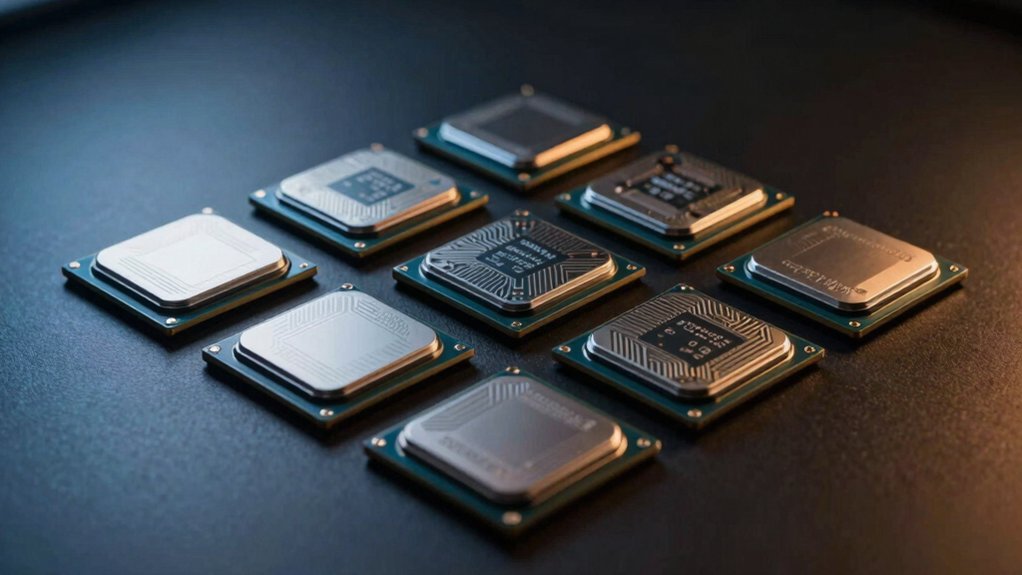

You’ll want to choose a CPU that handles video rendering efficiently, which means prioritizing core count, single-thread speed, and memory support. AMD Ryzen and Intel Core i9 processors dominate this space for good reason. However, selecting the right one depends on your specific workflow—whether you’re editing 4K footage, managing multiple streams, or working with 8K content. Each option offers different advantages that can dramatically cut your render times, but how do you know which fits your needs?
| CPU Solutions Express 4K Video Editing Workstation PC |
| Professional Grade | Processor: AMD Ryzen 9 9950X (16 cores, 32 threads, 5.7 GHz) | RAM: 64 GB DDR5 (expandable to 192 GB) | Storage: 2 TB NVMe PCIe 4.0 SSD | VIEW LATEST PRICE | Read Our Analysis |
| Acer Aspire Business Desktop Intel Processor 256GB SSD |

| Budget-Friendly Pick | Processor: Intel Celeron N4505 (dual-core, 3.8 GHz) | RAM: 8 GB (expandable to 64 GB) | Storage: 256 GB PCIe SSD (up to 4 TB options) | VIEW LATEST PRICE | Read Our Analysis |
| ACEMAGIC M5 Mini PC Windows 11 Pro Intel Core |

| Best Compact Option | Processor: Intel Core i5-14500HX (14 cores, 20 threads, 4.9 GHz) | RAM: 32 GB DDR4 (expandable to 64 GB) | Storage: 1 TB NVMe PCIe 4.0 SSD (expandable to 4 TB) | VIEW LATEST PRICE | Read Our Analysis |
| HP ProDesk 600G4 Tower Desktop Computer (i7-8700) |

| Best Value | Processor: Intel i7-8700 (6 cores, 3.4 GHz) | RAM: 32 GB DDR4 | Storage: 1 TB SSD | VIEW LATEST PRICE | Read Our Analysis |
| CPU Solutions VidCore 8K Video Editing PC |

| Best Overall | Processor: Intel Core Ultra 9 285K (24 cores, 5.7 GHz) | RAM: 64 GB DDR5 | Storage: 2 TB PCIe NVMe M.2 SSD | VIEW LATEST PRICE | Read Our Analysis |
| QNAP TBS-h574TX-i3 5-Bay All-Flash NASbook |

| Best Storage Solution | Processor: Intel Core i3-1320PE (8 cores, 12 threads, 4.50 GHz) | RAM: 12 GB DDR4 (non-expandable) | Storage: 5 x E1.S NVMe SSD slots (up to 15 mm) | VIEW LATEST PRICE | Read Our Analysis |
More Details on Our Top Picks
CPU Solutions Express 4K Video Editing Workstation PC
Need a professional-grade machine that handles 4K editing without lag? The CPU Solutions Express delivers exactly that. You’re getting a Ryzen 9 9950X with 16 cores and 32 threads that boost up to 5.7 GHz, paired with 64 GB DDR5 RAM and a 2 TB NVMe SSD. The Quadro RTX 2000 ADA GPU with 16 GB dedicated memory accelerates rendering tasks substantially. You can expand to 192 GB RAM as your projects grow. Connect up to four high-resolution monitors for your workspace. Windows 11 Pro comes preinstalled without bloatware. The 650 W power supply sustains long editing sessions with water cooling keeping temperatures stable. You’re investing in a system built specifically for professional video workflows.
- Processor:AMD Ryzen 9 9950X (16 cores, 32 threads, 5.7 GHz)
- RAM:64 GB DDR5 (expandable to 192 GB)
- Storage:2 TB NVMe PCIe 4.0 SSD
- Dedicated Graphics:NVIDIA Quadro RTX 2000 ADA (16 GB, 2,816 CUDA cores)
- Display Support:Up to 4K monitors (7680 x 4320 at 60 Hz via 4 Mini DisplayPorts)
- Operating System:Windows 11 Pro (bloatware-free)
- Additional Feature:Water cooling premium design
- Additional Feature:Expandable up to 192GB RAM
- Additional Feature:Bloatware-free Windows 11 Pro
Acer Aspire Business Desktop Intel Processor 256GB SSD
Looking for an affordable entry-level machine? The Acer Aspire Business Desktop offers dual-core Intel Celeron processing at 3.8 GHz with 8GB RAM and 256GB SSD storage. You can expand memory to 64GB and storage to 4TB for demanding projects. The system supports dual 4K monitors, Wi-Fi 6, and includes USB 3.2 connectivity. While the Celeron processor handles basic editing tasks, you’ll find rendering speeds slower than higher-tier CPUs. This desktop suits hobbyists and beginners managing standard-definition or light 4K work. Windows 11 provides modern security and multitasking capabilities for productivity workflows.
- Processor:Intel Celeron N4505 (dual-core, 3.8 GHz)
- RAM:8 GB (expandable to 64 GB)
- Storage:256 GB PCIe SSD (up to 4 TB options)
- Dedicated Graphics:Intel UHD Graphics (integrated)
- Display Support:Up to 2x 4K monitors
- Operating System:Windows 11
- Additional Feature:Ultra-quiet operation design
- Additional Feature:Dual 4K monitor support
- Additional Feature:Included wired keyboard
ACEMAGIC M5 Mini PC Windows 11 Pro Intel Core
The ACEMAGIC M5 Mini PC packs professional video editing performance into a compact 5.03″ form factor that won’t dominate your workspace. Its Intel Core i5-14500HX processor delivers 14 cores and 20 threads, handling 4K video rendering efficiently. You’ll get 32GB DDR4 RAM and a 1TB NVMe SSD, both upgradeable for larger projects. Connect three displays via HDMI, DisplayPort, and USB-C to monitor timelines and previews simultaneously. The vapor chamber cooling system keeps temperatures stable during intensive rendering sessions without excessive noise. Windows 11 Pro arrives pre-installed, ready for Adobe Premiere Pro, DaVinci Resolve, or Final Cut Pro workflows immediately.
- Processor:Intel Core i5-14500HX (14 cores, 20 threads, 4.9 GHz)
- RAM:32 GB DDR4 (expandable to 64 GB)
- Storage:1 TB NVMe PCIe 4.0 SSD (expandable to 4 TB)
- Dedicated Graphics:Intel UHD Graphics (integrated)
- Display Support:4K UHD 60Hz (triple display via HDMI, DisplayPort, Type-C)
- Operating System:Windows 11 Pro (supports Ubuntu/Linux)
- Additional Feature:Compact 5.03″ form factor
- Additional Feature:Triple display via ports
- Additional Feature:2-year manufacturer warranty
HP ProDesk 600G4 Tower Desktop Computer (i7-8700)
HP’s ProDesk 600G4 delivers strong value for video editors who need reliable performance without premium pricing. The Intel i7-8700 hexa-core processor handles multitasking and rendering efficiently. You’ll get 32GB DDR4 RAM for smooth video editing workflows and the 1TB SSD ensures fast boot times and file access. The tower design offers four internal SATA bays for expanding storage capacity as your project library grows. DisplayPort connections support dual monitors, helping you organize timelines and previews separately. USB 3.0 ports enable quick file transfers from external drives. This refurbished unit comes from a Microsoft Authorized Refurbisher with technical support included.
- Processor:Intel i7-8700 (6 cores, 3.4 GHz)
- RAM:32 GB DDR4
- Storage:1 TB SSD
- Dedicated Graphics:No dedicated GPU mentioned
- Display Support:4K support (2x DisplayPort)
- Operating System:Windows 11 ready
- Additional Feature:Microsoft Authorized Refurbisher status
- Additional Feature:Internal SATA expansion bays
- Additional Feature:Free technical support included
CPU Solutions VidCore 8K Video Editing PC
Need a workstation that handles 8K video projects without lag? The VidCore 8K uses a 15th Gen Intel Core Ultra 9 285K with 24 cores and 5.7 GHz turbo speed to process demanding video files quickly. You’ll get 64GB DDR5 RAM, an RTX 5070Ti GPU with 16GB memory, and a 2TB NVMe SSD for fast file access. The system supports four monitors up to 7680×4320 resolution, letting you view multiple video angles simultaneously. Water cooling keeps the processor cool during extended rendering sessions. Windows 11 Pro and a 3-year warranty come standard, making this a reliable choice for professional 8K, 4K, and 3D editing projects.
- Processor:Intel Core Ultra 9 285K (24 cores, 5.7 GHz)
- RAM:64 GB DDR5
- Storage:2 TB PCIe NVMe M.2 SSD
- Dedicated Graphics:NVIDIA RTX 5070Ti (16 GB GDDR6)
- Display Support:Up to 4 monitors (7680 x 4320 at 60 Hz via 3x DisplayPort, 1x HDMI)
- Operating System:Windows 11 Pro
- Additional Feature:All-in-one liquid cooler
- Additional Feature:3-year parts/labor warranty
- Additional Feature:Supports 8K video editing
QNAP TBS-h574TX-i3 5-Bay All-Flash NASbook
Why settle for a standard external drive when you’re managing massive video files? The QNAP TBS-h574TX-i3 gives you five E1.S NVMe slots delivering fast, reliable storage for your editing workflow. Its Intel Core i3 processor with eight cores handles real-time 4K transcoding without bottlenecks. Connect via dual Thunderbolt 4 ports for maximum throughput to your editing system. The 10 GbE network port ensures seamless file transfers across your team. With 12GB DDR4 RAM and integrated graphics, you’ll process large video projects efficiently. This compact NASbook fits easily on film sets or in small studios, weighing under five pounds while maintaining professional-grade performance throughout your editing sessions.
- Processor:Intel Core i3-1320PE (8 cores, 12 threads, 4.50 GHz)
- RAM:12 GB DDR4 (non-expandable)
- Storage:5 x E1.S NVMe SSD slots (up to 15 mm)
- Dedicated Graphics:Intel UHD/Intel Iris Xe (integrated)
- Display Support:4K 30 Hz playback (HDMI 1.4b output)
- Operating System:Mac OS, Windows
- Additional Feature:Dual Thunderbolt 4 connectivity
- Additional Feature:Real-time 4K transcoding capability
- Additional Feature:5-bay E1.S NVMe storage
Factors to Consider When Choosing CPUs for Video Editing
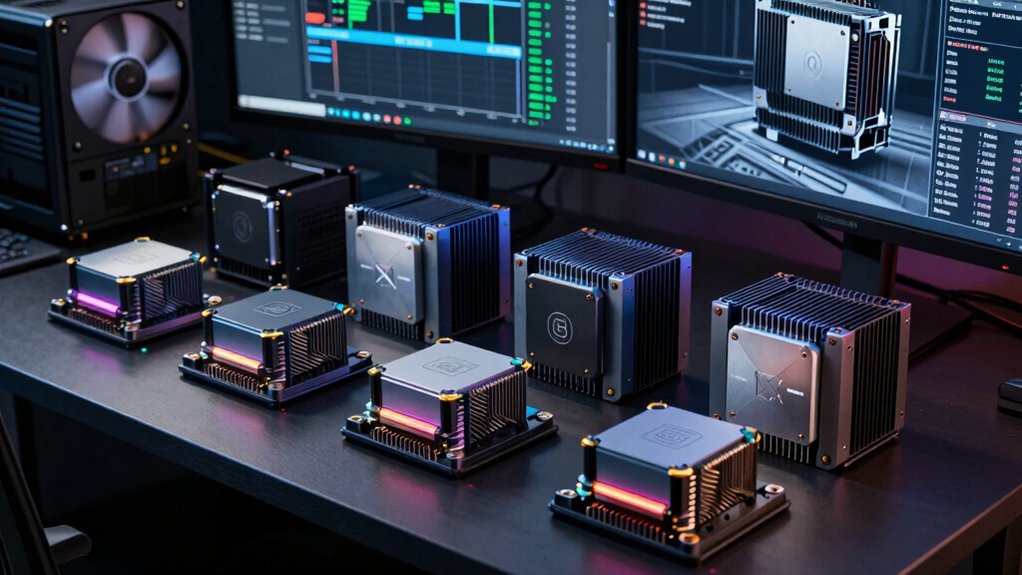
When you’re selecting a CPU for video editing, you’ll need to evaluate core count and threading capacity, which directly affect how many tasks your processor can handle simultaneously, along with clock speed performance that determines how fast each core operates. You should also examine RAM requirements and expandability options to ensure your system can support your editing software and large video files, while checking whether the CPU supports GPU acceleration capabilities that’ll speed up rendering times significantly. Finally, you’ll want to verify storage speed specifications since fast storage directly impacts your ability to work with high-resolution footage smoothly and render projects efficiently.
Core Count And Threading
How much processing power do you really need for smooth video editing? You’ll want to prioritize core count and threading based on your specific workflow. More cores and threads enable you to handle multi-tasking efficiently—encoding, applying effects, and scrubbing timelines run faster across multiple processors simultaneously. Hyper-threading adds simulated threads per core, boosting performance in complex projects with layered timelines and background rendering.
For 4K and 8K editing, higher core counts reduce idle time when running your NLE, color grading software, and audio applications concurrently. However, diminishing returns appear beyond a certain threshold. Single-threaded tasks like UI responsiveness depend more on clock speed and IPC. Balance core count with high single-core performance for optimal results across both sequential and parallel operations.
Clock Speed Performance
While core count handles your workload’s breadth, clock speed—measured in gigahertz (GHz)—determines how fast each core processes individual tasks. You’ll notice higher clock speeds directly improve timeline scrubbing and real-time playback effects in your editing software. CPUs with turbo frequencies reaching 5.7 GHz deliver faster encoding and decoding for many video codecs, reducing your render times considerably. However, sustained performance depends on your cooling solution. Without adequate thermal management, your CPU’s clock speed will throttle during long editing sessions, negating speed advantages. Consider your typical workload: burst-heavy projects benefit more from high turbo speeds, while sustained editing relies on stable base clocks. Some codecs prioritize multiple threads over clock speed, so verify your software’s specific requirements before prioritizing GHz alone.
RAM Requirements And Expandability
Why does RAM matter so much for video editing? Large video projects demand substantial memory to prevent disk paging, which slows down timeline scrubbing and playback. You’ll need 32–64 GB of RAM for standard 4K editing workflows, while 8K or multicam projects require 128 GB or more. DDR5 memory offers higher bandwidth and lower latency than DDR4, directly improving real-time editing and effects performance. When selecting a CPU platform, prioritize systems with expandable RAM slots so you can upgrade capacity as your projects grow more complex. Consider both total capacity and speed together—higher-speed modules paired with adequate storage reduce render times and accelerate background tasks. Future-proof your build by choosing platforms supporting memory upgrades beyond initial configurations.
GPU Acceleration Capabilities
When you’re selecting a CPU for video editing, you’ll also need to evaluate the GPU’s acceleration capabilities, since modern editing software relies heavily on graphics processors to speed up rendering and effects processing. Check that your GPU has CUDA cores and RT cores for encoding and effects, plus at least 16 GB of dedicated video memory for handling high-resolution timelines. Verify your GPU supports NVENC or NVDEC hardware encoders and decoders, which offload workloads from your CPU and reduce render times significantly. Review your GPU’s architecture generation—newer Tensor cores deliver faster AI-powered upscaling and denoising. Finally, confirm your editing software’s driver support and optimization for your specific GPU model to ensure maximum acceleration performance.
Storage Speed Specifications
How does your storage setup affect your editing workflow? Your drive’s speed directly impacts how smoothly you work with large media files. Choose NVMe PCIe 4.0 SSDs instead of older SATA drives, as they deliver significantly faster read and write speeds essential for 4K and 8K editing. A 2TB NVMe Gen4 drive sustains continuous data transfers, reducing playback delays and buffering interruptions.
Prioritize sustained write performance over burst speeds when selecting drives. Look for specifications showing high IOPS and low queue depth latency, which matter most for timeline-heavy projects. Consider adding multiple NVMe drives or using RAID configurations to increase transfer rates for complex multi-stream workflows. This setup ensures your storage keeps pace with your CPU’s processing power, eliminating bottlenecks during rendering and playback.
Thermal Management Solutions
Your storage speed keeps data flowing smoothly, but your CPU’s temperature management determines whether it can sustain that performance during extended rendering sessions. Choose an active cooling solution—either an all-in-one AIO or hybrid cooler—to maintain lower temperatures and enable sustained turbo boosts during long video render tasks. Pair this with a larger, well-ventilated case featuring mesh fronts to improve airflow and reduce thermal throttling on high-core-count CPUs. Match your cooler quality to your CPU’s TDP; higher-end processors require robust cooling to avoid throttling during multithreaded video encoding. Install thermal sensors with firmware-controlled fan curves to optimize the balance between cooling performance and noise levels during prolonged editing sessions. This setup prevents performance drops when you need consistent rendering speed.
Power Consumption Efficiency
Why does CPU efficiency matter when you’re editing video for hours at a time? Lower power consumption reduces heat output, letting you work longer without thermal throttling interrupting your session. You’ll want to examine three key metrics: TDP (thermal design power), which indicates maximum heat a CPU generates; per-core performance relative to power use; and frequency scaling behavior during different workloads. Look for CPUs built on advanced process nodes—smaller nanometer technology delivers better performance-per-watt. Check whether your CPU scales frequency down during lighter tasks to minimize idle power drain. If you’re doing GPU-accelerated 4K editing, verify your GPU has energy-efficient design to shift workloads effectively from CPU. Balancing these factors prevents unnecessary heat buildup and sustains consistent render speeds throughout extended editing sessions.
Budget And Upgrade Potential
When you’re investing in a CPU for video editing, balancing upfront cost with long-term scalability guarantees you’ll get solid performance now without overspending on features you won’t use immediately. Compare processors by calculating cost-per-core to identify the best value. Prioritize CPUs supporting DDR5 RAM and PCIe 5.0, which enable faster storage upgrades and GPU expansion later. Check your motherboard’s upgrade path—some platforms allow CPU swaps without replacing the entire system. For budget-conscious editors, a 16-core processor on a modern platform costs less upfront than premium models while leaving room for future improvements. Evaluate your current workflow against potential growth; choosing a platform with expandable RAM slots and additional PCIe lanes prevents costly rebuilds when your editing demands increase.
Final Thoughts
You’ll want to prioritize CPUs with high core counts and strong single-thread performance for fast video rendering. Pick either AMD Ryzen 9 7950X3D or 9950X for multi-core power, or Intel Core i9-14900K for clock speeds. Pair your choice with fast NVMe storage and plenty of RAM. Consider Threadripper or Xeon options if you’re handling heavy multi-stream workflows. Match your CPU selection to your specific editing demands and budget constraints.

Meet Ry, “TechGuru,” a 36-year-old technology enthusiast with a deep passion for tech innovations. With extensive experience, he specializes in gaming hardware and software, and has expertise in gadgets, custom PCs, and audio.
Besides writing about tech and reviewing new products, he enjoys traveling, hiking, and photography. Committed to keeping up with the latest industry trends, he aims to guide readers in making informed tech decisions.