
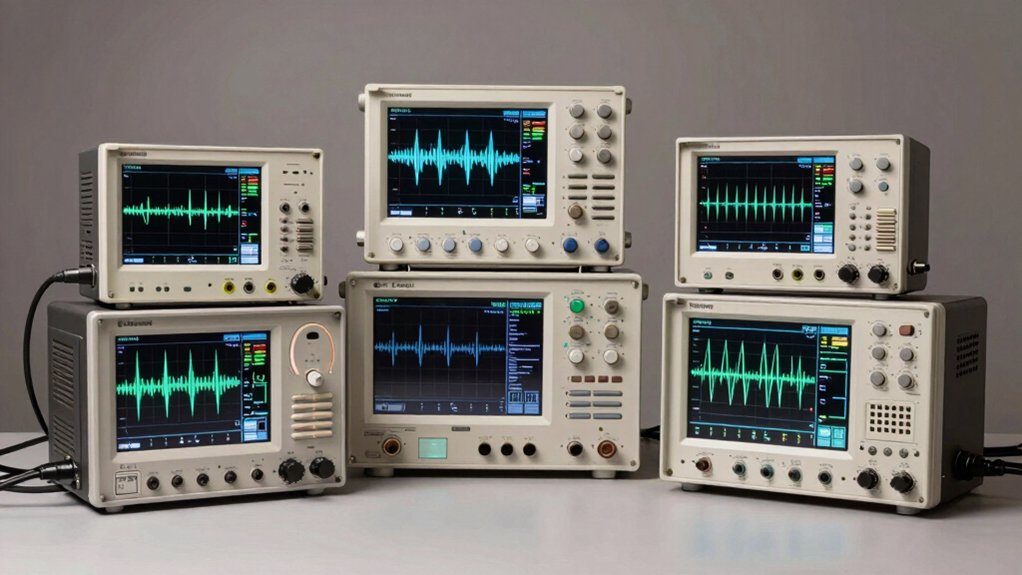

When you’re selecting a digital oscilloscope for professional fieldwork, you’ll need to evaluate bandwidth capacity, sampling rates, memory depth, and portability simultaneously. You’re choosing between handheld models starting at 200 kHz and advanced tablet-based systems reaching 350 MHz. Each option offers distinct triggering capabilities and integrated tools like DDS generators or multimeter functions. Understanding what features your specific applications demand will determine which model delivers the performance you require—and where compromises become necessary.
| FNIRSI DSO152 Handheld Digital Oscilloscope 200KHz |

| Pocket-Sized Essential | Bandwidth: 200 kHz | Sampling Rate: 2.5 MS/s | Display Screen: 2.8″ TFT LCD, 320×240 resolution | VIEW LATEST PRICE | Read Our Analysis |
| FNIRSI 2C53T Handheld Oscilloscope Multimeter DDS Generator |

| Feature-Rich Upgrade | Bandwidth: 50 MHz | Sampling Rate: 250 MSa/s | Display Screen: 2.8″ LCD display | VIEW LATEST PRICE | Read Our Analysis |
| FNIRSI DPOS350P 4-in-1 Tablet Oscilloscope Analyzer |

| Professional Lab Standard | Bandwidth: 350 MHz | Sampling Rate: 1 GSa/s | Display Screen: 7″ touchscreen, digital phosphor | VIEW LATEST PRICE | Read Our Analysis |
| FNIRSI 1014D Oscilloscope with DDS Signal Generator |
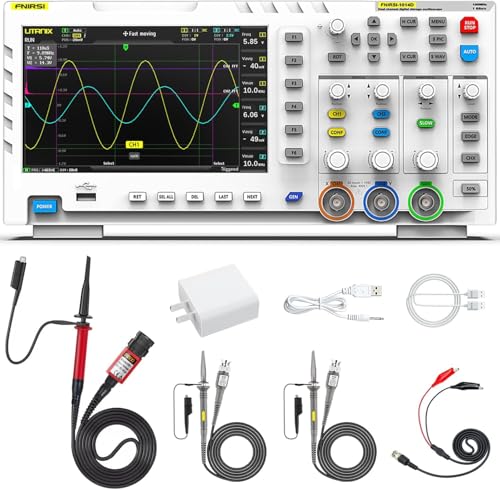
| Versatile All-In-One | Bandwidth: 100 MHz | Sampling Rate: 1 GSa/s | Display Screen: 7″ LCD display, 800×480 resolution | VIEW LATEST PRICE | Read Our Analysis |
| FNIRSI DSO-510 Handheld Oscilloscope & Signal Generator |

| Automotive Technician Pick | Bandwidth: 10 MHz | Sampling Rate: 48 MS/s | Display Screen: 2.8″ LCD display, 320×240 resolution | VIEW LATEST PRICE | Read Our Analysis |
| FNIRSI 1013D Plus Handheld Oscilloscope 100MHz |

| Touch-Screen Powerhouse | Bandwidth: 100 MHz | Sampling Rate: 1 GSa/s | Display Screen: 7″ TFT LCD touch screen | VIEW LATEST PRICE | Read Our Analysis |
More Details on Our Top Picks
FNIRSI DSO152 Handheld Digital Oscilloscope 200KHz
Why should you consider the FNIRSI DSO152 if you’re working in field maintenance, educational settings, or portable diagnostics? This handheld oscilloscope delivers practical functionality in a compact form. Its 2.8″ display shows signals at 2.5 MS/s sampling rate, sufficient for monitoring circuits up to 200 kHz. The 10× probe measures voltages to 800 VPP safely. You’ll appreciate the one-key AUTO setting for instant parameter adjustment and fast baseline calibration. The 1000 mAh battery provides roughly four hours of continuous operation. Type-C connectivity enables data transfer and firmware updates. Its lightweight design and ready-to-use construction make it ideal for technicians requiring portable, reliable measurement tools without setup complexity.
- Bandwidth:200 kHz
- Sampling Rate:2.5 MS/s
- Display Screen:2.8″ TFT LCD, 320×240 resolution
- Channels:Single channel
- Built-in Battery:1000 mAh lithium battery (~4 hours)
- Signal Generation Capability:None
- Additional Feature:One-key AUTO calibration
- Additional Feature:10× probe included (800V)
- Additional Feature:4-hour battery life
FNIRSI 2C53T Handheld Oscilloscope Multimeter DDS Generator
Looking for a single portable device that combines oscilloscope, multimeter, and signal generator functions? The FNIRSI 2C53T delivers all three. Its 50 MHz oscilloscope captures signals at 250 MSa/s across two channels. The integrated 4.5-digit multimeter measures voltage up to 999.9 V DC, current to 9.999 A, and resistance to 19.99 MΩ. You’ll generate signals up to 50 kHz using 13 waveform options. The 2.8-inch display shows measurements clearly, and the 3000 mAh battery provides up to 6 hours of operation. Store waveform images and transfer them to your PC via USB Type-C. This upgrade from the 2C23T adds math operations and persistence mode for enhanced analysis.
- Bandwidth:50 MHz
- Sampling Rate:250 MSa/s
- Display Screen:2.8″ LCD display
- Channels:2-channel
- Built-in Battery:3000 mAh battery (up to 6 hours standby)
- Signal Generation Capability:DDS signal generator, up to 50 kHz, 13 waveforms
- Additional Feature:Integrated multimeter functionality
- Additional Feature:Waveform image export capability
- Additional Feature:Math operation measurements
FNIRSI DPOS350P 4-in-1 Tablet Oscilloscope Analyzer
The FNIRSI DPOS350P serves field engineers and technicians who need a complete test suite in one portable device. You get a 350 MHz oscilloscope with 1 GSa/s sampling, a spectrum analyzer for EMI checks, a frequency response analyzer for Bode plots, and a DDS signal generator—all on a 7″ touchscreen. The 2 mV/div sensitivity captures small signals while 50,000 waveforms/second refresh keeps up with fast changes. You’ll store 500 waveforms and 90 screenshots on the 8000 mAh battery, lasting through your workday without constant charging.
- Bandwidth:350 MHz
- Sampling Rate:1 GSa/s
- Display Screen:7″ touchscreen, digital phosphor
- Channels:2-channel
- Built-in Battery:8000 mAh battery
- Signal Generation Capability:DDS signal generator, 0–50 MHz, 14 waveforms + customizable
- Additional Feature:Spectrum analyzer (FFT-based)
- Additional Feature:Frequency response analyzer
- Additional Feature:7″ touchscreen display
FNIRSI 1014D Oscilloscope with DDS Signal Generator
If you’re working with both signal measurement and signal generation in a single instrument, the FNIRSI 1014D combines a 2-channel digital oscilloscope with a built-in DDS function generator. You’ll capture signals at up to 1 GSa/s sampling rate across 100 MHz bandwidth. The integrated DDS generator outputs 14 standard waveforms plus 1,000 customizable signals at 1 Hz frequency steps. Use the 7-inch display to view signals directly, apply cursor measurements for peak-to-peak values, or activate the AUTO button for instant triggering. The Lissajous graphic tool compares two signals’ amplitude, frequency, and phase relationships. FFT viewing estimates harmonic content. Store up to 1 GB of captured data onboard.
- Bandwidth:100 MHz
- Sampling Rate:1 GSa/s
- Display Screen:7″ LCD display, 800×480 resolution
- Channels:2-channel
- Built-in Battery:Battery not specified
- Signal Generation Capability:DDS signal generator, 14 waveforms + customizable
- Additional Feature:1 GB built-in storage
- Additional Feature:Lissajous graphic display
- Additional Feature:1000 customizable signal storage
FNIRSI DSO-510 Handheld Oscilloscope & Signal Generator
Need a portable oscilloscope that combines measurement and signal generation in one device? The FNIRSI DSO-510 delivers both capabilities in a handheld format. You’ll access a 2.8-inch LCD display showing signals at 320×240 resolution. The oscilloscope measures voltages up to 400V with a 10 MHz bandwidth and 48 MS/s sampling rate. Its DDS signal generator produces 13 waveform types up to 50 kHz, supporting your testing and analysis needs. You can adjust the time base from 50 nanoseconds to 20 seconds for detailed or extended signal viewing. The device runs on a built-in 1000 mAh lithium battery with Type-C charging, making it practical for field work and automotive diagnostics.
- Bandwidth:10 MHz
- Sampling Rate:48 MS/s
- Display Screen:2.8″ LCD display, 320×240 resolution
- Channels:2-channel
- Built-in Battery:1000 mAh lithium battery
- Signal Generation Capability:DDS signal generator, up to 50 kHz, 13 waveforms
- Additional Feature:Infinite afterglow feature
- Additional Feature:Waveform image export capability
- Additional Feature:50 kHz maximum output frequency
FNIRSI 1013D Plus Handheld Oscilloscope 100MHz
Want a portable oscilloscope that doesn’t sacrifice core measurement capabilities? The FNIRSI 1013D Plus delivers two channels at 100 MHz bandwidth with a 1 GSa/s sampling rate on a 7″ touchscreen. You’ll measure peak-to-peak values and frequency directly without reading background scales. The device stores up to 1000 screenshots and 1000 waveform datasets in its 1 GB manager. You can analyze signals using Lissajous graphics to compare amplitude, frequency, and phase, or employ FFT viewing for harmonic estimation. The built-in high-voltage protection tolerates continuous 400V exposure. Its 6000 mAh battery sustains 4 hours of operation, making field work practical and efficient.
- Bandwidth:100 MHz
- Sampling Rate:1 GSa/s
- Display Screen:7″ TFT LCD touch screen
- Channels:2-channel
- Built-in Battery:6000 mAh lithium battery (~4 hours)
- Signal Generation Capability:None
- Additional Feature:1 GB waveform image manager
- Additional Feature:Capacitive touchscreen with gestures
- Additional Feature:Lissajous graphic display
Factors to Consider When Choosing a Digital Oscilloscope
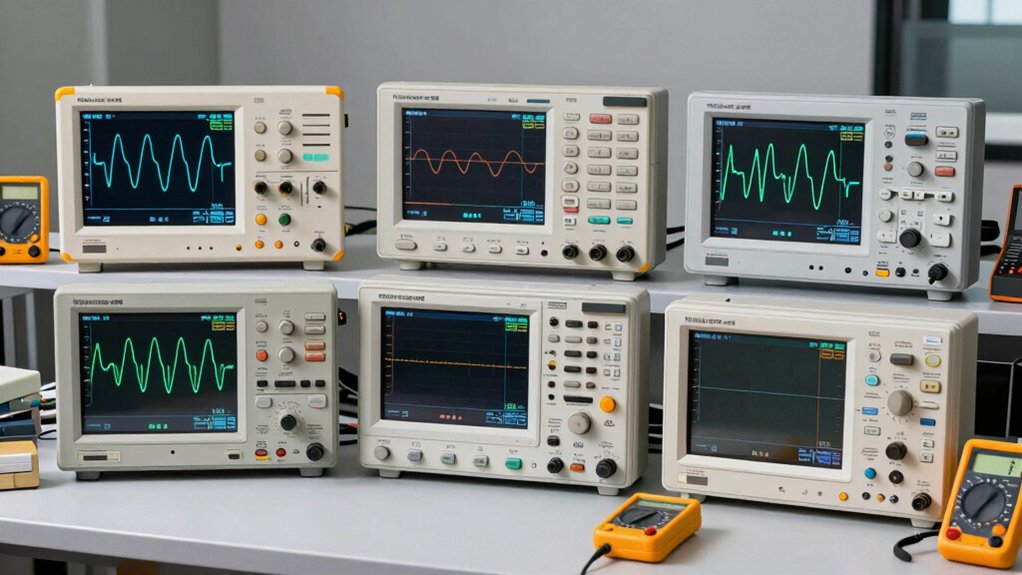
When selecting a digital oscilloscope, you’ll need to evaluate five key factors that directly affect your work: bandwidth and sampling rate determine how accurately you’ll capture fast signals, display size and resolution control how clearly you can read measurements, and battery life with portability determine whether you can use the scope in the field or only at your bench. You should also assess the measurement capabilities and features available, such as automatic voltage and frequency calculations, since these built-in functions save you time on repetitive tasks. Finally, examine the trigger modes and signal handling options, as these features let you isolate and examine specific portions of complex waveforms that you need to troubleshoot or analyze.
Bandwidth and Sampling Rate
How do you guarantee an oscilloscope captures your signal accurately without losing detail or introducing distortion? You need two key specifications: bandwidth and sampling rate.
Bandwidth determines the highest frequency your scope can display clearly. Choose a bandwidth three to five times higher than your signal’s frequency. A 100 MHz scope handles signals up to roughly 100 MHz, while 350 MHz provides clearer high-frequency views.
Sampling rate controls how often the scope captures data points. Higher rates like 1 GSa/s catch fast transients better than 48 MSa/s. Set your sampling rate at least five to ten times your signal’s bandwidth to prevent aliasing and ensure accurate waveform reconstruction.
Together, these specs determine whether you’ll see precise signal detail or distorted results.
Display Size and Resolution
After you’ve confirmed your oscilloscope meets bandwidth and sampling requirements, the next critical factor is whether you’ll actually be able to see what you’re measuring. Display size directly affects your ability to interpret waveforms accurately. A 7-inch screen provides substantially more viewing area than a 2.8-inch display, reducing the need for frequent scrolling or zooming. Higher resolution—such as 800×480 versus 320×240—yields crisper grids and clearer waveform details. You’ll read cursor measurements more precisely on high-resolution screens. Consider whether you need Lissajous or FFT visualizations, which require sufficient resolution to render clear information. Touchscreen and gesture-enabled displays let you zoom, pan, and select waveform features directly, enhancing real-time analysis. Evaluate these display specifications against your typical measurement environment and task complexity.
Battery Life and Portability
What runtime do you actually need from your oscilloscope? Most handheld models feature built-in batteries ranging from 1000 mAh to 3000 mAh, delivering 4–6 hours of continuous operation per charge. Consider your typical work sessions to determine if this duration suits your needs. If you require extended portability, look for higher-capacity options like 6000 mAh batteries, though these increase device weight and size. Display type significantly impacts battery consumption—color LCD touchscreens drain power faster than monochrome displays. Your sampling rate and bandwidth settings during operation also affect runtime. USB-C charging is standard on current models, enabling quick recharging and firmware updates. Match battery capacity to your fieldwork demands and usage patterns for optimal portability.
Measurement Capabilities and Features
When you’re selecting a digital oscilloscope, the core measurement capabilities determine whether it’ll handle your testing requirements effectively. You need to evaluate bandwidth first—it ranges from 10 MHz to 350 MHz across models and limits the highest frequencies you can accurately view. Next, examine sample rate, which affects how well you’ll capture fast transients and reconstruct waveforms, typically ranging from 2.5 MS/s to 1 GSa/s. Check record depth to understand how much historical waveform data you can store, usually between 1 Kpts and 47 Kpts. Consider trigger modes like Auto, Normal, and Single for precise timing control. Finally, assess advanced features such as Lissajous analysis, FFT capabilities, and cursor measurements that enable detailed amplitude and frequency analysis for your specific applications.
Trigger Modes and Signal Handling
How you set your oscilloscope’s trigger mode directly affects whether you’ll capture the signals you need to analyze. You have three primary options. Auto trigger continuously acquires data, letting you see waveforms immediately—ideal for routine testing. Normal trigger waits for a specific condition before capturing, giving you precise control over what you record. Single trigger captures one event only, perfect for transient or one-time occurrences you can’t repeat. Choose based on your signal type: use Auto for periodic analog signals, Normal for consistent digital patterns, and Single for unexpected events. Advanced oscilloscopes let you set programmable trigger levels and select edge or level triggering. Pre-trigger data capture shows what happened before the trigger point, providing essential context for complete signal analysis.
Connectivity and Data Management
Your oscilloscope’s ability to transfer data and manage files directly impacts your workflow efficiency and long-term record-keeping. Check for built-in Type-C or USB interfaces that enable firmware updates and PC connections. Verify the device stores at least 1,000 waveforms with a dedicated waveform manager for organization. Confirm you can export screenshots, FFT plots, and Lissajous mode files to external storage or your computer. Review the firmware upgrade procedure—it should involve straightforward cable or USB drive connections without complicated steps. Assess whether the oscilloscope supports circuit image saving and circuit analysis exports. These connectivity features ensure you’ll maintain detailed records, share data with your team, and keep your equipment current with the latest firmware improvements.
Final Thoughts
You’ll pick the right oscilloscope by matching bandwidth to your testing needs. Start with 200 kHz models for basic work, then move up to 100 MHz or 350 MHz for complex signals. Check memory depth for longer recordings, verify battery life for field use, and confirm triggering modes suit your transient capture requirements. Cross-reference price against features you’ll actually use.

Meet Ry, “TechGuru,” a 36-year-old technology enthusiast with a deep passion for tech innovations. With extensive experience, he specializes in gaming hardware and software, and has expertise in gadgets, custom PCs, and audio.
Besides writing about tech and reviewing new products, he enjoys traveling, hiking, and photography. Committed to keeping up with the latest industry trends, he aims to guide readers in making informed tech decisions.