
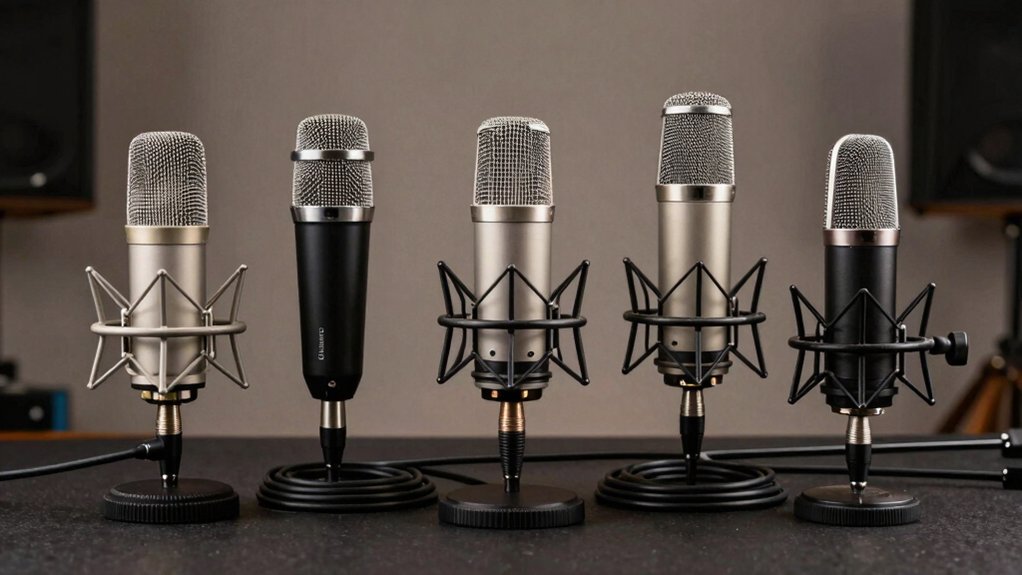

When you’re setting up a live drum kit, you need microphones that capture clean sound while handling the stage’s chaos. You’ll face choices about which mics work best for kick drums, snares, toms, and overheads—each requiring different specs. The right setup balances durability, gain structure, and isolation to minimize bleed between drums. You’ve got several proven packages available, but understanding what each mic does is essential before you choose.
| AUDIX DP7 Drum Mic Package for Live Sound or in the Studio |

| Complete Drum Kit Solution | Microphone Count: 7-piece kit | Connector Type: XLR | Polar Pattern: Unidirectional cardioid | VIEW LATEST PRICE | Read Our Analysis |
| Shure SM57 Dynamic Cardioid XLR Microphone |

| Versatile Workhorse | Microphone Count: 1 microphone | Connector Type: 3-pin XLR | Polar Pattern: Unidirectional cardioid | VIEW LATEST PRICE | Read Our Analysis |
| Pyle 7-Piece Wired Dynamic Microphone Kit for Drums |

| Budget-Friendly Pick | Microphone Count: 7-piece kit | Connector Type: XLR | Polar Pattern: Uni-directional | VIEW LATEST PRICE | Read Our Analysis |
| CAD Audio Stage7 7-Piece Drum Microphone Pack Bundle |

| Best Value | Microphone Count: 7-piece kit | Connector Type: XLR | Polar Pattern: Cardioid variants | VIEW LATEST PRICE | Read Our Analysis |
| PreSonus DM-7: Complete Drum Microphone Set for Recording and Live Sound |

| Professional Grade | Microphone Count: 7-piece kit | Connector Type: XLR | Polar Pattern: Unidirectional cardioid | VIEW LATEST PRICE | Read Our Analysis |
More Details on Our Top Picks
AUDIX DP7 Drum Mic Package for Live Sound or in the Studio
Are you setting up a complete drum kit for live events or studio work without purchasing individual microphones? The AUDIX DP7 package offers seven mics designed for kick, snare, toms, floor tom, and overhead applications. You’ll receive the D6 for kick drums, the i5 for snare with 140 dB SPL handling, the D2 for toms, the D4 for floor toms, and the ADX51 condenser for overhead capture. All mics connect via XLR with 200-ohm impedance and deliver frequency responses spanning 20 Hz–20 kHz. This integrated solution eliminates selecting individual mics, giving you matched equipment optimized for drum kit recording and live reinforcement.
- Microphone Count:7-piece kit
- Connector Type:XLR
- Polar Pattern:Unidirectional cardioid
- Frequency Response:20 Hz–20 kHz
- Maximum SPL Handling:140 dB SPL
- Warranty Length:1-year
- Additional Feature:Pre-polarized condenser overhead mic
- Additional Feature:Handles SPL exceeding 140 dB
- Additional Feature:Aluminum enclosure construction
Shure SM57 Dynamic Cardioid XLR Microphone
The Shure SM57 works well if you’re miking snare drums, tom-toms, or other percussion instruments that need crisp detail and minimal bleed from surrounding drums. Its cardioid pattern isolates your target drum while rejecting nearby kit noise. The presence boost highlights attack and clarity, making each hit punchy and defined. Position it close to the drum head at a 45-degree angle for best results. The rugged construction withstands repeated setup and breakdown during live gigs. You’ll appreciate the XLR connector’s reliability and the microphone’s compatibility with standard mic clips and shock mounts.
- Microphone Count:1 microphone
- Connector Type:3-pin XLR
- Polar Pattern:Unidirectional cardioid
- Frequency Response:40 Hz–15 kHz
- Maximum SPL Handling:High SPL capability
- Warranty Length:2-year limited
- Additional Feature:Presence boost frequency response
- Additional Feature:Includes shock-mount compatibility
- Additional Feature:Road-tested durability design
Pyle 7-Piece Wired Dynamic Microphone Kit for Drums
If you’re setting up a drum kit for live sound on a budget, Pyle’s 7-piece kit offers a complete solution that includes everything you need to mic kick, toms, snare, and cymbals in one package. You’ll get one large kick mic, four small drum mics, and two condenser mics designed for cymbal capture. The unidirectional polar pattern isolates each drum from surrounding noise, while the frequency response of 50 Hz to 18 kHz captures both low-end punch and high-end detail. All mics connect via XLR cables and require phantom power between 24–48 volts. The kit comes with thread clips, clamps, windscreens, and a carrying case, making transport and setup straightforward for live venues and studios.
- Microphone Count:7-piece kit
- Connector Type:XLR
- Polar Pattern:Uni-directional
- Frequency Response:50 Hz–18 kHz
- Maximum SPL Handling:130 dB (kick/bass mic)
- Warranty Length:1-year limited
- Additional Feature:Phantom power 24-48V required
- Additional Feature:Includes windscreens and clips
- Additional Feature:Briefcase-style carrying case
CAD Audio Stage7 7-Piece Drum Microphone Pack Bundle
For live sound engineers who need a complete drum miking solution without purchasing individual mics separately, the CAD Audio Stage7 bundle offers all seven pieces you’ll require in one package. The bundle includes a D10 kick mic, three D29 tom mics, a D19 snare mic, and two C9 overhead mics. Each microphone type targets specific drum components with appropriate polar patterns: cardioid dynamics for kick and toms, supercardioid for snare isolation, and cardioid condensers for overheads. You’ll receive seven XLR cables, mic clips, a carrying case, and a five-year warranty. Setup involves positioning each mic according to drum placement, securing with included clips, and connecting via XLR cables to your mixing console.
- Microphone Count:7-piece kit
- Connector Type:XLR
- Polar Pattern:Cardioid variants
- Frequency Response:Not specified
- Maximum SPL Handling:Not specified
- Warranty Length:5-year limited manufacturer
- Additional Feature:7× 10ft XLR cables included
- Additional Feature:Supercardioid snare mic pattern
- Additional Feature:Premium microfiber cleaning cloth
PreSonus DM-7: Complete Drum Microphone Set for Recording and Live Sound
Looking to outfit a complete drum kit with matched microphones without buying individual units separately? The PreSonus DM-7 gives you everything in one package: a BD-1 kick drum mic, four ST-4 tom and snare mics, and two OH-2 overhead condensers. Each microphone uses XLR connectors and connects directly to your audio interface or mixer. The BD-1 emphasizes kick attack and boom with its mid-cut response. The ST-4s mount on rims to avoid interfering with drumming. The OH-2s capture cymbal detail and room ambiance. You’ll receive mounts, clips, windscreens, and a carrying case for transport and storage.
- Microphone Count:7-piece kit
- Connector Type:XLR
- Polar Pattern:Unidirectional cardioid
- Frequency Response:Up to 20 kHz
- Maximum SPL Handling:Not specified
- Warranty Length:1-year limited
- Additional Feature:Mid-cut kick frequency response
- Additional Feature:Adjustable rim mount system
- Additional Feature:Hardshell carrying case included
Factors to Consider When Choosing Drum Mics for Live Sound
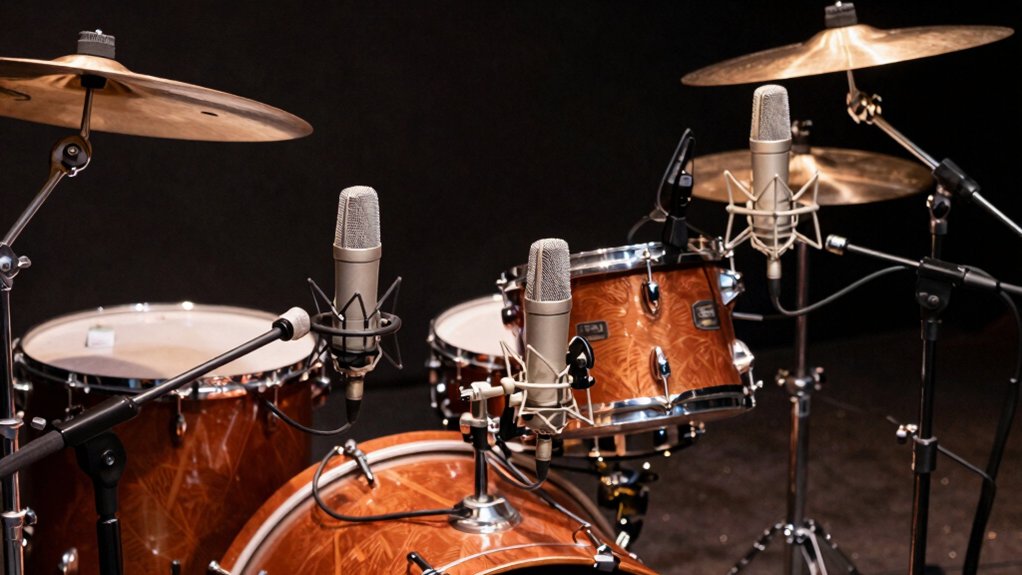
When you’re selecting drum mics for live sound, you’ll need to evaluate five critical factors: polar pattern selection (cardioid patterns reject feedback better than omnidirectional ones), frequency response (choose mics that emphasize the 2–5 kHz range for clarity in noisy venues), and SPL handling capability (kick drum mics must handle 130+ dB without distortion). You should also assess microphone durability and build quality—reinforced grilles and metal bodies withstand repeated setup and breakdown better than plastic construction—and verify XLR connectivity and compatibility with your existing mixer inputs and cable infrastructure. These decisions determine whether your drum sound remains tight and controlled throughout your performance or deteriorates due to feedback, distortion, or equipment failure.
Polar Pattern Selection Matters
The polar pattern you choose determines how your drum mics’ll pick up sound from different directions, and this directly affects how clean your live mix sounds. Cardioid mics reject sound from the rear, reducing stage bleed and crowd noise during live performances. Supercardioid patterns offer even tighter off-axis rejection, giving you greater separation between drum components. Use cardioid mics on your kick and snare to capture primary sources while minimizing cymbal bleed. Pair these with overhead condensers that pick up room ambience and cymbal detail. This combination balances on-axis presence with controlled off-axis pickup. Match your polar pattern selection to your venue size and stage setup to achieve the cleanest possible drum mix without sacrificing natural tone.
Frequency Response For Clarity
Once you’ve locked in your polar patterns, frequency response becomes your next control point for achieving clarity across your drum kit. Select kick drum mics that emphasize lows between 30–150 Hz while delivering attack definition in the 2–5 kHz range. This combination prevents muddiness while maintaining punch. For snare mics, look for a presence boost around 2–6 kHz to preserve snap and articulation without introducing excessive high-end hiss. Overhead condensers should extend to 20 kHz to capture cymbal shimmer and spatial air. A balanced frequency response across your entire mic selection reduces aggressive EQ demands later. This approach yields a clearer, more natural live sound with minimal mixing intervention needed during performance.
SPL Handling Capability Required
How much sound pressure can your drum mics actually withstand? You’ll need to check the SPL rating for each mic you select. Kick drum mics demand the highest SPL tolerance—aim for 140 dB SPL or higher to handle the beater’s intense transient without distortion. Snare mics require similar protection. Overhead and condenser mics typically handle lower SPL levels, so position them carefully to avoid cymbal crash overload. When setting up your rig, pair high-SPL mics with proper gain staging and use pads if available. This combination prevents clipping during loud passages. Review each mic’s SPL specification before purchase, then test your setup during soundcheck to confirm clean capture across all drum elements in your venue’s acoustic environment.
Microphone Durability And Build
Prioritize dynamic microphones with metal enclosures and rugged construction when you’re selecting drum mics for live sound work. These materials withstand high-impact environments and resist physical damage during setup and breakdown. Choose mics with cardioid or unidirectional polar patterns to minimize off-axis bleed and maintain signal integrity on crowded stages. Look for built-in mounts and secure XLR connectors that prevent accidental disconnections during performances. Verify that your bundle includes protective accessories like wind screens and carrying cases to safeguard equipment during transport. Check manufacturer warranties—multi-year or extended coverage indicates confidence in durability and provides financial protection against unexpected failures. These specifications ensure your drum mics deliver consistent performance night after night in demanding live venues.
XLR Connectivity And Compatibility
When you’re setting up drum mics for live sound, does your equipment actually connect without adapters or compatibility issues? XLR connectors are the industry standard for drum microphones, ensuring balanced audio signals and delivering phantom power when needed. You’ll need matching XLR outputs on your microphones and XLR inputs on your mixer or audio interface. Before purchasing, verify that all your mics have XLR connectors and that your preamps accept XLR inputs. Many drum mic bundles include multiple XLR cables, giving you immediate connectivity without hunting for extras. This standardization eliminates compatibility headaches and reduces setup time during live events. Check connector gender and pin configuration to confirm proper connections between all components in your signal chain.
Isolation And Bleed Reduction
Why does drum bleed matter in live sound? Unwanted sound from adjacent drums leaks into nearby microphones, creating muddy, unclear mixes. You’ll reduce bleed by choosing cardioid and unidirectional mics that reject sound from the sides and rear. Place dynamic mics on your kick and snare—they feature focused pickup zones and high SPL handling for high-volume settings. Position overhead condensers high and angle them properly to capture cymbals while minimizing snare and kick bleed. Mount tom mics on the drums themselves to spatially separate sources and decrease direct bleed into closer microphones. Use subtle off-axis rejection through strategic placement of all mics. These techniques—directional patterns, proper positioning, and spatial distribution—work together to maintain clear separation between kick, toms, and cymbals during live performances.
Mounting And Positioning Flexibility
How you’ll mount your drum mics directly affects your setup speed and sound consistency during live performances. Standard thread sizes—3/8″ and 5/8″—work across kick, snare, tom, and overhead positions, letting you swap mics between stands without adapting hardware. Tom and rim mounts like the ST-4 clamp directly to drum shells, keeping mics stable without stand space. Clip-based systems offer flexibility for overhead placement, letting you position mics at various angles to reduce bleed. Carrying cases with integrated clips and holders let you replicate exact mic positions night after night. Choose mounting options that match your drum configuration and available stage space. This preparation ensures faster soundchecks and reliable mic angles throughout your performance.
Warranty And Long-Term Support
Your drum mic investment requires protection that extends beyond the initial purchase, and warranty coverage directly affects your long-term costs and peace of mind. Check manufacturer warranties carefully—they range from one to five years depending on the brand and model. Verify exactly what’s covered: microphones only, or accessories included. Confirm whether you need proof of purchase and understand claim procedures. Review Amazon’s standard 30-day return policy alongside manufacturer warranties for complete post-purchase options. Consider durable construction features like rugged cardioid and dynamic designs, which withstand repeated setup and takedown cycles in live environments. Bundle purchases often include extended warranties and supporting accessories that protect your investment further. Document all warranty terms and keep receipts organized for seamless support access when needed.
Final Thoughts
You’ll want to match your mic choice to each drum component: use dynamic mics like the D6 for kick drums to capture low-end punch, pick high-SPL options for snare clarity, and select focused dynamics for toms to reduce bleed. Consider drum mic bundles from AUDIX, CAD, or PreSonus for complete setups with reliable XLR connections and rugged construction. Test your selected mics in your venue before live performances to ensure proper gain and isolation.

Meet Ry, “TechGuru,” a 36-year-old technology enthusiast with a deep passion for tech innovations. With extensive experience, he specializes in gaming hardware and software, and has expertise in gadgets, custom PCs, and audio.
Besides writing about tech and reviewing new products, he enjoys traveling, hiking, and photography. Committed to keeping up with the latest industry trends, he aims to guide readers in making informed tech decisions.