
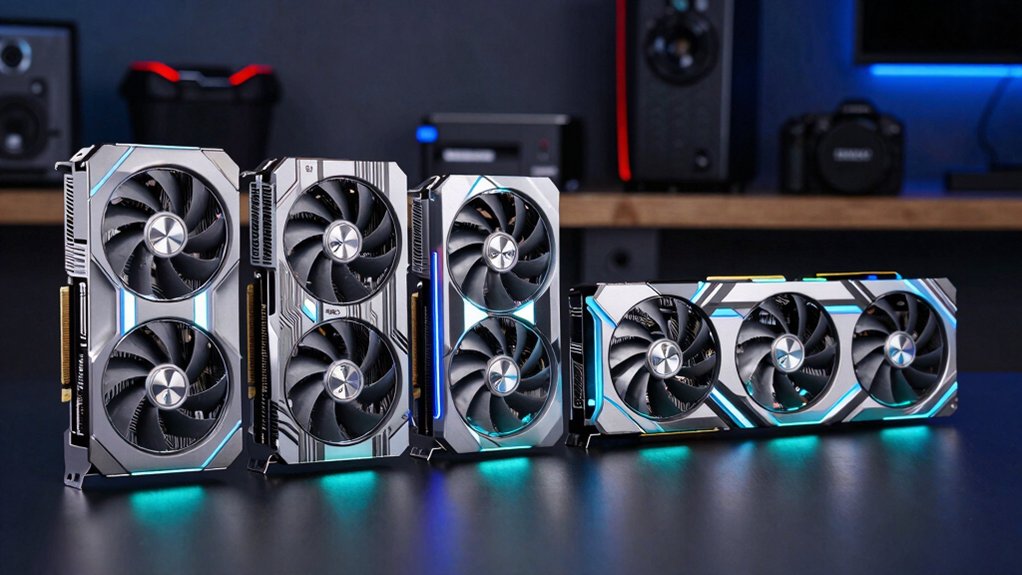

When you’re upgrading your gaming setup, you’ll need to evaluate Intel Arc GPUs across five distinct models that each serve different performance tiers and build requirements. You’ll find options ranging from compact, low-power cards suited for small cases to high-performance units delivering solid 1080p and 1440p gaming. Each card offers specific display outputs, power requirements, and cooling solutions you should match to your system. Understanding these differences will help you select the right fit, but the decision depends on your particular needs and constraints.
| ASRock Intel Arc A380 Challenger ITX Graphics Card |

| Best Compact Gaming | Memory Capacity: 6GB GDDR6 | Form Factor: Single-slot ITX | GPU Clock Speed: 2250 MHz | VIEW LATEST PRICE | Read Our Analysis |
| Sparkle Intel Arc A310 ECO Graphics Card 4GB |

| Budget-Friendly Pick | Memory Capacity: 4GB GDDR6 | Form Factor: Single-slot, low-profile | GPU Clock Speed: Not specified | VIEW LATEST PRICE | Read Our Analysis |
| ASRock Intel Arc Pro B60 Creator Graphics Card 24GB |

| Professional Grade | Memory Capacity: 24GB GDDR6 | Form Factor: 2-slot blower design | GPU Clock Speed: 2400 MHz | VIEW LATEST PRICE | Read Our Analysis |
| Intel 21P02J00BA Vga Intel21p02j00ba A750 R |

| Best Overall | Memory Capacity: 8GB GDDR6 | Form Factor: Dual-fan standard | GPU Clock Speed: 2050 MHz | VIEW LATEST PRICE | Read Our Analysis |
| ASRock Intel Arc A580 Challenger 8GB Graphics Card |

| Best Mid-Range Gaming | Memory Capacity: 8GB GDDR6 | Form Factor: 2.4-slot dual-fan | GPU Clock Speed: 2000 MHz | VIEW LATEST PRICE | Read Our Analysis |
More Details on Our Top Picks
ASRock Intel Arc A380 Challenger ITX Graphics Card
Looking for compact gaming performance? The ASRock Intel Arc A380 Challenger ITX delivers it in a single-slot design. This card features a 2250 MHz boost clock and 6GB GDDR6 memory, making it suitable for 1080p and 1440p gaming. The striped axial fan with optimized airflow keeps temperatures managed efficiently. You’ll get DisplayPort 2.0 and HDMI 2.0b connectivity for monitor setup flexibility. The PCIe 4.0 interface ensures adequate bandwidth. Its 0dB cooling mode operates silently during lighter workloads. DirectX 12 Ultimate support provides compatibility with modern games. Choose this card if you need a low-profile GPU that fits space-constrained builds without sacrificing essential gaming performance.
- Memory Capacity:6GB GDDR6
- Form Factor:Single-slot ITX
- GPU Clock Speed:2250 MHz
- Display Outputs:1x DisplayPort 2.0, 1x HDMI 2.0b
- PCIe Interface:PCIe 4.0 x16
- Target Use Case:Gaming (compact systems)
- Additional Feature:Single-slot ITX form factor
- Additional Feature:0dB silent cooling option
- Additional Feature:DisplayPort 2.0 connectivity
Sparkle Intel Arc A310 ECO Graphics Card 4GB
Need a compact GPU for budget-conscious builds? The Sparkle Intel Arc A310 ECO delivers entry-level performance in a low-profile, single-slot design. This 4GB GDDR6 card draws just 50W, requiring no external power connectors. You’ll get ray tracing support and Intel XeSS upscaling technology. The card connects via HDMI 2.0 and dual Mini DisplayPort outputs, handling 1080p displays effectively. Its 202-gram weight and short bracket make it ideal for space-limited cases. The three-year warranty provides manufacturer coverage. Choose this GPU when you need basic gaming performance without upgrading your power supply.
- Memory Capacity:4GB GDDR6
- Form Factor:Single-slot, low-profile
- GPU Clock Speed:Not specified
- Display Outputs:2x Mini DisplayPort, 1x HDMI 2.0
- PCIe Interface:PCIe x16
- Target Use Case:Entry-level desktop display
- Additional Feature:50W ultra-low TDP
- Additional Feature:Mini DisplayPort x2 outputs
- Additional Feature:3-year limited warranty
ASRock Intel Arc Pro B60 Creator Graphics Card 24GB
The ASRock Intel Arc Pro B60 Creator delivers professional-grade performance for your content creation and 3D rendering workloads. This card features 24GB GDDR6 memory with a 192-bit bus, supporting 8K video editing and complex AI model training. Its 160 XMX engines enable real-time ray tracing and AV1 encoding. The blower cooling design with nickel-plated copper keeps temperatures managed during intensive tasks. Connect via PCIe 5.0 x8 and four DisplayPort 2.1 outputs for multi-display setups. A single 8-pin power connector powers the card efficiently, requiring only 30mm extra space for cables in your case.
- Memory Capacity:24GB GDDR6
- Form Factor:2-slot blower design
- GPU Clock Speed:2400 MHz
- Display Outputs:4x DisplayPort 2.1
- PCIe Interface:PCIe 5.0 x8
- Target Use Case:Professional content creation/AI
- Additional Feature:160 XMX engines included
- Additional Feature:AV1 encoding support
- Additional Feature:Rear-exhaust blower design
Intel 21P02J00BA Vga Intel21p02j00ba A750 R
Intel’s Arc A750 stands out for gamers prioritizing 1080p performance without breaking their budget. This card features 8GB GDDR6 memory with a 256-bit interface, delivering smooth gameplay at high settings. The dual-fan cooling system maintains optimal temperatures during extended sessions. You’ll connect it via PCI Express 4.0 x16 and utilize the HDMI 2.1 or DisplayPort 2.0 outputs for your monitor. Raytracing and upscaling technologies enhance visual quality. With a 3-year warranty and solid 4.2-star rating from users, this graphics card provides reliable performance for 1080p gaming without unnecessary expense.
- Memory Capacity:8GB GDDR6
- Form Factor:Dual-fan standard
- GPU Clock Speed:2050 MHz
- Display Outputs:3x DisplayPort 2.0, 1x HDMI 2.1
- PCIe Interface:PCIe 4.0 x16
- Target Use Case:1080p gaming
- Additional Feature:Resizable BAR supported
- Additional Feature:Dual-fan cooling design
- Additional Feature:3-year seller warranty
ASRock Intel Arc A580 Challenger 8GB Graphics Card
Looking for solid mid-range gaming performance without overspending? The ASRock Intel Arc A580 Challenger delivers reliable performance with 8GB GDDR6 memory on a 256-bit interface. You’ll get a factory-overclocked 2000 MHz engine clock and DirectX 12 Ultimate support for modern games. The card connects via three DisplayPort 2.0 ports and one HDMI 2.0b, supporting up to four displays simultaneously. Its dual-fan cooling system operates silently at low temperatures, while the metal backplate ensures durability. You’ll need two 8-pin PCIe connectors and a 650W PSU minimum. The 2.4-slot design fits most cases, making this a practical choice for budget-conscious gamers.
- Memory Capacity:8GB GDDR6
- Form Factor:2.4-slot dual-fan
- GPU Clock Speed:2000 MHz
- Display Outputs:3x DisplayPort 2.0, 1x HDMI 2.0b
- PCIe Interface:PCIe 4.0 x16
- Target Use Case:Gaming (mainstream)
- Additional Feature:2000 MHz factory overclock
- Additional Feature:Dual-fan striped axial design
- Additional Feature:ASRock Super Alloy construction
Factors to Consider When Choosing an Intel Arc GPU
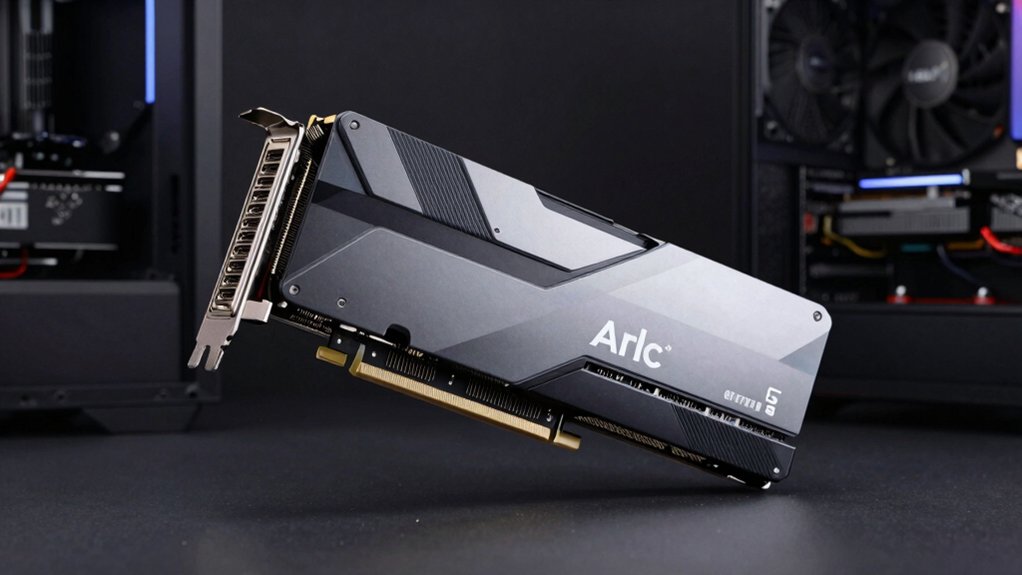
When you’re selecting an Intel Arc GPU, you’ll need to evaluate five critical factors: performance and workload requirements for your specific games or applications, memory capacity and bandwidth to handle your resolution and settings, thermal design efficiency to ensure proper cooling in your case, form factor compatibility to confirm the card fits your motherboard and chassis, and display output options to match your monitor connections. Start by identifying what games or software you’ll run, then check the GPU’s VRAM and bandwidth specifications against those demands. Finally, measure your available space, verify your power supply can handle the card’s TDP, and confirm your monitors have compatible ports like HDMI or DisplayPort.
Performance And Workload
Several key factors determine whether an Intel Arc GPU will meet your gaming and computing needs. First, match the GPU’s engine clock speed to your performance goals. Higher clocks like 2400 MHz deliver stronger gaming performance, while professional models prioritize AI and rendering with larger memory allocations. Second, evaluate memory capacity and bus width for your setup. An 8 GB GDDR6 configuration on a 256-bit bus supports high-resolution gaming, but multi-monitor setups may require more bandwidth. Third, consider DirectX 12 Ultimate compatibility and ray tracing capabilities for modern titles. Fourth, examine the Xe HPG architecture and XMX engines if you’ll run compute-heavy AI tasks. Finally, check power requirements and cooling design to ensure sustained performance under heavy workloads.
Memory And Bandwidth
How much memory and bandwidth do you actually need? Start by identifying your primary use case. Gaming typically requires 8 GB of VRAM, while professional workloads demand 24 GB. Next, examine memory interface width: 64-bit interfaces provide basic bandwidth, 192-bit offers moderate performance, and 256-bit delivers maximum throughput for multi-display setups and high-resolution tasks. Then check memory clock speeds around 15.5 Gbps for GDDR6, which directly impacts effective bandwidth. Finally, verify PCIe connectivity—PCIe 4.0 x16 suits most users, while PCIe 5.0 x8 on pro models optimizes data transfer for specialized applications. Match these specifications to your workload demands for optimal performance without overspending on unnecessary capacity.
Thermal Design Efficiency
Effective thermal management directly determines your GPU’s stability, lifespan, and performance ceiling, so you’ll want to evaluate cooling design before making a purchase. Check whether the Arc GPU uses a blower or multi-fan setup—blower designs exhaust hot air directly out of your chassis, while multi-fan layouts cool internally. Examine the shroud material and heatpipe configuration; die-cast shrouds with multiple heatpipes dissipate heat more efficiently than basic designs. Review the fan’s 0dB Silent Cooling feature; fans stop at light loads but resume under sustained workloads to prevent thermal throttling. Match the cooling capacity to your memory and GPU clock speeds—higher clock ranges demand better heat dissipation. Compare PCIe interface versions, as PCIe 5.0 provides superior power delivery and thermal headroom during intensive tasks compared to PCIe 4.0.
Form Factor Compatibility
What size case do you have, and does your power supply have available connectors? These questions determine which Intel Arc GPU fits your setup. Measure your case’s internal dimensions and note any space restrictions around PCIe slots. Check whether your power supply offers one or two available PCIe connectors, as some Arc models require dual connectors while others need only one. Examine your case’s bracket compatibility by verifying clearance for single-slot versus dual-slot designs. Dual-slot cards deliver superior cooling but demand more horizontal space. Review display outputs on each card model—HDMI and DisplayPort configurations vary—to ensure they match your monitor setup. Finally, confirm the card’s length won’t obstruct other components like storage drives or RAM modules in tight builds.
Display Output Options
Once you’ve confirmed your case and power supply compatibility, you’ll need to examine the display outputs your chosen Arc GPU provides. Check whether the card offers DisplayPort 1.4, 2.0, or 2.1, as these support higher resolutions and refresh rates than HDMI options. Count the total number of outputs available—high-end models typically feature multiple connectors for multi-monitor setups. Review your monitors’ input types: if you own DisplayPort displays, prioritize cards with native DisplayPort outputs. If your monitors use HDMI exclusively, verify the card includes HDMI 2.0b or higher for adequate bandwidth. Note that compact, low-profile cards may have fewer outputs or require adapters. Match the GPU’s output specifications to your current monitor configuration and any future expansion plans you anticipate.
Power Consumption Requirements
Because GPU power needs directly affect your entire system’s stability and efficiency, you’ll want to check your Arc card’s Thermal Design Power (TDP) or Thermal Base Power (TBP) rating before making a purchase. Entry-level models typically draw 50W TBP, requiring only standard PSU capacity. Mid-range cards listing 75W TDP need slightly more headroom. Higher-performance boards with 8-pin or dual 8-pin connectors demand 650W+ power supplies to maintain stable operation under load. Overclocked variants consume additional power, so verify your PSU wattage exceeds the card’s requirements by at least 20%. Low-profile designs use reduced cooling, potentially limiting sustained performance through thermal throttling. Calculate your total system power draw—CPU, motherboard, storage, and GPU combined—then select your PSU accordingly to prevent instability and ensure longevity.
Final Thoughts
You’ll choose your Intel Arc GPU based on your specific needs. For 1080p gaming, pick the A580 Challenger. If you’re building a compact system, select the A310 ECO or A380 Challenger ITX. For professional work, get the Pro B60 Creator. The A750 handles 1440p gaming well. Match your choice to your case size, power supply capacity, and performance requirements. Review your monitor’s display connections before purchasing.

Meet Ry, “TechGuru,” a 36-year-old technology enthusiast with a deep passion for tech innovations. With extensive experience, he specializes in gaming hardware and software, and has expertise in gadgets, custom PCs, and audio.
Besides writing about tech and reviewing new products, he enjoys traveling, hiking, and photography. Committed to keeping up with the latest industry trends, he aims to guide readers in making informed tech decisions.