
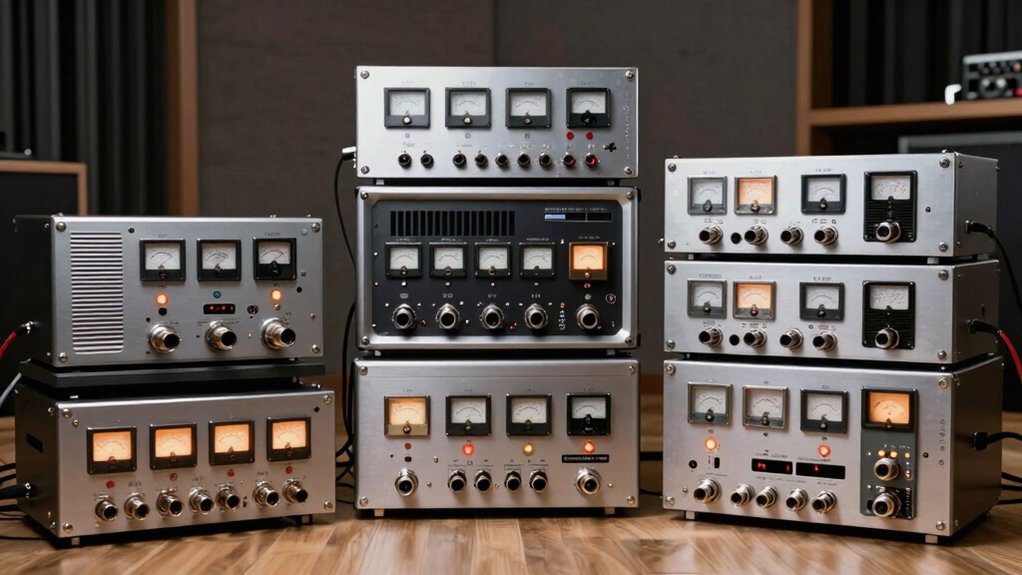

When you’re selecting a linear amplifier for ham radio, you’ll need to evaluate several key models that operators consistently rely on. The Xiegu GPA100 handles HF and 6m bands with automatic switching. The BTECH AMP-U25 works for UHF frequencies. Low-noise amplifiers cover extended frequency ranges. Each option offers distinct advantages depending on your setup—but understanding what separates these choices is essential.
| Xiegu GPA100 100W Linear Power Amplifier for HF Transceivers Amateur Radio |

| Best Overall | Frequency Range: HF and 6m bands | Output Power: 100W (HF), 80W (6m) | Input/Output Impedance: 50 Ohms | VIEW LATEST PRICE | Read Our Analysis |
| BTECH AMP-U25 UHF Power Amplifier for Handheld Radios |
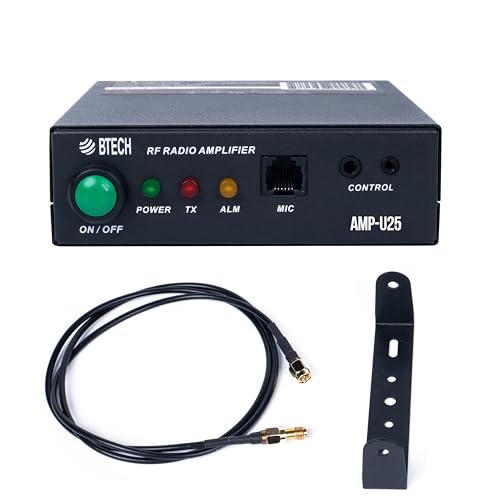
| Best For Mobility | Frequency Range: UHF (400-480 MHz) | Output Power: 30W | Input/Output Impedance: Not specified | VIEW LATEST PRICE | Read Our Analysis |
| Low Noise Amplifier 10M-6GHZ 20DB LNA RF |

| Wideband Specialist | Frequency Range: 10 MHz – 6 GHz | Output Power: N/A (receiving amplifier) | Input/Output Impedance: 50 Ω | VIEW LATEST PRICE | Read Our Analysis |
| GOTOTOP Linear CB RF Power Amplifier RF2126 |

| Compact Broadband | Frequency Range: 400-2700 MHz | Output Power: 1W | Input/Output Impedance: 50Ω | VIEW LATEST PRICE | Read Our Analysis |
| Power Amplifier DIY Kit 5W-70W SSB Linear |

| Budget DIY Kit | Frequency Range: 3.5–30 MHz | Output Power: 70W | Input/Output Impedance: Not specified | VIEW LATEST PRICE | Read Our Analysis |
| BTECH AMP-V25 VHF Amplifier 20-40W Power Boost |

| Best VHF Option | Frequency Range: VHF (144-148 MHz typical) | Output Power: 20-40W | Input/Output Impedance: Not specified | VIEW LATEST PRICE | Read Our Analysis |
| 9-12V RF Wideband Low Noise Amplifier 0.1-2000MHz |

| Best For Receivers | Frequency Range: 0.1-2000 MHz | Output Power: 20 mW | Input/Output Impedance: 50 ohms | VIEW LATEST PRICE | Read Our Analysis |
| Socobeta RF Power Amplifier 1MHz-700MHz Ham Radio Module |

| Broadband Transmitter | Frequency Range: 1 MHz – 700 MHz | Output Power: 1.6W-3.2W | Input/Output Impedance: Not specified | VIEW LATEST PRICE | Read Our Analysis |
| Garosa 50M-4GHz Low Noise Amplifier for Ham Radio |

| Professional Grade | Frequency Range: 50 MHz – 4 GHz | Output Power: 0.16W | Input/Output Impedance: 50 Ω | VIEW LATEST PRICE | Read Our Analysis |
More Details on Our Top Picks
Xiegu GPA100 100W Linear Power Amplifier for HF Transceivers Amateur Radio
Are you operating a low-power QRP transceiver and need to boost your signal without replacing your entire setup? The Xiegu GPA100 delivers 100W output on HF bands and 80W on 6m, making it ideal for expanding your transmission power. This solid-state amplifier works with Xiegu transceivers and the ICOM IC-705 via Bluetooth, enabling automatic band switching without cables. The unit monitors output power, SWR, temperature, and current draw on its bright LCD display. Built-in protection detects high SWR, overcurrent, and overheating conditions. You’ll receive the amplifier, 12V power cable, control cables, and an 18-month warranty, giving you reliable linear amplification for SSB, AM, FM, CW, and digital modes.
- Frequency Range:HF and 6m bands
- Output Power:100W (HF), 80W (6m)
- Input/Output Impedance:50 Ohms
- Power Supply Voltage:7.4 Volts (DC)
- Gain/Amplification:Not specified
- Warranty Period:18 months
- Additional Feature:Bluetooth wireless band control
- Additional Feature:Automatic SWR/thermal protection
- Additional Feature:Real-time LCD monitoring display
BTECH AMP-U25 UHF Power Amplifier for Handheld Radios
If you’re operating a handheld UHF radio and need a straightforward power boost without complex setup procedures, the BTECH AMP-U25 delivers 20-40W of amplification across the 400-480MHz band. You’ll connect your radio using the included SMA and K1 cables—a plug-and-play process requiring no modifications. The amplifier runs on 13.8V DC power and draws 5.5 amps during operation. Built-in harmonic filters clean your output signal, while protection circuitry safeguards against damage. The unit includes a speaker microphone and mounting bracket for mobile installations. BTECH backs this amplifier with a one-year USA warranty and local support, making it reliable for field, mobile, or base station use across analog and digital modes.
- Frequency Range:UHF (400-480 MHz)
- Output Power:30W
- Input/Output Impedance:Not specified
- Power Supply Voltage:13.8 V (13.8-14.04 V)
- Gain/Amplification:Not specified
- Warranty Period:1 year
- Additional Feature:Universal plug-and-play compatibility
- Additional Feature:Harmonic filters for cleaner output
- Additional Feature:Built-in loudspeaker for audio
Low Noise Amplifier 10M-6GHZ 20DB LNA RF
The CYTGOUPER Low Noise Amplifier stands out for ham radio operators who need reliable RF signal reception across multiple frequency bands without sacrificing performance. This wideband device covers 10 MHz to 6 GHz with 20 dB gain and a 5 dB noise figure, making it ideal for GPS receivers, FM radio, and software radio applications. The aluminum housing provides durability, while the SMA female output ensures compatibility with standard RF equipment. Power it with a USB Type-C connection delivering 5V at under 80 mA. Its 50-ohm impedance matches most receiving systems. Install the amplifier between your antenna and receiver to enhance signal clarity and reception stability across your operating frequencies.
- Frequency Range:10 MHz – 6 GHz
- Output Power:N/A (receiving amplifier)
- Input/Output Impedance:50 Ω
- Power Supply Voltage:DC 5V
- Gain/Amplification:20 dB
- Warranty Period:Product warranty (duration not specified)
- Additional Feature:Wideband 10MHz-6GHz coverage
- Additional Feature:Type-C DC 5V powered
- Additional Feature:SMA female connector output
GOTOTOP Linear CB RF Power Amplifier RF2126
Looking for a compact amplifier that covers broad frequency applications without occupying much bench space? The RF2126 operates across 400-2700 MHz, making it versatile for ham radio and broadband work. You’ll connect it to a 6V power supply drawing 500mA maximum. The 50Ω input and output impedance match standard RF equipment. At 2450 MHz, you’ll get 12 dB gain to boost your signal strength. The aluminum alloy housing with large heat dissipation area keeps temperatures manageable during extended operation. Its 1.6mm PCB construction ensures durability. Measuring just 3.15 x 1.97 x 0.79 inches, you’ll easily integrate this amplifier into existing setups without rearranging your workbench.
- Frequency Range:400-2700 MHz
- Output Power:1W
- Input/Output Impedance:50Ω
- Power Supply Voltage:6V
- Gain/Amplification:12 dB @ 2450 MHz
- Warranty Period:Not specified
- Additional Feature:1.6mm thick robust PCB
- Additional Feature:Large heat dissipation area
- Additional Feature:400-2700MHz broadband capability
Power Amplifier DIY Kit 5W-70W SSB Linear
Eujgoov’s SSB Linear Power Amplifier Kit delivers 70W output from a 5W input across the 3.5–30 MHz frequency range, making it ideal for ham radio operators who need portable amplification without sacrificing power. The unit’s AB linear circuit design supports SSB, AM, CW, and FM modes, giving you flexibility across multiple transmission types. Its compact dimensions of 5.94 x 4.13 x 1.46 inches and 4.2-ounce weight let you transport it easily. You’ll appreciate the built-in fan that manages heat during extended operations. With approximately 40 dB gain, you’re getting reliable signal boost for handheld radio reception and transmission across amateur bands.
- Frequency Range:3.5–30 MHz
- Output Power:70W
- Input/Output Impedance:Not specified
- Power Supply Voltage:13.8V
- Gain/Amplification:~40 dB
- Warranty Period:Not specified
- Additional Feature:40dB Class AB amplification
- Additional Feature:Integrated cooling fan system
- Additional Feature:Multiple modulation mode support
BTECH AMP-V25 VHF Amplifier 20-40W Power Boost
Need to extend your handheld radio’s communication range without upgrading to a completely new system? The BTECH AMP-V25 VHF Amplifier boosts your output from standard levels to 20-40W, making it ideal for mobile, field, or home setups. You’ll connect it directly to popular brands like BaoFeng, Kenwood, Yaesu, and ICOM through its plug-and-play design. The kit includes mounting brackets, cables, and a speaker microphone for immediate use. Built-in harmonic filters clean your signal, while protection circuitry safeguards your equipment. This amplifier handles both analog and digital modes, giving you versatile operation. BTECH provides USA-based support and warranty coverage backing your investment.
- Frequency Range:VHF (144-148 MHz typical)
- Output Power:20-40W
- Input/Output Impedance:Not specified
- Power Supply Voltage:13.8V typical
- Gain/Amplification:Not specified
- Warranty Period:1 year (BTECH USA warranty)
- Additional Feature:Universal handheld radio compatibility
- Additional Feature:Harmonic filter cleaner output
- Additional Feature:USA-based local support warranty
9-12V RF Wideband Low Noise Amplifier 0.1-2000MHz
When you’re extending your receive range across shortwave, FM broadcasting, and remote control frequencies, the FORIOT GXFH0047-002 delivers consistent performance with its 32 dB gain and low-noise design across the 0.1-2000 MHz band. You’ll need a 9-12V power supply, drawing just 27 mA during operation. The amplifier connects directly to your receiver’s antenna input using standard 50-ohm impedance matching. Mount the surface-mount device near your antenna to minimize cable losses and boost weak incoming signals effectively. With 20 mW output power and FCC compliance verification, this unit strengthens reception without introducing significant noise degradation across its wide frequency span.
- Frequency Range:0.1-2000 MHz
- Output Power:20 mW
- Input/Output Impedance:50 ohms
- Power Supply Voltage:9-12 V
- Gain/Amplification:32 dB
- Warranty Period:Not specified
- Additional Feature:Lithium battery voltage compatible
- Additional Feature:Surface mount integration design
- Additional Feature:32dB high gain output
Socobeta RF Power Amplifier 1MHz-700MHz Ham Radio Module
The Socobeta RF Power Amplifier covers a broad frequency spectrum from 1 MHz to 700 MHz, making it suitable for ham radio operators who work across HF, VHF, and UHF bands without needing multiple amplifiers. You’ll receive up to 32 dBm output power at 500 meters, with approximately 3 watts at the low end. The module requires a 15-volt power supply and draws about 35 milliamps during operation. Its compact dimensions of 37 × 56 × 17 millimeters allow easy integration into existing radio systems. Before ordering, verify model compatibility with your equipment to ensure proper functionality. The manufacturer provides quality assurance and responds to technical questions within 24 hours.
- Frequency Range:1 MHz – 700 MHz
- Output Power:1.6W-3.2W
- Input/Output Impedance:Not specified
- Power Supply Voltage:15 V
- Gain/Amplification:Up to 35 dBm
- Warranty Period:Quality assurance provided
- Additional Feature:Broadband 1MHz-700MHz operation range
- Additional Feature:Multi-application RF versatility module
- Additional Feature:24-hour professional customer support
Garosa 50M-4GHz Low Noise Amplifier for Ham Radio
Looking to strengthen your receiver’s sensitivity across FM, HF, VHF, and UHF bands without introducing excessive noise? The Garosa 50M-4GHz Low Noise Amplifier delivers 19 dB gain with a 0.6 dB noise factor at 0.9 GHz. Its 50 Ω impedance matches standard ham radio equipment. Supply it with +5 V at 90 mA for reliable operation. Handle input signals up to +10 dBm to avoid distortion. Install this surface-mount device in your receiver’s front-end, intermediate frequency stage, or transceiver input. For higher gain requirements, cascade multiple units. The unit handles frequencies spanning 50 MHz to 4 GHz, covering your primary operating bands effectively.
- Frequency Range:50 MHz – 4 GHz
- Output Power:0.16W
- Input/Output Impedance:50 Ω
- Power Supply Voltage:+5 V
- Gain/Amplification:19 dB (typical)
- Warranty Period:Not specified
- Additional Feature:Ultra-low 0.6dB noise figure
- Additional Feature:Cascade-capable multiple LNA stacking
- Additional Feature:Tower-mounted preamplifier ready
Factors to Consider When Choosing Linear Amplifiers for Ham Radio
When you’re choosing a linear amplifier for ham radio, you’ll need to evaluate five essential factors: your power output requirements based on your operating goals, the frequency bands your equipment supports, impedance matching to prevent signal loss, cooling systems that prevent overheating during extended use, and mode support that matches your preferred operating styles like SSB, CW, or digital modes. Start by identifying your target wattage output and the specific frequency ranges you plan to use, then verify that any amplifier you consider offers proper impedance specifications and adequate thermal management for your station setup. Finally, confirm that the amplifier supports all the transmission modes you’ll regularly operate so you won’t need to upgrade later.
Power Output Requirements
How do you know what power output your linear amplifier actually needs to deliver? Start by identifying your operating mode and band. HF linear amplifiers typically deliver 100 watts, while UHF handheld boosters provide around 30 watts. Next, check whether you need peak or continuous output power, since some units specify only peak ratings that don’t reflect real operating conditions. Review your transceiver’s drive level requirements and your intended communication distance. Match the amplifier’s output to your antenna system and expected propagation conditions. Finally, verify that the amplifier can sustain its rated power without auto-limiting due to SWR mismatches or thermal protection activation during extended operations.
Frequency Band Compatibility
Once you’ve determined your amplifier’s power output requirements, you’ll need to confirm it can operate effectively across the specific bands you plan to use. Look for models explicitly covering your target frequencies—HF and 6m operators should seek amplifiers rated for 3.5–30 MHz or similar wide ranges with true 100 W output. Check the manufacturer’s documentation for frequency-specific performance data including gain, noise figure, and P1dB compression point across all bands. Verify the amplifier maintains stable gain and flat frequency response without gaps or dropouts. Confirm 50-ohm impedance matching at input and output to prevent SWR issues. If your amplifier includes automatic band-switching, ensure it aligns precisely with your operating bands for consistent linear amplification throughout your sessions.
Impedance And Matching
Why does impedance matching matter so much in linear amplifier selection? You need identical 50-ohm impedance at your amplifier’s input and output to minimize reflections and preserve power transfer. Mismatches increase SWR, which reduces output, causes distortion, and risks damage to your equipment.
When choosing an amplifier, verify it’s rated for 50-ohm input and output. Select models advertising wideband performance—they maintain 50-ohm impedance across multiple frequency bands, reducing retuning requirements. Ensure your transmitter, amplifier, and antenna all match at 50 ohms.
If you’re using external tuners or ALC systems, keep the impedance path consistent at 50 ohms. Any deviation degrades linearity and efficiency. Match each component before operating to guarantee stable gain and linear performance across your bands.
Cooling And Thermal Management
Thermal management directly impacts your linear amplifier’s reliability and performance—neglect it, and you’ll face thermal runaway, reduced output, and premature component failure. Choose amplifiers with large heatsinking surfaces and efficient airflow designs that dissipate heat across all operating bands. Install smart cooling systems that monitor temperature and automatically adjust fan speed to prevent overheating during extended sessions. Check that your amplifier includes protective circuitry that detects high SWR conditions and throttles output power, reducing thermal stress on components. Verify the cooling capacity matches your expected duty cycle—continuous operation demands more aggressive heat management than intermittent use. Proper thermal design preserves gain consistency, maintains low distortion, and extends your amplifier’s operational lifespan significantly.
Mode Support And Versatility
How do you know if a linear amplifier will work reliably across all the operating modes you use? First, confirm the amplifier handles SSB, AM, FM, CW, and digital modes that match your radio’s capabilities. Next, verify it preserves signal integrity across these modes by minimizing distortion and maintaining clean ALC behavior when your transceiver supports it. Check whether the amplifier supports your preferred bands—HF and 6m, or VHF/UHF—and review its automatic band-tracking features if you operate multiple bands. Finally, ensure stable performance through built-in protections like SWR monitoring, overcurrent safeguards, and thermal controls that prevent mode-induced instability. These verification steps guarantee your amplifier adapts to your complete operating range without compromise.
Supply Voltage Specifications
When you’re evaluating a linear amplifier, you’ll need to confirm its supply voltage requirements match your transceiver and power supply system. Most amplifiers operate on 12–14.8 V, standard for automotive or aircraft-style setups. Check the manufacturer’s specifications for exact minimums and maximums—for example, 13.8 V nominal with a 14.04 V maximum and 13.8 V minimum. Voltage dips below these thresholds can trigger under-voltage protection, causing shutoffs or performance loss. Higher output power demands greater current draw, which stresses your power supply during peak operation. Install filtering or regulation if your supply voltage fluctuates. Verify your power supply can deliver the required amperage at full output before purchasing.
Size And Portability Factors
Once you’ve confirmed your power supply can handle the amplifier’s voltage and current demands, you’ll want to assess the physical footprint and weight—factors that directly affect how easily you’ll transport and deploy your equipment in the field. Look for compact units measuring around 2.5 x 4 x 6 inches or smaller. Check that the device weighs under 6 ounces for maximum portability, though some higher-wattage models may reach 5–6 pounds. Select amplifiers with lightweight aluminum housings and flat, slim profiles that fit into carrying cases or knapsacks without excessive bulk. Verify integrated mounting brackets or surface-mount options to reduce space when stacking with other gear. Confirm power connections align with your portable 12V or 14V battery packs to eliminate extra adapters.
Protection And Safety Features
Why’d you ignore protection features when selecting a linear amplifier? You’ll want to prioritize SWR overload protection, overcurrent protection, overheating protection, and overpower protection to prevent equipment damage during mismatches or power surges. Verify ALC compatibility with your transceiver to maintain safe, linear operation and prevent distortion. Check that your amplifier includes thermal management through smart cooling or built-in fans to maintain safe operating temperatures during extended transmissions. Confirm the unit has built-in harmonic filtering to reduce unwanted spurious emissions. Finally, examine the real-time monitoring indicators for output power, SWR, input voltage, current draw, and internal temperature. These displays let you detect unsafe conditions immediately and adjust your operation accordingly.
Final Thoughts
You’ve reviewed nine trusted linear amplifiers for ham radio. Choose based on your frequency needs: the Xiegu GPA100 for HF, BTECH models for UHF/VHF, or wideband options like GOTOTOP for flexibility. Verify power output matches your transceiver. Check cooling capacity for continuous use. Confirm 50-ohm impedance matching. Review built-in protections against overheating and RF feedback. Install proper connectors and grounding. Test at low power before full operation.

Meet Ry, “TechGuru,” a 36-year-old technology enthusiast with a deep passion for tech innovations. With extensive experience, he specializes in gaming hardware and software, and has expertise in gadgets, custom PCs, and audio.
Besides writing about tech and reviewing new products, he enjoys traveling, hiking, and photography. Committed to keeping up with the latest industry trends, he aims to guide readers in making informed tech decisions.