
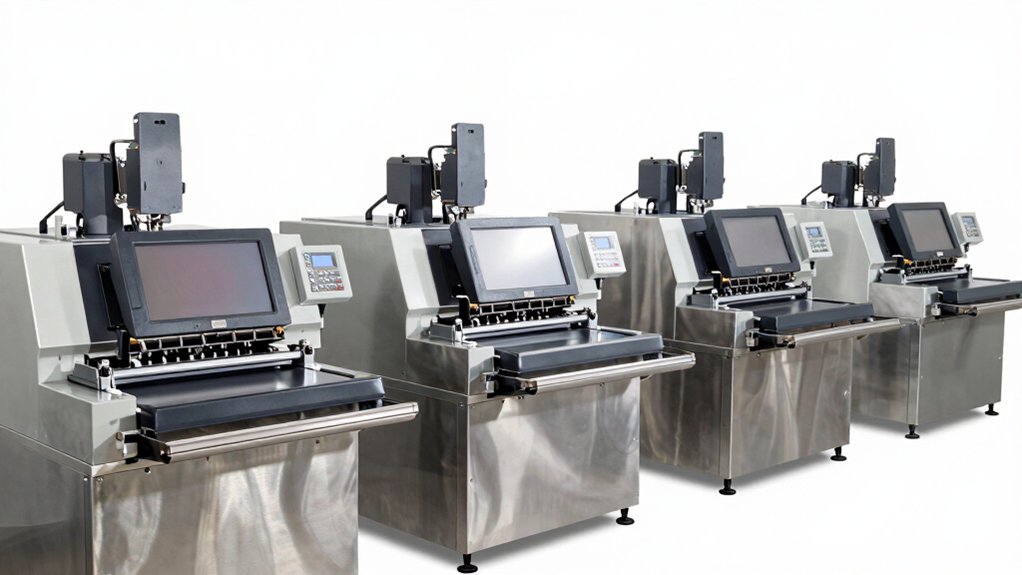

When you’re setting up a screen printing operation, you’ll need equipment that handles multiple substrates and ink types without sacrificing precision. The right printer combines durability with practical features like adjustable tensioning and metal construction. You’ve got several solid options available—from compact manual presses to advanced transfer machines—each serving different production scales. Your choice depends on your specific substrate needs and ink compatibility requirements, which we’ll break down next.
| UOKHO Transparency Film Paper for Inkjet Printers (30 Sheets) |
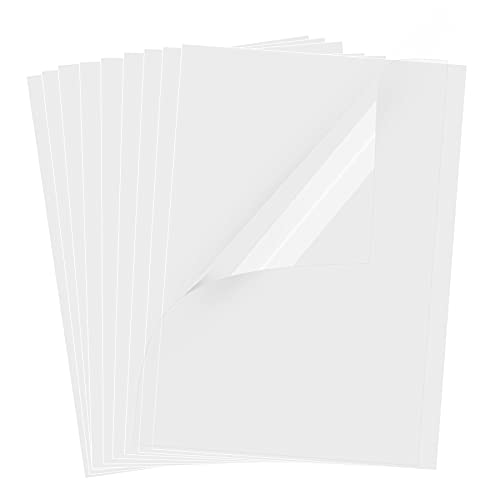
| Film Prep Essential | Primary Use Case: Inkjet transparency film for screen printing stencils | Print Technology: Inkjet printing on transparent film | Setup Complexity: Ready-to-use; load into standard inkjet printer | VIEW LATEST PRICE | Read Our Analysis |
| VEVOR 1 Color Screen Printing Press Machine |

| Professional Press Machine | Primary Use Case: Direct screen printing machine for flat substrates | Print Technology: Manual silk screen printing press | Setup Complexity: Manual operation; requires screen setup and substrate placement | VIEW LATEST PRICE | Read Our Analysis |
| Epson EcoTank ET-2800 Wireless All-in-One Printer |

| Hybrid Printing Solution | Primary Use Case: General home/office inkjet printing with scan/copy | Print Technology: Micro Piezo inkjet with heat-free technology | Setup Complexity: Plug-and-play wireless all-in-one printer | VIEW LATEST PRICE | Read Our Analysis |
| Ecoofor Screen Printing Kit with UV Lamp (53pcs) |

| Complete Beginner Kit | Primary Use Case: Complete screen printing kit with UV exposure | Print Technology: Screen printing with UV photo emulsion | Setup Complexity: Beginner-friendly kit with detailed operating guide | VIEW LATEST PRICE | Read Our Analysis |
| Lancelot A3 DTF Transfer Printing Machine Bundle |

| Advanced DTF System | Primary Use Case: Direct-to-film (DTF) transfer printing on fabrics | Print Technology: DTF (Direct-to-Film) inkjet transfer printing | Setup Complexity: Beginner-friendly operation; import design and press print | VIEW LATEST PRICE | Read Our Analysis |
More Details on Our Top Picks
UOKHO Transparency Film Paper for Inkjet Printers (30 Sheets)
If you’re printing screen printing stencils and need a reliable, cost-effective transparency film that works immediately out of the box, UOKHO’s 30-sheet pack delivers exactly what you need. Each sheet measures 8.5 by 11 inches and features PET material with a specially coated surface for high ink absorption. Load the film into your inkjet printer following your manual’s instructions, then allow several minutes of air-dry time to prevent smudging before handling. The anti-static coating resists scratches and wrinkles, while the high permeability ensures faster drying than standard films. This transparency film works with conventional inkjet inks and produces sharp line definition suitable for charts, graphs, and PCB stencils.
- Primary Use Case:Inkjet transparency film for screen printing stencils
- Print Technology:Inkjet printing on transparent film
- Setup Complexity:Ready-to-use; load into standard inkjet printer
- Material Compatibility:Compatible with inkjet printers only
- Included Components:30 sheets of 8.5 x 11 inch transparent film
- Sustainability/Cost Efficiency:No waste; designed for single-use printing applications
- Additional Feature:100% clear anti-static coating
- Additional Feature:Optimized fast-drying formula
- Additional Feature:Scratch-resistant PET material
VEVOR 1 Color Screen Printing Press Machine
The VEVOR 1 Color Screen Printing Press Machine works well for small business owners and DIY artists who need a compact, affordable entry point into screen printing without sacrificing durability. Its cold-rolled steel construction and stainless steel components withstand regular use. The 21.2 x 17.7-inch printing area accommodates most flat substrates—clothing, fabrics, ceramics, leather, and wood. You’ll adjust tension easily and rotate screens simply for different tasks. Double-layer positioning pallets with position stops ensure accurate alignment. The machine weighs 24.4 pounds, making it suitable for limited spaces. You’ll receive installation tools: wrenches, spanners, and a hex wrench set for straightforward assembly and maintenance.
- Primary Use Case:Direct screen printing machine for flat substrates
- Print Technology:Manual silk screen printing press
- Setup Complexity:Manual operation; requires screen setup and substrate placement
- Material Compatibility:Clothing, fabrics, metals, paper, plastics, wood, glass, ceramics, leather
- Included Components:Machine, double-ended wrench, single-ended spanner, screwdriver, hex wrenches, manual
- Sustainability/Cost Efficiency:Reusable screens; adjustable for multiple tasks
- Additional Feature:Double-layer positioning pallet
- Additional Feature:Cold-rolled steel construction
- Additional Feature:Wide substrate compatibility
Epson EcoTank ET-2800 Wireless All-in-One Printer
Looking for a printer that cuts ink costs without sacrificing basic functionality? The Epson EcoTank ET-2800 offers cartridge-free printing with refillable ink tanks, delivering up to 90% savings on replacement ink. You’ll get up to 4,500 black pages and 7,500 color pages per bottle set. The all-in-one design includes scanning, copying, and wireless connectivity via USB or network. Its 5760 x 1440 dpi resolution handles sharp text and color graphics on various paper types. Setup requires initial ink bottles included in the package. Operating temperature ranges from 50–95°F. The 2-year limited warranty with registration provides full unit replacement coverage. Use the Epson Smart Panel app for remote printing and scanning control.
- Primary Use Case:General home/office inkjet printing with scan/copy
- Print Technology:Micro Piezo inkjet with heat-free technology
- Setup Complexity:Plug-and-play wireless all-in-one printer
- Material Compatibility:Standard paper types, envelopes, glossy photo paper
- Included Components:Printer with built-in scanner, initial ink bottles, trays
- Sustainability/Cost Efficiency:Up to 90% savings on ink; up to 2 years of ink per replacement set
- Additional Feature:High-capacity refillable ink tanks
- Additional Feature:Built-in color flatbed scanner
- Additional Feature:Up to 90% ink savings
Ecoofor Screen Printing Kit with UV Lamp (53pcs)
Want to start screen printing without investing in expensive equipment? The Ecoofor Screen Printing Kit gives you fifty-three pieces to begin immediately. You’ll receive three wood frames, a fifty-watt UV lamp, six ink colors, and photo emulsion supplies. The UV lamp speeds up exposure time, letting you cure designs faster than traditional methods. Mix the six included inks to create custom colors for t-shirts, canvas bags, and fabrics. The kit includes a squeegee, scoop coater, measuring cup, gloves, mixing sticks, and fifteen transparency films. This setup works for hobbyists learning screen printing fundamentals without buying professional-grade equipment separately.
- Primary Use Case:Complete screen printing kit with UV exposure
- Print Technology:Screen printing with UV photo emulsion
- Setup Complexity:Beginner-friendly kit with detailed operating guide
- Material Compatibility:T-shirts, canvas bags, tablecloths, fabrics, and crafts
- Included Components:3 frames, squeegee, emulsion kit, 6 color inks, 50W UV lamp, 15 transparency films, tools
- Sustainability/Cost Efficiency:Reusable frames and screens; minimal consumable waste per project
- Additional Feature:50W UV exposure lamp
- Additional Feature:Six blendable ink colors
- Additional Feature:Complete beginner-friendly kit
Lancelot A3 DTF Transfer Printing Machine Bundle
If you’re looking to print on diverse fabrics without the complexity of traditional screen printing, the Lancelot A3 DTF Transfer Printing Machine Bundle offers a complete solution that combines the printer, oven, laptop, and consumables you need to start immediately. The white ink circulation system produces flawless prints on cotton, polyester, leather, t-shirts, jeans, and hats without pre-treatment. You’ll import your design, press print, and transfer your work to garments efficiently. The included roll feeder reduces paper jams while supporting both single sheets and roll material. Setup requires minimal maintenance—keep the printer clean, and you’re ready to work. Windows 7/10/11 compatibility ensures stable data transmission with pre-installed drivers and software for straightforward operation.
- Primary Use Case:Direct-to-film (DTF) transfer printing on fabrics
- Print Technology:DTF (Direct-to-Film) inkjet transfer printing
- Setup Complexity:Beginner-friendly operation; import design and press print
- Material Compatibility:Cotton, polyester, leather, t-shirts, jeans, hats, handbags, pillows, shoes, hoodies
- Included Components:Printer, roll feeder, oven, laptop, consumables, technical support
- Sustainability/Cost Efficiency:No pre-treatment required; more durable results; white ink circulation system
- Additional Feature:White ink circulation system
- Additional Feature:Roll feeder reduces jams
- Additional Feature:No fabric pre-treatment required
Factors to Consider When Choosing Printers for Screen Printing
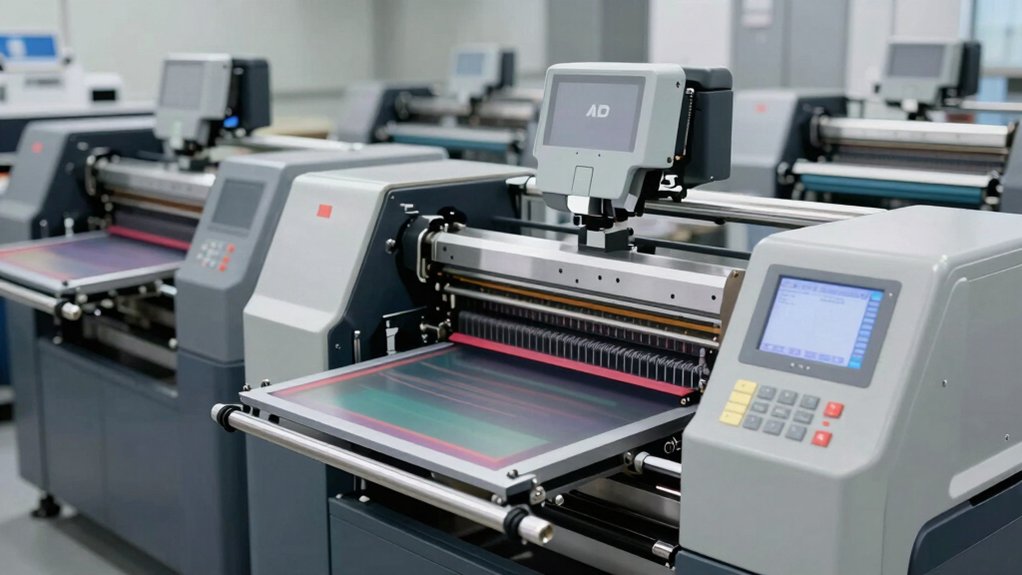
When you’re selecting a screen printing machine, you’ll need to evaluate five key factors: print quality and resolution to ensure crisp, detailed output; ink compatibility and types to match your production needs; speed and production capacity to meet your order volume; budget and operating costs to determine long-term affordability; and ease of setup and use to minimize training time and errors. Each factor directly impacts your workflow efficiency and final product quality, so you must assess how each machine performs in these areas before making your purchase. Start by listing your specific production requirements, then compare machines against each criterion to find the best fit for your operation.
Print Quality and Resolution
How do you guarantee your screen prints maintain sharp edges and accurate colors across every garment you produce? Start by selecting a printer with DPI (dots per inch) high enough to handle your design complexity. Higher DPI enables finer line definition for both graphics and text. Next, evaluate the printer’s ink coverage and color depth capabilities, which directly influence tonal gradients and color accuracy on your substrates. Check the platen accuracy and pixel alignment features to ensure consistent image placement across multiple prints. Finally, understand the printer’s dot gain characteristics and how its inks absorb into your specific fabrics. If using UV curing, verify it prevents pigment spreading before the print sets. These specifications combined determine whether your final prints deliver the sharpness and color quality professionals expect.
Ink Compatibility and Types
What ink types’ll your printer actually handle, and does that match your production goals? You need to identify whether your equipment supports water-based, solvent, UV, or pigment inks, since each type requires different curing methods and affects fabric adhesion. Water-based inks dry quickly but may lack vibrancy on dark fabrics. Solvent inks bond strongly to synthetic materials but require longer drying times. UV inks cure instantly under light exposure, enabling faster production. Pigment inks deliver superior color accuracy and wash-fastness. Next, verify your printer’s white ink capability if you’re printing on dark substrates. Finally, calculate ink bottle yields and waste rates against your monthly output volume. This analysis determines your total cost per print and workflow efficiency directly.
Speed and Production Capacity
Your printer’s speed and production capacity will determine whether you can meet tight deadlines and scale your business profitably. Evaluate the machine’s maximum substrate size, duty cycle, and time required per color layer. Single-color, single-station presses complete faster cycles but produce lower overall throughput than multi-color, multi-station models. If you run high-volume jobs, choose machines with roll-fed capabilities to reduce handling stops and jams. Check that exposure and curing times in ancillary equipment synchronize with your pressing speed—mismatched timing bottlenecks production. Inspect frame rigidity, bearings, and alignment quality, as these directly affect repeatable cycle times over long production runs. Match your printer’s capacity to your typical order volume and deadline requirements.
Budget and Operating Costs
When you’re ready to invest in a screen printing press, the upfront price tag tells only part of the financial story. Calculate your total cost of ownership by adding the printer price to recurring expenses: ink or emulsion costs, screen and mesh replacements, washout chemicals, and maintenance supplies. Examine ink yield—how many pages or prints each bottle produces—to determine your per-print cost. Factor in energy consumption and potential downtime expenses. Review warranty coverage and spare parts availability, as these affect long-term spending. Account for software expenses, including RIP software, drivers, and calibration tools you may need. Compare these complete costs against your expected print volume to identify which press delivers the best value for your operation.
Ease of Setup and Use
Once you’ve settled on a budget that works for your operation, you’ll want to focus on how quickly you can get your press running without extensive downtime or frustration. Look for machines with pre-assembled components and simple alignment features like double-layer pallets or position stops to reduce calibration time. Choose systems that include frames, squeegees, and exposure tools so you don’t purchase extras separately. Verify the kit provides educational materials explaining screen tension, emulsion coating, and curing procedures. Select compact, portable designs with clearly labeled controls for small-space operation. Check whether the printer supports both single-sheet and roll-fed options to minimize loading errors and jams. These features collectively streamline your setup process and accelerate your learning curve significantly.
Material Versatility and Applications
Because screen printing serves diverse industries—from apparel and promotional products to signage and industrial applications—you’ll need equipment that accommodates multiple substrate types and thicknesses. Look for presses with adjustable pallets and tension systems that handle cotton, polyester, leather, paper, wood, plastics, glass, and metals. Verify that your screens can adapt to different material densities without jamming or slipping. Choose equipment compatible with water-based, UV-curable, and plastisol inks to expand your color options and material capabilities. If you plan to print fabrics and larger textiles, select a press with roll feeder capability and expansive print areas. Finally, confirm your workflow includes proper proofing, curing, and finishing steps for each material type to guarantee adhesion and durability across all substrates you’ll encounter.
Final Thoughts
You’ll find your ideal screen printing press by prioritizing metal construction, precise tension control, and multi-substrate compatibility. Evaluate each option’s ink support—water-based, UV-curable, and plastisol—against your production needs. Check for pre-assembled components and included educational resources to minimize setup time. Start with a single-color press if you’re beginning, then scale to multi-color systems as your business grows. Compare pricing and warranty coverage before deciding.

Meet Ry, “TechGuru,” a 36-year-old technology enthusiast with a deep passion for tech innovations. With extensive experience, he specializes in gaming hardware and software, and has expertise in gadgets, custom PCs, and audio.
Besides writing about tech and reviewing new products, he enjoys traveling, hiking, and photography. Committed to keeping up with the latest industry trends, he aims to guide readers in making informed tech decisions.