


When you’re setting up your RV’s power system, you’ll need a reliable battery box that protects your investment and keeps your electrical setup running safely. Your battery box must handle vibrations, resist corrosion, and contain acid spills while maintaining proper ventilation. You’ll find several solid options from trusted brands like NOCO, Camco, and Attwood, each designed for different battery sizes and mounting situations. But which one actually fits your specific setup?
| NOCO Snap-Top BG27 Battery Box for Marine & RV |

| Best Overall | Battery Compatibility: Group 27 (12V) | Material Construction: Polypropylene/polymer with honeycomb lattice | Hold-Down Strap Included: 48-inch strap included | VIEW LATEST PRICE | Read Our Analysis |
| Camco Double Battery Box for RV/Marine (55375) |
| Best Value | Battery Compatibility: Group GC2 (6V) or Group 24/24M (12V) | Material Construction: Heavy-duty corrosion-resistant polymer | Hold-Down Strap Included: Two straps with clamps included | VIEW LATEST PRICE | Read Our Analysis |
| Attwood PowerGuard 24 Vented Battery Box (9065-1) |

| Best For Group 24 | Battery Compatibility: Group 24 | Material Construction: Durable polypropylene | Hold-Down Strap Included: 40-inch heavy-duty strap (350 lbs force) | VIEW LATEST PRICE | Read Our Analysis |
| Camco Large Battery Box with Straps (55373) |
| Best For Group 27 | Battery Compatibility: Group 27, 30, 31 | Material Construction: Lightweight corrosion-resistant polypropylene | Hold-Down Strap Included: Woven hold-down strap included | VIEW LATEST PRICE | Read Our Analysis |
| Camco Large Battery Box with Straps (55372) |

| Best Dual Battery | Battery Compatibility: Group 27, 30, 31 | Material Construction: Lightweight corrosion-resistant polypropylene | Hold-Down Strap Included: Woven hold-down strap included | VIEW LATEST PRICE | Read Our Analysis |
| Peastorm Waterproof Steel RV Marine Battery Box (Group 27) |

| Most Durable | Battery Compatibility: Group 27 (12V) | Material Construction: Heavy-duty steel with black spray coating | Hold-Down Strap Included: No strap (handles and lockable cover only) | VIEW LATEST PRICE | Read Our Analysis |
| NOCO Snap-Top BGU1 Battery Box for Equipment |

| Best For Equipment | Battery Compatibility: Group U1 (12V) | Material Construction: Polypropylene with honeycomb lattice | Hold-Down Strap Included: 36-inch strap included | VIEW LATEST PRICE | Read Our Analysis |
| Newport Trolling Motor Smart Battery Power Center |
| Most Advanced Features | Battery Compatibility: Group 24 & 27 | Material Construction: Heavy-duty plastic | Hold-Down Strap Included: No strap (external ports) | VIEW LATEST PRICE | Read Our Analysis |
| Litime Portable Battery Box for Marine & RV Boats |

| Most Versatile | Battery Compatibility: Group 24, 27, 31 | Material Construction: Lightweight PC/PBT plastic | Hold-Down Strap Included: No strap (external terminals) | VIEW LATEST PRICE | Read Our Analysis |
More Details on Our Top Picks
NOCO Snap-Top BG27 Battery Box for Marine & RV
Looking for a battery box that handles Group 27 batteries across multiple vehicle types? The NOCO Snap-Top BG27 offers rugged protection for marine, automotive, RV, and boat applications. You’ll install it using pre-drilled pilot holes or a battery strap mount, both included. The honeycomb lattice design prevents battery movement and terminal shorting while collecting acid safely. Front and side cable entry ports let you route wiring from multiple directions. It resists impact down to -20ºF, acid, UV rays, and oil. This box meets USCG 183.420 and ABYC E-10.7 specifications. You get a 48-inch hold-down strap, mounting tray, and four self-tapping screws. The one-year limited warranty covers manufacturer defects.
- Battery Compatibility:Group 27 (12V)
- Material Construction:Polypropylene/polymer with honeycomb lattice
- Hold-Down Strap Included:48-inch strap included
- Temperature Resistance:Impact resistant to -20°F (-28°C)
- Regulatory Compliance:USCG 183.420 and ABYC E-10.7
- Additional Features/Ports:Multiple cable entry ports, ventilation holes, mounting tray
- Additional Feature:Snap-top design simplification
- Additional Feature:Front and side cable routing
- Additional Feature:Pre-drilled pilot holes mounting
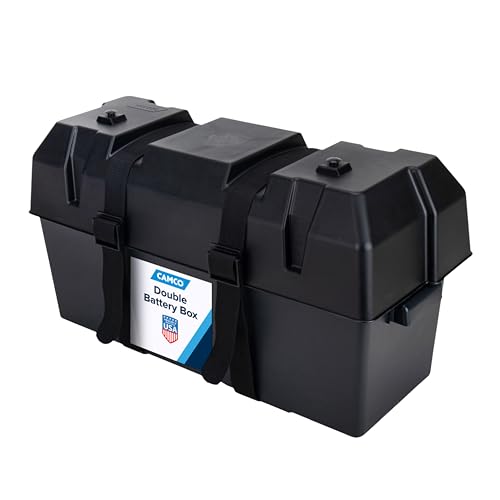
Camco Double Battery Box for RV/Marine (55375)
Need reliable battery storage that won’t drain your wallet? The Camco Double Battery Box offers heavy-duty corrosion-resistant polymer construction designed for RV, automotive, and marine applications. You’ll fit either two 6V Group GC2 batteries or two 12V Group 24/24M batteries inside. The interior measures 21½ inches long, 7⅜ inches wide, and 11³⁄₁₆ inches tall. Installation requires using the included two straps and four strap clamps with screws to secure the box. This model meets U.S. Coast Guard CFR 183.420 specifications and ABYC E-10.7 standards when equipped with two 6V batteries, ensuring compliance for marine use.
- Battery Compatibility:Group GC2 (6V) or Group 24/24M (12V)
- Material Construction:Heavy-duty corrosion-resistant polymer
- Hold-Down Strap Included:Two straps with clamps included
- Temperature Resistance:Not specified
- Regulatory Compliance:USCG CFR 183.420 and ABYC E-10.7
- Additional Features/Ports:Lift-off lid, foot clamps
- Additional Feature:Holds two 6V batteries
- Additional Feature:Dual battery capacity option
- Additional Feature:Two included straps included
Attwood PowerGuard 24 Vented Battery Box (9065-1)
The Attwood PowerGuard 24 Vented Battery Box (9065-1) secures Group 24 batteries with reliable protection and regulatory compliance. This polypropylene box holds standard marine and RV batteries up to 10.125 inches tall with interior dimensions of 10.6 x 7 x 10.125 inches. The acid-resistant construction withstands temperatures from -20°F to +120°F, making it suitable for extreme marine environments. A safety-vented design allows hazardous battery gases to escape safely while a protective cover minimizes water intrusion. The heavy-duty 40-inch hold-down strap provides 350 lbs of force, exceeding USCG requirements nearly four times over. This battery box meets USCG 183.420 regulations for OEM-installed hold-down systems, ensuring your battery stays locked and protected.
- Battery Compatibility:Group 24
- Material Construction:Durable polypropylene
- Hold-Down Strap Included:40-inch heavy-duty strap (350 lbs force)
- Temperature Resistance:Impact-tested -20°F to +120°F
- Regulatory Compliance:USCG 183.420
- Additional Features/Ports:Vented design, protective cover
- Additional Feature:350 lbs strap rating
- Additional Feature:Safety vented gas design
- Additional Feature:Water intrusion minimization cover
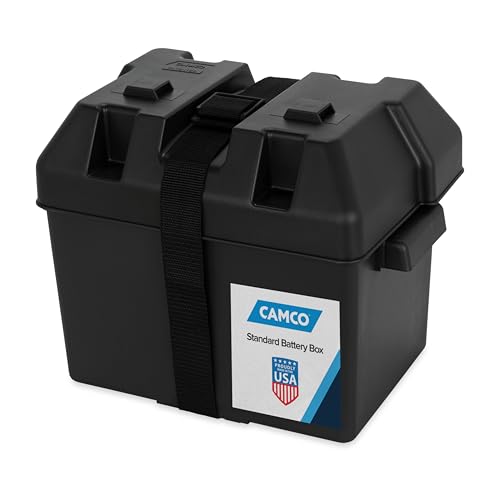
Camco Large Battery Box with Straps (55373)
Camco’s Large Battery Box with Straps (55373) accommodates group 27, 30, and 31 batteries, making it ideal for RV owners who need secure power storage without complicated installation. The box features a lightweight polypropylene construction that resists corrosion, protecting your battery from environmental damage. You’ll find a lift-off lid for easy access, durable woven hold-down straps, foot clamps, and stainless steel screws included. The interior dimensions measure 7¼” wide by 13¼” long by 8⅝” high, with an extra 2 inches of headroom for battery terminals. This box meets USCG CFR 183.420 and ABYC E-10.7 specifications, ensuring compliance with marine and RV safety standards.
- Battery Compatibility:Group 27, 30, 31
- Material Construction:Lightweight corrosion-resistant polypropylene
- Hold-Down Strap Included:Woven hold-down strap included
- Temperature Resistance:Not specified
- Regulatory Compliance:USCG CFR 183.420 and ABYC E-10.7
- Additional Features/Ports:Lift-off lid, 2″ terminal headroom
- Additional Feature:Lift-off lid design
- Additional Feature:2″ terminal head room
- Additional Feature:Stainless steel hardware included
Camco Large Battery Box with Straps (55372)
Looking for a battery box that’ll secure your dual-battery setup in tight spaces? The Camco Large Battery Box with Straps (55372) fits Group 27, 30, and 31 batteries, making it compatible with most RV and marine applications. Inside dimensions measure 7¼” W x 13¼” L x 8⅝” H, with 2″ additional headroom for battery terminals. You’ll get a lift-off lid, durable woven hold-down strap, foot clamps, and stainless steel screws. The polypropylene construction resists corrosion while remaining lightweight. This box meets USCG CFR 183.420 and ABYC E-10.7 specifications, ensuring safe battery storage in RVs, automobiles, and marine environments.
- Battery Compatibility:Group 27, 30, 31
- Material Construction:Lightweight corrosion-resistant polypropylene
- Hold-Down Strap Included:Woven hold-down strap included
- Temperature Resistance:Not specified
- Regulatory Compliance:USCG CFR 183.420 and ABYC E-10.7
- Additional Features/Ports:Lift-off lid, 2″ terminal headroom
- Additional Feature:Lift-off lid design
- Additional Feature:2″ terminal head room
- Additional Feature:Stainless steel hardware included
Peastorm Waterproof Steel RV Marine Battery Box (Group 27)
Need a battery box that’ll outlast your RV adventures? The Peastorm Waterproof Steel RV Marine Battery Box accommodates Group 27 batteries and delivers robust protection. Its heavy-duty steel construction with black spray coating resists water, sun damage, and fire. You’ll find dual side handles for easy transport, a lockable upper cover with included lock, and rubber-ringed holes for secure cable routing. The box includes four rubber rings, four screws, and bottom fixing holes for permanent installation. Measure your battery first—the internal capacity reaches 13.78 L x 7.8 W x 11 H inches. This box suits cars, RVs, trailers, boats, and camping setups, making it versatile for multiple applications.
- Battery Compatibility:Group 27 (12V)
- Material Construction:Heavy-duty steel with black spray coating
- Hold-Down Strap Included:No strap (handles and lockable cover only)
- Temperature Resistance:Waterproof, sunscreen, fireproof (temperature range not specified)
- Regulatory Compliance:Not specified
- Additional Features/Ports:Lockable upper cover, dual handles, rubber-protected holes
- Additional Feature:Steel construction with coating
- Additional Feature:Lockable upper cover included
- Additional Feature:Dual side handles design
NOCO Snap-Top BGU1 Battery Box for Equipment
The NOCO Snap-Top BGU1 works well for equipment like lawn mowers, generators, and gate openers that need dependable power protection. This Group U1 battery box features a rugged snap-lock design that improves rigidity and simplifies installation. You can mount it two ways: use pre-drilled pilot holes for direct fastening without a strap, or employ the included 36-inch hold-down strap for demanding installations. The box includes cable entry ports on the front and sides, plus optional ventilation holes for airflow. Its reinforced honeycomb lattice resists impact down to -20°F and withstands acid, gas, UV exposure, and oil. The box collects battery acid and prevents movement and shorting, meeting USCG and ABYC marine specifications.
- Battery Compatibility:Group U1 (12V)
- Material Construction:Polypropylene with honeycomb lattice
- Hold-Down Strap Included:36-inch strap included
- Temperature Resistance:Impact resistant to -20°F (-28°C)
- Regulatory Compliance:USCG 183.420 and ABYC E-10.7
- Additional Features/Ports:Multiple cable entry ports, ventilation holes, mounting tray
- Additional Feature:Snap-lock design improvement
- Additional Feature:Optional ventilation holes included
- Additional Feature:36-inch battery hold-down strap
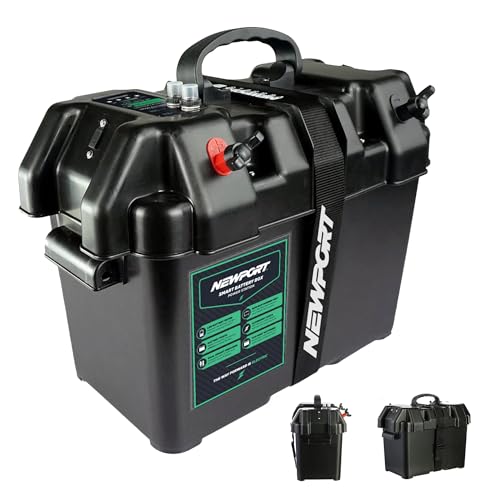
Newport Trolling Motor Smart Battery Power Center
If you’re running trolling motor accessories without constant box access, Newport’s Smart Battery Power Center delivers the most advanced features for external connections. The unit fits Group 24 and 27 lead acid batteries and includes dual circuit breakers rated at 10 and 60 amps for motor and accessory protection. You’ll find a USB charging port and one 12V DC accessory port built into the box. An LED meter displays your battery’s charge level at a glance. The rubberized feet prevent shifting during operation. Note that this system works exclusively with lead acid batteries, not lithium-ion models. Dimensions measure 17 by 12 by 10 inches.
- Battery Compatibility:Group 24 & 27
- Material Construction:Heavy-duty plastic
- Hold-Down Strap Included:No strap (external ports)
- Temperature Resistance:Not specified
- Regulatory Compliance:Not specified
- Additional Features/Ports:USB charger port, 12V accessory port, LED charge meter, dual circuit breakers (10A and 60A)
- Additional Feature:Dual circuit breaker protection
- Additional Feature:LED battery charge meter
- Additional Feature:USB charger port included
Litime Portable Battery Box for Marine & RV Boats
Litime’s portable battery box stands as the most versatile option for RV owners who need reliable power management across multiple battery types and charging scenarios. The unit accommodates Group 24, 27, and 31 batteries while supporting lithium, lead acid, and gel types. You’ll monitor voltage in real-time using the built-in voltmeter and charge multiple devices simultaneously through two 15A cigarette ports, one QC3.0 port, and one Type-C port. A 16A automatic reset circuit breaker protects against overload. The lightweight plastic construction weighs just 3.04 pounds, making transport simple. External M8 ring terminals eliminate the need to open the box during operation, enhancing safety for boats, trailers, and off-grid setups.
- Battery Compatibility:Group 24, 27, 31
- Material Construction:Lightweight PC/PBT plastic
- Hold-Down Strap Included:No strap (external terminals)
- Temperature Resistance:Not specified
- Regulatory Compliance:Not specified
- Additional Features/Ports:Voltmeter, 16A circuit breaker, two 15A cigarette ports, QC3.0 port, Type-C port
- Additional Feature:Built-in voltmeter monitoring system
- Additional Feature:16A automatic reset breaker
- Additional Feature:Multi-device charging port system
Factors to Consider When Choosing an RV Battery Box
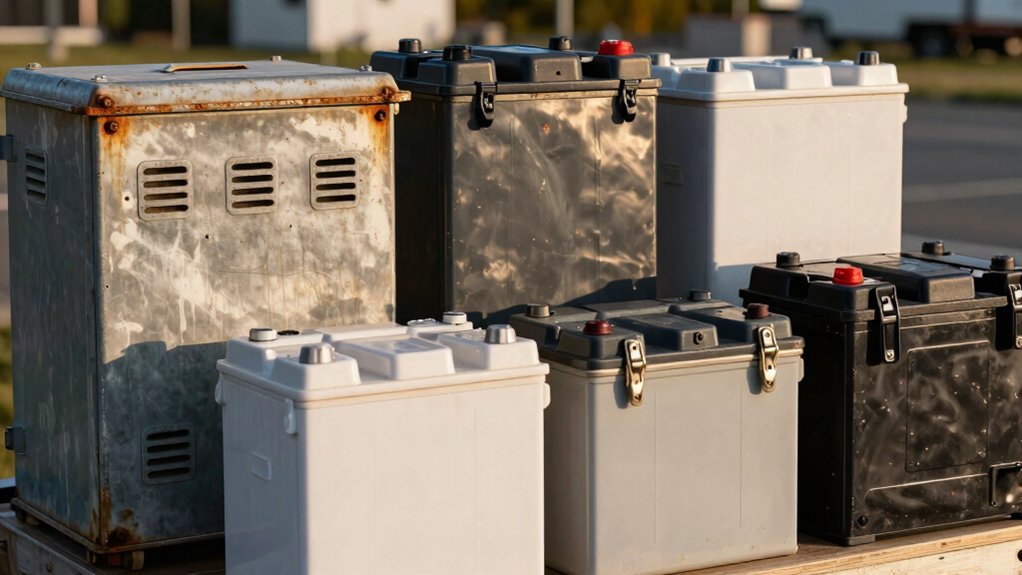
When you’re selecting an RV battery box, you’ll need to evaluate five key areas: battery size and compatibility with your RV’s electrical system, material durability and construction quality to ensure long-term protection, temperature resistance and performance in various climates, ventilation and safety features to prevent gas buildup and overheating, and installation and mounting options that fit your RV’s layout. Each factor directly impacts how well the box protects your battery, maintains its lifespan, and keeps your power system running safely. You should check your RV’s battery specifications first, then match them against each box’s technical details before making your purchase decision.
Battery Size And Compatibility
How do you know which battery box will actually fit your RV’s battery? Start by identifying your battery’s group size—common sizes include Group 24, 27, 30/31, and U1. Next, measure your battery’s width, length, and height in inches. Then, check the battery box’s internal dimensions to confirm your battery fits with adequate clearance. Most boxes list maximum battery height limits, typically around 10.125 inches, so verify your battery doesn’t exceed this threshold. Finally, confirm the box’s weight capacity matches or exceeds your battery’s weight. Mismatched dimensions cause improper mounting, reduce ventilation, and create safety hazards. Match these specifications precisely before purchasing to ensure secure, functional installation.
Material Durability And Construction
Your RV battery box’s material composition directly determines how well it’ll withstand moisture, temperature swings, and physical damage over time. Select reinforced polypropylene or coated steel to resist corrosion from moisture and outdoor exposure. Verify the box maintains structural integrity in extreme temperatures, including lows around -20°F. Choose UV-resistant coatings or UV-stable plastics to prevent sun degradation during extended use. Confirm acid-resistant properties protect against battery leakage and internal corrosion. Examine interior construction for honeycomb lattice or reinforced designs that minimize movement and prevent electrical shorting. These material features work together to extend your battery box’s lifespan and ensure reliable power storage in demanding RV conditions.
Temperature Resistance And Performance
Why does temperature matter so much when you’re selecting an RV battery box? Temperature swings directly affect battery performance, material durability, and safety. You’ll want a box rated for your climate’s extremes—typically -20°F to 120°F for most RV camping regions.
Choose boxes made from acid-resistant polypropylene or coated steel, which withstand temperature exposure without cracking or degrading. Check that your box includes ventilation holes or vented covers to prevent gas buildup and pressure problems in high-heat conditions.
Verify the box maintains structural integrity at cold temperatures, ensuring your battery stays secure during winter camping. Review the manufacturer’s operating range specifications before purchasing. A wider temperature tolerance means your box performs reliably across seasonal changes and varied climates you’ll encounter while traveling.
Ventilation And Safety Features
Ventilation and safety features deserve your close attention when selecting an RV battery box, since batteries release hazardous gases during charging and operation that must escape safely. Look for boxes with integrated ventilation systems featuring front and side entry ports that allow airflow from multiple directions, improving gas dispersion. Choose designs with protective covers that minimize water intrusion while maintaining adequate cooling airflow. Select boxes constructed with reinforced honeycomb lattice designs that prevent movement and reduce short-circuit risks. Verify that your chosen box complies with recognized standards like USCG CFR 183.420 and ABYC E-10.7, which ensure venting and protective features meet established safety requirements. These specifications protect both your equipment and your safety during RV operation.
Installation And Mounting Options
How you’ll mount your RV battery box depends on your space constraints, battery weight, and the box’s design features. Many boxes offer pre-drilled pilot holes for direct mounting without additional straps, streamlining installation. Heavier or vibration-prone setups benefit from separate hold-down straps that secure the box firmly. Front and side cable entry ports let you route connections in multiple directions, which proves essential in tight spaces. Reinforced or honeycomb lattice designs stabilize the battery during movement and prevent internal shifting. Check your battery’s group size—Group 24, 27, or U1—to ensure compatibility. Verify whether your chosen box includes necessary hardware like straps, screws, or clamps. Vented designs manage battery gases in enclosed areas, protecting both your equipment and safety.
Regulatory Compliance Standards
Once you’ve selected a mounting method that fits your RV’s layout, you’ll want to verify that your battery box meets established safety standards. Check that the box complies with USCG CFR 183.420 standards for hold-down systems and ABYC E-10.7 specifications. These regulations ensure your battery won’t shift during travel or create dangerous electrical connections. Confirm the box has been tested for acid resistance, impact exposure, and environmental protection. Verify compatibility with your battery type, typically Group 24/27/30/31 sizes. Check that ventilation requirements match your installation space to prevent gas buildup. Look for certifications indicating approval for marine, automotive, and RV applications. Regulatory compliance reduces risks of leaks, corrosion, and electrical hazards during outdoor operation.
Cable Routing And Connectivity
What’s the best way to organize your battery box’s electrical connections? Start by identifying your cable entry points—front and side ports let you route wires in multiple directions based on your RV’s layout. Choose entry locations that don’t obstruct ventilation, which keeps airflow clear and prevents terminal exposure to debris.
Next, match your cables to your battery type and voltage. Standard 12V systems use A/B terminal configurations, so verify compatibility before connecting. Position test ports for easy access during maintenance checks.
Finally, secure cables away from moving parts and sharp edges. Use the internal pilot holes or strap mount provided, depending on your battery weight. Organized routing prevents electrical hazards and simplifies future troubleshooting.
Weight Capacity And Portability
When you’re selecting an RV battery box, should you prioritize what it can hold or how easily you’ll move it? You need both. First, check the internal weight capacity in pounds or kilograms—ensure it accommodates your heaviest batteries, like deep-cycle or lithium groups. Next, examine the box’s own weight and whether it includes handles or a carrying strap for transport. Review the total load-bearing capability of any hold-down systems, often rated at 350 lbs or higher. Consider the construction material: polypropylene offers light weight with durability and impact resistance. If you frequently relocate setups, prioritize lightweight designs with integrated mounting options. Balance security and maneuverability by matching capacity to your actual battery weight while keeping the box itself manageable.
Final Thoughts
You’ll protect your RV’s power system by selecting a battery box that matches your battery size and meets USCG ABYC standards. Verify internal dimensions against your battery group type, check for UV-resistant construction and proper ventilation, and confirm secure mounting options. Compare NOCO, Camco, and Attwood models based on your specific needs, then install with included hardware to prevent vibration damage and ensure long-term reliability.

Meet Ry, “TechGuru,” a 36-year-old technology enthusiast with a deep passion for tech innovations. With extensive experience, he specializes in gaming hardware and software, and has expertise in gadgets, custom PCs, and audio.
Besides writing about tech and reviewing new products, he enjoys traveling, hiking, and photography. Committed to keeping up with the latest industry trends, he aims to guide readers in making informed tech decisions.