

You need servos that respond instantly when you command your RC plane’s control surfaces. High-torque digital servos like the MG996R deliver the power you’re after, but pairing them with lighter micro servos creates a balanced setup. The choice between metal and plastic gears, voltage requirements, and torque ratings directly impacts your plane’s performance. Understanding these differences helps you avoid costly mistakes—and there’s more to consider about matching components.
| 4Pcs SG90 9g Micro Servos for RC Robots |

| Budget-Friendly Pick | Operating Speed: 0.1 sec/60° (4.8V) | Torque Output: Not specified | Operating Voltage: 4.8-6V | VIEW LATEST PRICE | Read Our Analysis |
| Deegoo MG996R Metal Gear Digital Servo Motor (4-Pack) |
![Deegoo [4-Pack] MG996R 55g Metal Gear Torque Digital Servo Motor](https://m.media-amazon.com/images/I/41vK0XrtSjL._SL500_.jpg)
| Best For Performance | Operating Speed: 0.17 sec/60° (4.8V) | Torque Output: 12 kg/cm (6V), 13 kg/cm (7.2V) | Operating Voltage: 5V, 7.2V | VIEW LATEST PRICE | Read Our Analysis |
| Miuzei MG90S Micro Servo Motor Kit for RC Projects |
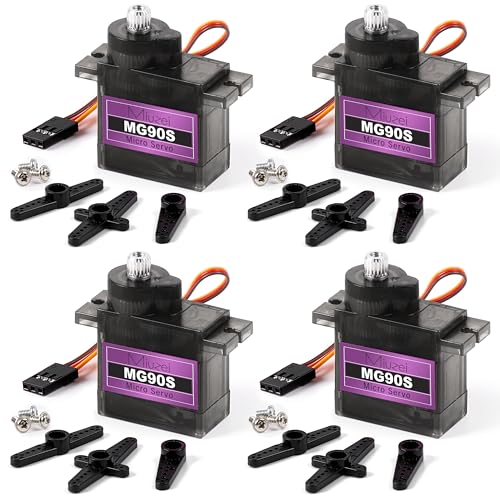
| Best For Beginners | Operating Speed: 0.11 sec/60° (4.8V) | Torque Output: 2.0 kg/cm (4.8V) | Operating Voltage: 4.8-6V | VIEW LATEST PRICE | Read Our Analysis |
| Miuzei MG90S 9G Micro Servo Motor Kit for RC |

| Most Versatile | Operating Speed: 0.11 sec/60° (4.8V) | Torque Output: 2.0 kg/cm (4.8V) | Operating Voltage: 4.8-6V | VIEW LATEST PRICE | Read Our Analysis |
| Hosyond 4Pack MG996R Digital RC Servo Motors High Torque |

| Best Value | Operating Speed: 0.17 sec/60° (4.8V) | Torque Output: 12 kg/cm (6V), 13 kg/cm (7.2V) | Operating Voltage: 5V (recommended) | VIEW LATEST PRICE | Read Our Analysis |
| Miuzei 20KG Digital Servo Motor High Torque (4-Pack) |

| Professional Grade | Operating Speed: ~0.09 sec/60° (6.8V equivalent) | Torque Output: 22.8 kg/cm (6.8V) | Operating Voltage: 6.8V | VIEW LATEST PRICE | Read Our Analysis |
| Spektrum A6390 Standard Analog Aircraft Servo (SPMSA6390) |

| Best Overall | Operating Speed: 0.14 sec/60° | Torque Output: 66 oz/in | Operating Voltage: 4.8-6V | VIEW LATEST PRICE | Read Our Analysis |
| 4pcs 17g Metal Gear Digital Servo for RC Vehicles |
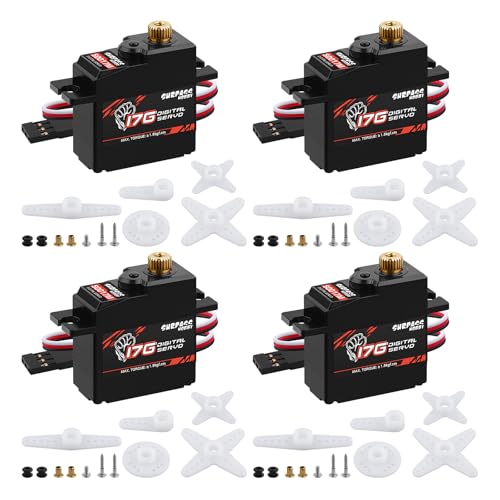
| Best For Speed | Operating Speed: 0.08 sec/60° (4.8V) | Torque Output: 2.2 kg/cm (4.8V), 3 kg/cm (6V) | Operating Voltage: 4.8-6V | VIEW LATEST PRICE | Read Our Analysis |
| 4-Pack MG995 Metal Gear Servo Motor 13KG |

| Best For Power | Operating Speed: 0.17 sec/60° (4.8V) | Torque Output: 13 kg/cm (6V) | Operating Voltage: 5-6V | VIEW LATEST PRICE | Read Our Analysis |
| 2PCS 2G Plastic Gear Mini Servo Motor Kit |

| Most Compact | Operating Speed: 0.08 sec/60° (5V) | Torque Output: 0.09-0.25 kg/cm | Operating Voltage: 3.7-5V | VIEW LATEST PRICE | Read Our Analysis |
More Details on Our Top Picks
4Pcs SG90 9g Micro Servos for RC Robots
If you’re building or upgrading a small RC aircraft, robot, or helicopter, the 4Pcs SG90 9g Micro Servos deliver the speed and precision you need without adding excess weight. These servos operate at 0.1 seconds per 60 degrees, making them responsive for control surfaces. They function within 4.8–6V operating voltage, compatible with most RC power systems. At just 0.423 ounces each, they keep your aircraft lightweight. The compact dimensions of 0.8 x 0.5 x 1.2 inches fit tight spaces in fuselages and robot frames. Use them for aileron, elevator, and rudder controls on fixed-wing planes or helicopter rotor adjustments. Install servos securely and connect control wires to ensure reliable movement during flight operations.
- Operating Speed:0.1 sec/60° (4.8V)
- Torque Output:Not specified
- Operating Voltage:4.8-6V
- Weight:0.423 oz per servo
- Gear Type:Standard gears
- Rotation Range:Standard (not specified)
- Additional Feature:Extremely compact dimensions
- Additional Feature:Lightweight at 0.423 ounces
- Additional Feature:Fixed-wing compatible design
Deegoo MG996R Metal Gear Digital Servo Motor (4-Pack)
The Deegoo MG996R serves RC enthusiasts who need dependable torque and speed for multiple aircraft or want to replace worn servos across several planes without buying individual units. You’ll receive four metal gear servos with 12 kg/cm torque at 6V and 13 kg/cm at 7.2V. They respond in 0.17 seconds per 60 degrees, making them faster than earlier models like the SG90. These servos fit standard receiver connectors from Futaba, Hitec, and Sanwa brands. You’ll need an external power adapter to operate them. Install them in 1:10 scale RC aircraft, helicopters, or robots. The coreless motor and metal gears provide durability for demanding flight maneuvers.
- Operating Speed:0.17 sec/60° (4.8V)
- Torque Output:12 kg/cm (6V), 13 kg/cm (7.2V)
- Operating Voltage:5V, 7.2V
- Weight:7.8 oz per servo
- Gear Type:Metal gear with coreless motor
- Rotation Range:Standard (not specified)
- Additional Feature:Coreless motor technology
- Additional Feature:External adapter power supply
- Additional Feature:Universal receiver compatibility
Miuzei MG90S Micro Servo Motor Kit for RC Projects
Looking for a servo that’ll handle multiple RC projects without breaking your budget? The Miuzei MG90S delivers solid performance for lightweight aircraft and drones. It operates at 4.8V–6V with a 0.11-second response time per 60 degrees, ensuring quick control inputs. The metal gears and coreless motor provide durability and reduced noise during operation. With a 2.0 kg/cm stall torque and 180° rotation range, this servo manages standard control surfaces effectively. The kit includes four units, allowing you to outfit multiple planes or build redundancy into your systems. Its compact size fits tight fuselage spaces, making it ideal for park flyers and smaller RC models where weight matters.
- Operating Speed:0.11 sec/60° (4.8V)
- Torque Output:2.0 kg/cm (4.8V)
- Operating Voltage:4.8-6V
- Weight:9g per servo
- Gear Type:Aluminum metal teeth with coreless motor
- Rotation Range:180°
- Additional Feature:Double ball bearing design
- Additional Feature:Arduino project compatible
- Additional Feature:Wide temperature range operation
Miuzei MG90S 9G Micro Servo Motor Kit for RC
Want a servo that won’t struggle with the speed demands of RC plane control? The Miuzei MG90S delivers responsive performance with a 0.11-second response time at 60 degrees on 4.8V power. You’ll get 2.0 kg/cm stall torque, sufficient for most light aircraft applications. The metal gears reduce noise while improving durability under continuous use. Its compact, lightweight design fits easily into tight fuselage spaces without adding excessive weight. Operating between 4.8V and 6V, you can adjust power levels based on your plane’s electrical system. The servo handles temperature ranges from 0°C to 55°C, making it reliable across seasonal flying conditions. A 5-microsecond dead zone width ensures precise control inputs without drift.
- Operating Speed:0.11 sec/60° (4.8V)
- Torque Output:2.0 kg/cm (4.8V)
- Operating Voltage:4.8-6V
- Weight:9g per servo
- Gear Type:Aluminum metal teeth with coreless motor
- Rotation Range:180°
- Additional Feature:Aluminum teeth construction
- Additional Feature:Reduced noise operation
- Additional Feature:Enhanced durability design
Hosyond 4Pack MG996R Digital RC Servo Motors High Torque
Need servos that’ll handle mid-size RC planes without breaking your budget? The Hosyond 4Pack MG996R offers high torque performance suitable for 50-90cc aircraft models. Each 55g servo delivers 12 kg·cm torque at 6V and 13 kg·cm at 7.2V. Operating speed reaches 0.13 seconds per 60 degrees at 6.0V, ensuring responsive control. The metal gear construction provides durability for extended use. These digital servos feature standard connectors compatible with Futaba, Hitec, and Sanwa receivers. With a 30cm cable and external power supply requirement, you’ll integrate them into your RC system efficiently.
- Operating Speed:0.17 sec/60° (4.8V)
- Torque Output:12 kg/cm (6V), 13 kg/cm (7.2V)
- Operating Voltage:5V (recommended)
- Weight:55g per servo
- Gear Type:Metal gear with coreless motor
- Rotation Range:180° (90° each direction)
- Additional Feature:Anti-vibration coreless motor
- Additional Feature:30cm cable length
- Additional Feature:180-degree rotation capability
Miuzei 20KG Digital Servo Motor High Torque (4-Pack)
The Miuzei 20KG Digital Servo Motor delivers the high torque and fast response you’ll need if you’re building RC crawlers, 1:8 or 1:10 scale cars, or robotic systems that demand consistent performance. This four-pack includes metal gears, waterproof construction, and a 270° control angle. The servo operates on pulse widths between 500 and 2500 microseconds, positioning at 90° around 1166 microseconds and 180° near 1833 microseconds. You’ll get up to 22.8 kilogram-centimeters of torque at 6.8 volts with quick response times. Built-in protections include automatic safeguards against motor burnout, rotor blocking detection, and overheat shutoff at 70°C. Double ball bearings reduce noise while maintaining stable torque throughout operation.
- Operating Speed:~0.09 sec/60° (6.8V equivalent)
- Torque Output:22.8 kg/cm (6.8V)
- Operating Voltage:6.8V
- Weight:High-torque (specific weight not listed)
- Gear Type:Aluminum gear with double ball bearings
- Rotation Range:270°
- Additional Feature:270-degree control angle
- Additional Feature:Automatic burn protection
- Additional Feature:70°C overheat protection
Spektrum A6390 Standard Analog Aircraft Servo (SPMSA6390)
If you’re building a 60-size trainer or sport model and you’re working with a tight budget, Spektrum’s A6390 servo delivers solid mid-range performance without requiring a significant investment. This analog servo generates 66 ounces per inch of torque and completes a 60-degree rotation in 0.14 seconds, making it responsive for basic flight control. The plastic gear train keeps costs down while the durable composite housing withstands typical trainer use. You’ll need 4.8 to 6.0 volts to operate it, supplied through standard battery or DC power. The single ball bearing output shaft ensures reliable movement, and the included three heavy-duty plastic arms give you mounting flexibility. At 0.11 pounds, it won’t strain your airframe.
- Operating Speed:0.14 sec/60°
- Torque Output:66 oz/in
- Operating Voltage:4.8-6V
- Weight:0.11 lbs per servo
- Gear Type:Plastic gear train
- Rotation Range:Standard (not specified)
- Additional Feature:Single ball bearing shaft
- Additional Feature:Includes mounting hardware
- Additional Feature:Included plastic servo arms
4pcs 17g Metal Gear Digital Servo for RC Vehicles
Want a lightweight servo that won’t slow down your RC plane’s response time? The 4pcs 17g Metal Gear Digital Servo delivers fast performance in a compact package. Operating at 4.8V to 6V, you’ll get response speeds of 0.06 seconds per 60 degrees at maximum voltage. The digital chip provides high resolution control, ensuring precise movements. Waterproof rubber seals protect internal components, while the CNC aluminum shell adds durability. Electronic protection circuits prevent motor damage from locked rotors. At just 17 grams each, these servos reduce weight significantly. Purchase four units, install them in your RC plane’s control surfaces, then calibrate using your transmitter’s programming menu for optimal responsiveness.
- Operating Speed:0.08 sec/60° (4.8V)
- Torque Output:2.2 kg/cm (4.8V), 3 kg/cm (6V)
- Operating Voltage:4.8-6V
- Weight:17g per servo
- Gear Type:Aluminum gear with digital chip
- Rotation Range:Standard (not specified)
- Additional Feature:Waterproof rubber seals
- Additional Feature:CNC aluminum shell
- Additional Feature:High resolution digital chip
4-Pack MG995 Metal Gear Servo Motor 13KG
You’ll find the 4-Pack MG995 Metal Gear Servo Motor works well for RC planes that need responsive control surfaces because it delivers 0.13 seconds per 60° movement at 6V operation. Each servo operates on 5V–6V power and produces 13 kg·cm stall torque, making it suitable for control surfaces on medium-weight aircraft. The metal gear design with ball bearings resists shock and vibration during flight. Install these servos in aileron, elevator, and rudder positions for full 180° range control. The 300mm connector wire allows flexible mounting within your fuselage or wing structure without requiring extensions.
- Operating Speed:0.17 sec/60° (4.8V)
- Torque Output:13 kg/cm (6V)
- Operating Voltage:5-6V
- Weight:0.27 kg for 4-pack (67.5g per servo)
- Gear Type:Metal gears with double coreless motor
- Rotation Range:180° (±90°)
- Additional Feature:Double coreless motor design
- Additional Feature:Full 180-degree travel
- Additional Feature:Shock-proof construction
2PCS 2G Plastic Gear Mini Servo Motor Kit
Looking for lightweight servos that won’t weigh down your RC plane? The 2PCS 2G Plastic Gear Mini Servo Motor Kit delivers compact performance with a coreless motor design. You’ll operate it between 3.7–5V DC, making it compatible with standard RC batteries. At 3.7V, it generates 0.09 kgf-cm rated torque and completes 60° rotation in 0.08 seconds. Increase voltage to 5V, and you’ll gain faster response at 0.06 seconds per 60°. The servo draws only 20 mA standby current, preserving battery life during flight. Its plastic gears and ABS case keep weight minimal. You can install this JST-connector servo in helicopters, airplanes, cars, boats, and robot projects where lightweight operation matters most.
- Operating Speed:0.08 sec/60° (5V)
- Torque Output:0.09-0.25 kg/cm
- Operating Voltage:3.7-5V
- Weight:2g per servo
- Gear Type:Plastic gear with coreless motor
- Rotation Range:Standard (not specified)
- Additional Feature:Ultra-low standby current
- Additional Feature:JST connector included
- Additional Feature:ABS plastic case
Factors to Consider When Choosing Servos for RC Planes
When you’re selecting a servo for your RC plane, you’ll need to evaluate five key factors: torque and speed requirements based on your aircraft’s control surface size, operating voltage compatibility with your plane’s power system, weight and size constraints that fit your fuselage and control surfaces, servo type selection between standard, digital, or coreless models, and durability and build quality to ensure reliable performance during flights. Start by calculating the torque needed for your specific control surfaces, then match that requirement to a servo’s speed rating, which you’ll verify works with your plane’s battery voltage. Finally, weigh the servo against your aircraft’s specifications and compare build quality features like sealed gearboxes and metal components to determine which option best fits your flying needs.
Torque And Speed Requirements
What makes a servo capable of controlling your RC plane effectively? Two critical specs: torque and speed.
Torque determines whether your servo can move control surfaces against aerodynamic forces. Micro servos typically deliver 2–3 kg-cm to 12 kg-cm, while high-torque digital servos reach 12–22 kg-cm. You’ll need sufficient torque to prevent stalling or sluggish control during flight.
Speed, measured in seconds per 60 degrees, affects control response. Faster servos (0.11–0.17 s/60°) give snappier handling at standard voltages like 4.8–6V.
Both specs increase with higher voltages. A 6V servo delivers more torque and faster speeds than the same model at 4.8V.
Match your servo’s torque to your plane’s weight and speed. Undersized servos fail under load; oversized ones waste weight and battery power.
Operating Voltage Compatibility
Your servo’s operating voltage directly affects the torque and speed gains you calculated in the previous section. Most RC plane servos operate between 4.8V and 6.0V, so you must match your receiver and ESC voltage within this range. At 4.8V, micro servos typically deliver speeds around 0.11–0.17 seconds per 60 degrees. Increasing voltage to 6V or 7.2V boosts both torque and speed—for example, MG996R servos jump from 12 kg/cm at 6V to 13 kg/cm at 7.2V. Coreless motors with metal gears handle 4.8–6V operation efficiently while managing heat. For high-torque servos, connect an external power supply to maintain stable receiver voltage. This prevents brownouts that slow response and compromise control authority during flight.
Weight And Size Constraints
How do you know if a servo’s weight and dimensions will work for your RC plane? First, check your aircraft’s weight budget and available mounting space. Micro servos like the SG90 weigh 0.423 ounces and measure 0.8 x 0.5 x 1.2 inches, fitting easily into tight wing and fuselage spaces. For lightweight builds, 17-gram micro servos minimize thrust-to-weight ratio impact. Heavier servos like the MG996R weigh 7.8 ounces with larger dimensions, requiring careful center of gravity planning. Next, measure your control surface mounting areas to confirm fit. Finally, calculate total servo weight against your aircraft’s weight limit. Using 4-pack servo sets lets you match different servo weights to specific control surfaces, optimizing weight distribution throughout your plane.
Servo Type Selection
When you’re choosing a servo, you’ll need to match the servo’s specifications to your plane’s demands and power constraints. First, determine the torque required by measuring your control surface size and weight. Micro servos like the MG90S work well for lightweight wings, while larger ailerons need MG996R-type servos offering 12–13 kg/cm torque. Next, check the travel range your plane requires: standard servos provide 180°, but 20kg-class digital servos deliver 270° for complex control surfaces. Finally, evaluate your power supply. Higher-torque digital servos demand robust external power and connectors, whereas analog servos integrate easily with standard receivers. Match your servo choice to these three factors—torque, travel, and power availability—before purchasing.
Durability And Build Quality
Three critical construction features determine how long your servo’ll last under the demands of RC flying: gear material, bearing design, and housing protection. Metal gears outperform plastic alternatives by resisting wear under repetitive loads and higher torques. Double ball bearings reduce play and improve rigidity, keeping your servo stable during extended flights. Sealed or reinforced housings protect internal components from dust, moisture, and vibration damage. You should also verify torque ratings at your operating voltage—higher ratings indicate better durability under load. Coreless motors paired with metal gears reduce heat buildup, extending longevity in high-demand applications. Check housing construction for weatherproofing features before purchasing. These build-quality factors directly affect how reliably your servo responds over time.
Control Range And Precision
What’ll determine how accurately your servo positions your control surfaces? Two main factors: control range and precision.
Control range refers to how far your servo shaft rotates—typically 180° for standard servos. You’ll need to match this range to your aircraft’s control surface movements. If your plane requires 30° of aileron deflection, confirm your servo can deliver that travel without binding.
Precision depends on your servo’s dead zone and potentiometer resolution. Smaller dead zones (measured in microseconds of PWM input) yield finer position accuracy. Metal-gear and coreless servos generally offer tighter control with less slack than plastic-gear alternatives.
Your PWM input signal maps directly to position. Standard servos accept 1000–2000 microsecond pulses corresponding to full travel. Verify your receiver outputs this range to maximize your servo’s precision across the entire control envelope.
Power Supply Considerations
You’ve confirmed your servo’s control range and precision—now you need to ensure it gets the right power to perform reliably. Match your power supply voltage to your servo’s specifications: micro servos typically need 4.8–6V, while larger digital servos require 5–7.2V. Check your servo’s current draw under load—micro servos draw 1–2A, but high-torque models like the MG996R demand 3A or more. Your receiver’s BEC may not handle these demands, so use an external adapter for high-torque servos. Select a well-regulated supply with appropriate connectors to eliminate voltage fluctuations and noise. Ensure your power supply delivers peak current without voltage drop, which prevents stalls and flight controller resets that compromise responsiveness.
Final Thoughts
You’ll want to match servo specs directly to your plane’s demands. Pick high-torque digital servos like the MG996R for primary control surfaces, then add compact micro servos for redundancy and weight savings. Verify voltage compatibility with your battery, guarantee external power for high-torque units, and prioritize metal gears and sealed housings. Test response times before flight to confirm your setup handles aggressive maneuvers reliably.

Meet Ry, “TechGuru,” a 36-year-old technology enthusiast with a deep passion for tech innovations. With extensive experience, he specializes in gaming hardware and software, and has expertise in gadgets, custom PCs, and audio.
Besides writing about tech and reviewing new products, he enjoys traveling, hiking, and photography. Committed to keeping up with the latest industry trends, he aims to guide readers in making informed tech decisions.