
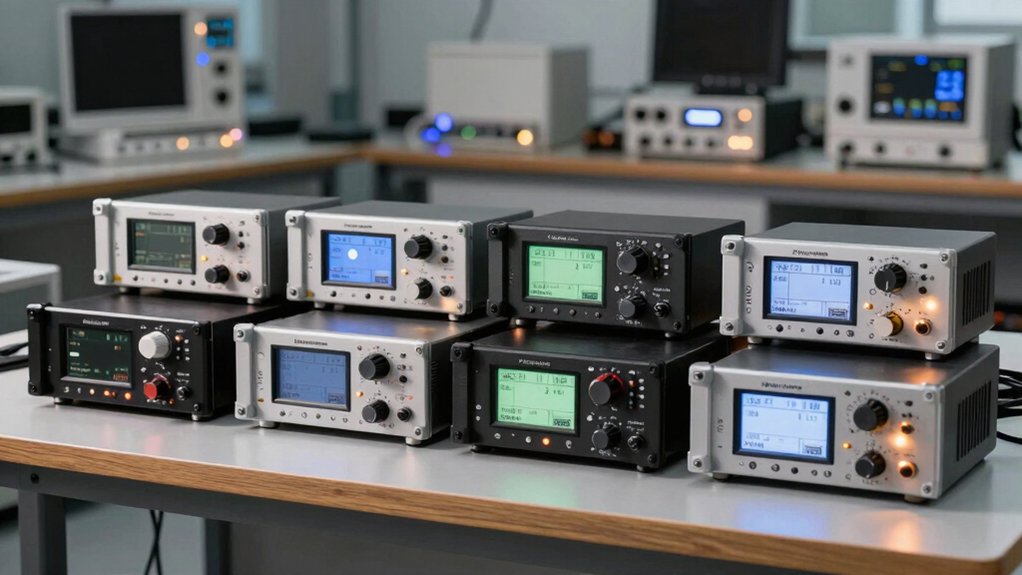

When you’re testing electronic circuits and systems, you’ll need a signal generator that matches your specific requirements. You can choose from portable battery-powered models for fieldwork or bench-mounted devices for lab precision. Your decision depends on frequency range, waveform options, and measurement accuracy. Understanding these categories helps you select the right tool—and we’ll show you how to evaluate each option.
| Riiai SG003A 4-20mA Current Signal Generator for PLC Testing |

| Best For PLC Testing | Maximum Frequency Output: 9,999 Hz (0-9999 Hz pulse) | Waveform Types Supported: Sine, square, triangle, sawtooth, pulse, custom curves | Channels: Single channel | VIEW LATEST PRICE | Read Our Analysis |
| Seesii 60MHz DDS Signal Generator Counter Function Meter |

| Professional Grade | Maximum Frequency Output: 60 MHz | Waveform Types Supported: Sine, square, triangle, sawtooth, pulse, white noise, user-defined | Channels: Dual-channel | VIEW LATEST PRICE | Read Our Analysis |
| Adjustable Signal Generator 4-20mA 0-12V DC Analog Simulator |
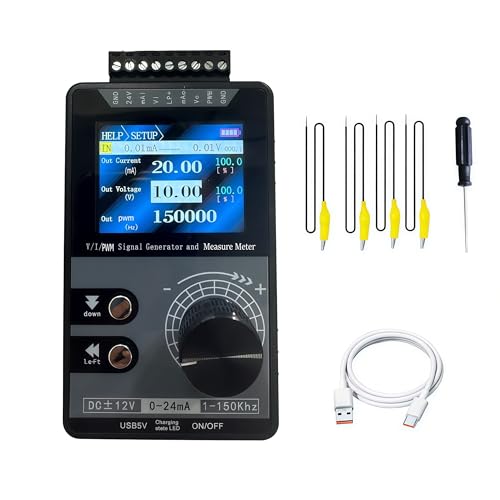
| Best Value | Maximum Frequency Output: 150 kHz (PWM) | Waveform Types Supported: Voltage/current simulation, PWM output | Channels: Single channel | VIEW LATEST PRICE | Read Our Analysis |
| XR2206 Signal Generator Kit 1Hz-1MHz Adjustable |

| Best For Beginners | Maximum Frequency Output: 1 MHz | Waveform Types Supported: Sine, triangle, square | Channels: Single channel | VIEW LATEST PRICE | Read Our Analysis |
| Rigol DG1022Z Function/Arbitrary Waveform Generator 25MHz |

| Most Versatile | Maximum Frequency Output: 25 MHz | Waveform Types Supported: Multiple waveforms (specifications not fully detailed) | Channels: 2 channels | VIEW LATEST PRICE | Read Our Analysis |
| Koolertron DDS Signal Generator Counter 80MHz Display |

| Best Overall | Maximum Frequency Output: 80 MHz | Waveform Types Supported: Sine, square, triangle, sawtooth, pulse, white noise, user-defined | Channels: Dual-channel | VIEW LATEST PRICE | Read Our Analysis |
| Seesii DDS Signal Generator Counter with LCD Display (FG-615) |

| Best For Labs | Maximum Frequency Output: 15 MHz | Waveform Types Supported: Sine, square, triangle, sawtooth, pulse, white noise, user-defined | Channels: Dual-channel | VIEW LATEST PRICE | Read Our Analysis |
| DDS Signal Generator 1Hz-500kHz with Schumann Resonator |

| Unique Niche Pick | Maximum Frequency Output: 500 kHz | Waveform Types Supported: Sine, square, triangle, sawtooth | Channels: Single channel | VIEW LATEST PRICE | Read Our Analysis |
| Signal Generator DGE2070 Arbitrary Waveform 70 MHz Dual Channel |

| High-Performance Option | Maximum Frequency Output: 70 MHz | Waveform Types Supported: 5 basic waveforms + 150 built-in arbitrary waveforms | Channels: 2 channels | VIEW LATEST PRICE | Read Our Analysis |
| ECUTEE Audio Signal Generator 10Hz-1MHz (TAG-101) |

| Budget-Friendly Pick | Maximum Frequency Output: 1 MHz | Waveform Types Supported: Sine, square | Channels: Single channel | VIEW LATEST PRICE | Read Our Analysis |
More Details on Our Top Picks
Riiai SG003A 4-20mA Current Signal Generator for PLC Testing
Need a portable tool that converts multiple signal types for PLC testing? The Riiai SG003A handles 4-20mA current, 0-24V voltage, passive current, and Hz pulse signals with 0.01 precision across modes. You’ll operate it through a 2.4-inch color screen with adjustable backlight for day or night use. The device outputs three automatic modes: single ascent, single drop, and loop cycles. Its 3000 mAh rechargeable battery runs up to 26 hours per charge. You can display real-time curves, set preset values, and switch between input waveform graphs. The compact design measures 4.41 × 3.23 × 1.06 inches and weighs 1.08 pounds, fitting easily into toolkits for on-site testing applications.
- Maximum Frequency Output:9,999 Hz (0-9999 Hz pulse)
- Waveform Types Supported:Sine, square, triangle, sawtooth, pulse, custom curves
- Channels:Single channel
- Display Type:2.4-inch TFT color screen (240×320)
- Power Source:Built-in 3000 mAh USB rechargeable battery (3.7V)
- Primary Application:PLC testing and analog simulation
- Additional Feature:26-hour battery runtime
- Additional Feature:Real-time curve display
- Additional Feature:Auto/preset output modes
Seesii 60MHz DDS Signal Generator Counter Function Meter
When you’re working with dual-channel waveform generation, the Seesii 60MHz DDS Signal Generator delivers professional-grade precision that handles both standard and custom signals. You’ll access sine, square, triangle, sawtooth, pulse, and white noise waveforms with independent channel controls for each. The unit stores up to 99 instrument configurations and 60 custom waveforms for offline operation. Its FPGA architecture and active-crystal oscillator provide 0.1% precision across measurements. You can perform frequency sweeps, measure periods and pulse widths, and count signals directly. The compact design suits laboratories, production lines, and field testing environments where reliable signal generation matters.
- Maximum Frequency Output:60 MHz
- Waveform Types Supported:Sine, square, triangle, sawtooth, pulse, white noise, user-defined
- Channels:Dual-channel
- Display Type:Intuitive control panel (display type not specified)
- Power Source:AC powered (specifications not detailed)
- Primary Application:Electronic engineering, laboratories, teaching, scientific research
- Additional Feature:99 saved instrument configurations
- Additional Feature:Frequency sweep functions
- Additional Feature:Measurement/counting capabilities
Adjustable Signal Generator 4-20mA 0-12V DC Analog Simulator
Engineers who need versatile analog signal simulation without overspending should consider this adjustable generator—it delivers dual output modes (voltage and current) in one compact unit. Select voltage output for 0–12V adjustments or current output for 4–20mA simulation. The built-in 3.7V lithium battery (1500mAh) runs 1–5 hours per charge depending on load. Calibration accuracy reaches 0.03V and 0.05mA respectively. Short-circuit protection safeguards your equipment. You’ll also access PWM output (1–150 kHz adjustable) for controller testing. The device retains settings when powered off, making it reliable for field work and lab calibration tasks.
- Maximum Frequency Output:150 kHz (PWM)
- Waveform Types Supported:Voltage/current simulation, PWM output
- Channels:Single channel
- Display Type:Digital display (specifications not detailed)
- Power Source:Built-in 1500 mAh lithium battery (3.7V)
- Primary Application:PLC controller testing, voltage/current simulation
- Additional Feature:1500mAh battery capacity
- Additional Feature:PWM output 1-150kHz
- Additional Feature:Short-circuit protection included
XR2206 Signal Generator Kit 1Hz-1MHz Adjustable
The XR2206 Signal Generator Kit offers an accessible entry point into function signal generation, requiring only basic soldering skills and a 9–12 V DC power source to assemble. You’ll generate sine, triangle, and square waveforms across 1 Hz to 1 MHz. The sine and triangle outputs reach 0–3 V with less than 1% distortion at 1 kHz, while square waves deliver 8 V unloaded with rise times under 50 nanoseconds. The kit maintains ±0.05 dB flatness from 1 Hz to 100 kHz, making it reliable for audio testing and circuit development. Its 600 Ω impedance suits standard lab equipment. Assemble the transparent case kit yourself, then connect your power supply and begin testing immediately.
- Maximum Frequency Output:1 MHz
- Waveform Types Supported:Sine, triangle, square
- Channels:Single channel
- Display Type:No display (DIY kit module)
- Power Source:9-12V DC input (external)
- Primary Application:DIY kit for hobbyists and educational use
- Additional Feature:DIY soldering kit required
- Additional Feature:<1% distortion at 1kHz
- Additional Feature:Transparent case assembly visibility
Rigol DG1022Z Function/Arbitrary Waveform Generator 25MHz
Rigol’s DG1022Z offers the most versatile dual-channel setup for labs needing simultaneous signal generation across multiple test points. You’ll generate frequencies up to 25MHz with 14-bit vertical resolution, ensuring precise waveform control. The 2M-point arbitrary waveform memory lets you create and store complex custom signals for repeatable testing. You can produce standard waveforms—sine, square, triangle—or design proprietary patterns matching your exact specifications. The two independent channels operate simultaneously, allowing you to test circuit responses to multiple signals at once. At 7.7 pounds, it’s portable enough for bench work or field deployment. This makes it ideal when you need reliability and flexibility in one compact instrument.
- Maximum Frequency Output:25 MHz
- Waveform Types Supported:Multiple waveforms (specifications not fully detailed)
- Channels:2 channels
- Display Type:Digital display (specifications not detailed)
- Power Source:AC powered (specifications not detailed)
- Primary Application:Electronic engineering, laboratories, teaching, scientific research
- Additional Feature:2M points arbitrary memory
- Additional Feature:14-bit vertical resolution
- Additional Feature:2-channel independent operation
Koolertron DDS Signal Generator Counter 80MHz Display
Want a signal generator that handles both basic and advanced testing without requiring a computer? The Koolertron DDS Signal Generator Counter delivers dual-channel output up to 80 MHz with a 2.8″ display for standalone operation. You’ll generate sine waves, squares, triangles, sawtooches, pulses, and custom waveforms using its 14-bit resolution and 275 MSa/s sampling rate. Store up to 100 instrument configurations for quick recall. You can perform frequency sweeps, measure signal parameters, and count pulses directly on the device. Alternatively, you’ll control everything through included PC software or download the mobile app to adjust settings remotely. The built-in FPGA and active crystal oscillator ensure stable, low-distortion output suitable for calibration, laboratory work, and production testing.
- Maximum Frequency Output:80 MHz
- Waveform Types Supported:Sine, square, triangle, sawtooth, pulse, white noise, user-defined
- Channels:Dual-channel
- Display Type:2.8-inch screen
- Power Source:AC powered (specifications not detailed)
- Primary Application:Electronic engineering, laboratories, teaching, scientific research
- Additional Feature:Mobile app control capability
- Additional Feature:100 saved parameter groups
- Additional Feature:PC software waveform drawing
Seesii DDS Signal Generator Counter with LCD Display (FG-615)
Need a dual-channel signal generator that handles lab work without breaking your budget? The Seesii FG-615 delivers dual-channel capability with a 15MHz sine output and 200 MSa/s sampling rate. You’ll access five standard waveforms—sine, square, triangle, sawtooth, and pulse—plus white noise and user-defined options across 60 save slots. Set parameters independently on each channel, then store up to 99 instrument states for quick recall. The frequency meter includes linear and logarithmic sweep functions, measuring frequency, period, pulse width, and counts. Input settings accommodate signals up to 20 volts. Built on FPGA architecture with active crystal oscillator technology, this unit maintains stable, low-distortion output. Compact and portable, it suits electronics labs, production lines, teaching environments, and research applications.
- Maximum Frequency Output:15 MHz
- Waveform Types Supported:Sine, square, triangle, sawtooth, pulse, white noise, user-defined
- Channels:Dual-channel
- Display Type:LCD display
- Power Source:AC powered (specifications not detailed)
- Primary Application:Electronic engineering, laboratories, teaching, scientific research
- Additional Feature:60 user-defined waveform slots
- Additional Feature:Active crystal oscillator stability
- Additional Feature:Linear/logarithmic frequency sweep
DDS Signal Generator 1Hz-500kHz with Schumann Resonator
This versatile 1Hz-500kHz DDS signal generator stands out as a unique niche pick for engineers who need both precision testing capabilities and integrated wellness features. You’ll generate sine, square, triangle, and sawtooth waveforms with switchable filtering for exact outputs. The device uses quality pulse chips and correction capacitance to maintain frequency stability during oscilloscope calibration and audio amplifier testing. You can power it through an AC/DC adapter or external battery pack, making it portable for labs and field work. The integrated 7.83Hz Schumann resonator provides documented relaxation benefits while you conduct technical testing, combining professional instrumentation with wellness functionality in one compact package.
- Maximum Frequency Output:500 kHz
- Waveform Types Supported:Sine, square, triangle, sawtooth
- Channels:Single channel
- Display Type:No built-in display
- Power Source:AC/DC adapter or external battery pack
- Primary Application:Oscilloscope calibration, audio amplifier testing, stress relief
- Additional Feature:7.83Hz Schumann resonator included
- Additional Feature:Switchable sine/pulse filter
- Additional Feature:Dual AC/DC power options
Signal Generator DGE2070 Arbitrary Waveform 70 MHz Dual Channel
For engineers who require simultaneous dual-channel waveform generation, the DGE2070 delivers a high-performance option with 70 MHz output capability and independent channel control. You’ll access 5 basic waveforms plus 150 built-in arbitrary waveforms, with customizable lengths up to 8K samples. The 14-bit vertical resolution and 300 MSa/s sample rate ensure precise signal creation. You can apply comprehensive modulation options including AM, FM, PM, FSK, Sweep, and Burst across both channels. The 3.6-inch TFT display shows real-time waveform status and menu settings for each channel. You’ll configure brightness, language, and load settings directly through shortcut keys, streamlining your workflow and reducing setup time.
- Maximum Frequency Output:70 MHz
- Waveform Types Supported:5 basic waveforms + 150 built-in arbitrary waveforms
- Channels:2 channels
- Display Type:3.6-inch TFT color LCD display
- Power Source:USB connectivity with AC/DC power (specifications not detailed)
- Primary Application:General waveform generation and testing
- Additional Feature:150 built-in arbitrary waveforms
- Additional Feature:AM/FM/PM/FSK modulation support
- Additional Feature:3.6-inch TFT color LCD
ECUTEE Audio Signal Generator 10Hz-1MHz (TAG-101)
The ECUTEE TAG-101 works well as your budget-friendly pick for basic audio signal testing across a broad frequency spectrum. You’ll generate sine and square waveforms across 10 Hz to 1 MHz using five selectable ranges and a single graduated scale for calibration. The 6-step attenuator lets you adjust output in 10 dB increments, delivering over 5 Vrms without a load or 2.8 Vrms into 600 Ω loads. Mount the vertical panel assembly for convenient operation, then use the device to measure amplifier gain and perform routine audio testing. Its durable construction supports extended use in lab environments.
- Maximum Frequency Output:1 MHz
- Waveform Types Supported:Sine, square
- Channels:Single channel
- Display Type:Vertical panel with graduated scale
- Power Source:110V AC powered
- Primary Application:Audio signal generation, amplifier gain measurement
- Additional Feature:6-step 10dB attenuator
- Additional Feature:Single graduated scale calibration
- Additional Feature:Vertical panel integration design
Factors to Consider When Choosing a Signal Generator
You’ll need to evaluate several key criteria before purchasing a signal generator, starting with the frequency range and waveform types that match your specific testing requirements. Consider whether you need portability and battery operation, or if a stationary AC-powered unit works for your lab setup, then review the measurement and testing features available such as frequency accuracy, amplitude control, and output impedance matching. Cross-reference these factors against your budget and intended applications to narrow down which generator will deliver the precision and functionality your projects demand.
Factors to Consider When Choosing Signal Generator
What specifications matter most when you’re selecting a signal generator for your testing work? Start by checking the maximum output frequency—you’ll need at least 80 MHz or 60 MHz depending on your signal requirements. Next, evaluate available waveforms like sine, square, triangle, and sawtooth to match your test needs. Verify the sample rate and vertical resolution, typically 14-bit, for accurate signal reproduction. Review modulation capabilities including AM, FM, PM, and FSK to support your applications. Confirm output options—whether TTL or analog outputs align with your equipment interfaces. Finally, assess control methods: PC software, app access, or built-in displays determine your operational flexibility. Examine distortion specifications to ensure signal fidelity meets your calibration standards.
Frequency Range And Capability
How broad does your frequency range need to be? Your application determines this requirement. For basic audio work, you’ll need generators covering 1 Hz to a few kilohertz. RF and high-speed testing demand outputs reaching 60 MHz to 80 MHz or higher. DDS-based generators provide digitally synthesized ranges with fine granularity, letting you set precise frequency steps. Consider whether you need sweep functionality—linear or logarithmic sweeps expand your coverage for calibration and measurement across broad spectrums. Arbitrary waveform capabilities often accompany wide frequency support, enabling you to generate complex sequences across multiple bands. Match your generator’s frequency range directly to your testing requirements. Overshooting your needs wastes budget; undershooting creates limitations later.
Waveform Types And Customization
Once you’ve determined your frequency range, the next consideration is what waveform shapes your generator can produce. Standard waveforms include sine, square, triangle, and sawtooth patterns. You’ll want a generator offering multiple waveform types because different applications require different signal shapes. Beyond basics, look for generators with specialized options like PWM, burst, or swept signals for your specific testing needs. Independent channel control lets you run different waveforms simultaneously on separate channels, which is essential for complex testing scenarios. User-defined waveform storage—typically 60 to 99 slots—enables you to save and quickly recall custom configurations. Arbitrary waveform capacity matters too; generators with 2 million points or 8K waveform storage provide high-resolution, intricate signal shapes for advanced applications.
Power Source And Portability
Battery capability and charging options are crucial factors that directly affect whether you can use your signal generator in the field or must keep it tethered to an AC outlet. Check if the model includes a rechargeable Li-ion battery pack (typically 3000 mAh or higher) for portable operation. Review the battery life specification—some units run up to 26 hours on a single charge. Verify the charging interface and time required; most models use micro USB 5V charging with full recharge times between 4–6 hours. Examine power protection features like charging protection, reverse connection protection, and short-circuit safeguards. Lighter, compact units with integrated batteries are easier to transport for field testing. AC-only models restrict you to stationary locations with outlet access.
Measurement And Testing Features
Beyond ensuring your signal generator runs reliably in the field or lab, you’ll want to confirm it can accurately measure and analyze the signals it produces. Look for generators offering frequency, period, and pulse width measurements to quantify signal timing. Check whether the device performs frequency sweeps—both linear and logarithmic—to test how your equipment responds across different ranges and identify bandwidth limits. Verify measurement resolution and accuracy specifications, such as 0.1% precision in TTL outputs or 14-bit vertical resolution for waveform quality. Confirm the generator supports independent channel control with low-distortion output specs to prevent measurement errors. Finally, ensure it stores multiple instrument states and waveform slots, allowing you to quickly recall and compare previous test configurations during ongoing development work.
Final Thoughts
You’ll choose a signal generator by matching your testing needs to specific features. First, identify your required frequency range and resolution. Next, decide between portable battery models for field work or bench units for lab precision. Then, confirm the waveform types and modulation options you need. Finally, check memory capacity and configuration storage. Compare your list against available models to find the best fit for your application.

Meet Ry, “TechGuru,” a 36-year-old technology enthusiast with a deep passion for tech innovations. With extensive experience, he specializes in gaming hardware and software, and has expertise in gadgets, custom PCs, and audio.
Besides writing about tech and reviewing new products, he enjoys traveling, hiking, and photography. Committed to keeping up with the latest industry trends, he aims to guide readers in making informed tech decisions.