
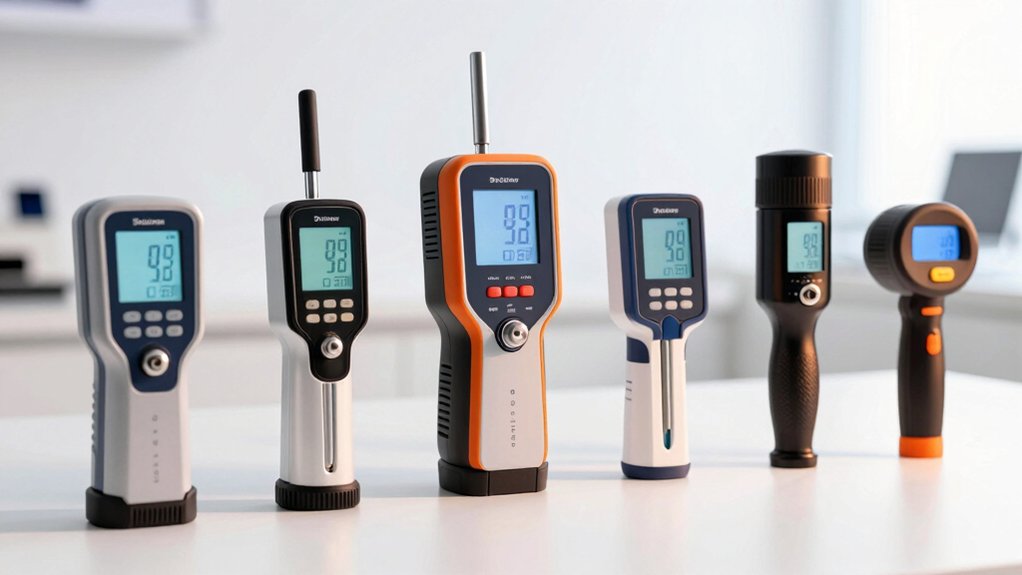

When you’re choosing a turbidity meter, you need to understand what separates reliable models from mediocre ones. You’ll want ISO 7027 compliance, 0–1000 NTU range, and 90° scattered light measurement for accurate water quality testing. You should also verify two-point calibration, data logging capability, and portability for field work. Here’s what you need to know about five turbidity meters that deliver the performance and durability you’re looking for.
| VEVOR Turbidity Meter 0-1000 NTU Portable |

| Best Wide-Range Performance | Measurement Range: 0–1000 NTU | Measurement Method: 90° light scattering | Display Type: Large TFT color screen | VIEW LATEST PRICE | Read Our Analysis |
| Sper Scientific Turbidity Meter Water Quality Tester (860040) |

| Best for Professionals | Measurement Range: Not specified | Measurement Method: Nephelometric method (light scattering) | Display Type: Large LCD display | VIEW LATEST PRICE | Read Our Analysis |
| Portable Handheld Turbidimeter 0-200 NTU LCD Display |

| Best Portable Option | Measurement Range: 0–200 NTU | Measurement Method: 90° scattered light method | Display Type: LCD display with backlight | VIEW LATEST PRICE | Read Our Analysis |
| Portable Digital Water Turbidity Meter WGZ-1B |

| Best Budget-Friendly Pick | Measurement Range: 0–200 NTU | Measurement Method: 90° scattered light turbidity measurement | Display Type: Digital readout | VIEW LATEST PRICE | Read Our Analysis |
| Digital Turbidity Meter Handheld Tester (AMT27) |

| Best Data Management Features | Measurement Range: 0–1100 NTU/FNU | Measurement Method: Not specified | Display Type: Digital display | VIEW LATEST PRICE | Read Our Analysis |
More Details on Our Top Picks
VEVOR Turbidity Meter 0-1000 NTU Portable
The VEVOR Turbidity Meter works best for you if you’re monitoring water clarity across different environments—whether that’s a laboratory testing low-turbidity samples or an industrial facility handling high-turbidity wastewater. This portable device covers 0–1000 NTU range with ISO 7027 compliance, using 90° light scattering for standardized measurements. You’ll get real-time readings on its large TFT color screen with auto-ranging capability across three scales: 0.01–19.99, 20.0–99.9, and 100–1000 NTU. The kit includes calibration solutions, sample vials, and cleaning materials for immediate field or lab use. Operation involves 10 consecutive readings that automatically compute the mean, providing reliable results. Four AA batteries power the device, making it deployable anywhere without external charging requirements.
- Measurement Range:0–1000 NTU
- Measurement Method:90° light scattering
- Display Type:Large TFT color screen
- Calibration:0–800 NTU calibration kit included
- Power Source:4 AA batteries (included)
- Included Accessories:Calibration solutions, sample vials, cleaning kit, carrying case
- Additional Feature:Extended 0-1000 NTU range
- Additional Feature:Real-time operation guidance prompts
- Additional Feature:Average mode: 10 readings
Sper Scientific Turbidity Meter Water Quality Tester (860040)
Looking for a portable turbidity meter that you can deploy in both field and laboratory settings without sacrificing accuracy? The Sper Scientific model 860040 meets ISO 7027 standards using the nephelometric method to measure light scattering in water. You’ll calibrate it in under a minute using its automatic two-point self-calibration feature. The included carry case, calibration solutions for 0 and 100 NTU levels, sample cell bottles, and cleaning cloth support immediate deployment. Its large LCD display shows turbidity levels while autoranging and min/max recall functions simplify data collection. Deploy this meter across water treatment facilities, beverage factories, pharmaceutical operations, and environmental agencies for consistent, reliable water quality testing.
- Measurement Range:Not specified
- Measurement Method:Nephelometric method (light scattering)
- Display Type:Large LCD display
- Calibration:Automatic 2-point self-calibration with solutions
- Power Source:Not specified
- Included Accessories:Carry case, calibration solutions, sample bottles, cleaning cloth
- Additional Feature:Two-point self-calibration under minute
- Additional Feature:Min/max recall functionality
- Additional Feature:Two-piece set included
Portable Handheld Turbidimeter 0-200 NTU LCD Display
Need a turbidity meter that works reliably both in the field and in controlled lab environments? This portable handheld model measures 0-200 NTU with lab-grade accuracy using the 90° scattered light method. You’ll get stable readings within ±1.5% over 30 minutes, with 0.1 readability for precise measurements. The backlit LCD display lets you read results indoors or outdoors without glare interference. Power it with four AA batteries for on-site testing or connect 6V AC power in your lab. The robust optics and extended-life light source minimize downtime, making it ideal for water treatment plants, breweries, environmental testing, and scientific research applications.
- Measurement Range:0–200 NTU
- Measurement Method:90° scattered light method
- Display Type:LCD display with backlight
- Calibration:Not specified
- Power Source:4 AA batteries or 6V AC power
- Included Accessories:Not detailed
- Additional Feature:Dual power options available
- Additional Feature:Backlit LCD display
- Additional Feature:±1.5% stability guarantee
Portable Digital Water Turbidity Meter WGZ-1B
Want a turbidity meter that works across multiple industries without breaking your budget? The WGZ-1B measures water clarity using 90° scattered light technology, detecting suspended solids in liquids from 0–200 NTU with 0.1 NTU precision. You’ll get reliable readings with 8% basic accuracy and 1% repeatability across power plants, waterworks, sewage treatment, beverage factories, and hospitals. The device’s zero drift stays within 1% F.S, ensuring consistent performance over time. Simply immerse the meter’s sensor in your water sample and read the digital display. This portable model handles industrial water quality monitoring, environmental testing, and pharmaceutical applications efficiently. Choose this meter when you need dependable turbidity measurement without specialized training or excessive cost.
- Measurement Range:0–200 NTU
- Measurement Method:90° scattered light turbidity measurement
- Display Type:Digital readout
- Calibration:Not specified
- Power Source:Not specified
- Included Accessories:Not detailed
- Additional Feature:0.1 NTU minimum indication
- Additional Feature:90° scattered light method
- Additional Feature:8% basic error rate
Digital Turbidity Meter Handheld Tester (AMT27)
The AMT27 stands out as the best choice for professionals who need reliable turbidity measurements across multiple measurement standards. You’ll measure turbidity in NTU/FNU, EBC, or ASBC ranges up to 1100, 275, and 9999 respectively. Switch between single and continuous measurement modes depending on your testing needs. Store up to 100 data sets in internal memory, then transfer results via USB to your computer for detailed reporting. You’ll receive calibration standards, glass vials, and a portable case, enabling immediate deployment across water testing environments. The device charges through USB connectivity, ensuring you won’t lose data even when batteries deplete.
- Measurement Range:0–1100 NTU/FNU
- Measurement Method:Not specified
- Display Type:Digital display
- Calibration:Multiple calibration standards included
- Power Source:Batteries with USB backup power option
- Included Accessories:Glass vials, calibration standards, lint-free cloth, portable case
- Additional Feature:Stores up to 100 datasets
- Additional Feature:Multiple measurement units supported
- Additional Feature:USB data transfer connectivity
Factors to Consider When Choosing a Turbidity Meter
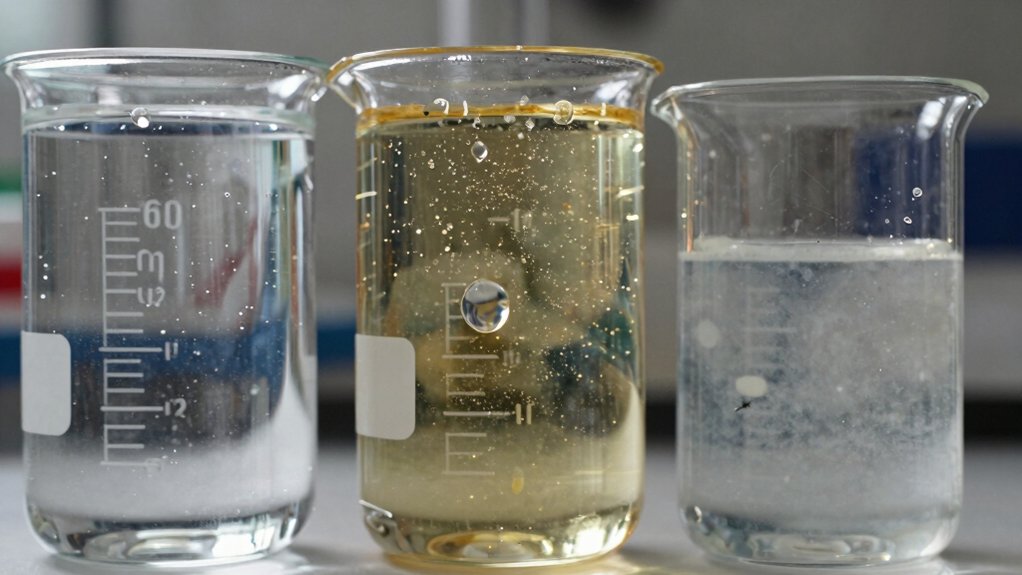
When you’re selecting a turbidity meter, you’ll need to evaluate your measurement range requirements, accuracy levels, and power supply options based on your specific water testing environment. Consider how often you’ll calibrate the device, whether you need portability for field work, and what application-specific features—such as data logging or multiple measurement units—your testing situation demands. Match these factors to your budget and frequency of use to find the meter that’ll serve your needs most effectively.
Measurement Range Requirements
How do you know if a turbidity meter can actually measure your water samples? Check the instrument’s measurement range first. If you’re testing clear water, you’ll need a meter that reads below 10 NTU. For highly turbid samples, select one covering up to 1000 NTU. Auto-ranging models simplify this by automatically shifting between ranges—for example, 0.01–19.99, 20.0–99.9, and 100–1000 NTU—without manual adjustment. Verify the calibration range matches your needs, typically 0–800 NTU for standard use. Match the meter’s range to your expected sample turbidity to avoid out-of-range errors. This prevents repeated measurements and ensures accurate results every time.
Accuracy and Precision Levels
Beyond matching your measurement range, you’ll want to examine how precisely your turbidity meter can report results. Check the accuracy specification—you’ll typically find it listed as a percentage of full scale (F.S.) or as a fixed NTU error. An 8% F.S. rating means less precision than 1% F.S., particularly when measuring across wide ranges. Next, review repeatability specifications, which show how stable readings remain over time (±1% over 30 minutes indicates strong consistency). Verify the calibration method: zero-to-high calibration with auto-ranging ensures measurements stay in the most accurate zone. Finally, examine readout resolution—0.1 NTU increments give you finer detail than 1 NTU increments, especially for low-turbidity samples. These factors directly impact whether your results prove reliable and actionable.
Power Supply and Portability
What’ll keep your turbidity meter running in the field—batteries, USB power, or both? You’ll find three main power options: AA battery-powered models for maximum portability, USB-powered versions for continuous operation, or dual-power designs offering flexibility. Battery-powered meters weigh 3–4 pounds with compact dimensions, making them easy to transport to remote locations. Many include low-battery indicators so you know when replacement’s needed. USB connectivity serves dual purposes: it provides emergency power when batteries deplete and enables data transfer to reduce downtime. For field readiness, select meters with included carry cases and calibration kits. Rechargeable battery options eliminate frequent replacement costs. Choose your power supply based on your work environment and measurement frequency to ensure consistent readings without interruption.
Calibration Ease and Frequency
When you’re selecting a turbidity meter, you’ll want to prioritize calibration simplicity to save time and reduce measurement errors in the field. Look for meters offering automatic two-point self-calibration at 0 NTU and 100 NTU, which streamlines your setup process. Choose models with calibration ranges spanning 0–800 NTU or 0–1000 NTU to handle both low and high turbidity samples accurately. Check for ISO 7027 compliance to ensure your calibration meets industry standards. Select meters featuring auto-ranging and min/max recall functions—these keep measurements within valid ranges and verify stability over time. Verify that your kit includes calibration solutions and dedicated vials for on-site calibration. Frequent calibration maintains accuracy; perform it regularly according to manufacturer guidelines before critical measurements.
Application-Specific Functionality Needs
Your turbidity meter’s capabilities must align with your specific use case, so you’ll want to match the device’s NTU range to your application’s demands. For drinking water quality monitoring, select a meter with 0–200 NTU capability. If you’re testing industrial wastewater, choose equipment rated for 1000 NTU or higher. Next, determine whether you need continuous measurement and data logging for trend analysis, or if spot-check readings suffice. Evaluate your work environment: handheld meters suit field operations, while benchtop models fit laboratory settings. Check power requirements—battery-powered devices offer portability, but AC-powered units provide consistent performance in fixed locations. Finally, assess whether USB data transfer capabilities support your reporting needs.
Final Thoughts
You’ll find that selecting a turbidity meter requires matching the meter’s capabilities to your specific water testing needs. Compare the NTU range, ISO 7027 compliance, and measurement technology across models. Evaluate portability requirements, calibration frequency, and data storage options. Test the display clarity and battery life. Purchase the model that best fits your budget, intended use, and maintenance capacity. Verify the included standards and support options before deciding.

Meet Ry, “TechGuru,” a 36-year-old technology enthusiast with a deep passion for tech innovations. With extensive experience, he specializes in gaming hardware and software, and has expertise in gadgets, custom PCs, and audio.
Besides writing about tech and reviewing new products, he enjoys traveling, hiking, and photography. Committed to keeping up with the latest industry trends, he aims to guide readers in making informed tech decisions.