
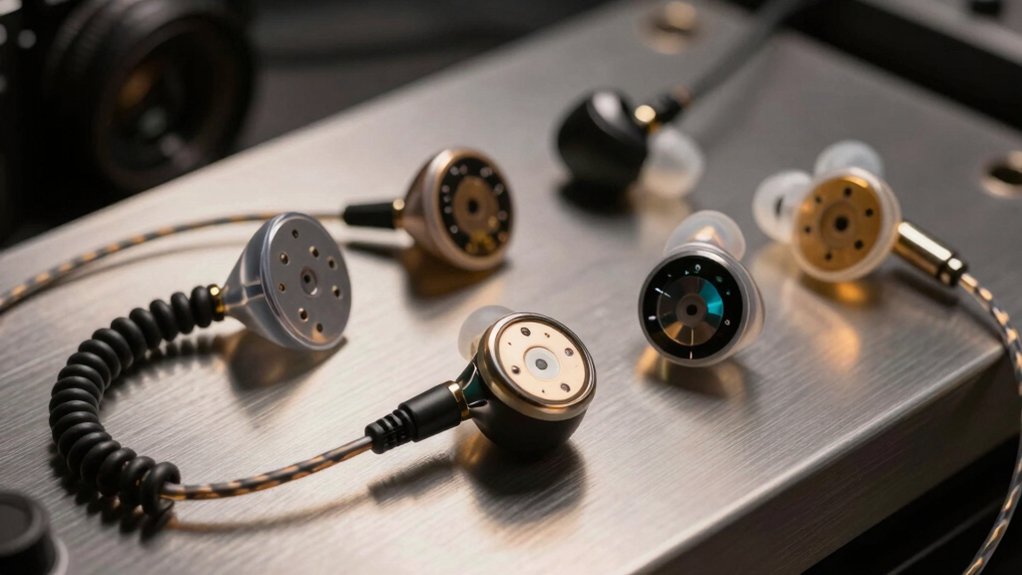

When you’re shopping for wired IEMs, you’ll want to focus on driver configuration, build quality, and cable upgradability. Audio professionals consistently recommend models that deliver balanced sound across frequencies while withstanding daily use. The right choice depends on your priorities—whether you need hybrid drivers for clarity, gaming-focused bass, or compact ergonomics for extended wear. Understanding these core factors will help you narrow down which option suits your needs.
| Linsoul KZ ZS10 Pro Hybrid IEM Earbuds |

| Best for Audiophiles | Driver Configuration: 4BA + 1DD hybrid (5 drivers total) | Frequency Response: 7–40,000 Hz | Cable Type: Detachable gold-plated ODC cable | VIEW LATEST PRICE | Read Our Analysis |
| CCZ Yinyoo Melody In-Ear Monitors Wired Earbuds |

| Best All-Rounder | Driver Configuration: 1BA + 1DD hybrid (2 drivers total) | Frequency Response: 20 Hz–20 kHz | Cable Type: Detachable 4-core 4N OFC wire with 2-pin connector | VIEW LATEST PRICE | Read Our Analysis |
| Linsoul KZ ZS10 Pro Hybrid IEM Earbuds |

| Professional Grade | Driver Configuration: 4BA + 1DD hybrid (5 drivers total) | Frequency Response: 7–40,000 Hz | Cable Type: Detachable gold-plated ODC cable | VIEW LATEST PRICE | Read Our Analysis |
| Ak3file Wired Gaming Earbuds with Deep Bass HiFi Sound |

| Best for Gaming | Driver Configuration: 1DD dynamic (1 driver total) | Frequency Response: 20 Hz–20,000 Hz | Cable Type: Non-detachable 3.5 mm jack cable | VIEW LATEST PRICE | Read Our Analysis |
| CCA CRA In Ear Monitor Headphones with Dynamic Driver |

| Best Budget Option | Driver Configuration: Dual dynamic drivers | Frequency Response: Not specified | Cable Type: OFC double-line parallel cable (detachable) | VIEW LATEST PRICE | Read Our Analysis |
More Details on Our Top Picks
Linsoul KZ ZS10 Pro Hybrid IEM Earbuds
Looking for wired IEMs that’ll deliver professional-grade sound? The Linsoul KZ ZS10 Pro combines four balanced armature drivers with one dynamic driver to handle highs, mids, and bass separately. You’ll get extended highs beyond 40 kHz and dynamic lows with bright resolution. The stainless steel faceplate and resin cavity provide durability for active use. Noise isolation reaches 26 dB, which helps in noisy environments. The ergonomic design, developed from cochlear data, ensures a secure fit during extended wear. You can detach and upgrade the gold-plated cable for different sound profiles. Consider trying a Tripowin cable if you want potential sound improvements.
- Driver Configuration:4BA + 1DD hybrid (5 drivers total)
- Frequency Response:7–40,000 Hz
- Cable Type:Detachable gold-plated ODC cable
- Noise Isolation:Up to 26 dB
- Warranty:1 year
- Intended Use Cases:Musicians, gaming, vigorous activity
- Additional Feature:Extended highs beyond 40 kHz
- Additional Feature:Ergonomic cavity from cochlear data
- Additional Feature:Gold-plated detachable ODC cable
CCZ Yinyoo Melody In-Ear Monitors Wired Earbuds
Are you a musician, studio engineer, or content creator seeking reliable earbuds that handle multiple sound demands equally well? The CCZ Yinyoo Melody delivers hybrid sound through its 1 DD and 1 BA driver setup, producing clear highs and deep bass across the 20 Hz–20 kHz range. Its lightweight 2.3-gram design and ergonomic wrap-around fit reduce ear fatigue during extended sessions. The detachable 2-pin connector lets you upgrade cables without replacing the monitors. Three silicone ear tip sizes ensure proper fit for different ear shapes. Use the inline controls to manage calls and playback. The 110 dB sensitivity drives most devices adequately. This configuration suits studio work, gaming, and live performance equally well.
- Driver Configuration:1BA + 1DD hybrid (2 drivers total)
- Frequency Response:20 Hz–20 kHz
- Cable Type:Detachable 4-core 4N OFC wire with 2-pin connector
- Noise Isolation:Not specified
- Warranty:1 year
- Intended Use Cases:Musicians, singers, stage, studio, gaming, video editing
- Additional Feature:Ultra-lightweight at 2.3g
- Additional Feature:Groove design enhances soundstage
- Additional Feature:Memory ear hook wraparound design
Linsoul KZ ZS10 Pro Hybrid IEM Earbuds
The Linsoul KZ ZS10 Pro delivers professional-grade hybrid sound through its 4BA+1DD driver configuration. You get extended highs beyond 40 kHz paired with dynamic lows for full-range performance. The ergonomic cavity, shaped from cochlear data, ensures secure fit during extended use and vigorous activity. Noise isolation reaches 26 dB, reducing ambient sound effectively. The stainless steel faceplate protects the internal structure, while the detachable gold-plated cable allows upgrades. Consider upgrading to a Tripowin cable for enhanced sound quality. With 111 dB sensitivity and 24-ohm impedance, these earbuds deliver consistent output across devices. The one-year warranty covers manufacturing defects.
- Driver Configuration:4BA + 1DD hybrid (5 drivers total)
- Frequency Response:7–40,000 Hz
- Cable Type:Detachable gold-plated ODC cable
- Noise Isolation:Up to 26 dB
- Warranty:1 year
- Intended Use Cases:Musicians, gaming, music listening
- Additional Feature:PCB dividing board optimization
- Additional Feature:26 dB noise isolation capability
- Additional Feature:Limit slot prevents pin breakage
Ak3file Wired Gaming Earbuds with Deep Bass HiFi Sound
Gamers who demand immersive audio during competitive play’ll find the Ak3file’s 10mm dynamic driver delivers the deep bass and clear mids needed for directional sound cues. The earbuds feature a secure PU memory ear hook and ergonomic design that won’t slip during extended sessions. You’ll get three ear tip sizes to customize fit for comfort and noise isolation blocking roughly 90% of ambient sound. The 16-ohm impedance ensures compatibility with phones, laptops, and tablets through the 3.5mm jack. At 0.05kg, they’re lightweight for travel and exercise. The two-year warranty protects your investment while delivering HiFi sound across bass, mids, and treble frequencies.
- Driver Configuration:1DD dynamic (1 driver total)
- Frequency Response:20 Hz–20,000 Hz
- Cable Type:Non-detachable 3.5 mm jack cable
- Noise Isolation:~90% ambient noise blocking
- Warranty:2 years
- Intended Use Cases:Music, gaming, video calling, travel, exercise
- Additional Feature:10mm dynamic driver emphasis
- Additional Feature:Blocks 90% ambient noise
- Additional Feature:PU memory ear hook included
CCA CRA In Ear Monitor Headphones with Dynamic Driver
Looking for reliable in-ear monitors that won’t drain your budget? The CCA CRA delivers professional-grade performance through its upgraded dual magnetic driver, which strengthens bass response and clarifies vocal separation. The ultra-thin 3.8 μm diaphragm expands frequency range without excessive bass emphasis. You’ll experience crystal-clear detail across all frequencies during performances, recording, and gaming. The ergonomic cavity design with memory hook reduces ear pressure during extended sessions. The metal cavity paired with transparent resin construction ensures durability, while the OFC double-line cable resists tangling. The standard 3.5 mm jack connects to Android devices, tablets, and MP3 players. This model suits musicians, singers, and audio enthusiasts needing dependable monitoring equipment.
- Driver Configuration:Dual dynamic drivers
- Frequency Response:Not specified
- Cable Type:OFC double-line parallel cable (detachable)
- Noise Isolation:Not specified
- Warranty:Not specified
- Intended Use Cases:Musicians, singers, audio enthusiasts, performances, recording, gaming
- Additional Feature:Ultra-thin 3.8μm diaphragm
- Additional Feature:Metal cavity with resin
- Additional Feature:OFC parallel cable tangle-resistant
Factors to Consider When Choosing Wired IEMs (In Ear Monitors)

You’ll want to evaluate five key factors before purchasing wired IEMs: driver configuration and types (single dynamic, balanced armature, or hybrid setups), sound signature and frequency response that matches your listening preferences, comfort and fit quality through proper ear tip selection, build materials and durability for long-term use, and noise isolation capabilities that suit your environment. Start by identifying which driver type produces the sound character you need, then test how the IEMs sit in your ears for extended wear, check the construction quality of the cable and housing, and finally assess whether the passive isolation meets your daily requirements. These decisions determine whether you’ll invest in IEMs that perform reliably for your specific audio work or listening demands.
Driver Configuration And Types
Driver configuration—the combination and arrangement of audio drivers inside an IEM—directly affects how the earpiece reproduces sound across different frequencies. Hybrid models combine balanced armature (BA) drivers with dynamic drivers (DD) to divide responsibilities. BA drivers handle mids and highs with precision and fast transient response, while DD drivers manage bass and overall impact with deeper extension. A typical hybrid might use 4BA drivers plus 1DD or 1BA plus 1DD. The PCB dividing board routes frequencies to each driver type appropriately. This separation allows you to achieve detailed sound across the full range. Consider your listening priorities: if you need crisp vocals and instruments, BA-heavy configs work well. If you prioritize bass punch and warmth, choose DD-dominant setups.
Sound Signature And Frequency Response
How does an IEM’s frequency response shape what you actually hear? Your IEM’s frequency response range—typically 20 Hz to 20 kHz—determines which sounds it can reproduce. The driver type affects how those frequencies sound: balanced armature drivers deliver precise highs and detailed mids, while dynamic drivers produce stronger bass and impact. Hybrid IEMs combine multiple driver types to balance all three ranges cohesively. When evaluating specs, focus on the 20 Hz–20 kHz range most listeners perceive; treble extension beyond 40 kHz offers minimal practical benefit unless paired with quality crossover design. Check your IEM’s sensitivity and impedance ratings too—higher sensitivity (like 111 dB@1 mW) means louder output from your device, affecting how the entire frequency spectrum sounds across your equipment.
Comfort And Fit Quality
What makes an IEM comfortable for hours of listening? You need to match the earpiece design to your ear’s unique shape and your intended use. Start by examining the ergonomic cavity design, which mirrors cochlear data to secure a proper fit. Next, check the weight—lightweight earpieces around 2.3 grams per unit reduce ear pressure and fatigue during extended wear. Consider the ear design: wrap-around styles with memory ear hooks keep earpieces stable during gaming or running. Then evaluate the seal system. In-ear fins or soft TPE tips in multiple sizes prevent slipping and improve comfort. Finally, assess cable options. Memory wire or detachable cables reduce connector strain during vigorous activity. Test each combination to find your optimal comfort setup.
Build Materials And Durability
When you’re evaluating wired IEMs for long-term use, the materials used in their construction directly determine how well they’ll withstand daily wear and maintain their performance. Look for stainless steel faceplates, such as 304 stainless steel, which resist corrosion and damage from sweat and moisture. Check that the cavity uses imported or high-quality resin for structural integrity and acoustic stability. Verify the cables are detachable with gold-plated connectors—this design lets you replace worn cables without replacing the entire unit. Inspect the internal PCB divisions and slot protection to prevent pin damage. Finally, choose models with metal or hybrid enclosures paired with reinforced cables if you’ll use your IEMs during vigorous activity. These choices ensure your investment lasts.
Noise Isolation Capabilities
Noise isolation in wired IEMs works by physically blocking ambient sound from entering your ear canal, and you’ll find that most models rely entirely on passive isolation rather than active noise cancellation. The effectiveness of isolation depends on fit and seal quality. You need to ensure the silicone tips create a snug, secure fit that forms a complete seal within your ear canal. Multiple tip sizes allow you to find the right fit for each ear. Materials like custom-like cavity designs and ergonomic shapes enhance passive sealing. Poor fit or loose seals drastically reduce isolation performance. Test different tip sizes and insertion depths to achieve consistent blocking of environmental sounds. Premium wired IEMs can deliver isolation levels up to 26 dB.
Cable Design And Upgradability
Because detachable cables are standard on quality wired IEMs, you’ll want to understand how cable design affects your listening experience and long-term value. Check the connector type—2-pin or gold-plated interfaces determine compatibility with replacement cables. Examine the cable material: 4N OFC copper and gold-plated contacts improve signal quality and prevent corrosion. Upgradable cables let you customize resistance and flexibility without replacing your earpieces. Detachable designs reduce wear on connectors, extending equipment life. Consider limit slot protection features, which safeguard interfaces during repeated connections. Test different cable variants to see how they influence microphonics and fit. Evaluate whether your IEMs come with multiple cable options or random deliveries. Prioritize cables that balance durability, conductance, and your specific listening needs.
Impedance And Sensitivity Specifications
After you’ve selected a cable design that suits your needs, you’ll want to examine your IEM’s impedance and sensitivity ratings—two electrical specifications that determine how your earpieces interact with your audio source. Impedance measures electrical resistance, affecting how much voltage your source must supply for desired output levels. Lower impedance (16–24 ohms) works better with portable players but risks amplifier hiss. Sensitivity indicates loudness per input power, measured in dB/mW or dB/V. Higher sensitivity (100–110 dB/mW) produces more volume with minimal power, requiring less capable sources. Match these specs to your device: pairing low-impedance, high-sensitivity IEMs with smartphones prevents excessive volume and distortion while maintaining adequate headroom for dynamic music passages.
Intended Use Cases And Applications
What’ll you be using your wired IEMs for—stage performances, studio work, gaming, or everyday listening? Each application demands different features. For stage use, prioritize secure fit, strong isolation, and accurate vocal-to-instrument separation; hybrid or dual-driver configurations deliver the clarity you need. Studio and gaming work benefit from flatter, detailed high-frequency response for precise audio cueing without excessive bass coloration. Choose detachable cables and robust housings if you’ll move frequently or swap cables often. Verify 3.5 mm jack compatibility with your equipment. Select low-impedance designs around 16–24 ohms for reliable loudness when performing in noisy environments. Match your IEM’s specifications directly to your specific activity to avoid purchasing features you won’t use.
Final Thoughts
You’ve reviewed five reliable wired IEMs that pros depend on. Start by identifying your priority: hybrid sound (KZ ZS10 Pro), compact comfort (Yinyoo Melody), gaming performance (AK3file), or balanced mids (CRA). Check that your choice has detachable cables and durable housing. Compare prices and read user reviews for your specific use case. Purchase from established retailers to ensure warranty coverage and authentic products.

Meet Ry, “TechGuru,” a 36-year-old technology enthusiast with a deep passion for tech innovations. With extensive experience, he specializes in gaming hardware and software, and has expertise in gadgets, custom PCs, and audio.
Besides writing about tech and reviewing new products, he enjoys traveling, hiking, and photography. Committed to keeping up with the latest industry trends, he aims to guide readers in making informed tech decisions.