
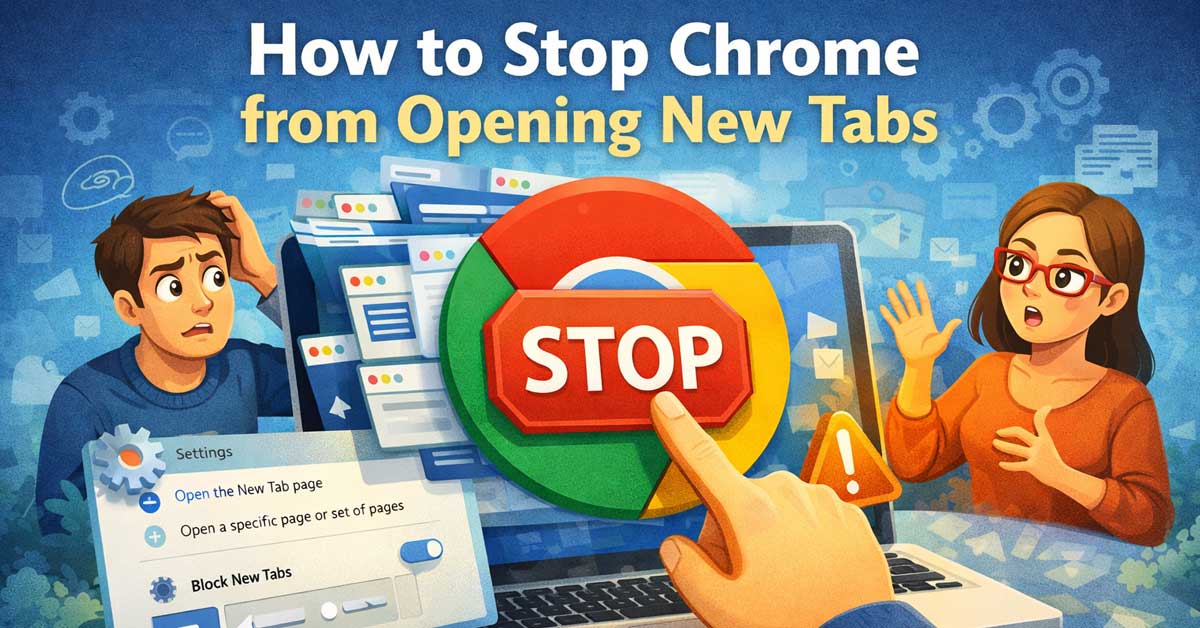

Usually a setting, extension, or malware issue — here’s how to identify which and fix it
Chrome opening new tabs when you don’t want it to covers several distinct scenarios — tabs opening on startup, links opening in new tabs instead of the current one, tabs appearing randomly without any action, or a specific site hijacking your browser with popups.
The fix depends entirely on which of these is happening. Identifying the specific behavior narrows the cause immediately.
New Tabs Opening on Startup
If Chrome opens multiple tabs or a specific page in a new tab every time you launch it, the startup settings are controlling this behavior.
Go to Chrome Settings → On Startup. You’ll see three options: Open the New Tab page, Continue where you left off, and Open a specific page or set of pages.
Continue where you left off reopens every tab from your previous session. If you had fifteen tabs open when Chrome closed, you get fifteen tabs on the next launch. Switch to Open the New Tab page to start fresh with a single tab every time.
Open a specific page or set of pages lists URLs that open automatically on startup. If unexpected pages are listed here, remove them by clicking the three dots next to each entry and selecting Remove. Unwanted startup pages are sometimes added by extensions or software without obvious notification.
Links Opening in New Tabs Instead of the Current Tab
When clicking links opens them in a new tab rather than loading in the current tab, this is usually the website’s behavior rather than Chrome’s. Sites add target="_blank" to their links to force new tab opens — a deliberate design choice by the website developer.
Chrome doesn’t have a built-in setting to override this behavior globally, but an extension can handle it. Open Link in Same Tab and similar extensions intercept these forced new tab links and load them in the current tab instead. Search the Chrome Web Store for this type of extension if you consistently want links to stay in the current tab.
Middle-clicking a link or Ctrl + clicking also opens links in new tabs — this is intentional Chrome behavior for when you want to open something without leaving your current page. If you’ve been doing this accidentally, standard left-clicking opens links in the same tab.
The Address Bar Opening New Tabs
If typing in the address bar and pressing Enter opens a new tab instead of loading in the current one, the most likely cause is accidentally pressing Alt + Enter instead of just Enter. Alt + Enter is Chrome’s shortcut to open the address bar result in a new tab — easy to trigger accidentally on laptop keyboards.
Use Enter only when you want to load in the current tab. If this keeps happening without Alt being involved, check whether a keyboard shortcut has been remapped by an extension or system software.
Tabs Opening Randomly Without Any Action
If new tabs appear without you clicking anything — while reading, while the browser is idle, or immediately on launch — this is the most concerning scenario. It almost always points to one of three causes: a misbehaving extension, a notification or permission that was granted to a site, or malware.
Check your extensions first. Go to chrome://extensions and review everything installed. Extensions with broad permissions — particularly ones you don’t remember installing or ones with vague names — can open tabs autonomously. Disable all extensions temporarily and see if the random tab opening stops.
If it stops with extensions disabled, re-enable them one at a time to identify the culprit. Remove the offending extension immediately.
Check site notification permissions. Some sites request permission to send notifications and use that access to open new tabs or redirect the browser. Go to Chrome Settings → Privacy and Security → Site Settings → Notifications. Review the Allow list and remove any sites you don’t recognize or didn’t deliberately allow.
Check site permissions for pop-ups and redirects. Go to Chrome Settings → Privacy and Security → Site Settings → Pop-ups and Redirects. Make sure it’s set to Don’t allow sites to send pop-ups or use redirects. If any sites are listed in the Allowed section that you didn’t add intentionally, remove them.
New Tabs Opening to Advertising or Unfamiliar Sites
If new tabs open to ad-heavy pages, fake security warnings, unfamiliar search engines, or suspicious sites, this is a reliable indicator of browser hijacking or malware — not a settings issue.
Run Chrome’s built-in cleanup tool first. Go to Chrome Settings → Reset and Clean Up → Clean Up Computer. Chrome scans for harmful software and offers to remove it. This catches many common browser hijackers.
Run Malwarebytes. Download the free version from malwarebytes.com and run a full scan. Malwarebytes specifically detects browser hijackers and adware that Chrome’s own tool sometimes misses.
Check your extensions again with extra scrutiny. Malicious extensions often disguise themselves as useful tools — PDF converters, screenshot tools, coupon finders. If you don’t remember installing an extension or can’t identify what it legitimately does, remove it.
Reset Chrome to default settings as a last resort. Go to Chrome Settings → Reset and Clean Up → Restore Settings to Their Original Defaults. This disables all extensions, clears temporary data, and resets all settings — while preserving bookmarks, history, and saved passwords. After resetting, add back only the extensions you genuinely need and trust.
Chrome Reopening Tabs After a Crash
After a crash, Chrome offers to restore your previous session — which can feel like unwanted tabs appearing if you weren’t expecting it.
When Chrome shows the restore prompt after a crash, clicking Restore reopens everything from before the crash. If you consistently don’t want session restoration, go to Chrome Settings → On Startup and switch from Continue where you left off to Open the New Tab page. The restore prompt won’t appear on normal closures after this change.
New Tab Page Loading Unwanted Content
If the issue isn’t extra tabs opening but the new tab page itself showing content you don’t want — news feeds, sponsored shortcuts, or an unfamiliar page entirely — the new tab page has been customized or replaced.
For the default Chrome new tab page, unwanted shortcuts can be removed by hovering over them and clicking the X that appears. Pinned shortcuts can be unpinned the same way.
If the new tab page shows a completely different site — a search engine you didn’t choose, a branded page, or an advertising page — an extension has replaced it. Check your extensions at chrome://extensions and look for anything that controls the new tab page. Remove it and the default Chrome new tab page returns.
Some extensions explicitly state they modify the new tab page — Weather extensions, productivity dashboards, and similar tools do this intentionally. If you installed one and want the default back, removing the extension restores it.
Pop-Ups Opening as New Tabs
Chrome blocks most pop-ups by default, but sites that are specifically allowed to show pop-ups can open them as new tabs. If a specific site keeps spawning new tabs when you interact with it:
Go to Chrome Settings → Privacy and Security → Site Settings → Pop-ups and Redirects. Find the site in the Allowed list and remove it. Future attempts by that site to open pop-ups will be blocked.
A Quick Checklist
Match your symptom to the right fix:
- Multiple tabs on startup — Settings → On Startup → switch to Open the New Tab page
- Links opening in new tabs — install an Open Link in Same Tab extension
- Address bar results opening new tabs — avoid Alt + Enter, use Enter only
- Tabs opening randomly — disable all extensions and test, then check notification permissions
- Tabs opening to ads or unfamiliar sites — run Chrome cleanup tool and Malwarebytes, check extensions
- New tab page showing wrong content — find and remove the extension controlling it
- Pop-ups appearing as new tabs — remove site from pop-ups allowed list in Site Settings
The Bottom Line
Chrome opening unwanted new tabs comes down to startup settings, extension behavior, site permissions, or malware — and which one it is determines whether the fix is a settings change, an extension removal, or a malware scan.
Startup settings and the extension audit resolve the vast majority of cases. Random new tabs opening to ad sites without any user action is the scenario that warrants a malware scan — it’s rarely just a settings issue when that specific pattern appears.
Chrome doesn’t open new tabs on its own — something told it to. Find what gave that instruction and remove it.

Meet Ry, “TechGuru,” a 36-year-old technology enthusiast with a deep passion for tech innovations. With extensive experience, he specializes in gaming hardware and software, and has expertise in gadgets, custom PCs, and audio.
Besides writing about tech and reviewing new products, he enjoys traveling, hiking, and photography. Committed to keeping up with the latest industry trends, he aims to guide readers in making informed tech decisions.