
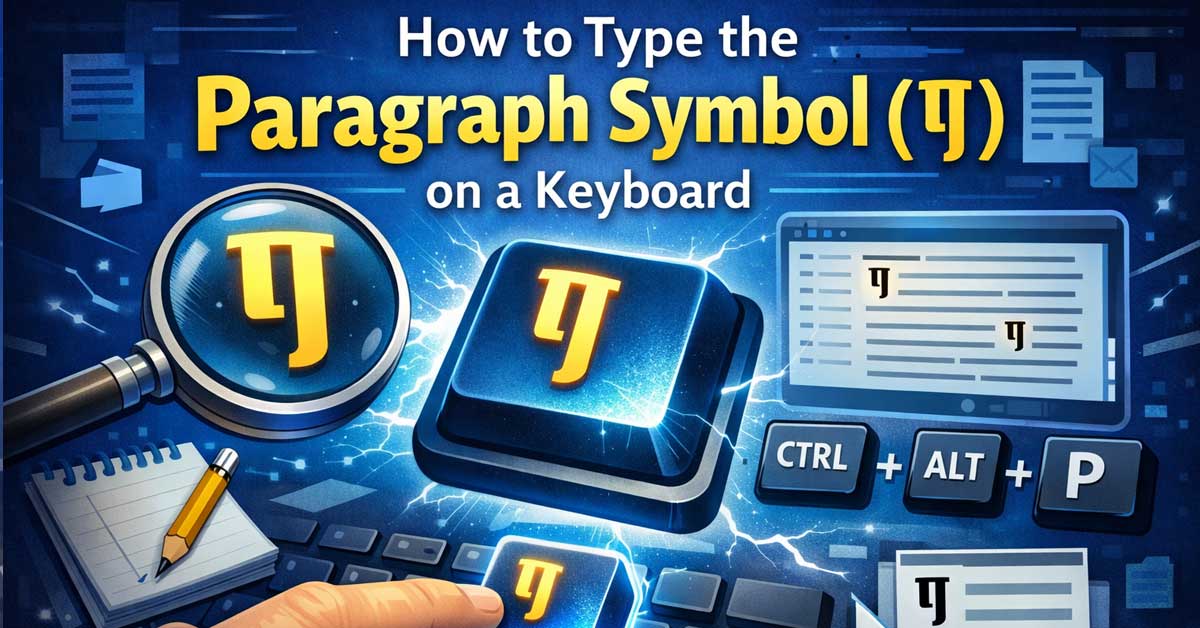

Also called the pilcrow — here’s every method on every platform
The paragraph symbol ¶ (Unicode U+00B6) has a name most people don’t know — the pilcrow — and uses that go well beyond marking paragraphs.
It appears in legal documents to reference specific sections, in proofreading and editing to indicate paragraph breaks, in typography as a formatting mark, and in word processors as a hidden formatting indicator.
It’s not on any standard keyboard but every platform has a reliable way to produce it.
What the Pilcrow Is Used For
¶ — the pilcrow or paragraph sign (U+00B6). Common uses include:
Legal and academic writing where it references a specific paragraph — ¶ 14 means paragraph 14 of a document. In contracts, briefs, and citations this is standard notation.
Proofreading marks indicating where a new paragraph should begin.
Typography and publishing as a visible end-of-paragraph marker.
Microsoft Word’s Show/Hide ¶ button which makes all formatting marks visible — this is the most common context where people see the symbol and want to type it themselves.

SPEED UP YOUR CREATIVE WORKFLOW: Work smarter and faster in Final Cut Pro with preprogrammed editing shortcuts designed for creative professionals. The Dash keyboard...
Windows
Method 1: Alt Code
Hold Alt and type 0182 on the numeric keypad. Release Alt and ¶ appears.
- Num Lock must be on
- Use the numeric keypad only — not the number row
- Doesn’t work on laptops without a dedicated numpad
Method 2: Character Map
Search for Character Map in the Start menu. Find ¶ in the Latin-1 Supplement block, copy, and paste. Works on any Windows machine.
Method 3: System-Wide Text Expansion
Use PhraseExpress, AutoHotkey, or Espanso to map a trigger like \para or pilcrow to ¶ system-wide.
A simple AutoHotkey script:
::\para::¶
Reaper - Colored Shortcut Sticker Keyboard (keys 11.5x13 mm) Keyboard Sticker Shortcut for Reaper are laminated and made with typographical method on high-quality Matt Vinyl...
Mac
Method 1: Keyboard Shortcut
Press Option + 7 to type ¶ instantly.
This is the method to remember on Mac. Works in every application with no setup required — browsers, documents, email, everything.
Method 2: Character Viewer
Press Control + Command + Space to open the Character Viewer. Search “pilcrow” or “paragraph” and double-click ¶ to insert.
Method 3: Text Replacement
Go to System Settings → Keyboard → Text Replacements and map a trigger like \para to ¶. Works system-wide across every Mac app.
iPhone and iPad
Method 1: Text Replacement
Go to Settings → General → Keyboard → Text Replacement. Add ¶ as the phrase and a trigger like \para or pilcrow as the shortcut. Auto-expands in any text field across iOS after setup.
Method 2: Symbols Page
Tap ?123 to switch to numbers and symbols, then tap #+— to reach the extended symbols screen. ¶ may appear on one of these pages depending on your iOS version and keyboard configuration.
Method 3: Copy and Paste
For occasional use, copy ¶ from a reference source and paste where needed. Keep it in a note for easy access.
Android
Method 1: Gboard Symbol Search
In Gboard, tap the G logo and use the search function. Type “pilcrow” or “paragraph” and ¶ appears as an insertable option.
Method 2: Symbol Keyboard
Tap ?123 to switch to numbers and symbols. Look through the available symbol pages — ¶ appears on some Android keyboard configurations without needing a search.
Method 3: Text Replacement
In Gboard settings, go to Dictionary → Personal Dictionary, select your language, and add ¶ with a shortcut like \para. Expands automatically as you type.
Chromebook
Method 1: Unicode Input
Press Ctrl + Shift + U, type 00b6, then press Enter or Space. ¶ appears at your cursor immediately.
Method 2: Special Characters Picker
Press Search + Shift + Space to open the emoji and special characters panel. Search “pilcrow” or “paragraph sign” and select ¶.
Linux
Method 1: Unicode Input
Press Ctrl + Shift + U, type 00b6, then press Enter. Works consistently across most Linux distributions.
Method 2: Compose Key
With a Compose key configured, the sequence is Compose + p + ! or Compose + ! + p on some distributions to produce ¶. Check your specific compose key table as sequences vary.
Microsoft Word (Any Platform)
Method 1: Alt + X
Type 00B6 then immediately press Alt + X. Word converts the Unicode code point to ¶ instantly.
Method 2: Insert Symbol With AutoCorrect
Go to Insert → Symbol → More Symbols. Find ¶ in the Latin-1 Supplement character set or search by name. Click AutoCorrect and set a trigger like \para that Word converts automatically as you type.
Method 3: Alt Code
Hold Alt and type 0182 on the numpad — same as the standard Windows method.
Method 4: Show/Hide Button
Worth noting for Word specifically: if you want to see paragraph marks in your document for formatting purposes rather than type the ¶ character into your text, the Show/Hide button in the Home tab (the ¶ button in the Paragraph group) toggles visible formatting marks on and off. This shows the ¶ at every paragraph end as a formatting guide — it doesn’t insert the symbol into the text.
Google Docs
Option + 7 on Mac works inside Google Docs exactly as it does everywhere else. The Alt code works on Windows inside Docs.
Go to Insert → Special Characters, search “pilcrow” or “paragraph sign,” and click to insert for occasional use.
Legal Writing Conventions
Since legal writing is one of the primary use cases for ¶, it’s worth knowing the conventions around it.
In legal documents and academic citations, ¶ precedes a paragraph number with a thin space or regular space between the symbol and the number: ¶ 14 or ¶14. Multiple paragraphs use the doubled symbol: ¶¶ 14-16.
The doubled paragraph symbol ¶¶ is two pilcrows placed together. Type ¶¶ by simply typing the symbol twice — there’s no dedicated Unicode character for the doubled version. In a text expander, mapping \paras to ¶¶ saves a step when citing multiple paragraphs.
The Section Symbol § — Frequently Confused With ¶
These two symbols appear in the same contexts — particularly legal writing — and are often confused.
§ — the section sign (U+00A7). References a specific section of a document. § 4 means section 4.
¶ — the pilcrow (U+00B6). References a specific paragraph within a section.
To type § on each platform:
- Windows: Alt + 0167 on numpad
- Mac: Option + 6
- iPhone / iPad: Long press on the & key or text replacement
- Android: Symbol keyboard or Gboard search for “section sign”
- Chromebook / Linux: Ctrl + Shift + U, then 00a7
- Microsoft Word: Type 00A7 then Alt + X
Quick Reference Table
| Symbol | Platform | Fastest Method | Shortcut |
|---|---|---|---|
| ¶ | Windows | Alt code (numpad) | Alt + 0182 |
| ¶ | Mac | Keyboard shortcut | Option + 7 |
| ¶ | iPhone / iPad | Text replacement | Set \para → ¶ in settings |
| ¶ | Android | Gboard symbol search | Search “pilcrow” in G menu |
| ¶ | Chromebook | Unicode input | Ctrl + Shift + U, 00b6 |
| ¶ | Linux | Unicode input | Ctrl + Shift + U, 00b6 |
| ¶ | Microsoft Word | Code conversion | Type 00B6 then Alt + X |
| § | Windows | Alt code (numpad) | Alt + 0167 |
| § | Mac | Keyboard shortcut | Option + 6 |
The Bottom Line
On Mac, Option + 7 is clean and immediate — no setup, works in every application. On Windows, Alt + 0182 with a numpad covers most situations. On mobile, a text replacement shortcut is the most practical solution for anyone who uses the pilcrow regularly — particularly legal writers who reference paragraphs frequently in documents.
For legal writing specifically, setting up text expansion shortcuts for both ¶ and § together is worth doing in one session — both symbols appear constantly in legal citation and neither is on any keyboard.
Option + 7 on Mac. Alt + 0182 on Windows. Text replacement on mobile. The pilcrow is one shortcut away on every platform — you just need to know its name to find it.

Meet Ry, “TechGuru,” a 36-year-old technology enthusiast with a deep passion for tech innovations. With extensive experience, he specializes in gaming hardware and software, and has expertise in gadgets, custom PCs, and audio.
Besides writing about tech and reviewing new products, he enjoys traveling, hiking, and photography. Committed to keeping up with the latest industry trends, he aims to guide readers in making informed tech decisions.