
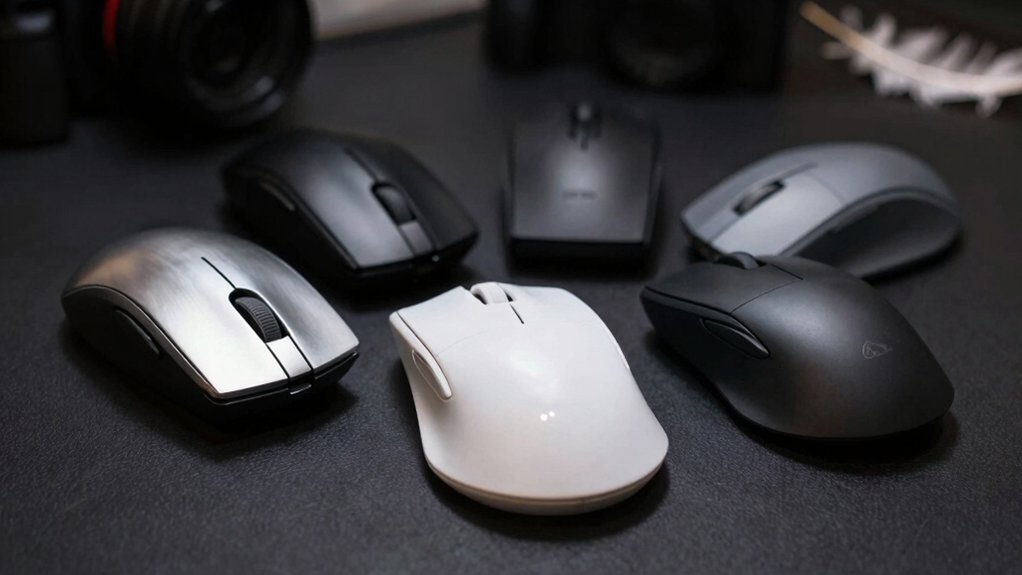

You want under-the-radar wireless trackballs that perform. Start with Nulea M501 for triple-device Bluetooth/USB, then consider Logitech Ergo M575S for long sessions and AA battery life. Next, Seenda offers multi-device Bluetooth/3‑device switching with DPI up to 1600. For posture tweaks, test ProtoArc EM01 NL’s 0–20 degree hinge, and Kensington Orbit with a scroll ring for ambidextrous use. If you want more options and concrete steps, you’ll find them as you continue.
| Nulea M501 Wireless Trackball Mouse (Bluetooth/USB) |

| Best All-Around | Connectivity: Bluetooth or USB dongle | Multi-Device: 3 devices | DPI/Tracking: Adjustable DPI | VIEW LATEST PRICE | Read Our Analysis |
| Logitech Ergo M575S Wireless Trackball Mouse (Black) |

| Long-Lasting Comfort | Connectivity: Bluetooth or Logi Bolt USB receiver | Multi-Device: 3 devices | DPI/Tracking: Adjustable cursor speed (via app) | VIEW LATEST PRICE | Read Our Analysis |
| Seenda Wireless Trackball Mouse—Bluetooth 3-Device DPI Adjustable |

| Multi-Device Specialist | Connectivity: Bluetooth or 2.4G USB receiver | Multi-Device: 3 devices | DPI/Tracking: 5 DPI levels (200–1600) | VIEW LATEST PRICE | Read Our Analysis |
| ProtoArc EM01 NL Wireless Trackball Mouse for PC/Mac (Gray) |

| Learn-Curve Friendly | Connectivity: Bluetooth or 2.4 GHz wireless | Multi-Device: 3 devices | DPI/Tracking: 5 DPI levels (200–1600) | VIEW LATEST PRICE | Read Our Analysis |
| Kensington Orbit Wireless Trackball with Scroll Ring |

| Ambidextrous Precision | Connectivity: Bluetooth LE or 2.4 GHz wireless | Multi-Device: 3 devices | DPI/Tracking: 4 DPI settings (400–1600) | VIEW LATEST PRICE | Read Our Analysis |
More Details on Our Top Picks
Nulea M501 Wireless Trackball Mouse (Bluetooth/USB)
If you want a compact, ergonomic option that works across multiple devices, the Nulea M501 Wireless Trackball Mouse stands out thanks to its triple-connection capability (Bluetooth or USB dongle) and rechargeable battery. You will use Bluetooth or the 2.4G USB receiver stored at the bottom to connect up to three devices. Pair it by turning on Bluetooth on your device, selecting M501, and confirming. Charge before first use with the included cable. Choose one mode for all-day work, or switch between devices as needed. The design reduces wrist movement, and DPI is adjustable for precision.
- Connectivity:Bluetooth or USB dongle
- Multi-Device:3 devices
- DPI/Tracking:Adjustable DPI
- Ergonomic:Ergonomic thumb control
- Trackball:Trackball-based cursor
- Power:Rechargeable built-in battery
- Additional Feature:Three-device switching
- Additional Feature:Onboard USB receiver storage
- Additional Feature:Non-programmable buttons
Logitech Ergo M575S Wireless Trackball Mouse (Black)
The Logitech Ergo M575S Wireless Trackball Mouse (Black) stands out for its ergonomic design that reduces forearm strain and supports long sessions; this makes it the best choice for users who prioritize comfort and posture. You choose connection: Bluetooth or Logi Bolt USB receiver. You navigate comfort with the sculpted shape and thumb control, keeping your hand still while cursor moves. You customize with 3 buttons and Logi Options+ for speed. You use quiet clicks and trackball geometry on any surface. You pair with Wave Keys if needed, and expect up to 18 months from the included AA battery.
- Connectivity:Bluetooth or Logi Bolt USB receiver
- Multi-Device:3 devices
- DPI/Tracking:Adjustable cursor speed (via app)
- Ergonomic:Ergonomic sculpted shape
- Trackball:Trackball with thumb control
- Power:AA battery (rechargeable option implied via long life)
- Additional Feature:Quiet clicks
- Additional Feature:Recycled plastic build
- Additional Feature:Logi Options+ customization
Seenda Wireless Trackball Mouse—Bluetooth 3-Device DPI Adjustable
The Seenda Wireless Trackball Mouse stands out for multi-device versatility, allowing you to switch between up to three devices via Bluetooth or a 2.4G USB receiver with a single press of the mode button. You can adjust DPI for precision: 200, 400, 800, 1200, or 1600. The ergonomic design fits the natural hand curve, reducing strain during long sessions. Use the thumb trackball to navigate while your hand stays still. Connect to Mac, Android, or Windows via Bluetooth or the USB receiver. Recharge the built-in battery with the included cable to avoid disposable batteries. Switch devices easily for work, study, and travel.
- Connectivity:Bluetooth or 2.4G USB receiver
- Multi-Device:3 devices
- DPI/Tracking:5 DPI levels (200–1600)
- Ergonomic:Ergonomic palm-fit design
- Trackball:Thumb-accessible trackball
- Power:Built-in rechargeable battery
- Additional Feature:One-click device switch
- Additional Feature:3-device Bluetooth/2.4G
- Additional Feature:Female-focused ergonomic design
ProtoArc EM01 NL Wireless Trackball Mouse for PC/Mac (Gray)
ProtoArc EM01 NL stands out for its adjustable trackball angle, letting you tailor the grip to your posture and workspace. You connect via Bluetooth, 2.4 GHz, or plug-and-play USB, then switch among three devices with a single button. The ergonomic design supports a 0–20 degree hinge, so adjust the tail to fit your desk, chair, or couch. Use the thumb trackball to control the cursor, reducing wrist and arm fatigue. It offers 5 DPI levels for sensitivity, from 200 to 1600. Clean regularly; rotate the rollers, and charge the built‑in battery for continuous use.
- Connectivity:Bluetooth or 2.4 GHz wireless
- Multi-Device:3 devices
- DPI/Tracking:5 DPI levels (200–1600)
- Ergonomic:Ergonomic with adjustable angle
- Trackball:Thumb-controlled trackball
- Power:Rechargeable battery
- Additional Feature:Adjustable 0–20° angle
- Additional Feature:Not Mac-compatible back button
- Additional Feature:Learning curve acknowledged
Kensington Orbit Wireless Trackball with Scroll Ring
If you need an ambidextrous, secure wireless trackball with precise control and a built‑in scroll ring, the Kensington Orbit Wireless Trackball with Scroll Ring stands out. You get dual wireless options, 2.4 GHz or Bluetooth LE, for flexible connections. For security, it uses 128‑bit AES encryption. It is plug‑and‑play on Mac or PC, but Windows ARM‑based computers aren’t supported. Choose your DPI: 400, 800, 1,200, or 1,600. Use the 40mm ball and precise surface for accurate tracking. Customize buttons and speed with Kensington Konnect software, and consider the detachable wrist rest for extended use. Two AA batteries are included.
- Connectivity:Bluetooth LE or 2.4 GHz wireless
- Multi-Device:3 devices
- DPI/Tracking:4 DPI settings (400–1600)
- Ergonomic:Ambidextrous/ergonomic design
- Trackball:Trackball with scroll ring
- Power:2 AA batteries included
- Additional Feature:Scroll Ring included
- Additional Feature:Ambidextrous design
- Additional Feature:AES-128 encryption
Factors to Consider When Choosing Wireless Trackball Mice
When choosing a wireless trackball, start with ergonomic comfort by testing grip types and palm support to avoid strain. Consider multi-device connectivity options, and ensure you can pair with your computer, tablet, or phone, plus switch quickly between them; check compatibility and any software needed for seamless switching. Then evaluate trackball precision adjustments, surface versatility, and battery life, detailing how to adjust DPI, test on different surfaces, and confirm charging methods and run-time for your typical work day.
Ergonomic Comfort Considerations
Ergonomic comfort starts with choosing a design that fits how you work. Choose a model with a natural palm position and reduced wrist movement to cut muscle strain during long sessions. Remember that trackball control keeps the hand stationary, so you lower forearm and shoulder effort compared with a traditional mouse. Look for thumb-controlled navigation to move the cursor without large hand motions, which helps on small desks. Check adjustable angles and tilt options, such as 0–20 degrees, to match your forearm and wrist alignment. Consider ambidextrous versus hand-specific shapes and palm rests, as these choices affect long-term comfort and fatigue. Prioritize a design that preserves posture, supports steady control, and minimizes reach during extended use.
Multi-Device Connectivity Options
Multi-device connectivity lets you switch quickly between computers, tablets, or phones without unplugging. Choose your connection method: Bluetooth, a 2.4 GHz USB receiver, or a dedicated dongle. Bluetooth offers broad compatibility with PC, Mac, Android, and some iPadOS devices, while a separate 2.4 GHz receiver provides lower latency. Some mice support up to three devices at once, with quick mode switches to activate the desired device. USB receivers can be stored onboard for easy transport and re-pairing when needed. Prepare for setup by pairing each device through its preferred method, then label buttons if needed. Third‑party software, such as Logi Options+, can customize per‑device button mapping and trackball sensitivity to match workflows. Aim for seamless, reliable cross‑device productivity.
Trackball Precision Adjustments
Trackball precision comes down to how you adjust sensitivity and how steady the hardware feels under your hand. Start by checking DPI options, which range from 200 to 1600 in typical models. Measured options like 200, 400, 800, 1200, and 1600 let you tailor precision for tasks such as detailed design work or fast navigation. Set DPI to a value that lets you place the cursor exactly where you intend, without moving your wrist. Remember that precision also depends on hardware stability—ball, rollers, and sensor quality affect smooth motion on different surfaces. Use adjustable DPI and software profiles to switch setups for different tasks, optimizing cursor placement with minimal hand movement. Non-programmable buttons may limit quick precision shortcuts.
Surface Versatility Capabilities
Surface versatility matters for wireless trackball mice because you’ll likely use the device away from a traditional mousepad. Look for models that work on desks, fabric, cushions, and even your lap. Some mice advertise performance on various surfaces, thanks to thumb-controlled cursor navigation that minimizes hand movement. Check if surface compatibility is highlighted alongside DPI-adjustable speed to keep precision across textures. Some devices emphasize you don’t need optical tracking on a surface, relying on the trackball mechanism instead. Expect potential differences in glide smoothness or precision on soft or reflective surfaces. When testing, compare glide on fabric vs. wood, note any lag, and verify consistent cursor control across environments you actually use.
Battery Life And Charging
Battery life and charging affect how you actually use the mouse, so start by checking the power options for each model. Look at battery type: built-in rechargeable packs or removable AA/AAA cells. Built-in packs offer steady weight, but confirm total cycles and expected lifespan. Removable cells let you swap quickly, but add weight and balance considerations. Rechargeable designs usually require a full initial charge and should be charged with the included cable; avoid fast chargers to maximize longevity. Wireless trackballs often store a USB receiver and may support multi-device switching, helping conserve power when idle. Battery-saving features turn off when not in use, extending days between charges. Consider runtime estimates and recharging time before choosing.
Final Thoughts
To pick the right wireless trackball, start by matching your workspace needs with features. If you value Bluetooth and USB, consider the Nulea M501 or Seenda for multi-device use and DPI control. For ergonomic comfort, choose Logitech Ergo M575S with a low profile and thumb control. If you need a scroll ring, Kensington Orbit fits. Compare DPI ranges, device pairing limits, and compatibility with PC or Mac, then test grip, button layout, and weight before purchase.

Meet Ry, “TechGuru,” a 36-year-old technology enthusiast with a deep passion for tech innovations. With extensive experience, he specializes in gaming hardware and software, and has expertise in gadgets, custom PCs, and audio.
Besides writing about tech and reviewing new products, he enjoys traveling, hiking, and photography. Committed to keeping up with the latest industry trends, he aims to guide readers in making informed tech decisions.