
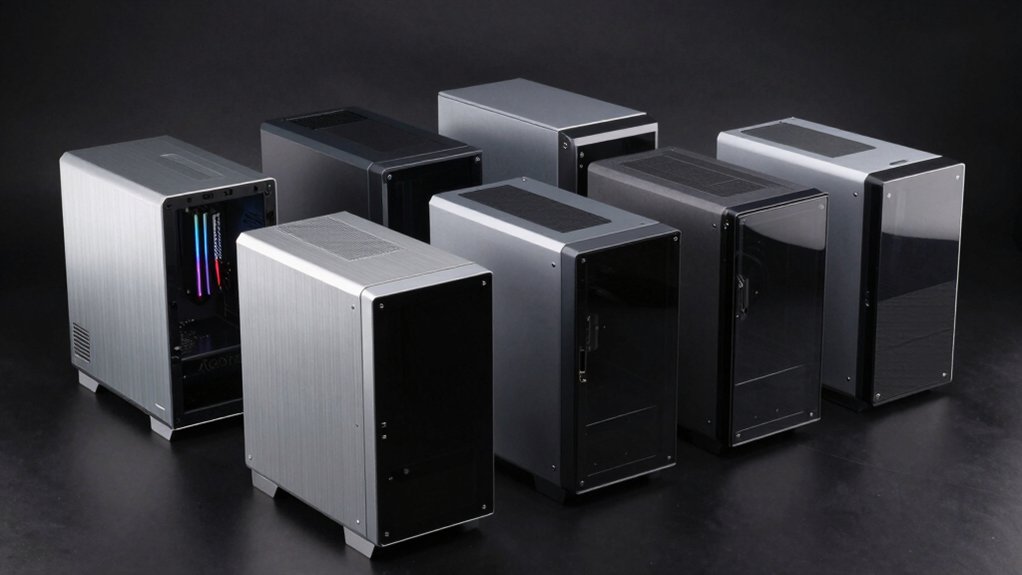

Here are five solid small ATX cases for compact builds. Start with Cooler Master MasterBox Q300L for Micro-ATX layouts, 159mm CPU clearance, 360mm GPU space, modular I/O and a 120mm fan; consider adding a 240mm AIO if you need more cooling. Zalman CUBIX offers a compact 17.1-liter frame, perforated front, and one 80mm fan. JONSBO Z20 provides detachable handle and flexible drive options. LIAN LI O11D MINI V2 adds five 120mm fans and a GPU-focused airflow design. Matx Case emphasizes high airflow with perforated front. If you continue, you’ll learn more.
| Cooler Master MasterBox Q300L Micro-ATX PC Case |
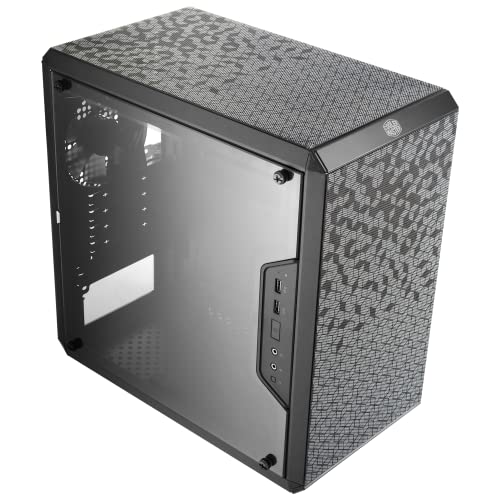
| Best All-Rround Micro-ATX | Form Factor Support: Micro-ATX / Mini-ITX | GPU Clearance: 360mm | CPU Cooler Clearance: 159mm | VIEW LATEST PRICE | Read Our Analysis |
| Zalman CUBIX Micro-ATX Mini Tower PC Case |

| Compact Airflow King | Form Factor Support: Micro-ATX / DTX / ITX / SFF / SFX HTPC | GPU Clearance: 260mm | CPU Cooler Clearance: 137mm | VIEW LATEST PRICE | Read Our Analysis |
| JONSBO Z20 Black Micro-ATX Mini Tower Case |

| High-GPU Clearance | Form Factor Support: Micro-ATX | GPU Clearance: 363mm | CPU Cooler Clearance: 164mm (Intel) / 163mm (AMD) | VIEW LATEST PRICE | Read Our Analysis |
| LIAN LI O11D MINI V2 Case with 5 Fans |
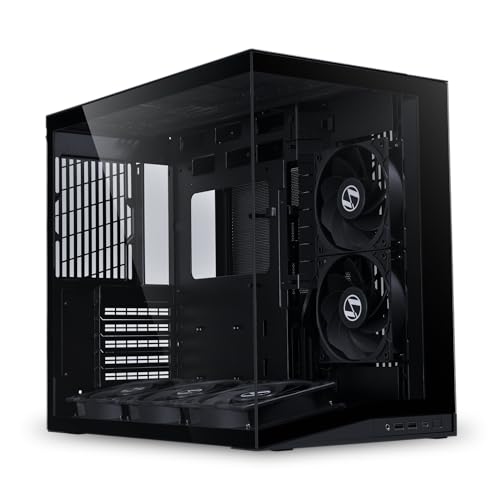
| Premium Mini-ATX Cooling | Form Factor Support: ATX / micro-ATX / mini-ITX | GPU Clearance: Not explicitly stated (supports full ATX PSU and general GPU support) | CPU Cooler Clearance: Not specified | VIEW LATEST PRICE | Read Our Analysis |
| Matx Case: High Airflow Micro ATX USB3.0 Black |

| Budget Micro Build Power | Form Factor Support: MATX / Mini-ITX / Micro ATX | GPU Clearance: Not explicitly stated (GPU clearance varies with front-board) | CPU Cooler Clearance: Not specified | VIEW LATEST PRICE | Read Our Analysis |
More Details on Our Top Picks
Cooler Master MasterBox Q300L Micro-ATX PC Case
The Cooler Master MasterBox Q300L stands out for compact, flexible mATX builds, making it the best choice when you need a small case without sacrificing cooling and expandability. You verify compatibility by checking that it supports Micro-ATX or Mini-ITX boards and fits a CPU cooler up to 159mm high. You plan for airflow with the 120mm fan installed and perforated sides, then consider adding a 240mm liquid cooler if needed. You measure GPU length up to 360mm and PSU up to 160mm, ensuring space for future expansion. You position the modular I/O panel anywhere among six options.
- Form Factor Support:Micro-ATX / Mini-ITX
- GPU Clearance:360mm
- CPU Cooler Clearance:159mm
- Front I/O Options:Noted I/O panel repositioning (front/top/bottom on both sides)
- Pre-installed Fans / Cooling:1 x 120mm pre-installed
- Filtration / Airflow Design:Magnetic dust filters; perforated sides
- Additional Feature:Magnetic dust filters
- Additional Feature:Edge-to-edge side panel
- Additional Feature:Front/top/bottom I/O options
Zalman CUBIX Micro-ATX Mini Tower PC Case
If you need a compact case that still leaves room for a decent Mini-ITX or Micro-ATX build, the Zalman CUBIX delivers a sturdy 0.8T steel chassis in a 17.1-liter footprint. You get a heavy-duty frame in black finish, suitable for Micro-ATX, DTX, ITX, SFF, and SFX HTPC setups. It supports standard ATX PSUs and fits GPUs up to 260mm long, with CPU cooler height up to 137mm. Expect a high-airflow design, perforated front, and one preinstalled 80mm fan. Connect devices via USB 3.0, USB 2.0, and a 3.5mm AUX. Verify compatibility, then proceed to install components step by step.
- Form Factor Support:Micro-ATX / DTX / ITX / SFF / SFX HTPC
- GPU Clearance:260mm
- CPU Cooler Clearance:137mm
- Front I/O Options:USB 3.0, USB 2.0, 3.5mm
- Pre-installed Fans / Cooling:1 x 80mm pre-installed
- Filtration / Airflow Design:Perforated front panel
- Additional Feature:Heavy-Duty 0.8T steel
- Additional Feature:17.1-liter compact volume
- Additional Feature:Perforated front panel
JONSBO Z20 Black Micro-ATX Mini Tower Case
JONSBO Z20 stands out for compact builds that still demand strong GPU clearance and flexible cooling, making it a practical choice if you need a 20L micro-ATX case that doesn’t limit performance. You’ll install a Micro-ATX board, then check 363mm GPU clearance and plan space for the chosen cooler. Use the detachable handle for easy transport and the removable PCI-E piece to simplify GPU seating. Install drives: 2×2.5″ and 1×3.5″ or 3×2.5″. Fit TOP 240 AIO under 60mm, or use air cooling up to 164mm CPU height. Ensure SFX or ATX power options as needed.
- Form Factor Support:Micro-ATX
- GPU Clearance:363mm
- CPU Cooler Clearance:164mm (Intel) / 163mm (AMD)
- Front I/O Options:USB 3.2 Gen1 Type-A, USB 3.2 Gen2 Type-C, Audio & Mic
- Pre-installed Fans / Cooling:Real fans 120mm×1 and 92mm×1 (plus top/bottom possible mounts)
- Filtration / Airflow Design:Magnetic dust filter
- Additional Feature:Detachable carrying handle
- Additional Feature:20L mini size
- Additional Feature:Removable PCI-E fixing piece
LIAN LI O11D MINI V2 Case with 5 Fans
This case stands out for anyone seeking strong cooling in a compact ATX build. You get pre-installed cooling with five 120mm reverse blade fans, positioned for optimal airflow. The 10° slanted bottom design directs cold air to the GPU, boosting cooling performance. Its compact footprint fits full-sized ATX power supplies behind a protruded mesh side panel, while still showing every component through pillar-less tempered glass. It supports ATX, M-ATX, and Mini-ITX, with anti-sag brackets for GPU stability. Use the 24-pin cable brackets to maintain a tidy layout and maximize airflow without clutter.
- Form Factor Support:ATX / micro-ATX / mini-ITX
- GPU Clearance:Not explicitly stated (supports full ATX PSU and general GPU support)
- CPU Cooler Clearance:Not specified
- Front I/O Options:Not specified (focus on airflow and glass panels)
- Pre-installed Fans / Cooling:5 pre-installed 120mm fans
- Filtration / Airflow Design:Pillar-less tempered glass; optimized airflow design
- Additional Feature:Five pre-installed 120mm fans
- Additional Feature:10° bottom airflow tilt
- Additional Feature:Horizontal/vertical GPU anti-sag brackets
Matx Case: High Airflow Micro ATX USB3.0 Black
A strong pick for compact builds is the Matx Case: High Airflow Micro ATX, USB3.0, Black, thanks to its high airflow front panel that delivers filtered air directly to components. You choose form factor support: MATX, Mini-ITX, Micro ATX, then use budget design with pre-mounted holes for Mini-ITX and Micro ATX boards. Install up to 2x 120mm fans and 1x 80mm fan, with radiators up to 135mm tall. Enable high performance airflow via the perforated front panel, and position fans to optimize GPU clearance. If needed, consider GPU length limits: 250mm without, 225mm with front-board fan. USB 3.0 and USB 2.0 ports provided. Black exterior.
- Form Factor Support:MATX / Mini-ITX / Micro ATX
- GPU Clearance:Not explicitly stated (GPU clearance varies with front-board)
- CPU Cooler Clearance:Not specified
- Front I/O Options:USB 3.0 x1, USB 2.0 x1
- Pre-installed Fans / Cooling:2×120mm front/1×80mm (as per compact notes)
- Filtration / Airflow Design:Perforated front panel with filtered air
- Additional Feature:Front perforated panel
- Additional Feature:Front-board fan impact GPU length
- Additional Feature:Slim form factor with included fans
Factors to Consider When Choosing Small ATX Cases for Compact Builds
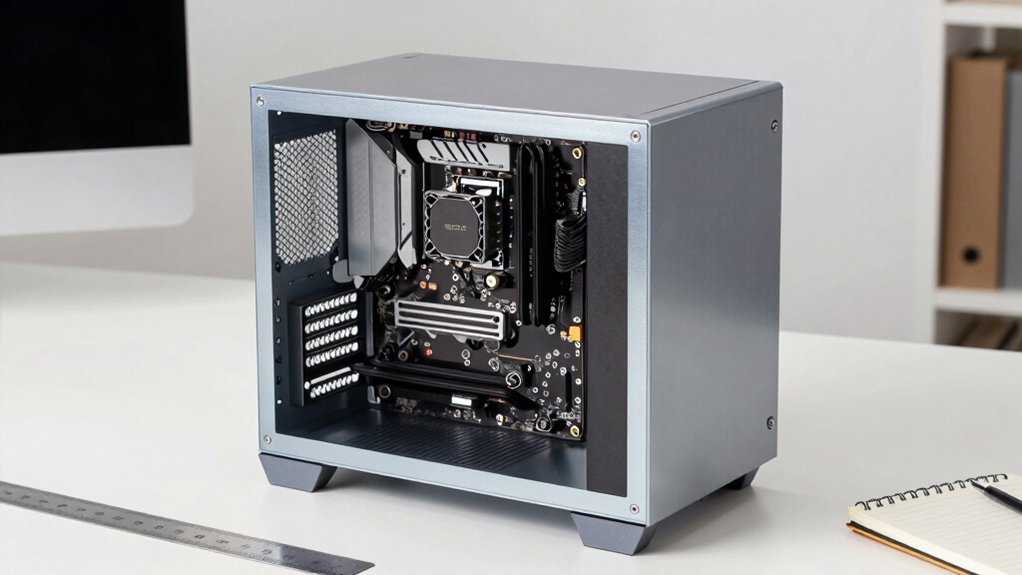
When choosing a small ATX case, check size and form factor first to ensure it fits your motherboard and GPU length, then verify GPU clearance and CPU cooler height so components align with your cooling plan. Confirm PSU compatibility and cable management options, noting PSU length, modularity, and space for tidy wiring. Finally, compare the trade-offs between compactness and expandability, and outline concrete steps to measure, test fit, and plan for future upgrades.
Size and Form Factor
Start by identifying the motherboard size you’ll use. Micro-ATX and Mini-ITX are the standard options small ATX cases accommodate, enabling compact builds without sacrificing core expansion. Next, assess interior volume, measured in liters, to estimate fit for components. For example, a 20–17 liter range affects GPU length limits and CPU cooler height clearance, so check exact specs (up to ~260 mm or 363 mm GPU length, 137–164 mm cooler height). Then verify PSU compatibility, noting that some cases accept SFX or ATX formats, while others require smaller PSUs. Examine GPU clearance and mounting for top or bottom fans and radiators to maintain cooling. Finally, consider detachable or modular features, like removable PCI-E brackets, as they influence space planning and assembly ease.
GPU Clearance Limits
GPU clearance in small ATX cases hinges on how long your graphics card can be while still leaving room for other components. Start by measuring the case’s internal length, then compare it to your GPU’s listed length. Remember that case tolerance varies from about 225mm to 363mm depending on layout. Check for a maximum GPU length specified for micro-ATX or mini-tower designs, often around 260mm in compact builds. Next, account for top- or front-mounted fans and drive bays, which can reduce usable length. If the interior is modular or perforated, verify the actual clearance with your GPU cooler height. Also assess case width, motherboard tray position, power supply depth, and any front-mounted radiator or fans that encroach on the GPU area.
CPU Cooler Height
CPU cooler height can determine whether your small ATX case fits a tall air cooler or forces a low-profile option. Start by checking the case’s maximum height in millimeters or inches before picking a cooler. In micro-ATX and mini-tower builds, expect typical maximum heights from about 120mm to 159mm, which guides your choice between mid-range and compact air coolers. If you’re considering liquid cooling, compact SFF radiators bypass height limits, but still assess external radiator clearance and space for fans. A case with a modular or open interior design may allow taller coolers by reconfiguring drive bays or removing obstructive components. Always verify motherboard clearance and potential GPU or PSU obstructions, as these can reduce usable height despite stated maximums.
PSU Compatibility
If you’ve narrowed cases by size and layout, you’ll want to verify PSU compatibility next. Check if the case lists support for standard ATX PSUs, which keeps options simple and available. If not, look for models that accept SFX or SFX-L PSUs, or side-mount designs, to support Mini-ITX or mATX builds. Identify the maximum PSU length the case allows; typical limits run around 160mm, which affects cable routing and GPU clearance. Note whether detachable or modular drive bays alter clearance, and plan around that if you need extra space. For tight mini/tower designs, confirm PSU height and depth constraints to prevent interference with GPUs or cooling components. Choose accordingly and measure before purchasing.
Cable Management
Efficient cable management in small ATX cases starts with planning your layout before you install components. Begin by noting where the 24-pin motherboard cable will run, using dedicated brackets to keep it tucked flat and out of airflow paths. Consider pillar-less tempered glass and removable PCI-E fixing pieces, which simplify routing around cables and reduce clutter. With modular I/O panels and adjustable front-board fans, measure cable lengths carefully and route cables along clean channels to avoid obstructing GPU clearance. Use pre-installed accessories like brackets and anti-sag supports to minimize movement and looseness. Magnetic dust filters and perforated front panels shape airflow, so plan routes that don’t block these openings. Verify every path before mounting components, then test the build for clearance and airflow.
Cooling Capacity
When choosing a small ATX case, start by evaluating its cooling options and how they fit your hardware. Look for cases that explicitly support multiple cooling options, such as mounting up to a 240mm liquid cooler or accommodating up to five fans, to maximize airflow in compact builds. Consider perforated front or side panels and an open thermal design, which enhance direct air intake and heat dissipation in small enclosures. Note the placement of pre-installed fans and their positions (top, front, bottom), as they markedly influence initial cooling performance and noise levels. Check GPU clearance and the interior layout to ensure sufficient airflow paths around hot components, especially in micro-ATX or mini-tower designs. Evaluate flexible configurations, like multiple 120/140mm fans or a 240mm AIO, to tailor cooling.
Build Accessibility
Start by checking how accessible the case’s layout and panels are during build. Look for detachable handles and modular layouts, which simplify component installation in tight spaces. Identify whether panels are tool-less or removable, and note how easy it is to access interior components without full disassembly. Consider I/O panel placement options—front, top, or bottom—since desk setup and case orientation affect reach. Assess interior density and whether perforated front panels and dust filters maintain airflow paths without blocking access to parts. Verify support for GPU lengths up to 260–363mm and CPU cooler heights around 137–164mm, as these limits determine how easily you install and adjust components. Check for pre-installed fans (1–5) and how they influence maintenance and upgrades.
Expandability Potential
First, evaluate GPU length and CPU cooler height to ensure your components fit without clearance issues. Check maximum GPU length supported, as cases show ranges from 260 to 363 mm, and confirm your card fits. Next, verify CPU cooler height clearance, noting typical limits from 137 to 164 mm, so the cooler doesn’t contact the case. Assess drive bays and expansion options for future storage, counting SSD/HDD slots and PCIe mounting flexibility. Confirm PSU compatibility and length limits, since many small ATX cases use side or bottom mounting, which can create clearance problems. Consider modular I/O panels and removable or adjustable components that enable reconfiguration as you upgrade. Plan for future expansion while maintaining compact form.
Final Thoughts
To wrap up, pick a small ATX case by identifying your needs first: determine motherboard size, GPU length, and cooling plans. If you prioritize airflow, choose the LIAN LI O11D MINI V2 or Q300L for more fan options. For compact footprints, consider the Zalman CUBIX or JONSBO Z20, then verify internal clearance and drive bays. Finally, compare ports and build ease, then follow manufacturer installation steps step by step to assemble your components.

Meet Ry, “TechGuru,” a 36-year-old technology enthusiast with a deep passion for tech innovations. With extensive experience, he specializes in gaming hardware and software, and has expertise in gadgets, custom PCs, and audio.
Besides writing about tech and reviewing new products, he enjoys traveling, hiking, and photography. Committed to keeping up with the latest industry trends, he aims to guide readers in making informed tech decisions.