
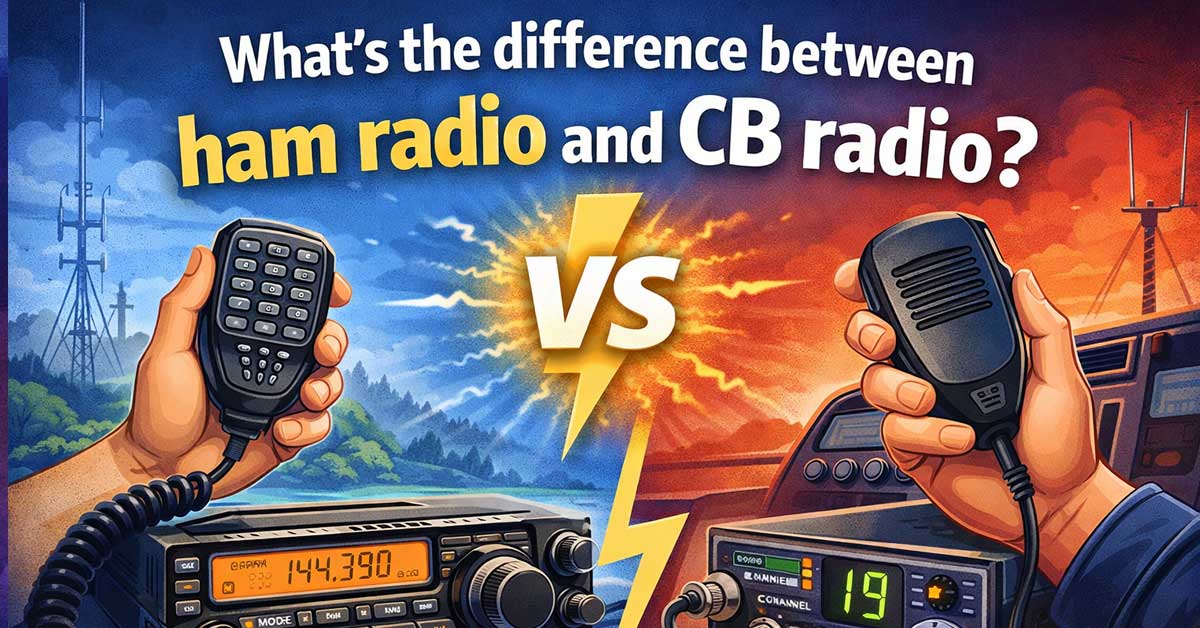

Two very different tools that get lumped together — here’s what actually separates them
Ham radio and CB radio both involve transmitting voice over radio frequencies, which is probably why people group them together. In practice they’re almost entirely different hobbies, tools, and regulatory categories. Understanding what separates them helps clarify which one is relevant to what you’re trying to do — whether that’s emergency communication, long-distance contact, trucking, off-road recovery, or just curiosity about how radio works.
The Core Difference in One Sentence
CB radio is a simple, license-free short-range communication tool available to anyone. Ham radio is a licensed, technically deep hobby and emergency communication system that spans local to global distances.
Everything else flows from that distinction.
Licensing
CB radio requires no license. You buy a radio, plug it in, and start transmitting. The FCC regulates CB but doesn’t require operators to register or pass any kind of test. Anyone can use it.
Ham radio requires a license from the FCC. There are three license classes — Technician, General, and Amateur Extra — each unlocking more frequencies and privileges than the last. Getting licensed requires passing a written exam covering radio theory, regulations, and operating procedures. The Technician exam is entry level and most people pass it with a few weeks of study. There’s no Morse code requirement anymore — that was dropped in 2007.
The licensing requirement exists because ham operators have access to far more spectrum and far higher power levels than CB users. More power and more frequencies means more potential for interference, which is why the FCC wants operators to demonstrate basic competency before handing them that access.
Frequencies and Spectrum
CB radio operates on 40 fixed channels in the 27 MHz band. That’s it. You have no control over what frequency you use beyond picking one of those 40 channels. Channel 19 is the traditional trucker channel. Channel 9 is designated for emergencies. The rest are general use.
Ham radio spans an enormous range of frequencies — from 1.8 MHz all the way through microwave frequencies above 300 GHz, across dozens of allocated bands. Different bands behave differently. Lower frequencies bounce off the ionosphere and can travel thousands of miles. Higher frequencies travel line-of-sight but carry more data. Ham operators choose their band based on what they’re trying to accomplish — local communication, worldwide contact, bouncing signals off the moon, talking through satellites in orbit.
That frequency flexibility is one of the core reasons ham radio is so much more capable than CB.
Transmit Power
CB radio is limited to 4 watts on AM and 12 watts on SSB (single sideband, a more efficient transmission mode). This is a hard FCC cap. Illegal linear amplifiers exist and some CB operators use them, but they’re prohibited and can result in serious fines.
Ham radio power limits depend on band and license class but go dramatically higher — up to 1,500 watts on most HF bands for General and Extra class licensees. More power means signals travel further, punch through interference better, and make weak-signal communication possible under conditions where CB would be completely useless.
Range
CB radio is effectively a short-range tool — under normal conditions, you’re looking at 1 to 5 miles for reliable communication, sometimes up to 10 to 15 miles in flat open terrain or from an elevated position. CB operators occasionally experience skip propagation where signals bounce off the ionosphere and travel hundreds of miles, but this is unpredictable and inconsistent.
Ham radio range varies from a few miles to global depending on band, power, antenna, and conditions. A Technician-class operator on VHF/UHF can easily cover 20 to 50 miles through a local repeater. A General or Extra class operator on HF can hold a two-way conversation with someone on another continent on a regular basis. Some ham operators communicate via amateur satellites or through EME — Earth-Moon-Earth, where the signal bounces off the surface of the moon.
Equipment
CB radios are simple and inexpensive. A basic mobile unit costs $30 to $100. They’re plug-and-play — no configuration beyond channel selection. The technology hasn’t changed meaningfully in decades and that simplicity is part of the appeal. You don’t need to understand radio theory to use one effectively.
Ham radio equipment ranges from simple to extraordinarily complex. A basic handheld VHF/UHF radio (called an HT or handie-talkie) costs $25 to $50 and works well for local communication. A capable HF station covering multiple bands runs from a few hundred dollars to several thousand. Serious operators invest in external antennas, amplifiers, digital interfaces, and software-defined radio equipment. The technical depth is part of what attracts people to the hobby.
What Each Is Actually Used For
CB radio is primarily used for:
- Truckers coordinating on the highway — the original and still dominant use case
- Off-road and overlanding groups staying in contact on trails
- Farmers and rural communities where quick local communication matters
- Construction sites and work crews
- Emergency communication in areas where nothing else is available
Ham radio is used for:
- Emergency and disaster communication — ham operators provide critical communication infrastructure when commercial systems fail
- Long-distance and international contact — talking to operators on other continents is routine
- Contesting — competitive operating events where operators try to make as many contacts as possible
- Experimentation with antennas, digital modes, satellite communication, and weak-signal propagation
- Public service events like marathons and parades where reliable communication is needed
- Technical education and exploration of radio theory
The Culture and Community
CB radio culture is informal and largely practical. The lingo — 10-4, what’s your 20, smokey, bear — developed in the trucking community and became popular during the CB boom of the 1970s. Most CB use today is functional rather than hobbyist. People use it because it works for a specific practical purpose without any barriers to entry.
Ham radio has a deeply established worldwide community built around technical experimentation, emergency preparedness, and the challenge of communication itself. Operators earn call signs that become a permanent identity. There are clubs, contests, awards for achieving various communication milestones, and a culture of technical self-improvement that goes back over a century. Many ham operators build their own antennas, modify equipment, and write their own software.
Emergency Use
Both are used in emergencies, but ham radio is far more integrated into official emergency communication infrastructure.
Organizations like ARES (Amateur Radio Emergency Service) and RACES (Radio Amateur Civil Emergency Service) coordinate trained ham operators who support emergency management agencies during disasters. When hurricanes, earthquakes, or wildfires knock out commercial infrastructure, ham operators provide communication for hospitals, emergency shelters, and relief coordinators. This happens at every major disaster in the United States and internationally.
CB radio plays a role in informal community emergency communication — truckers relaying road conditions, rural communities staying in contact during storms — but it isn’t integrated into formal emergency response the way ham is.
Which One Should You Get?
Get a CB radio if:
- You drive a truck, tow a trailer, or spend time on highways
- You go off-roading or overlanding and want trail communication
- You want simple, instant communication with no learning curve
- You don’t want to study for or hold a license
Look into ham radio if:
- You want reliable long-distance communication capability
- You’re interested in emergency preparedness at a serious level
- You enjoy technical learning and experimentation
- You want to communicate globally, not just locally
- You’re willing to spend a few weeks studying for a license exam
The Bottom Line
CB radio is a simple, accessible, license-free tool for short-range practical communication. It’s been doing that job reliably for decades and still does it well. Ham radio is an entirely different category — a licensed, technically rich hobby with global reach, emergency communication infrastructure, and a depth of capability that CB can’t approach.
They share the basic concept of voice over radio. Beyond that, they serve different purposes for different people, and choosing between them comes down entirely to what you actually want to do.
CB gets you talking to the truck ahead of you. Ham radio gets you talking to someone on the other side of the planet.

Meet Ry, “TechGuru,” a 36-year-old technology enthusiast with a deep passion for tech innovations. With extensive experience, he specializes in gaming hardware and software, and has expertise in gadgets, custom PCs, and audio.
Besides writing about tech and reviewing new products, he enjoys traveling, hiking, and photography. Committed to keeping up with the latest industry trends, he aims to guide readers in making informed tech decisions.