
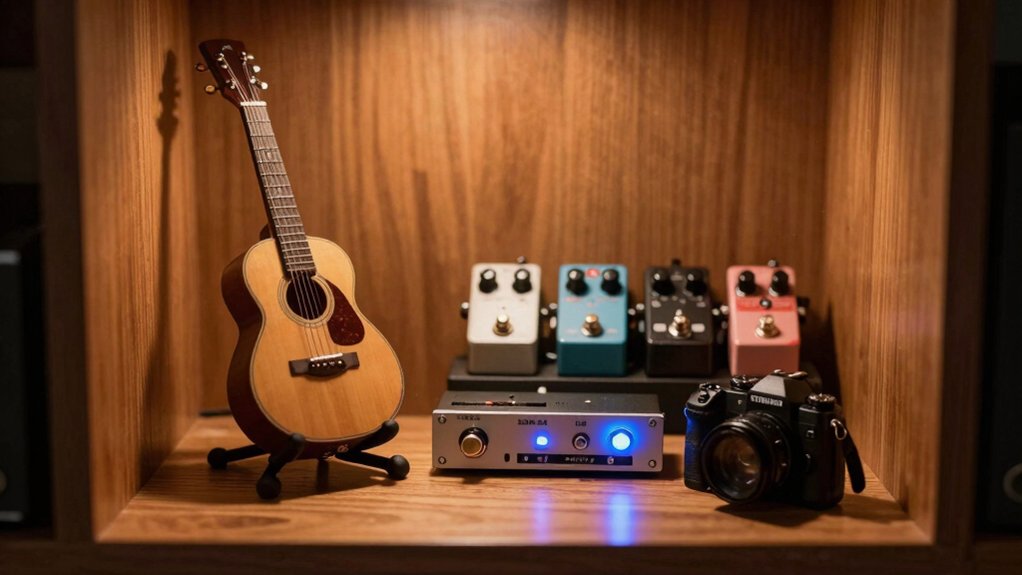

Take 5 solid options for acoustic preamps: start with Sonicaake for built‑in reverb, Notch filter, mute, and a balanced XLR output; next Jiayouy offers a 4‑band EQ and piezo preamp with a 9V battery holder for easy swap‑in; then BOSS AD‑2 adds Acoustic Resonance, Ambience, Notch filter, DI out, and a battery; fourth, the Acoustic Guitar Preamp with 5‑Band EQ includes tuner and 9V power; fifth, Plastic 301 provides tuner, notch, phase switch, and mounting screws. If you want more, you’ll find additional guidance below.
| Sonicaake Acoustic Guitar Effects Pedal with Reverb and Preamp |

| Best Acoustic Flavor | Power: 9V (center-negative) power supply (not included) | Bands/EQ: Not applicable (preamp with gain and frequency range, tone shaping) | Output: XLR balanced output | VIEW LATEST PRICE | Read Our Analysis |
| Jiayouy 4-Band EQ Piezo Guitar Pickup Preamp |

| Easy Install Pick | Power: 9V battery powered (battery not included) | Bands/EQ: 4-band EQ | Output: Not specified (preamp output details not given) | VIEW LATEST PRICE | Read Our Analysis |
| BOSS AD-2 Natural Acoustic Preamp Guitar Pedal |

| Studio-Quality Tone | Power: 9V battery (included) | Bands/EQ: Not applicable (preamp with acoustic effects) | Output: Balanced DI out and normal out | VIEW LATEST PRICE | Read Our Analysis |
| Acoustic Guitar Preamp Pickup with 5-Band EQ |

| All-in-One Preamp | Power: 9V battery-powered (battery not included) | Bands/EQ: 5-band EQ | Output: Not specified (output type not detailed) | VIEW LATEST PRICE | Read Our Analysis |
| Plastic 301 Acoustic Guitar Preamp Pickup Guitar Pickup Tuner Preamp Black |

| Budget Tuner-Preamplifier | Power: 9V battery powered | Bands/EQ: 4-band EQ | Output: Not specified (output type not detailed) | VIEW LATEST PRICE | Read Our Analysis |
More Details on Our Top Picks
Sonicaake Acoustic Guitar Effects Pedal with Reverb and Preamp
The Sonicaake Acoustic Guitar Effects Pedal with Reverb and Preamp is a solid choice if you need a simple, integrated preamp with built-in reverb for live or studio use. You connect your acoustic guitar to the high-impedance input, then set the gain and frequency to fit your tone. Use the built-in digital reverb to add space, adjusting level to avoid mud. Engage the notch filter to stop whistling, and use the mute function for silent switching. Output is XLR balanced, with power from a 9V center-negative supply. Buffer bypass preserves signal integrity through the chain.
- Power:9V (center-negative) power supply (not included)
- Bands/EQ:Not applicable (preamp with gain and frequency range, tone shaping)
- Output:XLR balanced output
- Notch/Feedback Control:Notch filter for feedback reduction
- Tuner/Reference:No tuner
- Assembly/Pre-wired:Noted for buffer bypass and preamp features (assembly not explicitly stated)
- Additional Feature:Notch filter for feedback
- Additional Feature:Mute function for silent switching
- Additional Feature:XLR balanced output
Jiayouy 4-Band EQ Piezo Guitar Pickup Preamp
If you’re after precise acoustic tone shaping, consider the Jiayouy 4-Band EQ Piezo Guitar Pickup Preamp for its built-in four-band EQ and easy wiring. This device acts as an acoustic guitar preamp with a piezo pickup and EQ, designed to modify and perfect your sound. It is pre-wired for straightforward assembly and includes a connection wire with a 2.5mm plug. The four-band EQ covers bass, middle, and treble adjustments, with push controls for each band. A built-in 9-volt battery holder is included, though the battery is sold separately. Install, connect, and tune your instrument accordingly.
- Power:9V battery powered (battery not included)
- Bands/EQ:4-band EQ
- Output:Not specified (preamp output details not given)
- Notch/Feedback Control:Not explicitly stated
- Tuner/Reference:No tuner
- Assembly/Pre-wired:Pre-wired for easy assembly
- Additional Feature:Pre-wired for easy assembly
- Additional Feature:Includes 2.5mm connecting wire
- Additional Feature:Built-in 9V battery holder
BOSS AD-2 Natural Acoustic Preamp Guitar Pedal
Choose the BOSS AD-2 Natural Acoustic Preamp Guitar Pedal when you need studio-quality acoustic tone with simple, stage-ready controls. You play with the Acoustic Resonance to reproduce unplugged tone, then adjust Ambience for room reverb. Use the Notch filter to reduce feedback in live setups. Connect normally to an acoustic guitar amp, or use the balanced DI out for direct PA. The mute function helps you tune and switch guitars on stage. It includes a 9V battery, weighs about 1.05 pounds, and ships with a 5-year warranty. This pedal emphasizes natural sound and easy, reliable operation.
- Power:9V battery (included)
- Bands/EQ:Not applicable (preamp with acoustic effects)
- Output:Balanced DI out and normal out
- Notch/Feedback Control:Notch filter for instant feedback reduction
- Tuner/Reference:No tuner
- Assembly/Pre-wired:Requires battery (included) and general ready-to-use
- Additional Feature:Acoustic Resonance modeling
- Additional Feature:Ambience reverb tuned for acoustic
- Additional Feature:Balanced DI out for PA
Acoustic Guitar Preamp Pickup with 5-Band EQ
A 5-band EQ preamp like this is ideal if you need precise tone shaping without adding external gear. You install the pickup inside your guitar, wiring it to the preamp unit. Use the 5-band EQ: Bass, Middle1, Middle2, Treble, and Presence to sculpt your core voice. Turn on the tuner when needed, read the LCD, and adjust volumes accordingly. The device is 9V powered, via the included battery holder, so you replace the battery as required. Pre-wired components simplify setup; follow the included wire and plug connections for a straightforward integration with your guitar system.
- Power:9V battery-powered (battery not included)
- Bands/EQ:5-band EQ
- Output:Not specified (output type not detailed)
- Notch/Feedback Control:Notch filter
- Tuner/Reference:Built-in tuner
- Assembly/Pre-wired:Pre-wired for straightforward setup
- Additional Feature:Built-in LCD tuner
- Additional Feature:9V battery powered
- Additional Feature:Includes tail nail battery box
Plastic 301 Acoustic Guitar Preamp Pickup Guitar Pickup Tuner Preamp Black
The Plastic 301 is the best choice when you need a compact, battery-powered preamp with built-in tuner for acoustic guitars. You install it by opening the battery compartment, insert a 9V battery, and mount the unit with the included screws and bandage. Connect to your guitar input, then adjust Volume, Bass, Midrange, Treble, and Brilliance for your tone. Use the Notch Filter and Phase Switch to fine-tune resonance and phase alignment. Turn on the tuner, play a note, and calibrate until the display shows in tune. Check compatibility with your model and verify its weight at 112 g.
- Power:9V battery powered
- Bands/EQ:4-band EQ
- Output:Not specified (output type not detailed)
- Notch/Feedback Control:Notch filter
- Tuner/Reference:Tuner included
- Assembly/Pre-wired:Easy Access Battery Compartment; Solder-free Installation
- Additional Feature:Easy Access Battery Compartment
- Additional Feature:Solder-free Installation
- Additional Feature:Notch Filter
Factors to Consider When Choosing Preamps for Acoustic Guitar
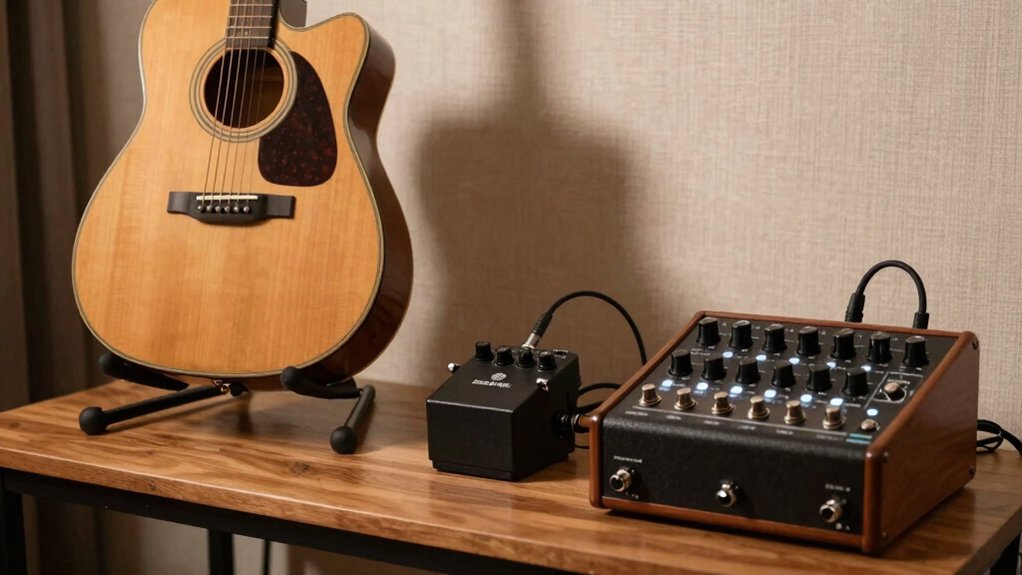
When selecting a preamp for your acoustic guitar, consider Tone Shaping Essentials to adjust warmth, brightness, and presence, and decide how much control you need for live versus studio use. Review Power Requirements Basics to ensure your setup can run on battery or mains power and note any necessary adapters or external supplies. Compare Output Connectivity Options and EQ Band Coverage to match your guitar, amp, and recording interface, then follow Preamp Placement Tips to position the unit for optimal feedback control and signal flow.
Tone Shaping Essentials
Choose a preamp with a robust five-band EQ to shape your acoustic guitar tone across lows, mids, highs, and articulation. Use the bass and treble bands to carve fundamental color; adjust the two mids to tame body and presence, ensuring articulation without shout. Activate notch or presence controls to suppress feedback and whistling without changing overall timbre. Apply phase or notch filtering to remove resonant peaks that cause feedback during amplified performances. Leverage a built-in tuner and mute/standby to tune on stage with minimal disruption. Ensure the preamp has a high-impedance input to preserve guitar fidelity, and balanced outputs to maintain signal integrity through the chain. Pair tone controls with the right cables and routing for clean, consistent sound.
Power Requirements Basics
Power options directly impact reliability and portability. Most acoustic guitar preamps run on 9V battery power or 9V DC power supplies, and some include a built-in battery compartment for field use. If a unit needs a built-in 9V battery, you must monitor life and have spares to avoid dropouts during performances. Battery-powered units offer plug-free operation, which improves on-stage portability, while mains-powered units require access to an outlet or power supply. Some models specify a center-negative 9V layout, which is important for compatibility with common power adapters. Power design can affect performance features, as battery or isolated power helps minimize hum and preserves consistent headroom. Consider your typical venues and carry additional batteries or a reliable power source accordingly.
Output Connectivity Options
You’ll start by examining the main output options on your acoustic preamp and selecting the path that fits your setup. Check XLR outputs for a balanced DI connection, improving noise rejection on longer runs to a stage or PA. If you’re routing to a guitar amp, use the 1/4″ instrument or line outputs to preserve signal level from preamp blocks. Some units offer balanced DI outs that work with phantom-powered or powered PA systems in live settings. Look for dry/wet or separate outputs to route effects or blend signals, and confirm multiple output paths. Built-in mute or solo/standby switching helps silent tuning and quick stage transitions without signal bleed.
EQ Band Coverage
EQ band coverage shapes your acoustic guitar’s overall balance and responsiveness, so choose a preamp with the right band count and routing to match your playing style and venues. A 5-band EQ typically covers Bass, Low/Mid, Mid, Treble, and Presence, shaping overall tonal balance. Use 4-band or 5-band EQs for distinct control over low, low-mid, high-mid, and high-end frequencies, enabling tailored contours. Presence control adds brightness without drastic changes to the core bass/mid structure, useful for cutting through live mixes. Dual mid bands (Middle1 and Middle2) grant finer shaping of body versus sparkle, improving string articulation and resonance. Built-in notch filters complement EQ by targeting feedback frequencies that interact with band settings. Implement this by testing in your space and adjusting during soundcheck.
Preamp Placement Tips
Choose the right placement for your acoustic preamp by weighing access, interference, and control needs. Place the preamp inside the guitar body for ergonomic access and to minimize cable runs, reducing noise and signal loss. Position it near the bridge or under the pickguard to keep the piezo sensor and electronics close, improving tactile control and reducing hum pickup. If you use a surface-mounted preamp, make sure the controls are accessible on the side or endpin area for quick adjustments on stage. Use shielded wiring and a short, direct cable from the piezo to the preamp to preserve high-impedance signal integrity and cut interference. Consider a notch or feedback reduction filter to mitigate whistling near amplified stages or loud monitors.
Battery And Runtime
How long will your acoustic preamp run on a battery, and what features affect that runtime? Start by checking the battery type, usually a 9-volt (6F22) battery, and note if the unit uses an optional built-in holder or an external battery box. Consider how features impact life: active processing like multi-band EQ or notch filters drains power more than simple preamp circuitry, and LED displays also draw current. Determine whether the unit is true-bypass or buffered, since buffering can affect battery use. If packaging says battery not included, plan for immediate runtime expectations and add fresh cells. Compare models by confirming if a 9V battery is required or if an alternative power source exists, and assess portability and replacement accessibility. Finally, evaluate solder-free or pre-wired installs for maintenance ease.
Noise And Feedback Control
To control noise and keep feedback in check, start by evaluating your preamp’s input and output design. Prefer a high-impedance input to preserve signal integrity from passive or piezo pickups, reducing noise. Check that the unit has a balanced DI output (XLR) to carry a differential signal to the PA or interface, which lowers noise along long cables. Look for onboard noise reduction features, such as notch filtering or ambience controls, to manage feedback while shaping tone. Notch filters target specific frequencies that cause whistling, letting you maintain stage volume without distortion. A mute function is useful for silent switching during performances, preventing pops or noise when changing settings or tuning. Combine these tools for steady, reliable live sound.
Installation Ease Factors
Installing a preamp can be straightforward if you pick options that fit your guitar and workflow. Pre-wired installations and simple assembly save setup time, so choose models that advertise quick mounting and minimal wiring. Built-in battery holders, typically 9V, simplify power management during installation, avoiding separate power sourcing steps. Look for included connecting wires and plug types, such as 2.5mm plugs, which streamline internal wiring and compatibility with your guitar electronics. Pre-wired designs and clear mounting hardware, including screws and battery boxes, minimize soldering or customization. Compact pickup and preamp dimensions help ensure a snug fit within standard acoustic guitar cavities. Check clearly listed package contents to confirm you have the necessary parts before starting, then follow step-by-step assembly instructions for a clean install.
Final Thoughts
Choose the right preamp by your needs. If you want warmth and simple use, pick a natural acoustic preamp like the BOSS AD-2 and run basic tests. For flexible tone, choose a 5-band EQ model and adjust mids, highs, and lows. If you need a pickup with built-in tuner, use a dedicated preamp pickup combo. Compare features, try in a live setup, and note output level, battery life, and durability. Decide, purchase, and install with clear steps.

Meet Ry, “TechGuru,” a 36-year-old technology enthusiast with a deep passion for tech innovations. With extensive experience, he specializes in gaming hardware and software, and has expertise in gadgets, custom PCs, and audio.
Besides writing about tech and reviewing new products, he enjoys traveling, hiking, and photography. Committed to keeping up with the latest industry trends, he aims to guide readers in making informed tech decisions.