
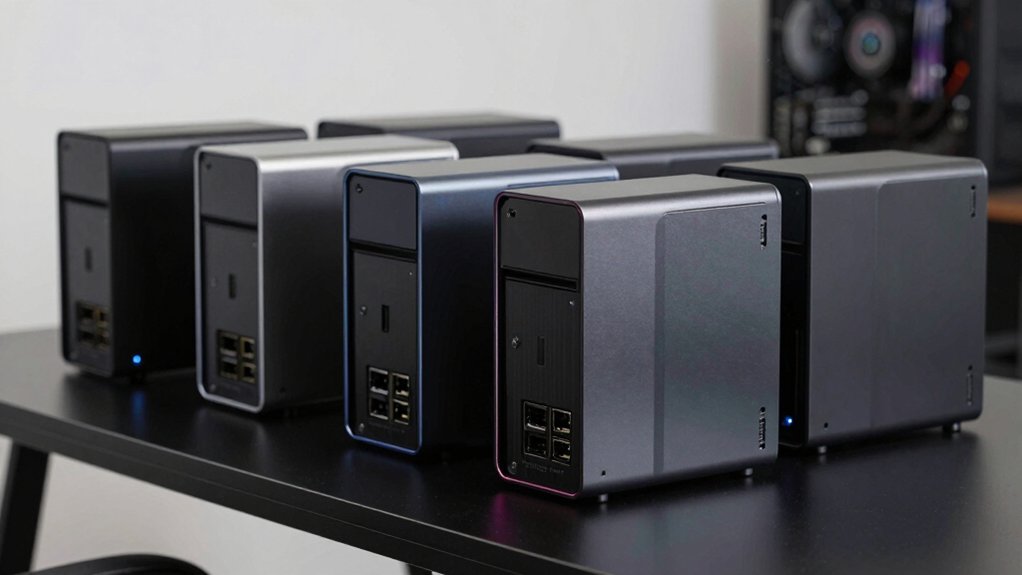

To pick the 10 best mini PCs for Proxmox, start with high-priority CPU cores and virtualization support, such as Ryzen 5 3500U or Intel 12th Gen, and ensure VT-d/AMD-Vi is enabled. Check dual M.2 slots, 16–64 GB RAM, and 2.5 GbE or higher networking. Favor models with multi–display outputs and PCIe slots for GPU passthrough. Include options like GMKtec Nucbox G10, N95, Ryzen 5 3500U, and KAMRUI Pinova P2. More specifics ahead.




More Details on Our Top Picks
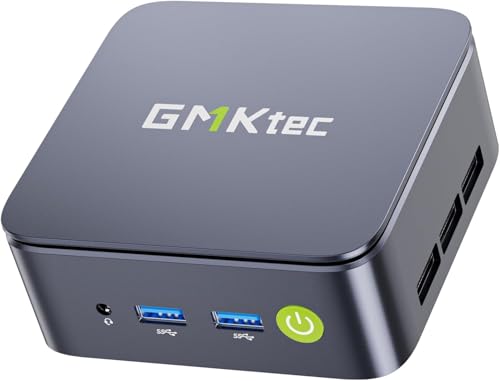
GMKtec Mini PC Ryzen 5 3500U 1TB NVMe SSD 16GB DDR4 2.5GbE NIC LAN Office Home Desktop Computers HTPC Proxmox HDMI 2.1 USB-C DP Triple 4K Display Nucbox G10
The GMKtec Nucbox G10 is a strong pick for Proxmox setups where you need solid CPU power plus generous RAM and fast storage in a compact form. You install Proxmox on the 1 TB NVMe SSD, then verify 16 GB RAM is installed. If needed, plan for up to 64 GB total using the dual channel slots. Enable 2.5 GbE for faster networking. Use the HDMI 2.1, DP, or USB-C for display pass-through if required. For hosting, leverage the dual M.2 slots to expand storage to 16 TB. Confirm Proxmox recognizes all hardware before creating containers.
- CPU:Ryzen 5 3500U
- RAM:16 GB
- Storage:1 TB NVMe
- Graphics:Radeon Vega 8
- Display outputs (multimonitors):Triple 4K (HDMI 2.1, DP, USB-C)
- Networking:2.5 GbE Ethernet
- Additional Feature:Triple 4K display support
- Additional Feature:2.5 GbE NIC
- Additional Feature:Proxmox ready
GMKtec Mini PC N95 (Beats N100 3.4GHz) 8GB RAM 256GB M.2 SSD Mini Desktop Computer with VESA Mount for Office Home Business HTPC Proxmox Dual 4K Display WiFi 5 Gigabit Ethernet G3S
If you’re prioritizing a compact, bootable Proxmox node with solid office and media capabilities, consider the GMKtec N95 Mini PC. You’ll get a 12th Gen Alder Lake N95 quad-core CPU, 8GB RAM, and a 256GB M.2 SSD. Use the dual HDMI 2.0 outputs for two 4K displays, and rely on Gigabit Ethernet and WiFi 5 for network access. This model supports AV1 decoding and 4K playback, making it suitable for HTPC tasks. Install Proxmox, allocate resources, and connect monitors, printers, and office gear via USB 3.2. Maintain a 1-year warranty and contact support for design defects or setup guidance.
- CPU:12th Gen Intel Alder Lake N95
- RAM:8 GB
- Storage:256 GB SSD
- Graphics:Intel UHD Graphics
- Display outputs (multimonitors):Dual 4K (HDMI 2.0 x2)
- Networking:Gigabit Ethernet
- Additional Feature:Dual 4K HDMI outputs
- Additional Feature:PCIe NVMe SSD (M.2)
- Additional Feature:Proxmox compatible
GMKtec Mini PC Ryzen 5 3500U 1TB NVMe SSD 16GB DDR4 2.5GbE NIC LAN Office Home Desktop Computers HTPC Proxmox HDMI 2.1 USB-C DP Triple 4K Display Nucbox G10 Black
For those building a Proxmox lab or small-office virtualization box, the GMKtec Nucbox G10 stands out with a Ryzen 5 3500U and a full 1 TB NVMe SSD plus 16 GB of DDR4. You get 2.5 Gbps Ethernet, triple 4K display support via HDMI 2.1, DP, and USB-C, plus capable PCIe storage expansion. Use the 2x M.2 slots to add drives or upgrade memory to 64 GB. Plan dual‑display or multi-display layouts, and run Untangle, Pfsense, or Proxmox as a server. Install, configure, test performance, and document network and VM settings for reliability.
- CPU:Ryzen 5 3500U
- RAM:16 GB
- Storage:1 TB SSD
- Graphics:Radeon Vega 8
- Display outputs (multimonitors):Triple 4K (HDMI 2.1, DP, USB-C)
- Networking:2.5 GbE Ethernet
- Additional Feature:3-display capable
- Additional Feature:PD power supply included
- Additional Feature:Untangle/Pfsense ready
GMKtec Mini PC Ryzen 5 3500U (Beats N150/N97) 16GB RAM 512 SSD 2.5GbE LAN Desktop Computer Office Home Business HTPC Proxmox Triple 4K Display HDMI 2.1 WiFi BT USB-C DP
GMKtec’s Ryzen 5 3500U mini PC is a solid pick when you need pro-grade performance in a compact form, especially if you’re running Proxmox across multiple VMs or containers. This unit delivers 16GB RAM and a 512GB SSD, plus a 2.5GbE LAN for fast networking. You can run triple 4K@60Hz displays via HDMI 2.1, DP, or USB-C, and upgrade RAM to 32GB and add extra storage with dual M.2 slots. Use the 2.5GbE for network storage or PFsense/Untangle, and rely on WiFi 5 and Bluetooth 5.2 for peripherals. Ensure firmware supports your Proxmox version.
- CPU:Ryzen 5 3500U
- RAM:16 GB
- Storage:512 GB SSD
- Graphics:Radeon Vega 8
- Display outputs (multimonitors):Triple 4K (HDMI 2.1, DP, USB-C)
- Networking:2.5 GbE Ethernet
- Additional Feature:512GB SSD
- Additional Feature:16GB RAM
- Additional Feature:VESA friendly design
KAMRUI Pinova P2 Mini PC 16GB RAM 512GB SSD AMD Ryzen 4300U(Beats 3500U/10110U/N150/N95,Up to 3.7 GHz)Mini Computers,Triple 4K Display/HDMI+DP+Type-C/WiFi/BT for Home/Business Mini Desktop Computers
The KAMRUI Pinova P2 stands out for IT pros who need solid multicore performance and robust display support in a compact, quiet Mini PC. You configure resources by starting with 16GB RAM and a 512GB M.2 SSD. If you need more, use the dual SO-DIMM slots for up to 64GB and add up to 4TB total storage across two slots. For display, enable triple 4K via HDMI 2.0, DP 1.4, and USB-C with DisplayPort 1.4 support. Connect over Gigabit LAN, WiFi, and BT. Mount via VESA or wall, and run Proxmox tasks efficiently.
- CPU:Ryzen 4300U
- RAM:16 GB
- Storage:512 GB SSD
- Graphics:Radeon graphics
- Display outputs (multimonitors):Triple 4K (HDMI, DP, Type-C)
- Networking:Gigabit LAN + WiFi
- Additional Feature:Dual M.2 slots
- Additional Feature:4K triple display
- Additional Feature:Lifetime support
MINISFORUM MS-01-S1260 Mini PC Barebone with Intel Core i5-12600H,vPro Enterprise Support,2x10Gbps SFP+LAN/2×2.5G RJ45/2xUSB4/HDIM/16xPCIe 4.0/M.2 NVMe SSD/U.2 NVMe SSD,Mini Computer(No OS/RAM/SSD)
MINISFORUM MS-01-S1260 stands out for IT pros needing enterprise-grade networking and storage in a compact barebone. You’ll configure it by noting it has 2x10Gbps SFP+ LAN and 2×2.5G RJ45, plus two USB4 ports for peripherals. Decide on memory and storage first: this unit supports up to 96 GB DDR5 and up to three NVMe SSDs with PCIe 4.0, plus a U.2 NVMe option. Plan expansion with the PCIe 4.0 x16 and x8 slots for external GPUs or storage cards. Remember it ships without OS, RAM, or SSD, so install them per project needs and enable vPro security.
- CPU:Core i5-12600H
- RAM:Up to 96 GB
- Storage:Up to 3× NVMe + U.2 (barebone)
- Graphics:Intel Iris Xe
- Display outputs (multimonitors):Not specified as triple, but multiple PCIe/NVMe; display not emphasized
- Networking:2x10Gbps SFP+ + 2×2.5GbE
- Additional Feature:2x10Gb SFP+ LAN
- Additional Feature:No OS/RAM/SSD included
- Additional Feature:16x PCIe 4.0 slots
MINISFORUM MS-01 Mini Workstation Core i5-12600H 32GB RAM 1TB SSD Mini PC HDMI + 2xUSB4 8K Display 2x10G SFP+ Port 2×2.5G LAN Port Support M.2 2280/22110/U.2 SSD/RTX 3050 Graphics Cards
The MINISFORUM MS-01 Mini Workstation stands out for IT pros who need serious multi‑tasking and fast networking in a compact form. You configure it with 32GB DDR5 RAM and a 1TB PCIe 4.0 SSD for operating speed. Add two more M.2 NVMe slots (2280 or 22110) for expansion, and you can run RAID0 or RAID1 as needed. Use the PCIe4.0x8 x16 slot for RTX 3050 if you require graphics power. Connect two 10G SFP+ ports and two 2.5G LAN ports for robust networking. Output options include HDMI 4K and USB4 for 8K/4K displays.
- CPU:Core i5-12600H
- RAM:32 GB
- Storage:1 TB SSD
- Graphics:Intel Iris Xe
- Display outputs (multimonitors):Up to 3 displays (HDMI, DP, USB-C)
- Networking:2x10G SFP+ + 2×2.5G LAN
- Additional Feature:RTX GPU upgrade path
- Additional Feature:8K/4K USB4 outputs
- Additional Feature:RAID support (RAID0/RAID1)
GMKtec Mini PC Intel Twin Lake N150 (Upgraded N100) 16GB DDR4 RAM 512GB PCIe M.2 SSD Desktop Computer 4K Dual HDMI/USB3.2/WiFi 6/BT5.2/2.5GbE RJ45 for Office Business
For Proxmox deployments where you need solid CPU performance, the GMKtec Mini PC with Intel Twin Lake N150 (upgraded from N100) stands out, offering a balanced mix of processing power, ample memory, and fast storage. You’ll get 4 cores, 4 threads, and up to 3.6GHz bursts, plus 16GB RAM and a 512GB PCIe NVMe drive. Use 4× USB 3.2, dual 4K HDMI, and 2.5GbE for fast networking. Install Proxmox, enable Wake-On-LAN and PXE, and verify Linux compatibility. Connect WiFi 6 and Bluetooth 5.2 if needed, and test VM performance with multitasking workloads.
- CPU:Intel Twin Lake N150 (upgraded N100)
- RAM:16 GB
- Storage:512 GB SSD
- Graphics:Intel Graphics
- Display outputs (multimonitors):Dual HDMI 2.0 (4K@60Hz)
- Networking:Gigabit Ethernet + WiFi 6
- Additional Feature:WiFi 6
- Additional Feature:2.5GbE + 2.5GbE
- Additional Feature:Proxmox/Firewall server ready
BOSGAME P4 Light Gaming Mini PC Ryzen 7 5825U 32GB RAM 1TB SSD 11 Pro Triple 4K 60HZ Displays Desktop Computers Support PS3 Emulator Micro PC HDMI+DP+Type-C WiFi 6E BT5.2 Dual 2.5GbE LAN
If you need a capable Proxmox host that can handle multiple VMs with strong multitasking, consider the BOSGAME P4 Mini PC with Ryzen 7 5825U. You get 32GB RAM and a 1TB NVMe SSD, with dual NVMe slots for expansion. Connect three 4K displays via HDMI, DP, and Type-C for monitoring and media tasks. Use WiFi 6E and Bluetooth 5.2 for peripherals, plus dual 2.5GbE LAN for fast network isolation. Install Windows 11 Pro or Linux variants, then create VMs, allocate cores, and tune memory. PS3 emulator support adds optional testing; upgrade RAM to 64GB if needed.
- CPU:Ryzen 7 5825U
- RAM:32 GB
- Storage:1 TB NVMe SSD
- Graphics:Radeon integrated
- Display outputs (multimonitors):Triple display (HDMI 2.0, DP, Type-C)
- Networking:Dual 2.5G LAN
- Additional Feature:PS3 emulator support
- Additional Feature:3-year factory support
- Additional Feature:11 Pro triple 4K displays
ACEMAGIC K1 Mini PC AMD Ryzen 4300U 16GB DDR4 1TB SSD Mini Computers (Turbo 3.7GHz) Win 11 Pro Radeon 4K Triple Display Desktop Computers 3.2USB-C Max 28W VESA GbE/WiFi/BT Education/Business Office
ACEMAGIC K1 Mini PC stands out for Proxmox setups that prioritize multitasking with solid RAM and fast storage, plus strong display flexibility. You’ll install Proxmox on the 1TB SSD, with 16GB DDR4 as baseline. Use the 6x USB 3.2 ports and USB-C DP 1.4 for peripherals and display outputs. Enable triple 4K monitors via HDMI 2.0, DP 1.4, and USB-C, if needed. Upgrade memory later to 64GB via dual SO-DIMMs, and expand storage with a second M.2 2280 slot. Leverage Gigabit Ethernet, Wi-Fi 5, and BT 4.2 for network and devices. Maintain 28W TDP for stable performance.
- CPU:Ryzen 4300U
- RAM:16 GB
- Storage:1 TB SSD
- Graphics:Radeon Graphics
- Display outputs (multimonitors):4K triple display (Type-C/DP/HDMI)
- Networking:Gigabit Ethernet + WiFi
- Additional Feature:Win11 Pro included
- Additional Feature:28W TDP
- Additional Feature:3.2 USB-C
Factors to Consider When Choosing Mini PC for Proxmox
When selecting a mini PC for Proxmox, start by evaluating CPU power and cores, then confirm you have enough RAM and memory slots for your expected workloads. Check storage options and expansion paths to meet your capacity and I/O needs, and verify networking throughput for reliable cluster performance. Finally, assess GPU and display support to ensure your hardware can handle virtual machines, containers, and any GPU-accelerated tasks you plan to run.
CPU Power and Cores
CPU power and cores matter most for Proxmox, so start by matching the CPU’s core count and thread support to your VM workload. Count how many VMs you plan and whether they run concurrently. Prefer CPUs with multiple cores and simultaneous threading to handle parallel tasks efficiently. Look for higher base and boost clocks to improve VM startup times and boost performance during bursts, especially for CPU‑bound tasks. Consider a mix of P-cores and E-cores if the mini PC supports them, to balance power use and responsiveness under load. Ensure the processor includes virtualization extensions (VT‑x/vt‑d or AMD‑V) and a solid L3 cache for VM stability. Check TDP and cooling headroom to sustain performance without throttling during heavy Proxmox activity.
RAM And Memory Slots
Memory configuration matters for Proxmox performance, so start by checking RAM capacity and how it’s installed. Look for dual-channel layouts, as 2×8 GB often outperforms a single 16 GB module. If your mini PC supports higher totals, verify how many DDR4 slots you have and the maximum supported memory—up to 32 GB or 64 GB in many models. When upgrading, prefer DDR4 modules that match the motherboard/CPU’s highest supported frequency to boost VM performance. If you’re limited to 2×8 GB, confirm whether mixing sizes is allowed or if you can upgrade to larger modules later. Check ECC support if your deployment requires reliability; not all platforms offer ECC memory. Plan upgrades before installing Proxmox.
Storage Capacities Expansion
Start by checking how many storage options the mini PC supports and what types they are. Look for multi-slot M.2 support, with at least two PCIe 3.0/4.0 NVMe slots to expand storage without hurting OS drive performance. Check the total maximum storage capacity, including both M.2 slots and any 2.5″ bays, to reach your target terabytes, such as up to 16 TB or more with dual M.2 and extra bays. Confirm RAID options (RAID0/RAID1) for speed or data safety when using multiple NVMe/SSD drives in Proxmox storage pools. Verify compatibility with U.2 or 2.5″ SATA drives if you plan to mix drive types for tiered storage or bulk archival. Ensure the system supports booting Proxmox from NVMe and offers reliable power and thermal design for sustained workloads.
Networking Throughput
To maximize Proxmox performance, start by evaluating your network interfaces and plan for growth. You should prioritize high-speed wired options like 2.5 GbE or 10 GbE, not standard Gigabit. Use SFP+ or PCIe-based expansion if you need lower latency and higher throughput for storage and virtualized services. Consider link aggregation (bonding) across multiple NICs to boost sustained throughput and provide failover for Proxmox clusters. Enable offloading features such as NIC RSS, GRO/LRO, and virtualization offloads to reduce CPU load and improve VM networking. Wireless interfaces are not recommended for Proxmox networking; wired 2.5/10 GbE offers reliability and predictable throughput. Plan for future growth by provisioning additional NICs or a capable switch to support expansion.
GPU And Display Support
Ensure you’re planning to run GPU‑intensive workloads or multi‑monitor dashboards on Proxmox? Start by selecting a GPU with solid virtualization support, such as integrated Vega 8 or Intel Iris Xe, which have proven compatibility for virtual GPUs or passthrough. Make sure the mini PC provides multiple display outputs—HDMI, DisplayPort, or USB-C DP—to drive multi‑monitor setups typical for Proxmox dashboards and VM labs. Check 4K capability or multi‑4K support without throttling, since high‑resolution VMs or containers benefit from clear UI rendering. Verify PCIe 3.0/4.0 lanes and adequate VRAM to support GPU passthrough or GPU‑accelerated workloads. Confirm driver stability and virtualization features like VT‑d/IOMMU for reliable VM performance and device passthrough.
Proxmox Compatibility Notes
Proxmox compatibility hinges on hardware that plays well with KVM virtualization, IOMMU, and PCI passthrough. Start by selecting a 64-bit x86 CPU with multiple cores and VT-d or AMD-Vi enabled in BIOS/UEFI. Ensure the system has at least 4 GB RAM; allocate more RAM for VMs and containers as needed. Check NIC support with Linux kernel drivers; avoid RAID controller cards if you plan direct Passthrough. Verify CPU/SSD/network hardware stability and enable VT-d/IOMMU in firmware before install. Prefer off-the-shelf mini PCs that offer multi‑GbE networking, multiple PCIe slots, and dual M.2/nVMe storage for scalable Proxmox setups. Confirm the motherboard and BIOS support PCI passthrough and test with a small VM pool prior to full deployment.
Final Thoughts
To pick a Proxmox mini PC, compare CPUs for virtualization headroom, RAM capacity, and NVMe speed. Ensure at least 16GB RAM, plus 512GB–1TB NVMe SSD for containers and VMs. Check network bandwidth; 2.5GbE or faster is preferable. Verify PCIe expansion if you need extra SSDs or NICs. Consider cooling and a compact form factor for your space. Match the model to your workload: lightweight lab use vs. heavier production. Prepare backups and test stability before deployment.

Meet Ry, “TechGuru,” a 36-year-old technology enthusiast with a deep passion for tech innovations. With extensive experience, he specializes in gaming hardware and software, and has expertise in gadgets, custom PCs, and audio.
Besides writing about tech and reviewing new products, he enjoys traveling, hiking, and photography. Committed to keeping up with the latest industry trends, he aims to guide readers in making informed tech decisions.