

You’re selecting a Linux graphics card, so you need to know what actually works. Your choice depends on your budget, your system’s power supply, and what you’re doing—gaming, design work, or basic computing. Some older cards still perform well; others deliver more power for modern tasks. Understanding these five proven options and the key factors behind them will help you make the right decision for your setup.
| Radeon HD 6570 Graphics Card 1GB GDDR3 |

| Legacy Budget Option | Memory Type: GDDR3 | Memory Bus Width: 64-bit | Video Output Options: 2x HDMI | VIEW LATEST PRICE | Read Our Analysis |
| GeForce GT 730 4GB Low Profile Graphics Card |

| Best Value | Memory Type: DDR3 | Memory Bus Width: 64-bit | Video Output Options: 2x HDMI, VGA, DisplayPort | VIEW LATEST PRICE | Read Our Analysis |
| Radeon HD 5450 1GB DDR3 Low Profile Graphics Card |

| Compact Older System | Memory Type: DDR3 | Memory Bus Width: 64-bit | Video Output Options: HDMI, VGA, DVI | VIEW LATEST PRICE | Read Our Analysis |
| GT 740 4GB GDDR5 Low Profile Graphics Card |
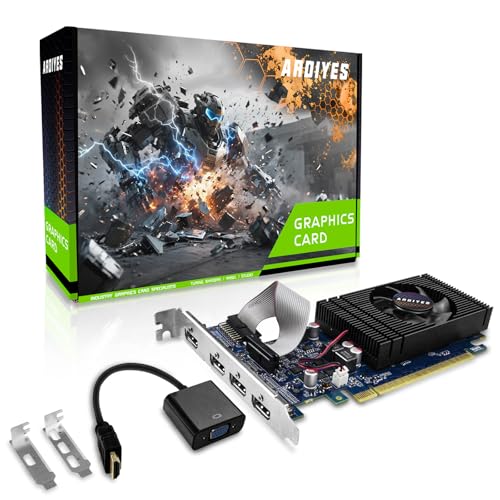
| Silent Office Pick | Memory Type: GDDR5 | Memory Bus Width: Not specified | Video Output Options: 4x HDMI | VIEW LATEST PRICE | Read Our Analysis |
| ASUS Dual RTX 3050 6GB Gaming Graphics Card |

| Modern Gaming Power | Memory Type: GDDR6 | Memory Bus Width: Not specified | Video Output Options: HDMI 2.1, DisplayPort 1.4a | VIEW LATEST PRICE | Read Our Analysis |
More Details on Our Top Picks
Radeon HD 6570 Graphics Card 1GB GDDR3
Why’d you choose a graphics card that doesn’t demand much power or space? The Radeon HD 6570 requires only 60W, eliminating the need for external power connections. Install it into any PCIe x16 slot on your motherboard. Its low-profile design fits compact cases. Connect dual HDMI cables to your monitors for multi-display support. Use Catalyst 15.7.1 or Crimson 16.2.1 Beta drivers on Windows 7, 8, or 10. Note that newer operating systems lack driver support. This card handles office work, video editing, and coding tasks efficiently. The 1GB GDDR3 memory and 480 stream processors deliver adequate performance for everyday computing without generating excessive heat.
- Memory Type:GDDR3
- Memory Bus Width:64-bit
- Video Output Options:2x HDMI
- Form Factor:Low profile
- Interface Type:PCI Express x16
- DirectX Support:DirectX 11
- Additional Feature:60W low power consumption
- Additional Feature:Dual HDMI outputs included
- Additional Feature:Plug & Play installation
GeForce GT 730 4GB Low Profile Graphics Card
If you’re building a compact system—whether it’s a small form factor PC, home theater setup, or older tower—the Glorto GeForce GT 730 4GB comes with the low-profile brackets you need to fit tight spaces where full-height cards won’t work. This entry-level GPU runs at 902 MHz with 4GB DDR3 memory, handling basic graphics tasks efficiently. You’ll get dual HDMI ports plus DisplayPort and VGA outputs, letting you connect up to four displays simultaneously using NVIDIA Surround technology. The card supports DirectX 12 and OpenGL 4.6, making it compatible with most Linux distributions. With a 3-year warranty and a 4.4-star rating from 194 reviews, this GPU delivers reliable performance for older systems and space-constrained builds.
- Memory Type:DDR3
- Memory Bus Width:64-bit
- Video Output Options:2x HDMI, VGA, DisplayPort
- Form Factor:Low profile
- Interface Type:PCI Express 2.0 x8
- DirectX Support:DirectX 12
- Additional Feature:NVIDIA Surround 4-screen technology
- Additional Feature:3-year warranty included
- Additional Feature:Original & low-profile brackets
Radeon HD 5450 1GB DDR3 Low Profile Graphics Card
The Radeon HD 5450 1GB DDR3 Low Profile Graphics Card delivers the specifications you’ll need if you’re building a compact Linux system that doesn’t require high-end gaming or rendering power. This entry-level GPU features a 625MHz core frequency and 64-bit memory bus, supporting DirectX 11 and OpenGL 4.5. You’ll connect displays through HDMI, VGA, or DVI ports, achieving resolutions up to 2560×1600. The card’s low-profile design fits standard PC towers and small form factor builds. Install it in a PCI Express 2.0 x16 slot. Verify Linux driver compatibility before purchasing, as support varies by distribution. This GPU handles basic desktop tasks and multimedia efficiently without consuming significant power.
- Memory Type:DDR3
- Memory Bus Width:64-bit
- Video Output Options:HDMI, VGA, DVI
- Form Factor:Low profile
- Interface Type:PCI Express 2.0 x16
- DirectX Support:DirectX 11
- Additional Feature:ATI Eyefinity multi-display support
- Additional Feature:Three video output ports
- Additional Feature:OpenGL 4.5 support
GT 740 4GB GDDR5 Low Profile Graphics Card
For users who need a compact graphics solution that doesn’t require high-end gaming performance, the GT 740 offers practical benefits through its low-profile design and quad-display capability. You’ll get 4GB of GDDR5 memory supporting four simultaneous monitors via HDMI outputs, making it ideal for multitasking environments and digital signage. The card fits standard PCI Express 3.0 x16 slots and includes both low-profile and full-height brackets for flexible installation. Driver support covers modern Windows and Linux systems reliably. Its fanless cooling keeps operation quiet. Installation is straightforward—insert the card, secure the bracket, and install drivers. This setup delivers sufficient performance for office work, video playback, and trading desk applications without excessive power consumption.
- Memory Type:GDDR5
- Memory Bus Width:Not specified
- Video Output Options:4x HDMI
- Form Factor:Low profile
- Interface Type:PCI Express 3.0 x16
- DirectX Support:Not specified
- Additional Feature:Quad HDMI quad-monitor setup
- Additional Feature:Hardware-accelerated video decoding
- Additional Feature:Silent fan operation
ASUS Dual RTX 3050 6GB Gaming Graphics Card
Looking to build a compact Linux gaming setup without sacrificing performance? The ASUS Dual RTX 3050 6GB delivers solid gaming power in a 2-slot design that fits smaller chassis. You’ll get 6GB GDDR6 memory for handling game textures, PCIe 4.0 connectivity, and modern display outputs via HDMI 2.1 and DisplayPort 1.4a. The Axial-tech fan design keeps temperatures controlled while the 0dB technology reduces noise during lighter workloads. For Linux gaming, you’ll benefit from NVIDIA’s driver support and DLSS capabilities through the 3rd-generation Tensor Cores, which enhance performance in compatible titles. This card balances affordability with capable 1080p-1440p gaming performance.
- Memory Type:GDDR6
- Memory Bus Width:Not specified
- Video Output Options:HDMI 2.1, DisplayPort 1.4a
- Form Factor:2-slot design
- Interface Type:PCIe 4.0
- DirectX Support:Not specified
- Additional Feature:2nd Generation RT Cores
- Additional Feature:3rd Generation Tensor Cores
- Additional Feature:0dB quiet operation technology
Factors to Consider When Choosing Linux Graphics Cards
When you’re selecting a Linux graphics card, you’ll need to check driver support availability for your specific Linux distribution, verify that the card’s memory meets your workload demands, and confirm the power consumption won’t exceed your power supply’s capacity. Next, you should examine the display output options—such as HDMI, DisplayPort, or DVI—to match your monitor connections, and measure the card’s physical dimensions against your case’s available space and cooling layout. These five factors will help you narrow down which card actually fits your system’s requirements rather than causing compatibility issues later.
Driver Support Availability
How do you know if a graphics card will actually work with your Linux system? Check whether your GPU has active driver support before purchasing. NVIDIA cards rely on proprietary drivers with quarterly updates, while AMD GPUs often use open-source AMDGPU drivers integrated into the Linux kernel. Intel integrated graphics benefit from Mesa’s continuous development. Verify your card’s driver status on the manufacturer’s website and Linux hardware compatibility databases. Open-source drivers offer broader kernel support but may lack features compared to proprietary versions. Proprietary drivers install separately and require manual updates. Consider your Linux distribution’s kernel version—newer kernels may drop support for older GPUs. Confirm that your chosen driver includes full 3D acceleration and display output support for your intended use case.
Memory Requirements Assessment
What’s the right amount of graphics memory for your Linux system? Start by determining your workload demands. For basic desktop tasks and 1080p gaming, 2GB suffices. Jump to 4GB for 1440p resolution or multi-monitor setups. If you’re running 4K displays or GPU-accelerated applications, 6GB or higher becomes necessary.
Next, assess memory type and bandwidth. GDDR5 and GDDR6 deliver superior performance compared to DDR3 for Linux graphics tasks. Check the memory bus width—wider buses (256-bit versus 64-bit) enable faster data transfer critical for texture detail and frame buffers.
Finally, verify memory clock speeds. Cards with 500–1334 MHz clocks provide adequate throughput for video processing and rendering. Match these specifications to your monitor resolution and intended applications to ensure smooth Linux performance.
Power Consumption Efficiency
Once you’ve matched your graphics card’s memory to your workload, you’ll need to evaluate how much power that card actually draws during operation. Check the card’s PCIe power requirements—lower wattage designs use less energy and generate less heat. Compare total system power draw under load and idle states to understand real-world consumption. Review your card’s memory type, since GDDR5 and GDDR6 offer better performance per watt than older DDR3. Verify Linux driver support for hardware video decoding and other efficiency features that reduce CPU utilization during multimedia tasks. Finally, examine cooling design specifications—efficient fans and good airflow sustain performance without excessive power consumption during extended use, improving overall system efficiency.
Display Output Compatibility
Which display ports you’ll need depends entirely on your monitor setup and Linux system requirements. Count your monitors and identify their connection types—HDMI, DisplayPort, or VGA. Check your GPU’s available outputs to ensure it matches. Next, verify maximum resolution support per port; a card supporting only 1080p limits your productivity on larger displays. Research driver compatibility for your Linux distribution. Some older cards lack full support on newer OS versions, restricting certain display features. Finally, confirm Mesa driver functionality for your specific GPU model, as Linux relies on OpenGL and Vulkan rather than DirectX. This ensures all output ports function properly and deliver the performance you need.
Form Factor Considerations
Here is the revised version using contextually relevant alternative words for ONLY the words “ensure” and “optimal”:
How’ll you know if a graphics card actually fits your Linux system? First, check your case’s height and length limits against the card’s dimensions. Second, verify your motherboard has the required PCIe slot—x16 or x8—and confirm the card’s bracket type matches your space. Low-profile brackets work in compact enclosures, while full-height brackets need standard cases. Third, measure clearance around RAM slots and power connectors to prevent obstruction. Fourth, assess your case’s airflow and cooling capacity against the card’s fan size and heat output. Fifth, examine cable routing space for dual or multi-output designs like HDMI and DisplayPort connectors. Finally, cross-reference your Linux distribution’s hardware compatibility list to guarantee driver support. These steps guarantee proper installation and peak performance.
DirectX And OpenGL
Beyond physical fit, you’ll need to evaluate graphics API support—the software layer that communicates between your GPU and Linux applications. Your GPU must support either OpenGL or Vulkan natively. OpenGL handles most traditional Linux applications, while Vulkan provides superior performance for modern gaming and compute tasks. DirectX isn’t natively available on Linux; instead, compatibility layers like DXVK translate DirectX commands to Vulkan, introducing slight latency. Check your GPU’s driver support first. NVIDIA cards work with proprietary drivers offering robust OpenGL and Vulkan support. AMD and Intel GPUs rely on Mesa drivers, which vary in maturity. Verify your target applications’ API requirements before purchasing—this prevents compatibility issues and ensures optimal performance on your Linux system.
Budget Versus Performance
When you’re shopping for a Linux graphics card, should you prioritize affordability or raw performance? Consider your actual workload first. If you’re running a desktop environment with multiple monitors, you’ll benefit from 4GB or more of VRAM, regardless of budget tier. Next, evaluate driver support maturity. Older GPUs with stable open-source drivers often outperform newer budget cards lacking kernel integration. For sustained workloads, check the card’s form factor—compact designs may throttle performance due to limited cooling. Finally, balance your budget against longevity. Higher-end cards deliver extended compatibility and driver updates, while budget-friendly legacy options provide reliable performance if their open-source drivers remain actively maintained. Match your choice to both your immediate needs and expected Linux system lifespan.
Thermal Management Solutions
Since thermal performance directly impacts your GPU’s stability and lifespan under Linux, you’ll want to evaluate cooling capacity before making a purchase. Check the TDP rating first—higher numbers demand more robust cooling. For compact cases, select low-profile cards with efficient heatsinks designed for tight spaces. Active cooling through fans maintains stable boost clocks during intensive tasks, preventing thermal throttling. Passive designs depend entirely on case airflow and ambient temperature, so they’re suitable only for well-ventilated setups. Install monitoring tools like GPU-Z or lm-sensors to track real-time temperatures and fan speeds. Proper kernel drivers enable you to adjust fan curves manually. Plan your case ventilation before buying, ensuring adequate intake and exhaust airflow around your GPU.
Final Thoughts
You’ll want to match your card choice to your actual needs. If you’re running light tasks, the Radeon HD 5450 or GeForce GT 730 work fine. For gaming or demanding workloads, pick the RTX 3050. Check your PSU wattage, PCIe slot type, and physical space before buying. Verify driver support for your Linux distribution. Install drivers following your distro’s documentation, then test performance with benchmark tools.

Meet Ry, “TechGuru,” a 36-year-old technology enthusiast with a deep passion for tech innovations. With extensive experience, he specializes in gaming hardware and software, and has expertise in gadgets, custom PCs, and audio.
Besides writing about tech and reviewing new products, he enjoys traveling, hiking, and photography. Committed to keeping up with the latest industry trends, he aims to guide readers in making informed tech decisions.