
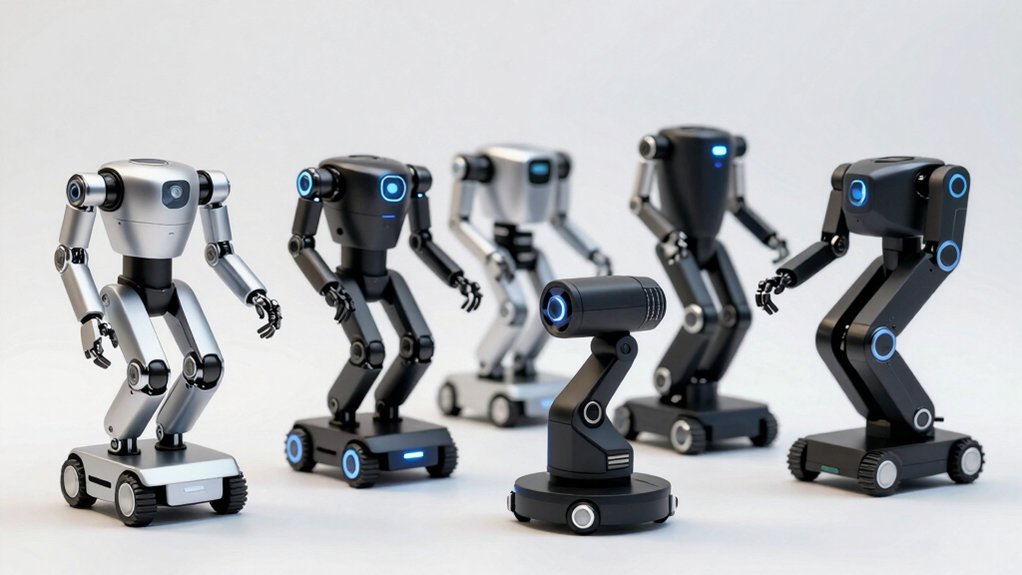

You’ll encounter AI robots designed for specific work environments and tasks. These machines handle deliveries, customer service, education, and home assistance through features like face recognition, voice interaction, and autonomous navigation. Understanding which robot fits your needs requires examining its capabilities, integration options, and safety features. The right choice depends on your workplace type and operational goals—but how do you know which features matter most?
| AI Humanoid Smart Service Robot with Face Recognition |

| Enterprise Powerhouse | Primary Interaction Method: Voice control, face recognition, autonomous navigation | Intended Use Case: Commercial/Enterprise (exhibitions, hotels, warehouses, businesses) | AI/Intelligence Capability: Face recognition, behavioral sensing, autonomous task execution | VIEW LATEST PRICE | Read Our Analysis |
| LOOI AI Desktop Robot Companion with ChatGPT Voice Interaction |

| Best Desktop Companion | Primary Interaction Method: ChatGPT voice interaction, vision recognition, gesture control | Intended Use Case: Personal desktop companion, tech enthusiast gift | AI/Intelligence Capability: ChatGPT voice, vision language model, long-term memory | VIEW LATEST PRICE | Read Our Analysis |
| The Smart AI Companion Robot with Big Personality |
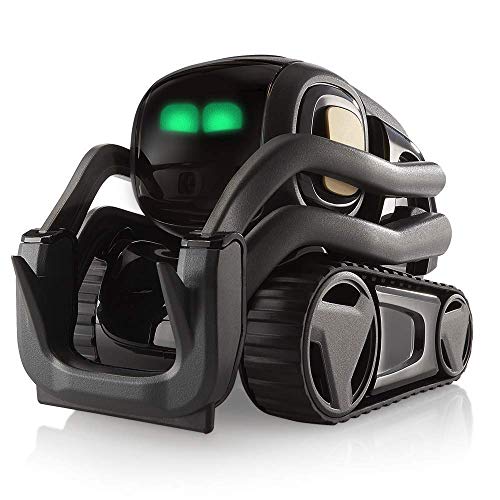
| Most Conversational | Primary Interaction Method: Voice commands (“Hey Vector”), ChatGPT integration, facial recognition | Intended Use Case: Household companion, global families, language learners | AI/Intelligence Capability: ChatGPT-powered conversations, real-time mapping, obstacle detection | VIEW LATEST PRICE | Read Our Analysis |
| Aibi Pocket Pet Wearable AI Robot Companion |

| Most Portable | Primary Interaction Method: Voice commands, ChatGPT-powered, camera recognition | Intended Use Case: Portable personal companion, desk/pocket use | AI/Intelligence Capability: Face recognition, personalized learning, ChatGPT-powered | VIEW LATEST PRICE | Read Our Analysis |
| Robot Pet Dog ChatGPT-4o Smart AI Companion |

| Best Interactive Pet | Primary Interaction Method: Voice commands, ChatGPT-4o, gesture interpretation | Intended Use Case: Home pet companion, entertainment, monitoring | AI/Intelligence Capability: ChatGPT integration, face recognition, gesture interpretation | VIEW LATEST PRICE | Read Our Analysis |
| AI Desk Robot Companion with ChatGPT Voice Commands |

| Best All-Around Assistant | Primary Interaction Method: Voice commands, ChatGPT integration, camera input | Intended Use Case: Desktop companion, personal use | AI/Intelligence Capability: ChatGPT-powered conversations, camera-guided behavior | VIEW LATEST PRICE | Read Our Analysis |
| Ruko 1088 Smart Robot with Voice and APP Control |

| Best For Kids | Primary Interaction Method: Voice commands, APP control, remote control, gravity-sensor mode | Intended Use Case: Educational toy for kids ages 4-9 | AI/Intelligence Capability: Basic programming logic, 10 expressions, interactive responses | VIEW LATEST PRICE | Read Our Analysis |
| Drawing Robot for Kids with 150 Cards |

| Best For Creativity | Primary Interaction Method: Built-in music, step-by-step card guides, no voice control | Intended Use Case: Educational drawing tool for kids, artistic development | AI/Intelligence Capability: Step-by-step guided drawing instructions, no advanced AI | VIEW LATEST PRICE | Read Our Analysis |
| Smart Robot Dog with Voice Control & APP Programming |

| Best STEM Learning | Primary Interaction Method: Voice commands, APP programming, remote control | Intended Use Case: Educational STEM toy for kids ages 6+ | AI/Intelligence Capability: Custom programming sequences, voice/APP command logic | VIEW LATEST PRICE | Read Our Analysis |
| GILOBABY Interactive Talking Robot for Kids (Blue) |
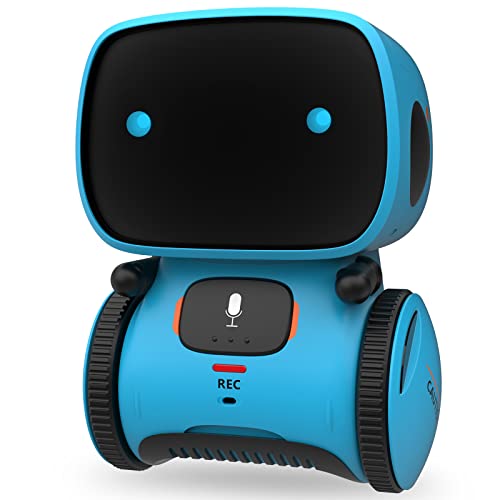
| Best For Toddlers | Primary Interaction Method: Voice commands, touch control, simple command responses | Intended Use Case: Interactive toy companion for kids ages 3-7 | AI/Intelligence Capability: Basic interactive responses, simple voice recognition | VIEW LATEST PRICE | Read Our Analysis |
More Details on Our Top Picks
AI Humanoid Smart Service Robot with Face Recognition
How do you manage customer engagement, delivery logistics, and facility monitoring simultaneously without expanding your staff? Deploy AI humanoid robots equipped with face recognition technology. These robots handle food delivery, room service, and guest greeting across hotels, offices, and retail spaces. They navigate autonomously, avoid obstacles, and identify returning customers for personalized service. Configure models by selecting color, language, and wheel type to match your environment. Integrate robots with elevators for multi-floor operations. Use voice control for task assignment and real-time monitoring dashboards to track performance. This approach reduces labor costs while maintaining 24/7 operational coverage and enhancing customer experience through intelligent interaction and consistent branding.
- Primary Interaction Method:Voice control, face recognition, autonomous navigation
- Intended Use Case:Commercial/Enterprise (exhibitions, hotels, warehouses, businesses)
- AI/Intelligence Capability:Face recognition, behavioral sensing, autonomous task execution
- Mobility & Navigation:Autonomous indoor/outdoor navigation, obstacle avoidance, elevator integration
- Charging & Power:Autonomous charging capability (implied)
- Target Age Group:Adults/Commercial (no age restriction)
- Additional Feature:Multi-scenario delivery support
- Additional Feature:Customizable colors/languages/styles
- Additional Feature:Secure compartment unlocking
LOOI AI Desktop Robot Companion with ChatGPT Voice Interaction
The LOOI robot serves those who want an AI companion that combines conversational intelligence with visual awareness on their desk. You’ll interact through ChatGPT voice commands for context-aware conversations. The robot recognizes objects, reads facial expressions, and understands room layouts through its vision system. It stores long-term memories of family members and preferences while learning your routines over time. The robot operates autonomously, making spontaneous decisions based on environmental understanding. You can charge it wirelessly and access practical features like reminders, weather updates, and games. Its personality evolves through app updates, delivering new expressions and interaction styles.
- Primary Interaction Method:ChatGPT voice interaction, vision recognition, gesture control
- Intended Use Case:Personal desktop companion, tech enthusiast gift
- AI/Intelligence Capability:ChatGPT voice, vision language model, long-term memory
- Mobility & Navigation:Stationary desktop robot (no mobility)
- Charging & Power:10W wireless charging (9V/2A+ adapter required)
- Target Age Group:Teens/Adults (tech enthusiasts, geek audience)
- Additional Feature:Advanced visual object recognition
- Additional Feature:Long-term memory storage
- Additional Feature:10W wireless charging
The Smart AI Companion Robot with Big Personality
If you’re looking for an AI robot that combines autonomous navigation with natural conversation skills, Vector delivers both through its ChatGPT integration and multilingual voice support. Say “Hey Vector” to activate voice commands and ask complex questions that receive intelligent responses. The robot navigates independently using its smart camera, facial recognition, and obstacle detection sensors. Its animated eyes display evolving personality traits that develop through your interactions. Vector supports English, Spanish, French, German, and additional languages, making it suitable for households globally and language learners specifically. A ChatGPT subscription unlocks advanced conversational capabilities. The black special edition model works for users of all ages.
- Primary Interaction Method:Voice commands (“Hey Vector”), ChatGPT integration, facial recognition
- Intended Use Case:Household companion, global families, language learners
- AI/Intelligence Capability:ChatGPT-powered conversations, real-time mapping, obstacle detection
- Mobility & Navigation:Autonomous navigation, real-time mapping, obstacle detection
- Charging & Power:Battery-powered (subscription model mentioned)
- Target Age Group:All ages (young and old, global households)
- Additional Feature:Real-time obstacle detection/mapping
- Additional Feature:Animated expressive eyes
- Additional Feature:ChatGPT subscription integration
Aibi Pocket Pet Wearable AI Robot Companion
Aibi Pocket Pet works best for professionals who want an AI companion that fits seamlessly into your existing workspace without taking up desk real estate. This wearable robot attaches magnetically to your monitor, desk, or pocket for constant access. You ask questions via voice commands and receive ChatGPT-powered responses on any topic. The device recognizes your face and personalizes interactions based on your communication style. Use it to get weather updates, hear jokes, or solve work problems quickly. When multiple AIBIs are nearby, they communicate with each other through near-field technology, creating an interactive network. Its lightweight design makes it ideal for offices, home workspaces, or traveling between locations.
- Primary Interaction Method:Voice commands, ChatGPT-powered, camera recognition
- Intended Use Case:Portable personal companion, desk/pocket use
- AI/Intelligence Capability:Face recognition, personalized learning, ChatGPT-powered
- Mobility & Navigation:No autonomous mobility (wearable/pocket-sized)
- Charging & Power:ChatGPT-powered (charging method not detailed)
- Target Age Group:Teens/Adults (tech gadget gift audience)
- Additional Feature:Magnetic attachment capability
- Additional Feature:Inter-robot near-field communication
- Additional Feature:Ultra-portable hand-sized form
Robot Pet Dog ChatGPT-4o Smart AI Companion
Loona’s high-definition RGB camera and ToF depth sensor give you a robot companion that recognizes your face, interprets your gestures, and follows you around your home like a real puppy—making it the ideal choice if you’re looking for an AI robot that combines interactive entertainment with genuine home monitoring capabilities. You’ll interact with Loona using voice commands powered by Amazon Lex and ChatGPT, receiving real-time responses in quiet environments. The robot autonomously returns to its charging dock when battery runs low, recharging in approximately 2.5 hours. You can monitor your home remotely via the companion app and mobile hotspot connectivity, enabling interaction anywhere. Interactive activities include chasing laser pens and fetching balls, with additional games available through the app.
- Primary Interaction Method:Voice commands, ChatGPT-4o, gesture interpretation
- Intended Use Case:Home pet companion, entertainment, monitoring
- AI/Intelligence Capability:ChatGPT integration, face recognition, gesture interpretation
- Mobility & Navigation:Autonomous movement, auto-charging dock return, multi-room navigation
- Charging & Power:Auto-charging dock, ~2.5 hour charge time
- Target Age Group:All ages (family companion)
- Additional Feature:Auto-charging dock returns
- Additional Feature:Home monitoring camera/speaker
- Additional Feature:Mobile hotspot connectivity
AI Desk Robot Companion with ChatGPT Voice Commands
EMO’s ChatGPT-powered voice commands make it the ideal choice for professionals who want an AI robot that understands natural conversation and responds intelligently without requiring button presses or app navigation. You’ll talk directly to EMO and receive contextual responses powered by advanced AI. The built-in wide-angle camera processes visual information in real time, allowing EMO to understand your environment and adjust its behavior accordingly. Use the EMOPET APP to adjust volume, access interactive games, and manage activities. EMO automatically locates its charging dock via AI vision and sensors, ensuring continuous operation throughout your workday without manual intervention.
- Primary Interaction Method:Voice commands, ChatGPT integration, camera input
- Intended Use Case:Desktop companion, personal use
- AI/Intelligence Capability:ChatGPT-powered conversations, camera-guided behavior
- Mobility & Navigation:Automatic charging dock navigation via camera/sensors
- Charging & Power:Automatic charging home station via AI navigation
- Target Age Group:Teens/Adults (personal companion)
- Additional Feature:Dance party music response
- Additional Feature:Weather-based mood simulation
- Additional Feature:Automatic charging dock finding
Ruko 1088 Smart Robot with Voice and APP Control
Looking for a robot that grows with your child’s learning needs? The Ruko 1088 Smart Robot offers multiple control methods: use the 2.4GHz remote for direct commands, download the Carle App for smartphone control via Bluetooth, or activate voice commands like “Dance for me!” The 15.8-inch robot features nine flexible joints enabling gymnastics, dancing, and storytelling. It includes ten expressions and ten songs that support STEM learning and creativity. Charge the rechargeable battery for 150 minutes to achieve up to 100 minutes of play time. The robot’s ABS material construction and smooth edges provide safety. FCC and CPC certifications confirm compliance with safety standards, making it appropriate for children aged four through nine.
- Primary Interaction Method:Voice commands, APP control, remote control, gravity-sensor mode
- Intended Use Case:Educational toy for kids ages 4-9
- AI/Intelligence Capability:Basic programming logic, 10 expressions, interactive responses
- Mobility & Navigation:Forward/reverse movement, 360° spin, no autonomous navigation
- Charging & Power:Rechargeable battery, 150 minutes charge for 100 minutes playtime
- Target Age Group:Kids ages 4-9
- Additional Feature:10 customizable expressions
- Additional Feature:Gravity-sensor tilting control
- Additional Feature:100 minutes playtime battery
Drawing Robot for Kids with 150 Cards
If you’re a parent seeking an educational toy that develops your child’s artistic abilities while building essential cognitive skills, this drawing robot stands out as an ideal choice. The robot includes 150 drawing cards with step-by-step guides for animals and everyday objects. Your child follows instructions, practices fine motor skills, and builds concentration through guided activities. The complete set contains 12 colorful markers, 5 drawing pens, a reusable drawing board, and a Type-C charging cable. Built-in music keeps kids engaged during drawing sessions. The robot requires a 5V/2A adapter for charging and supports independent creative practice while developing hand-eye coordination and problem-solving abilities.
- Primary Interaction Method:Built-in music, step-by-step card guides, no voice control
- Intended Use Case:Educational drawing tool for kids, artistic development
- AI/Intelligence Capability:Step-by-step guided drawing instructions, no advanced AI
- Mobility & Navigation:Stationary drawing tool (no mobility)
- Charging & Power:Type-C charging, 5V/2A adapter required
- Target Age Group:Kids (no specific age, educational focus)
- Additional Feature:150 themed drawing cards
- Additional Feature:Step-by-step guided instruction
- Additional Feature:Built-in music accompaniment
Smart Robot Dog with Voice Control & APP Programming
The smart robot dog from Dingdongwu works best for parents and educators who want to combine entertainment with hands-on STEM learning for children ages 6–12. You control the dog through voice commands, a mobile app, or a physical remote. The robot performs 30+ actions including kung fu moves, handshakes, and somersaults. You can program custom action sequences using the free iOS or Android app to teach logic and robotics concepts. The device charges fully in 1.5 hours via USB-C and runs for six hours. Its durable ABS materials and auto-shutdown protection during collisions ensure safe, long-term use for years of interactive play and educational value.
- Primary Interaction Method:Voice commands, APP programming, remote control
- Intended Use Case:Educational STEM toy for kids ages 6+
- AI/Intelligence Capability:Custom programming sequences, voice/APP command logic
- Mobility & Navigation:Forward/reverse movement via control, no autonomous navigation
- Charging & Power:USB-C fast charging, 1.5 hours for full charge, 6-hour runtime
- Target Age Group:Kids ages 6+ (STEM learning focus)
- Additional Feature:30+ lifelike action sequences
- Additional Feature:Custom APP programming capability
- Additional Feature:6-hour runtime battery
GILOBABY Interactive Talking Robot for Kids (Blue)
Parents seeking an AI robot that’ll engage children ages 3-7 in active, supervised play while building communication skills should consider the GILOBABY Interactive Talking Robot for Kids (Blue). You direct the robot using touch controls and voice commands to move forward, reverse, or spin 360 degrees. The robot dances and sings along to upbeat music while lights flash during playtime, encouraging movement and rhythm development. Made from durable, BPA-free ABS material with smooth edges, it withstands rough handling. Use this robot to spark creativity, strengthen verbal skills, and develop motor coordination through interactive engagement and responsive conversations.
- Primary Interaction Method:Voice commands, touch control, simple command responses
- Intended Use Case:Interactive toy companion for kids ages 3-7
- AI/Intelligence Capability:Basic interactive responses, simple voice recognition
- Mobility & Navigation:Forward/reverse movement, 360° spin via commands, no autonomous navigation
- Charging & Power:Battery-powered (type not specified, charging method not detailed)
- Target Age Group:Kids ages 3-7
- Additional Feature:360° spinning movement capability
- Additional Feature:Synchronized dance/music modes
- Additional Feature:BPA-free durable ABS material
Factors to Consider When Choosing AI Robots
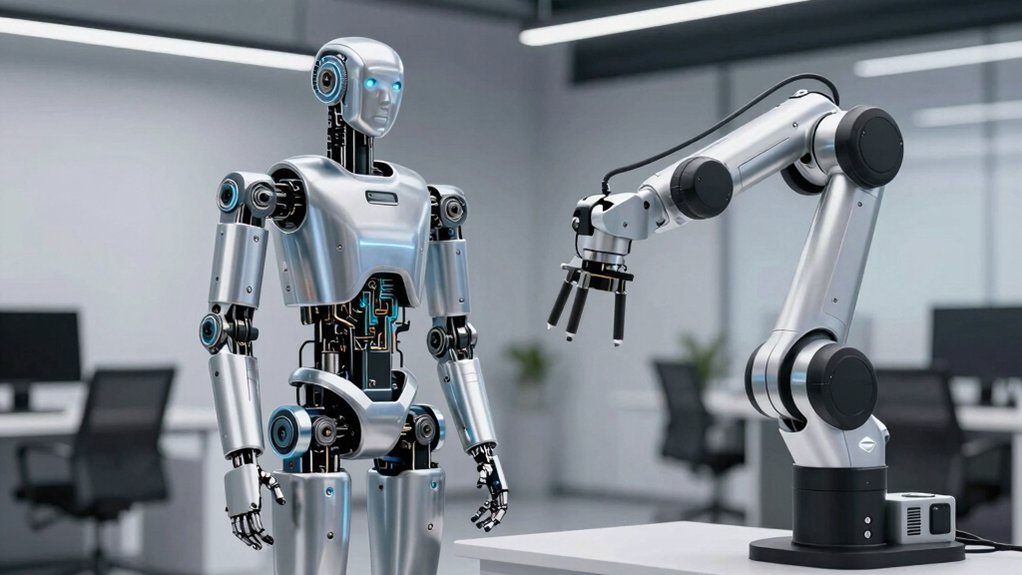
You’ll need to evaluate five key factors before selecting an AI robot: first, determine your primary purpose and use case, whether you’re automating workplace tasks, enhancing customer service, or supporting educational needs. Second, assess the robot’s AI capabilities and intelligence level to ensure it matches your required functions, then compare your budget against available price points and consider safety standards, durability ratings, and warranty coverage. Finally, examine the robot’s portability and form factor to confirm it fits your physical space and operational environment.
Purpose And Use Case
How’ll you actually use your AI robot? Start by defining its primary purpose—face recognition for security, voice control for assistance, navigation for deliveries, or autonomous task execution. Match this purpose to your environment: exhibition halls need public engagement robots, offices require task-focused models, and homes demand safety-conscious designs. Next, align the robot’s interaction style with your needs. Do you want conversational AI that responds to questions, autonomous gestures that work independently, or remote control requiring operator input? Finally, evaluate your autonomy requirements. Determine whether you need full independence or operator assistance. This guides your hardware decisions: sensors for obstacle avoidance, mapping systems for navigation, and charging infrastructure for sustained operation. These choices directly impact which robot best fits your workflow.
AI Capabilities And Intelligence
What separates a basic robot from one that truly integrates into your workflow? AI capabilities and intelligence level. Start by evaluating natural language processing—can the robot understand context and hold multi-turn conversations, or does it only respond to simple commands? Next, assess vision systems. Does it recognize faces, objects, and scenes in real time to support personalized interactions? Then examine memory capacity. Short-term conversation context works for single sessions, while long-term person-specific memories enable the robot to recall preferences and routines across multiple interactions. Finally, check autonomy levels. Determine whether you need fully autonomous navigation and task execution or environment-aware decision-making that combines reasoning with sensor data. These factors directly impact how effectively the robot adapts to your specific work requirements.
Budget And Price Point
Three primary price tiers exist when selecting an AI robot: basic models ranging from $200–$500, mid-range options between $500–$2,000, and premium units exceeding $2,000. Basic models offer programmability and app control, suitable for educational purposes. Mid-range robots add multi-scenario capabilities like entertainment and brand promotion with customizable features including color, language, and wheels. Premium models deliver autonomous navigation, advanced face recognition, and sophisticated AI systems for enterprise applications. Consider subscription costs for software integration like ChatGPT and ongoing updates that expand functionality. Factor in accessories, charging docks, and warranty extensions when calculating total investment. Match your budget to your specific needs: education, workplace automation, or customer service applications determine which tier delivers necessary capabilities without overspending.
Safety And Durability
Once you’ve settled on a budget, you’ll want to examine the safety and durability features built into your chosen robot. Check that the robot uses child-safe materials like ABS plastic and features smooth, rounded edges to prevent injuries. Verify it has obstacle avoidance sensors and auto-shutdown mechanisms that stop operation when hazards are detected. Look for certifications such as FCC or CPC compliance, which confirm the device meets regulatory safety standards. Inspect the protective casing for durability against drops and rough handling. Review power management features, including auto-charging docks and battery safeguards that prevent overcharging. If you’ll use the robot outdoors or in high-traffic areas, confirm it has weather-resistant or ruggedized design. These factors ensure safe, reliable operation across different environments.
Portability And Form Factor
How you’ll move and position your AI robot directly impacts its usefulness in your workspace and home. Consider the robot’s weight and size first—lighter models under five pounds transport easily between rooms, while heavier units stay stationary. Next, evaluate its form factor: humanoid robots navigate tight spaces better, desktop models require dedicated surface area, and compact designs fit shelves or bags. Check whether components detach or attach magnetically, allowing you to reconfigure the robot for different tasks. Finally, assess weather resistance if you need outdoor functionality for delivery or monitoring work. Match the robot’s physical design to your specific environment and how frequently you’ll move it. This alignment ensures you’ll actually use the device rather than leaving it unused due to transportation difficulties.
Language Support And Accessibility**
Two critical factors separate AI robots that work for everyone from those that limit your options: the languages they support and how accurately they understand different speakers.
Check whether each robot supports your primary language and any secondary languages your team uses. Verify the speech recognition quality for your specific language—some AI stacks handle accents and regional dialects better than others. Review whether the robot stores language-specific instructions and memory, which directly affects personalization in non-English contexts.
Confirm update requirements and subscription costs for maintaining expanded language features. Some robots require regular updates to sustain multilingual capability. Assess whether the robot’s dialogue system aligns with your regional language variations. This preparation ensures your chosen robot removes communication barriers rather than creating them.
Final Thoughts
When you’re selecting an AI robot, evaluate your primary need: humanoid service robots handle deliveries and monitoring, desktop companions offer ChatGPT-powered conversation, and wearable AIBIs coordinate across your devices. Check each model’s face recognition capability, multilingual support, and integration with your existing systems. Compare memory capacity and safety features. Match the robot’s functions to your workplace or home requirements, then verify compatibility with your equipment before purchasing.

Meet Ry, “TechGuru,” a 36-year-old technology enthusiast with a deep passion for tech innovations. With extensive experience, he specializes in gaming hardware and software, and has expertise in gadgets, custom PCs, and audio.
Besides writing about tech and reviewing new products, he enjoys traveling, hiking, and photography. Committed to keeping up with the latest industry trends, he aims to guide readers in making informed tech decisions.