
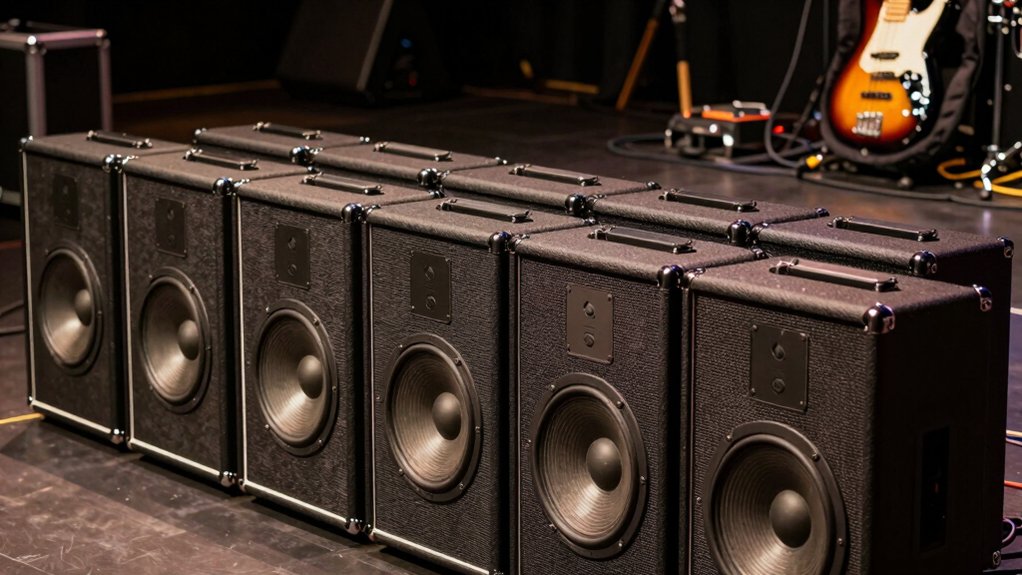

To pick 2×10 bass cabinets pros use, start by matching impedance and wattage to your amp; most 2x10s are 8 ohms and handle 200–400W RMS, with 4–8 ohm variants. Consider ported versus sealed designs for room response, then assess construction quality, secure connections, and portability. Compare options like Fender Rumble 210, Seismic 210, Hartke 210XL, Ashdown UK-ABM-210H-EVO IV, and Seismic 410 variants for headroom and projection. If you want more guidance, you’ll get a clear, step-by-step path ahead.
| Fender Rumble 210 CABINET V3 with 2-Year Warranty |

| Best Overall 2×10 | Type: Bass cabinet (2×10) | Power (W RMS): 700 | Impedance: 8 ohms (wired at 8 ohms) | VIEW LATEST PRICE | Read Our Analysis |
| Sound Town 2×10″ 400W Bass Cabinets Birch Black |
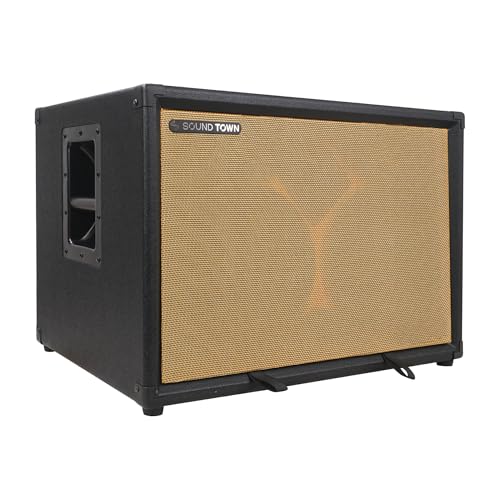
| Lightweight Gigessential | Type: Bass cabinet (2×10) | Power (W RMS): 400 | Impedance: 8 ohms | VIEW LATEST PRICE | Read Our Analysis |
| Seismic Audio 210 Bass Guitar Speaker Cabinet PA |

| Budget Robustness | Type: Bass guitar speaker cabinet | Power (W RMS): 200 | Impedance: 4 ohms | VIEW LATEST PRICE | Read Our Analysis |
| Seismic 210 Bass Guitar Speaker Cabinet with Horn |
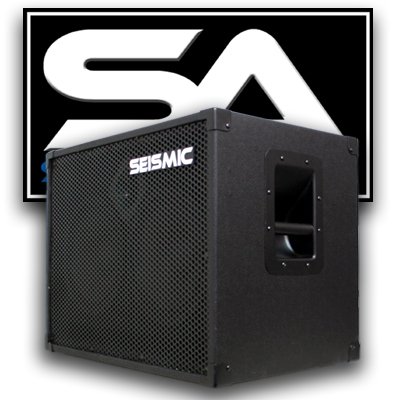
| Horn-Equipped Utility | Type: Bass guitar speaker cabinet | Power (W RMS): 200 | Impedance: 8 ohms | VIEW LATEST PRICE | Read Our Analysis |
| Hartke 210XL V2 Bass Cabinet |
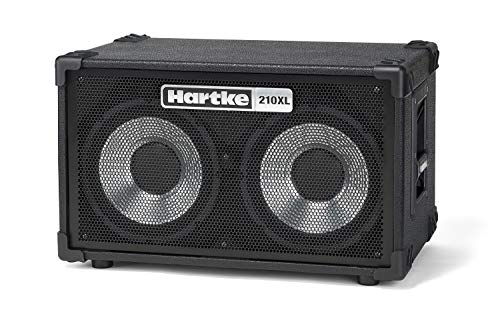
| Classic Hartke Sound | Type: Bass cabinet | Power (W RMS): 200 | Impedance: 8 ohms | VIEW LATEST PRICE | Read Our Analysis |
| Harmony Audio HA-V10P Pro DJ Speaker (300W) |

| Club-Ready PA Option | Type: PA/Speaker cabinet (2-way) | Power (W RMS): 300 | Impedance: 8 ohms | VIEW LATEST PRICE | Read Our Analysis |
| Fender Rumble 4×10 Bass Cabinet (v3) |

| Fender Elite Standout | Type: Bass cabinet (4×10) | Power (W RMS): Not specified (implied by 2-Year Fender context; treat as core cabinet; value not given) | Impedance: Not specified | VIEW LATEST PRICE | Read Our Analysis |
| Hartke 410XL V2 Bass Cabinet |

| Powerhouse 410 Alternative | Type: Bass cabinet | Power (W RMS): 400 | Impedance: 8 ohms | VIEW LATEST PRICE | Read Our Analysis |
| Ashdown UK-ABM-210H-EVO IV 500-watt 2 x 10-inch Bass Cabinet |

| UK-Built Benchmark | Type: Bass cabinet (2×10) | Power (W RMS): 500 | Impedance: 8 ohms | VIEW LATEST PRICE | Read Our Analysis |
| Seismic 410 Bass Guitar Speaker Cabinet with Horn |

| High-Output Stage Workhorse | Type: Bass cabinet (4×10) | Power (W RMS): 400 | Impedance: 8 ohms | VIEW LATEST PRICE | Read Our Analysis |
More Details on Our Top Picks
Fender Rumble 210 CABINET V3 with 2-Year Warranty
The Fender Rumble 210 Cabinet V3 is a practical choice for players seeking clear, powerful low-end with reliable portability. You set up this cabinet by handling it with care, using the inset handles, and placing it on a stable surface. Check compatibility with your Fender Rumble 200 head or combo, using the magnetic head-attachment system for secure coupling. Verify the two-year warranty and note the longer transferable option, plus speaker warranty terms. Confirm specs: 700 watts program, 350 watts continuous, 2×10 configuration, and ports for enhanced bass. Connect via Speakon or 1/4-inch jack, and test tone with low, mid, high controls.
- Type:Bass cabinet (2×10)
- Power (W RMS):700
- Impedance:8 ohms (wired at 8 ohms)
- Speaker count:2×10 (two 10″ woofers)
- Frequency range:40 Hz – 5 kHz
- Construction material:Plywood enclosure
- Additional Feature:Featherweight portability
- Additional Feature:Magnetic head-attachment system
- Additional Feature:Re-voiced for tonal detail
Sound Town 2×10″ 400W Bass Cabinets Birch Black
Choose the Sound Town 2×10″ 400W Bass Cabinets, Birch, Black when you want a compact, tour-ready setup that preserves tone without adding bulk. You get 400W RMS total power at 8 ohms and a 2 x 10 cast aluminum speaker pair. Use the compression driver and horn with attenuator to control high end. Connect via the back panel’s 1/4″ or Speakon inputs. The birch cabinet with a Black Tolex finish and removable wheat cloth grill keeps up on the road. Transport with side handles; rely on durable hardware for touring and gig use.
- Type:Bass cabinet (2×10)
- Power (W RMS):400
- Impedance:8 ohms
- Speaker count:2×10
- Frequency range:Not specified (bass-focused)
- Construction material:Birch plywood cabinet
- Additional Feature:Compression driver with horn
- Additional Feature:Back panel: combo inputs
- Additional Feature:Attenuator horn switch
Seismic Audio 210 Bass Guitar Speaker Cabinet PA
This Seismic Audio 210 bass cabinet stands out for its two 10″ woofers and 4-ohm load, making it a practical choice when you need solid low-end projection without overloading the system. You’ll use it as a floor-standing cabinet for bass guitar or PA tasks. Connect via two 1/4″ inputs or a single 8-ohm setup, noting its 200W RMS, 400W peak rating. Place the cabinet on a stable surface, position angled toward the audience, and test at low volume first. Verify dimensions (25″ wide, 18″ high, 14″ deep) and confirm compatibility with your amp. Consider the 49 lb weight for transport.
- Type:Bass guitar speaker cabinet
- Power (W RMS):200
- Impedance:4 ohms
- Speaker count:2×10
- Frequency range:40 Hz – 5 kHz
- Construction material:5/8″ plywood front panel
- Additional Feature:50 oz woofer magnets
- Additional Feature:Front panel 5/8″ plywood
- Additional Feature:Two 1/4″ inputs
Seismic 210 Bass Guitar Speaker Cabinet with Horn
Packed with power, the Seismic 210 Bass Cabinet is a practical choice when you need reliable stage output with clear mids and solid low end. You connect it by using the two 1/4″ or SpeakOn inputs and daisy chain to another cabinet. It handles 200 Watts RMS, 400 Watts peak, at 8 ohms, with two 10″ woofers and a horn with volume control. Expect a 40 Hz–5 kHz range and 98 dB sensitivity. Check dimensions (19″ x 26″ x 15″) and guarantee proper ventilation. Use the metal jack plate and rugged grill for on-road use. Verify availability; confirm non-returnable status before purchase.
- Type:Bass guitar speaker cabinet
- Power (W RMS):200
- Impedance:8 ohms
- Speaker count:2×10
- Frequency range:40 Hz – 5 kHz
- Construction material:5/8″ plywood front panel
- Additional Feature:Volume-controlled horn
- Additional Feature:Daisy chain capable
- Additional Feature:5/8″ plywood front panel
Hartke 210XL V2 Bass Cabinet
The Hartke 210XL V2 Bass Cabinet stands out for players who need solid low-end punch in a compact 2×10 format. You choose this cabinet for its 200W RMS power at 8 ohms and two 10″ proprietary aluminum cones with 1.5″ voice coils on Kapton formers. You verify its frequency response from 50 Hz to 5 kHz and use the two 1/4″ inputs wired in parallel for simple hookup. You note a single-chamber, sealed cabinet built from 3/4″ plywood with textured vinyl. You consider its suitability for compact gigs, evaluating tonal output and durability against your rig needs.
- Type:Bass cabinet
- Power (W RMS):200
- Impedance:8 ohms
- Speaker count:2×10
- Frequency range:50 Hz – 5 kHz
- Construction material:Solid 3/4″ plywood
- Additional Feature:Proprietary aluminum cones
- Additional Feature:2 x 1/4″ inputs parallel
- Additional Feature:Sealed single-chamber cabinet
Harmony Audio HA-V10P Pro DJ Speaker (300W)
The Harmony Audio HA-V10P Pro DJ Speaker delivers a clear, practical option for pro players needing portable, high-velocity stage sound. You set it up by confirming it’s a 300W, 8-ohm, 2-way cabinet with a 10″ woofer and 6″ tweeter. Check the built-in 35 mm stand mount and place the cabinet on a stable floor stand for optimal height. Connect wired input per the manual, and run tests at mid-volume to verify sensitivity at 92.3 dB. Use it for live clubs or parties, and deploy wall or ceiling mounts as needed. Keep the enclosure intact to minimize resonance.
- Type:PA/Speaker cabinet (2-way)
- Power (W RMS):300
- Impedance:8 ohms
- Speaker count:2-way (one woofer + horn)
- Frequency range:50 Hz – 18 kHz
- Construction material:MDF enclosure
- Additional Feature:35 mm stand mount
- Additional Feature:92.3 dB sensitivity
- Additional Feature:3×6 Double Piezo tweeter
Fender Rumble 4×10 Bass Cabinet (v3)
Choose the Fender Rumble 4×10 Cabinet v3 when you need strong low-end projection with clear mids and reliable reliability. You will consider its revoiced cabinet for better sonic detail and enhanced low-frequency translation. The Eminence drivers improve dynamics, while premium HF compression tweeters deliver crisp highs. Use the Magnetic Rumble Head-Attachment System to mount the head securely and simplify setup. Expect classic Fender styling with updated design for performance. This cabinet adds low-end extension and clarity across frequencies, suitable for live and studio bass setups. It comes with a 2-year warranty for peace of mind.
- Type:Bass cabinet (4×10)
- Power (W RMS):Not specified (implied by 2-Year Fender context; treat as core cabinet; value not given)
- Impedance:Not specified
- Speaker count:4×10
- Frequency range:Not specified
- Construction material:Not specified (cabinet details implied)
- Additional Feature:Revoiced bass cabinet
- Additional Feature:Eminence drivers
- Additional Feature:Head-attachment system
Hartke 410XL V2 Bass Cabinet
Check this option when you need reliable, stage-ready power: the Hartke 410XL V2 Bass Cabinet delivers four 10″ aluminum cones rated at 100W each, totaling 400W RMS at 8 ohms. You mount the cabinet and connect two 1/4″ inputs wired in parallel for input options. The cabinet uses a tuned dual-chamber, dual-ported design with solid 3/4″ plywood, ensuring durability on tour. Review the frequency response of 30 Hz–5 kHz to match your bass range, and verify impedance with your head unit. Use textured vinyl for a durable finish and plan for 400W continuous monitoring during gigs.
- Type:Bass cabinet
- Power (W RMS):400
- Impedance:8 ohms
- Speaker count:4×10
- Frequency range:30 Hz – 5 kHz
- Construction material:Solid 3/4″ plywood
- Additional Feature:4×10 configuration
- Additional Feature:Dual-ported cabinet
- Additional Feature:100W per cone
Ashdown UK-ABM-210H-EVO IV 500-watt 2 x 10-inch Bass Cabinet
This Ashdown UK-ABM-210H-EVO IV 500-watt 2 x 10-inch Bass Cabinet stands out for its 8-ohm, 500-watt output and two Ciare speakers, delivering strong low end and articulate midrange for pro-level tones. You set up with 8-ohm compatibility and connect via Premier Neutrik SpeakON ports. Check the 3-mode HF control to tailor brightness, then test tone by playing clean to brave dynamics. Weighs 57.7 pounds, so position against walls for bass throw and use the 2×10 design to split stage sound. Choose this cabinet when you need balanced lows, mids, and reliable power.
- Type:Bass cabinet (2×10)
- Power (W RMS):500
- Impedance:8 ohms
- Speaker count:2×10
- Frequency range:Not specified
- Construction material:Wood enclosure
- Additional Feature:UK-built enclosure
- Additional Feature:3-mode HF control
- Additional Feature:2 Ciare speakers
Seismic 410 Bass Guitar Speaker Cabinet with Horn
The Seismic 410 delivers a robust 4×10 configuration with a middle horn, making it a practical choice when you need both depth and projection in a 2×10 lineup. You connect it by wiring at 8 ohms and use the two 1/4″ inputs in the terminal cup for stereo or mono setups. Its four 10″ woofers handle bass frequencies, and the horn adds clarity at higher frequencies. Measure the cabinet at 26″ x 26″ x 15″ and note the 5/8″ plywood front and heavy duty grill. Use it for bass, PA, or DJ applications where power handling matters.
- Type:Bass cabinet (4×10)
- Power (W RMS):400
- Impedance:8 ohms
- Speaker count:4×10
- Frequency range:45 Hz – 5,000 Hz
- Construction material:5/8″ plywood front panel
- Additional Feature:Four 10″ woofers
- Additional Feature:Horn in the middle
- Additional Feature:8 ohm wired
Factors to Consider When Choosing 2×10 Bass Cabinets
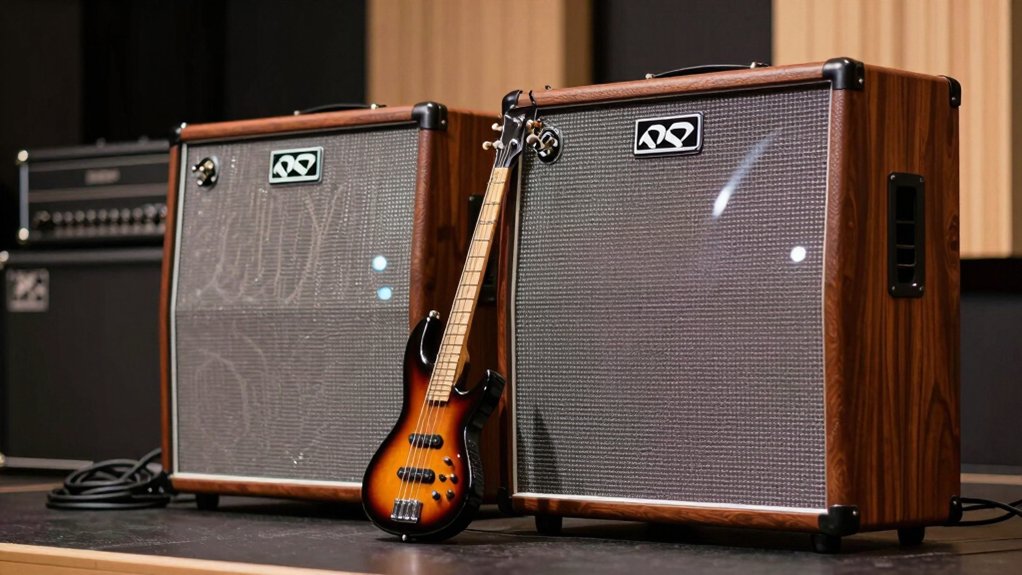
Consider your power handling, impedance, and how the cabinet is built, then match these to your head and playing style. Check the speaker configuration options, such as two 10s vs. single 2×10 with different cone sizes, and decide if you need more drivers for headroom or tighter low end. Compare ported and sealed designs by outlining the steps to test them: listen for punch and sustain, note weight and size, and verify compatibility with your rig and venue needs.
Power Handling Considerations
Start with the cabinet’s power rating and pair it correctly with your amplifier. Check the cabinet’s RMS (continuous) wattage, for example 200–400W RMS, and compare to your head’s continuous output. Do not exceed the cabinet’s RMS rating at the chosen impedance. If you use 8 ohms, ensure the amp’s power at 8 ohms stays within the cabinet’s RMS range to avoid thermal stress. Consider peak ratings as a safety margin, but rely on RMS for long gigs. Align the cabinet’s total RMS with your typical playing level, especially for dynamic bass passages. When in doubt, choose a higher RMS cabinet if you frequently push hard, ensuring the enclosure and drivers remain within spec. Verify impedance compatibility to maximize headroom and protection.
Impedance Compatibility Guide
So, how do you verify impedance compatibility when selecting 2×10 bass cabinets? Start by checking the cabinet’s impedance rating on the terminal plate. Most 2×10 cabs are 8 ohms, which allows many amps and lets you daisy-chain multiple cabinets in parallel or series as the amp supports. Confirm your head’s compatible load ranges in the manual. If two 8-ohm cabinets are used, they may present 4 ohms in parallel, or remain 8 ohms if wired properly. If a cabinet shows 4 ohms total, ensure your amplifier can deliver full power without overheating. When pairing cabinets, ensure the total impedance matches the amp’s rated load. Verify all connections, and avoid loads outside the amp’s safe range to prevent clipping.
Cabinet Construction Quality
What matters most is the cabinet’s construction because it directly affects durability and sound consistency. Start by choosing 5/8″ (0.625″) plywood or thicker for rigidity and reduced resonance. Verify the enclosure is well sealed to prevent air leaks that affect power delivery. Inspect the jack plate area; ensure sturdy options, such as two inputs or Speakon compatibility, for reliable connections. Check the front grill; a full metal grille and recessed handles protect the cabinet during transport and gig wear. Look for dual- or multi-chamber porting and solid cabinet construction to control internal standing waves and improve low-end response. Confirm corner hardware uses tight, robust metal corners and a textured finish to resist wear.
Speaker Configuration Variants
Two-by-ten bass cabinets balance size, power, and projection, so start by noting how the two 10″ drivers affect overall tone and load. Compare the impedance options, typically 4 to 8 ohms, and choose a cabinet that matches your amp’s load rating to ensure proper power transfer. Review power handling as RMS and peak values, such as 200W RMS / 400W peak, to assess continuous versus transient bass demands. Decide whether a horn or compression driver is paired with the woofers to gain higher-frequency clarity and projection. Consider cabinet type: dual-ported aids deeper extension, while sealed designs offer tighter bass. Check wiring compatibility, ensure proper speaker polarity, and confirm cabinet weight and size align with transport needs. Test in your rig for response consistency.
Ported Versus Sealed Design
Ported and sealed designs each have strengths you can leverage, so start by comparing their fundamental effects on low end and control. Ported cabinets improve low-frequency extension and efficiency, delivering deeper bass at the same power. Sealed cabinets provide tighter, more controlled low end and smoother transient handling, with less port noise at high output. Consider enclosure volume carefully: small changes in volume or port length can shift tuning and alter low-end emphasis in ported cabs. Sealed cabs stay more predictable across rooms, due to fewer resonances and no port chuff. Both designs benefit from appropriate power handling, such as 200–400W RMS, to achieve headroom. For ported options, plan tuning to avoid over-excursion. For sealed options, prioritize consistency across venues.
Final Thoughts
Choose the cabinet that fits your needs by purpose and budget. If you need portability and power, pick a 2×10 with durable construction and a reliable warranty. Compare speakers for clarity, gain handling, and horn options. Check compatibility with your head unit and impedance. Consider room size and venue wattage to avoid under- or over-driving. For beginners, start with a mid-priced Hartke or Ashdown model, test in your space, then adjust your setup accordingly.

Meet Ry, “TechGuru,” a 36-year-old technology enthusiast with a deep passion for tech innovations. With extensive experience, he specializes in gaming hardware and software, and has expertise in gadgets, custom PCs, and audio.
Besides writing about tech and reviewing new products, he enjoys traveling, hiking, and photography. Committed to keeping up with the latest industry trends, he aims to guide readers in making informed tech decisions.