
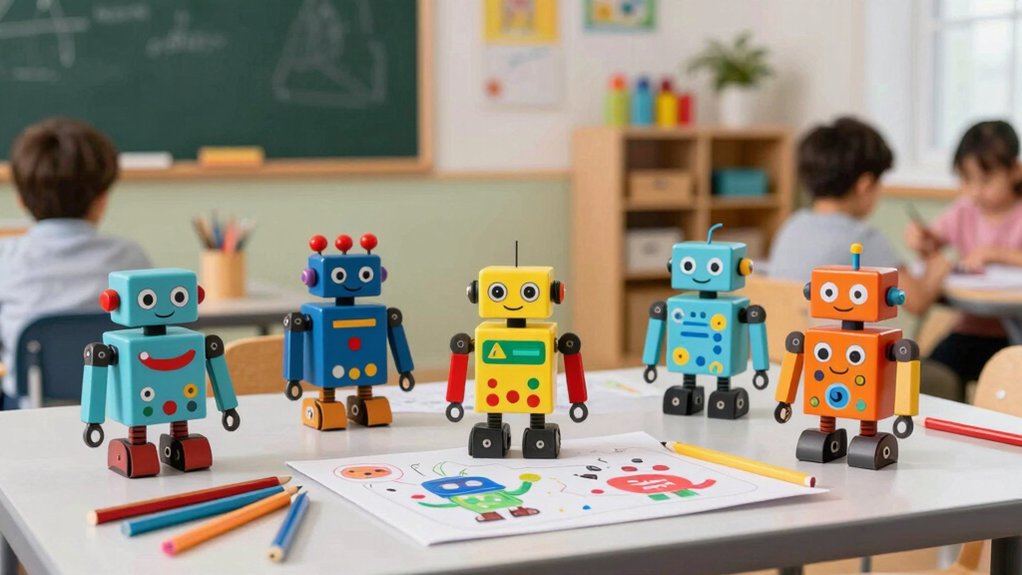

Consider these five drawing robots: pick the Drawing Robot for Kids or Drawing Robot with Cards for plug-and-play use on a flat surface; insert a card, press start, and watch it guide with step-by-step prompts. Choose Voice-Interactive options to boost vocabulary, with cards covering animals, plants, transportation, and food. For extended play, look for reusable or replaceable cards and USB-C power. If you want more details, keep exploring the options ahead.
| Drawing Robot for Kids: Interactive Learning Toy Set |

| Best Interactive Learning | Voice Interaction: Voice interaction | Card-Based Drawing Cards: 150 drawing cards | No App Required: No app required; plug-and-play | VIEW LATEST PRICE | Read Our Analysis |
| Drawing Robot for Kids with Cards – Voice Interactive Learning Toys |

| Montessori-Inspired Choice | Voice Interaction: Built-in music (voice interaction capability implied) | Card-Based Drawing Cards: 150 drawing cards | No App Required: No app required; ready-to-use set | VIEW LATEST PRICE | Read Our Analysis |
| Voice Interactive Drawing Robot for Kids with Cards & Pens |

| Comprehensive Card Set | Voice Interaction: Voice interactive | Card-Based Drawing Cards: 100 drawing cards | No App Required: No app required; complete set | VIEW LATEST PRICE | Read Our Analysis |
| Interactive Drawing Robot for Kids with Voice |

| Safe & Engaging Fun | Voice Interaction: Voice (interactive drawing with no app) | Card-Based Drawing Cards: 150 drawing cards | No App Required: No app required; interactive drawing | VIEW LATEST PRICE | Read Our Analysis |
| Drawing Robot for Kids with Pens and Cards |

| Value-Driven Bundle | Voice Interaction: Not explicitly stated, no voice interaction noted | Card-Based Drawing Cards: 100 drawing cards | No App Required: No app required; setup-free card insertion | VIEW LATEST PRICE | Read Our Analysis |
More Details on Our Top Picks
Drawing Robot for Kids: Interactive Learning Toy Set
A primary feature to highlight is that the Drawing Robot for Kids operates without an app and uses 150 pre-designed drawing cards to deliver plug-and-play learning. You will set up the kit by placing the robot on a flat surface, inserting a drawing card, and pressing the button to start painting. The kit includes 150 cards with categories like animals, plants, and transportation, plus pens and a drawing board. It supports voice interaction for word learning and painting. Use it to strengthen hand-eye coordination, color perception, and early language skills through structured, guided activities.
- Voice Interaction:Voice interaction
- Card-Based Drawing Cards:150 drawing cards
- No App Required:No app required; plug-and-play
- Educational Montessori Influence:Montessori-inspired learning
- Includes Pens/Markers:4 drawing pens, 12 color pens
- Age Range / Target Age:36 months–8 years
- Additional Feature:Card categories included
- Additional Feature:150 drawing cards
- Additional Feature:4.8 x 4.3 x 0.1 in size
Drawing Robot for Kids with Cards – Voice Interactive Learning Toys
This Drawing Robot for Kids with Cards—Voice Interactive Learning Toys stands out for its 150 guided drawing cards that teach step by step, building fine motor skills and independent thinking as kids follow prompts and receive tempo-guided feedback. You set up the kit by unboxing the Drawing Robot, the 150 drawing cards, markers, pens, board, and USB-C charger. Connect power, then choose a card. Follow the step-by-step guide, watch the robot prompt, and draw along. Use the cards to explore animals or objects, then switch to free drawing for practice. This combination supports creativity and steady concentration.
- Voice Interaction:Built-in music (voice interaction capability implied)
- Card-Based Drawing Cards:150 drawing cards
- No App Required:No app required; ready-to-use set
- Educational Montessori Influence:Montessori principles
- Includes Pens/Markers:12 colorful markers
- Age Range / Target Age:Not explicitly stated (implied kids; birthday/holiday use)
- Additional Feature:150 drawing cards
- Additional Feature:Built-in music
- Additional Feature:Type-C charging
Voice Interactive Drawing Robot for Kids with Cards & Pens
If you’re seeking a kid-friendly drawing robot that combines guided practice with creative control, this Voice Interactive Drawing Robot stands out for ages 3–8 thanks to its 100 cards and step-by-step prompts. You receive the robot, 100 cards, 12 markers, 4 drawing pens, a reusable board, and a Type-C cable. Follow the Montessori-inspired design to spark creativity and build fine motor skills. Use the voice prompts to complete subjects like animals, nature, food, and objects. No extra supplies are needed. Built-in music supports focus; use it to accompany the drawing session and improve coordination.
- Voice Interaction:Voice interactive
- Card-Based Drawing Cards:100 drawing cards
- No App Required:No app required; complete set
- Educational Montessori Influence:Montessori-inspired design
- Includes Pens/Markers:12 markers
- Age Range / Target Age:3 years and up
- Additional Feature:100 drawing cards
- Additional Feature:Reusable drawing board
- Additional Feature:Nonstandard battery included
Interactive Drawing Robot for Kids with Voice
The Interactive Drawing Robot with Voice stands out for children aged 5–10 who benefit from guided, hands-on learning without a smartphone or app. You insert 150 drawing cards and press a button to start painting. Cards cover categories such as animals, plants, transportation, and food, guiding color choices and shapes. The robot’s voice prompts you through steps, reinforcing vocabulary and sentence structure as you draw. Materials are child-safe, and the design is approachable for small hands. This supports Montessori-style learning via structured activities, combining play with early literacy. Use it for daily practice or example-led sessions with rotating card sets.
- Voice Interaction:Voice (interactive drawing with no app)
- Card-Based Drawing Cards:150 drawing cards
- No App Required:No app required; interactive drawing
- Educational Montessori Influence:Montessori-style learning through cards
- Includes Pens/Markers:(Not specified beyond cards; pens not listed)
- Age Range / Target Age:5–10 years
- Additional Feature:150 drawing cards
- Additional Feature:No app needed
- Additional Feature:Child-friendly design
Drawing Robot for Kids with Pens and Cards
Pair the Drawing Robot for Kids with Pens and Cards with simple, goal-driven activities to maximize learning, starting with the 100 drawing cards. You set up the device by inserting a card, then you select a topic such as animals, plants, or transportation to boost graphic recognition and color perception. The system requires no app; it develops hand-eye coordination, writing, drawing, problem-solving, creativity, and imagination through steady use. It includes 16 color pens and durable, safe materials. Follow care guidance to protect the card, and use 5–12 year olds with supervision for best results. Warranty and 24/7 support are available.
- Voice Interaction:Not explicitly stated, no voice interaction noted
- Card-Based Drawing Cards:100 drawing cards
- No App Required:No app required; setup-free card insertion
- Educational Montessori Influence:Montessori-inspired concept
- Includes Pens/Markers:16 color pens
- Age Range / Target Age:5–12 years
- Additional Feature:100 drawing cards
- Additional Feature:16 color pens
- Additional Feature:5–12 years range
Factors to Consider When Choosing Drawing Robots for Kids
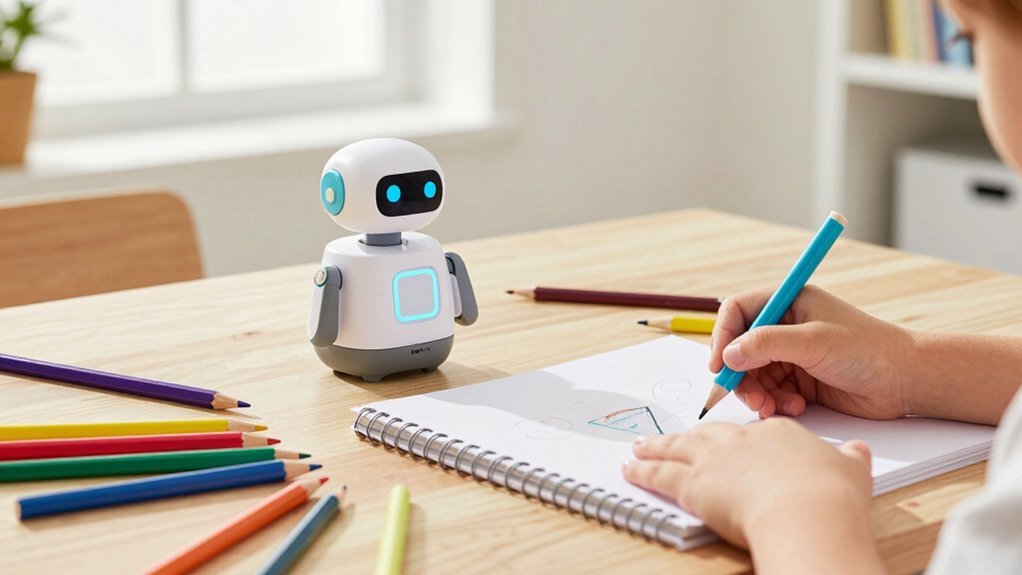
Consider age appropriateness by matching features to your child’s developmental stage and setting clear limits on complexity, then assess educational value by pairing drawing Modes with hands-on activities that reinforce steps like choosing tools and planning sketches. Evaluate card content variety, safety and materials, and setup usability by listing concrete checks: age labels, non-toxic plastics, rounded edges, simple assembly, and intuitive controls, plus examples of quick-start tasks and troubleshooting steps. Finally, outline a practical decision path that compares options side by side, with concrete criteria and sample scenarios to guide selection based on your kid’s interests and your household needs.
Age Appropriateness Considerations
Are you choosing a drawing robot that matches your child’s development and learning pace? Start by matching the recommended age range to your child’s stage, ensuring the device supports ages within 3–10 years or 5–12 years as specified by the product. Look for age-specific design features, such as simplified controls and larger buttons for younger children (5–8), and more complex prompts or extended activities for older kids (9–12). Check that the included drawing cards and activities align with cognitive level, offering step-by-step guidance for younger users and independent practice for older ones. Confirm safety certifications and materials appropriate for the target age group, avoiding small parts for younger children and ensuring durable construction for active use. Assess whether the product supports gradual skill development across ages, providing progression opportunities from basic shapes to more advanced drawings.
Educational Value Balance
Educational value should be evaluated through structured, concrete criteria that map directly to learning outcomes. Begin by selecting Montessori-inspired guidance and step-by-step drawing cards to support self-directed learning, ensure that progression is clear and trackable. Next, confirm the program emphasizes fine motor skills, hand-eye coordination, and color perception through hands-on drawing activities, with measurable milestones. Prioritize devices featuring voice interaction or built-in music to sustain attention during guided tasks, and verify that these tools enhance focus without distraction. Ensure the set covers diverse themes—animals, plants, transportation, and everyday objects—to promote cognitive flexibility and creativity. Finally, confirm no app requirement and that outcomes explicitly tie to language development and problem-solving via card-based activities.
Card Content Variety
Card content variety should begin with a broad set of 100–150 cards to cover topics like animals, plants, transportation, and food, ensuring sustained engagement over time. Start by selecting a diverse card pool that mirrors everyday interests and learning goals. Include step-by-step drawing guides on cards to scaffold learning, helping learners build confidence gradually. Align card topics with Montessori-inspired or early-learning aims to support language development and cognitive skills, then document how each topic maps to specific goals. Use reusable or replaceable cards to extend the toy’s lifespan and allow topic expansion without replacing units. Ensure imagery is colorful and age-appropriate to enhance color perception and visual recognition during drawing activities. Evaluate balance and update periodically for continued relevance and interest.
Safety and Materials
When selecting drawing robots for kids, focus first on materials and construction to reduce risk during frequent handling and drawing activities. Choose robots made from high-quality, child-safe materials designed to withstand regular use. Look for non-toxic, BPA-free plastics and paints, with certifications or clear safety testing data. Ensure components like drawing cards and pens are durable and securely attached to prevent small-part detachment hazards. Favor sturdy construction and rounded edges to minimize injury during play and learning. Verify the battery and charging system meet safety standards and include safeguards against overcharging or overheating. Check for clear documentation of safety testing, and prefer brands that provide maintenance guidance and replacement part availability for long-term use. Maintain ongoing inspection routines to identify wear before issues arise.
Setup And Usability
Setup and usability start with plug-and-play simplicity. Look for a design that requires no app, enabling immediate use after you insert drawing cards and press start. Verify card count and content coverage, aiming for about 100–150 cards with clear categories such as animals, plants, and transportation to ensure diverse prompts. Check power needs and battery type: consider Type-C charging, a 5V/2A adapter, or included lithium cells for reliable, long sessions. Ensure the set includes all essential components—the robot, drawing board, markers or pens, and a charging cable—to avoid buying extras later. Verify safety features and age-appropriateness to match your child’s motor skills and ensure parental setup is limited to initial assembly only.
Battery And Compatibility
Battery and Compatibility: Start by identifying the type of power the drawing robot uses, then check what you’ll need to keep it running. Most models use built-in rechargeable batteries or replaceable batteries, so verify whether a USB-C or Type-C charger is included or required. Look at battery capacity and run time; some units offer 2000–4000 mAh equivalents for extended use between charges. Compatibility typically requires standard charging adapters, such as 5V/2A, or specific cables; verify included accessories and what is compatible with common power sources. Some units use nonstandard or proprietary batteries, which can affect availability of replacements and maintenance. Always confirm safety certifications and age-appropriate handling guidance to ensure safe operation for children.
Final Thoughts
To decide, compare features, prices, and age suitability. Start by listing top picks from the article, then assess each option’s pens, cards, and voice interactivity. Check compatibility with your child’s skill level and bedroom/activity space. Prioritize durability and simple setup. If you need hands-off guidance, choose the all-in-one model with cards and pens. For budget, opt for a basic drawing robot with future upgrade potential. Finally, read reviews for real-world performance before buying.

Meet Ry, “TechGuru,” a 36-year-old technology enthusiast with a deep passion for tech innovations. With extensive experience, he specializes in gaming hardware and software, and has expertise in gadgets, custom PCs, and audio.
Besides writing about tech and reviewing new products, he enjoys traveling, hiking, and photography. Committed to keeping up with the latest industry trends, he aims to guide readers in making informed tech decisions.