
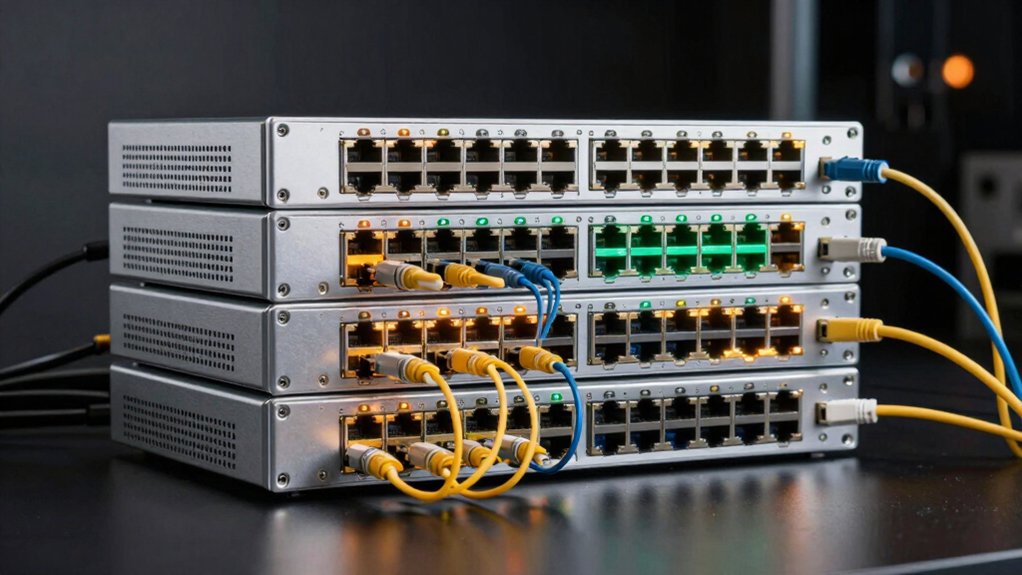

When you’re building or upgrading your enterprise network, selecting the right Layer 3 switch directly impacts your infrastructure’s performance and growth potential. You’ll need to evaluate uplink capacity, routing capabilities, power budgeting, and management features against your current constraints and three-to-five-year expansion goals. Four standout models deliver different strengths for various enterprise scenarios. Here’s what you need to know to make the right choice.
| NETGEAR 8-Port Gigabit Ethernet Smart Switch (GS108T) |

| Best for SMB Networks | Gigabit Ethernet Ports: 8 ports | Management Capabilities: Smart software with SNMP and NETGEAR Insight cloud management | High-Speed Uplink Ports: None listed | VIEW LATEST PRICE | Read Our Analysis |
| TP-Link 24 Port Gigabit Smart Switch (TL-SG1024DE) |

| Best Value Option | Gigabit Ethernet Ports: 24 ports | Management Capabilities: Easy Smart Managed with VLAN, QoS, and LAG support | High-Speed Uplink Ports: None listed | VIEW LATEST PRICE | Read Our Analysis |
| Grandstream GWN7813 24-Port Gigabit Network Switch |
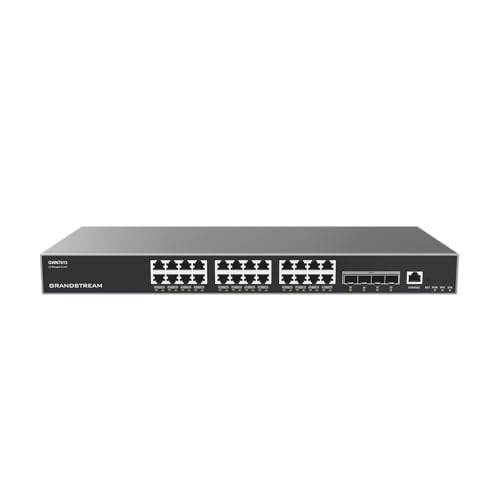
| Best Enterprise Security | Gigabit Ethernet Ports: 24 ports | Management Capabilities: Embedded controller with GDMS and GWN Manager platform | High-Speed Uplink Ports: 4 × 10 Gigabit SFP+ ports | VIEW LATEST PRICE | Read Our Analysis |
| Ubiquiti USW-Pro-Max-16-PoE (180W) |

| Best PoE Performance | Gigabit Ethernet Ports: 16 ports | Management Capabilities: Layer 3 switching with native VLAN indication via Etherlighting | High-Speed Uplink Ports: 2 × 10G SFP+ ports | VIEW LATEST PRICE | Read Our Analysis |
More Details on Our Top Picks
NETGEAR 8-Port Gigabit Ethernet Smart Switch (GS108T)
Are you looking for a managed switch that won’t consume excessive power or require complex setup? The NETGEAR GS108T offers eight Gigabit Ethernet ports with smart management software designed for straightforward operation. You’ll access the device through its easy-to-use interface for configuration and monitoring. The switch supports SNMP management via NMS 300 and includes NETGEAR Insight for remote network oversight. Its energy-efficient design meets IEEE 802.3az compliance standards, reducing operational costs. You can mount it on a desktop or wall, and it runs silently without cooling noise. NETGEAR backs this switch with a lifetime limited hardware warranty and next business day replacement service. Support includes 24/7 chat access with NETGEAR experts.
- Gigabit Ethernet Ports:8 ports
- Management Capabilities:Smart software with SNMP and NETGEAR Insight cloud management
- High-Speed Uplink Ports:None listed
- Quality of Service (QoS):Not specified
- Security Features:Secure setup and access
- Form Factor:Desktop or wall mountable
- Additional Feature:Lifetime Limited Hardware Warranty
- Additional Feature:Next Business Day Replacement
- Additional Feature:24/7 Expert Chat Support
TP-Link 24 Port Gigabit Smart Switch (TL-SG1024DE)
The TP-Link TL-SG1024DE is your best choice if you’re setting up a mid-sized enterprise network that doesn’t require advanced Layer 3 routing but demands reliable, manageable connectivity across multiple devices. This 24-port switch delivers Gigabit speeds on every port, reaching up to 1000 Mbps per connection. You’ll configure VLANs to segment traffic by department or function, then apply port-based or tag-based QoS to prioritize latency-sensitive applications like VoIP. The metal chassis withstands constant use, while shielded ports protect against electromagnetic interference. Setup takes minutes—just plug in cables and access the web interface. Three-year warranty coverage and weekday technical support from 6am–6pm PST provide ongoing protection for your investment.
- Gigabit Ethernet Ports:24 ports
- Management Capabilities:Easy Smart Managed with VLAN, QoS, and LAG support
- High-Speed Uplink Ports:None listed
- Quality of Service (QoS):Port-based and tag-based QoS for latency-sensitive traffic
- Security Features:Port security and cable diagnostics
- Form Factor:Desktop or rackmount
- Additional Feature:9K Jumbo Frame Support
- Additional Feature:Port Mirroring & Cable Diagnostics
- Additional Feature:Sturdy Metal Shielded Chassis
Grandstream GWN7813 24-Port Gigabit Network Switch
What if you’re managing an enterprise network that demands both robust security and centralized control? The Grandstream GWN7813 delivers exactly that. You’ll get 24 Gigabit ports plus four 10 Gigabit SFP+ ports for high-speed connectivity. The embedded controller manages your switch, routers, and network devices from one interface using GDMS Networking or GWN Manager. You configure security features like ARP Inspection, IP Source Guard, and DHCP snooping to protect against threats. Built-in QoS prioritizes critical traffic. You stack multiple switches for unified management and establish redundant backup between devices for reliability. This Layer 3 switch scales your enterprise infrastructure efficiently.
- Gigabit Ethernet Ports:24 ports
- Management Capabilities:Embedded controller with GDMS and GWN Manager platform
- High-Speed Uplink Ports:4 × 10 Gigabit SFP+ ports
- Quality of Service (QoS):Built-in QoS for traffic prioritization
- Security Features:ARP Inspection, IP Source Guard, DoS protection, DHCP snooping
- Form Factor:Rackmount for enterprise deployment
- Additional Feature:4 × 10 Gigabit SFP+ Ports
- Additional Feature:Stacking Support Unified Management
- Additional Feature:IPv6 & IPv4 Deployment Support
Ubiquiti USW-Pro-Max-16-PoE (180W)
Looking for a fanless Layer 3 switch that combines PoE power delivery with straightforward installation flexibility? The Ubiquiti USW-Pro-Max-16-PoE delivers 180W of total PoE budget across 16 ports: four 2.5 GbE PoE++ ports and twelve GbE PoE+ ports. Two 10G SFP+ ports handle uplink connectivity. You’ll mount it on your desktop, wall, or rack depending on your space constraints. The fanless design eliminates noise in your network closet. Etherlighting ports illuminate to show port location, link speed, and VLAN assignment. Layer 3 switching capabilities enable routing between network segments without additional equipment.
- Gigabit Ethernet Ports:16 ports
- Management Capabilities:Layer 3 switching with native VLAN indication via Etherlighting
- High-Speed Uplink Ports:2 × 10G SFP+ ports
- Quality of Service (QoS):Layer 3 switching features with advanced traffic management
- Security Features:Enterprise-grade Layer 3 switching security
- Form Factor:Desktop, wall, or rack mountable
- Additional Feature:Fanless Silent Cooling Design
- Additional Feature:Etherlighting Port Status Indicators
- Additional Feature:4 × 2.5 GbE PoE++ Ports
Factors to Consider When Choosing a Layer 3 Network Switch
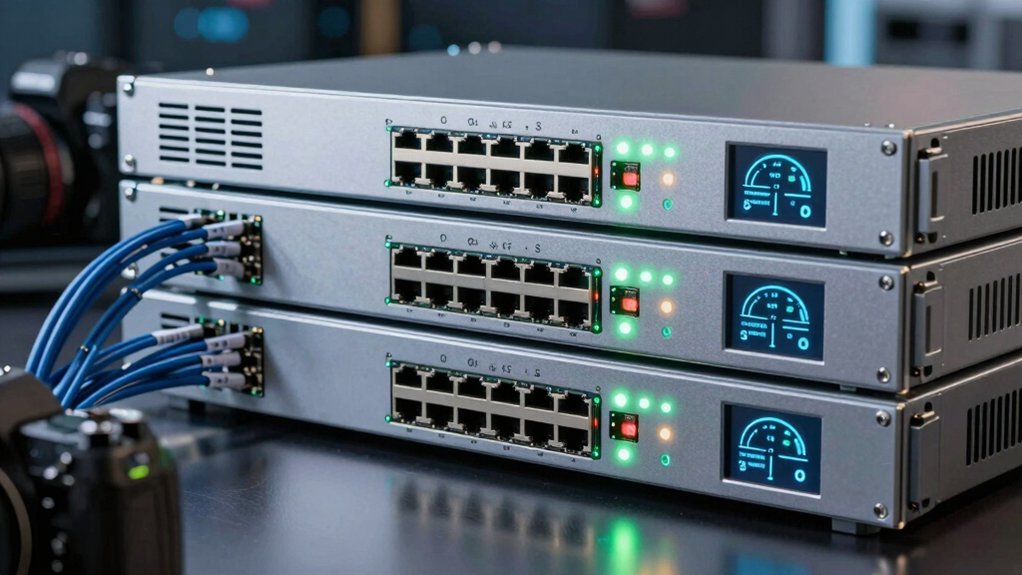
When selecting a Layer 3 network switch, you’ll need to evaluate five critical factors: port count and scalability to match your current and future network growth, power and PoE budget to support all connected devices, security and management features to protect your data and simplify administration, uplink speed capabilities to handle traffic between network segments, and deployment environment compatibility to ensure the switch functions reliably in your specific location. Start by calculating your immediate port requirements and projecting growth over the next three to five years, then assess whether your facility’s power infrastructure can support the switch’s consumption and PoE delivery. Finally, confirm that the switch’s security protocols, remote management options, and physical specifications align with your organization’s standards and your facility’s environmental conditions, such as temperature and humidity ranges.
Port Count and Scalability
How you choose a Layer 3 switch’s port count directly impacts your network’s ability to grow without constant hardware upgrades. Evaluate your current device count and project your growth over three to five years. A 24-port switch handles small to mid-sized networks, while 16-port options work for basic setups. Consider Link Aggregation (LAG) capabilities, which bundle multiple ports to increase uplink throughput without consuming additional connections. Ensure your switch reserves sufficient internal ports for both access devices and uplink connections to prevent bottlenecks. Higher port density reduces the need for cascaded devices or additional hardware. Plan for scalability by selecting a switch that accommodates your network’s expansion trajectory, minimizing future replacement costs and management complexity.
Power and PoE Budget
Why does your switch’s power delivery matter? Your PoE budget directly determines how many powered devices you can support simultaneously. Calculate your total power needs by adding the wattage requirements of all devices you’ll connect—cameras, access points, and IP phones. Match this total against the switch’s available budget in watts. For example, if you need 250W total and your switch offers only 180W, you’ll require external power injectors. Consider port types: standard PoE delivers 15W per port, PoE+ delivers 30W, and PoE++/4PPoE delivers up to 95W. If you’re using 2.5 GbE PoE ports, verify that power distribution doesn’t bottleneck other connections. Plan for future growth by selecting switches with scalable or redundant power options.
Security and Management Features
Consider your Layer 3 switch’s built-in security and management capabilities as foundational to your network’s protection and operational efficiency. Evaluate DHCP snooping, IP Source Guard, and ARP Inspection features to prevent spoofing attacks at your network edge. Verify DoS protection mechanisms that defend against denial-of-service threats. Assess whether the switch supports centralized management through cloud or on-premises platforms, enabling unified configuration across multiple devices. Confirm stacking capabilities for simplified administration. Review IPv4 and IPv6 support to ensure your switch handles current and future routing requirements. Check whether it supports static or dynamic routing protocols based on your network’s complexity and scalability needs. Prioritize switches offering QoS implementation for managing latency-sensitive traffic across routed paths effectively.
Uplink Speed Capabilities
Most modern Layer 3 switches rely on uplink ports to connect to upstream network devices, and you’ll want to evaluate these connections carefully since they directly determine the maximum throughput between your switch and the rest of your network infrastructure. Standard uplink speeds range from 1 GbE to 10 GbE, with SFP+ and QSFP+ options available for higher demands. You should assess whether your switch’s backplane capacity exceeds total aggregated port speeds to prevent bottlenecks. Consider implementing link aggregation (LACP) across multiple uplink ports to combine bandwidth and add redundancy. For data centers and core interconnections, 10G uplinks are standard. Match your uplink speed to your access port density and expected inter-VLAN traffic volumes to ensure consistent performance.
Deployment Environment Compatibility
How’ll you know if a Layer 3 switch fits your physical space and operational setup? First, identify your deployment environment: desktop, rackmount, or wall-mount. Measure your available space and compare it against the switch’s dimensions. Next, verify the switch supports your cabling layout and connectivity requirements. Then, confirm environmental compatibility by checking operating temperature ranges, noise levels, and power consumption against your facility’s conditions. Finally, assess PoE budget availability if you’re powering devices like IP cameras or access points. Document your space constraints, power capacity, and cooling capabilities before selecting a switch. This ensures the device integrates smoothly into your existing infrastructure without requiring costly modifications or upgrades to your facility.
Final Thoughts
You’ll choose the right Layer 3 switch by matching your network’s specific demands: port count, PoE requirements, uplink speed, and budget. Evaluate each option against your rack space, power capacity, and three-to-five-year growth plans. Prioritize models with strong security features, QoS capabilities, and comprehensive documentation. Test compatibility with your existing infrastructure before deployment to ensure smooth integration and long-term operational success.

Meet Ry, “TechGuru,” a 36-year-old technology enthusiast with a deep passion for tech innovations. With extensive experience, he specializes in gaming hardware and software, and has expertise in gadgets, custom PCs, and audio.
Besides writing about tech and reviewing new products, he enjoys traveling, hiking, and photography. Committed to keeping up with the latest industry trends, he aims to guide readers in making informed tech decisions.