
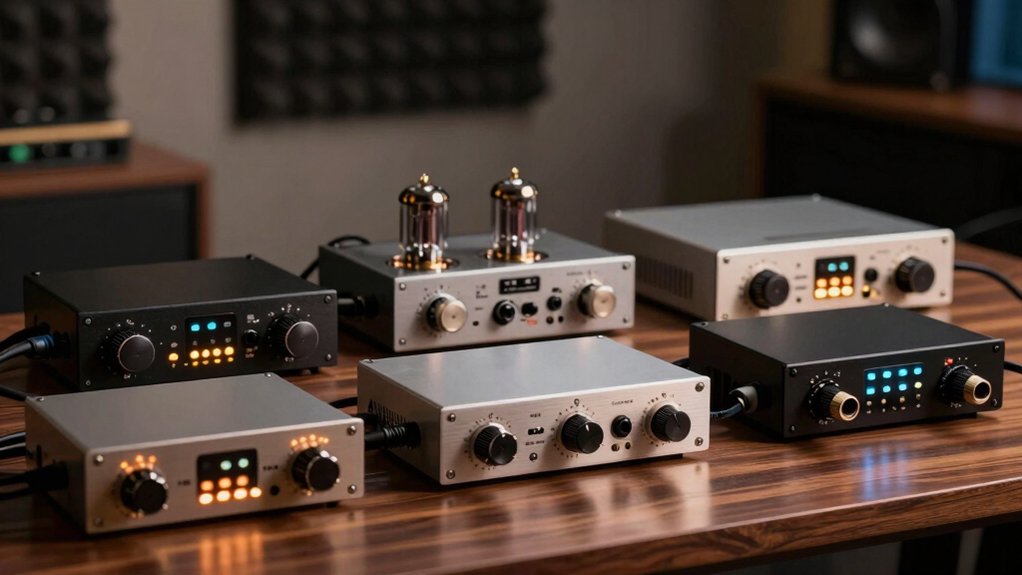

When you’re setting up a home studio, you need a microphone preamp that handles your recording demands reliably. You’ll want to evaluate gain range, phantom power availability, and connection types before making your choice. This guide walks you through fifteen proven preamps—from compact portable units to rack-mounted options—so you can match the right equipment to your specific setup. Here’s what you need to know.
| StudioMan DPM1 XLR Dynamic Microphone Preamp with Phantom Power |

| Best For Dynamic Mics | Gain Range: +29dB | Phantom Power: 48V (required, not passed to mic) | Microphone Compatibility: Dynamic & ribbon mics only | VIEW LATEST PRICE | Read Our Analysis |
| Microphone Preamp with 48V Power & XLR Output |

| Best Value | Gain Range: 20dB | Phantom Power: 48V (compatible) | Microphone Compatibility: Dynamic & condenser mics | VIEW LATEST PRICE | Read Our Analysis |
| Mic Preamp with 75db Gain and 48V Phantom Power |

| Most Versatile | Gain Range: 19-66dB | Phantom Power: 48V (built-in) | Microphone Compatibility: Dynamic & condenser mics | VIEW LATEST PRICE | Read Our Analysis |
| Microphone Preamplifier Power Amplifier Home Studio Recording Kit |
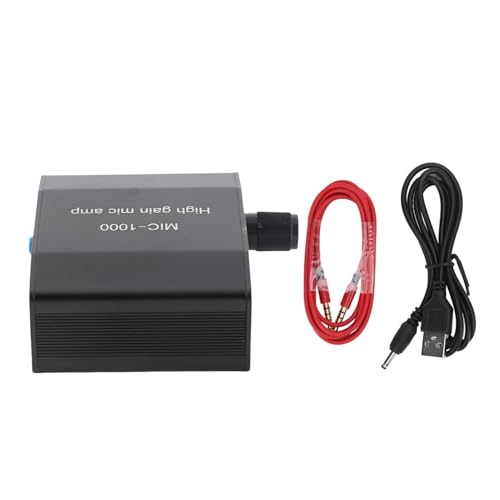
| Budget-Friendly Pick | Gain Range: 1000x amplification (60dB equivalent) | Phantom Power: None | Microphone Compatibility: General (unspecified) | VIEW LATEST PRICE | Read Our Analysis |
| RO-04 Mic Preamp Studio Grade 72dB Adjustable Gain |

| Best Overall | Gain Range: 0-72dB | Phantom Power: 48V (built-in) | Microphone Compatibility: Dynamic, condenser, ribbon mics & instruments | VIEW LATEST PRICE | Read Our Analysis |
| Microphone Preamp In Line Mic Booster Four Channel |

| Best For Podcasters | Gain Range: +25dB | Phantom Power: 48V (required, not passed to mic) | Microphone Compatibility: Dynamic & ribbon mics only | VIEW LATEST PRICE | Read Our Analysis |
| Rockville PPA20 Preamp 11V Rack Mount Professional Pre-Amplifier |
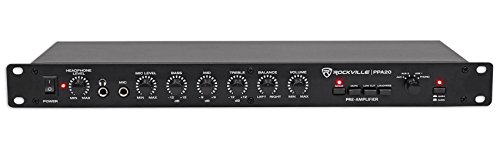
| Professional Grade | Gain Range: Variable (3-band EQ, no fixed gain stated) | Phantom Power: None | Microphone Compatibility: Phono/line sources (not mic-specific) | VIEW LATEST PRICE | Read Our Analysis |
| 60dB Studio Microphone Preamp with XLR Output |

| Best Gain | Gain Range: +60dB | Phantom Power: 48V (built-in) | Microphone Compatibility: Dynamic & condenser mics | VIEW LATEST PRICE | Read Our Analysis |
| Coda MB-1 Microphone Preamp with 48V Phantom Power |

| Best For Ribbons | Gain Range: +25dB | Phantom Power: 48V (required, not supplied by unit) | Microphone Compatibility: Dynamic & ribbon mics only | VIEW LATEST PRICE | Read Our Analysis |
| StudioMan CL-200 2-CH XLR Preamp for Microphones |

| Best Dual-Channel | Gain Range: +25dB | Phantom Power: 48V (compatible, powered from source) | Microphone Compatibility: Dynamic & ribbon mics only | VIEW LATEST PRICE | Read Our Analysis |
| Focusrite Scarlett Solo Studio 4th Gen USB Audio Interface |

| Best Beginner Bundle | Gain Range: N/A (audio interface, not preamp) | Phantom Power: None | Microphone Compatibility: Condenser mics (via bundled CM25) | VIEW LATEST PRICE | Read Our Analysis |
| Microphone Preamp with 48V Phantom Power & DI Box |
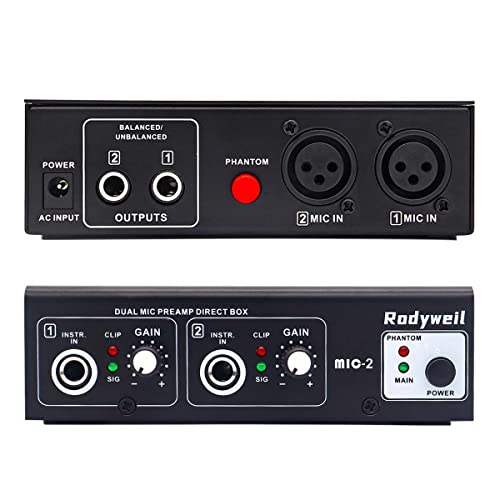
| Best For Vocals | Gain Range: +75dB | Phantom Power: 48V (built-in) | Microphone Compatibility: Dynamic & condenser mics | VIEW LATEST PRICE | Read Our Analysis |
| Focusrite Scarlett Solo 3rd Gen USB Audio Interface |

| Best Starter Interface | Gain Range: N/A (audio interface, not preamp) | Phantom Power: None | Microphone Compatibility: Instruments (via bundled interface) | VIEW LATEST PRICE | Read Our Analysis |
| Microphone Preamp 48V Power Supply XLR Inputs |

| Most Compact | Gain Range: +60dB | Phantom Power: 48V (built-in) | Microphone Compatibility: Dynamic & condenser mics | VIEW LATEST PRICE | Read Our Analysis |
| Mic Preamp XLR with 48V Power for Microphones |

| Best Balanced Sound | Gain Range: 20dB | Phantom Power: 48V (built-in) | Microphone Compatibility: Dynamic & condenser mics | VIEW LATEST PRICE | Read Our Analysis |
More Details on Our Top Picks
StudioMan DPM1 XLR Dynamic Microphone Preamp with Phantom Power
The StudioMan DPM1 serves dynamic microphones—like the SM7B and SM58—by delivering +29dB of clean gain directly at the source. You’ll place this compact XLR adapter between your microphone and mixer or audio interface, then supply 48V phantom power from your interface. The preamp boosts weak signals before they reach your preamp, improving your signal-to-noise ratio for broadcast-quality clarity. Its rugged metal housing shields against electronic interference and hum. You’ll get plug-and-play setup with universal XLR compatibility and a 1-year warranty backed by 24/7 technical support, making it suitable for studio, stage, and mobile recording applications.
- Gain Range:+29dB
- Phantom Power:48V (required, not passed to mic)
- Microphone Compatibility:Dynamic & ribbon mics only
- Noise Performance:Studio-grade noise reduction (not quantified)
- Output Connectivity:XLR output
- Form Factor:Compact inline XLR adapter
- Additional Feature:Plug-and-play metal adapter design
- Additional Feature:24/7 technical support included
- Additional Feature:Red/Black metallic finish options
Microphone Preamp with 48V Power & XLR Output
For home studio recordists seeking affordable amplification without compromising audio quality, this microphone preamp delivers exceptional value through its straightforward feature set. The unit provides 20 dB gain with balanced amplification circuitry, ensuring clean signal boosting for dynamic and condenser microphones alike. Its 48V phantom power supply enables compatibility with condenser mics that require external power. The fully balanced circuit design minimizes noise while maintaining transparent audio reproduction. The rugged black metal case reduces electromagnetic interference, protecting against unwanted noise contamination. Its compact, lightweight design fits easily into home studios, podcast setups, and live streaming environments. Connect your microphone via XLR input, power the unit, and engage the gain control to achieve optimal signal levels for your recordings.
- Gain Range:20dB
- Phantom Power:48V (compatible)
- Microphone Compatibility:Dynamic & condenser mics
- Noise Performance:Ultra-low noise (not quantified)
- Output Connectivity:XLR output
- Form Factor:Compact standalone unit
- Additional Feature:Fully balanced circuit design
- Additional Feature:Supports dynamic and condenser
- Additional Feature:Ultra-low noise operation
Mic Preamp with 75db Gain and 48V Phantom Power
Looking to expand your home studio’s microphone options? This mic preamp delivers 66 dB maximum gain and 48V phantom power for dynamic and condenser microphones. Connect the balanced output to your audio interface’s TRS line input for optimal noise performance at -120 dB EIN. The preamp features XLR and TS instrument inputs with a 1 MΩ impedance rating. Power it through USB Type-C at 5V. You’ll achieve 0.0035% THD+N across a 20 kHz frequency response. Use appropriate cables and avoid simultaneous input usage. The unit weighs 400 grams and includes a two-year support guarantee with free replacement for quality issues.
- Gain Range:19-66dB
- Phantom Power:48V (built-in)
- Microphone Compatibility:Dynamic & condenser mics
- Noise Performance:EIN -120dB; THD+N 0.0035%
- Output Connectivity:XLR/TRS/TS outputs
- Form Factor:Compact standalone unit (3.54 x 3.94 x 4.33 inches)
- Additional Feature:Type-C power input/portability
- Additional Feature:Separate instrument input impedance
- Additional Feature:2-year after-sales support
Microphone Preamplifier Power Amplifier Home Studio Recording Kit
Need a budget-friendly pick that delivers professional amplification without breaking your recording setup? This compact preamp offers 1000x amplification through its high-sensitivity design, letting you capture weak sounds clearly. The aluminum alloy shell protects internal components while maintaining a small 63 x 52 x 22 mm footprint. Connect your microphone via the 3.5mm interface and use the automatic level control to manage volume automatically. The stereo switch box handles signals without loss, and you’ll drive headphones directly for monitoring. Strong anti-interference performance keeps unwanted noise out. Use this kit for home studio recording, karaoke, podcasts, voice-overs, and audio system amplification. Mobile phone recording compatibility expands your recording options significantly.
- Gain Range:1000x amplification (60dB equivalent)
- Phantom Power:None
- Microphone Compatibility:General (unspecified)
- Noise Performance:Strong anti-interference (not quantified)
- Output Connectivity:3.5mm headphone output
- Form Factor:Small box (63 x 52 x 22mm)
- Additional Feature:1000x amplification capability
- Additional Feature:Automatic level control (ALC)
- Additional Feature:Direct headphone drive capability
RO-04 Mic Preamp Studio Grade 72dB Adjustable Gain
The RO-04 delivers studio-grade preamp performance across home recording, podcasting, and mobile streaming without requiring a dedicated power supply. You’ll adjust gain from 0–72 dB to match your source—vocals, instruments, or distant audio. The dual inputs accommodate microphones (dynamic, condenser, ribbon) and instruments with independent impedance circuits. You’ll power it via USB-C using wall adapters or power banks, maintaining 48V phantom power for condenser mics. Two output levels let you connect to professional interfaces or mobile devices directly. Ultra-low noise at –120 dBV EIN preserves detail in quiet sources. Five-year support and 24-hour technical assistance cover your setup needs.
- Gain Range:0-72dB
- Phantom Power:48V (built-in)
- Microphone Compatibility:Dynamic, condenser, ribbon mics & instruments
- Noise Performance:EIN -120dBV; ultra low noise
- Output Connectivity:Dual outputs (professional & consumer levels)
- Form Factor:Compact portable unit (USB-C powered)
- Additional Feature:Dual inputs with independent circuits
- Additional Feature:Power bank compatible operation
- Additional Feature:Streaming-friendly dual output levels
Microphone Preamp In Line Mic Booster Four Channel
Want to strengthen weak microphone signals without buying expensive outboard gear? The Microphone Preamp In Line Mic Booster Four Channel delivers +25 dB gain across four channels, making it ideal for multi-source setups. You’ll connect dynamic microphones like the SM7B or SM58 directly to this preamp, then route the boosted signal to your audio interface via XLR cables. The unit requires +48 V phantom power but won’t pass it to your mics, protecting dynamic and passive ribbon models. You’ll achieve clean audio with distortion under 0.02% and a 90 dB signal-to-noise ratio. Its 10–20 kHz frequency response suits podcasting, live streaming, and home recording without condenser microphone compatibility limitations.
- Gain Range:+25dB
- Phantom Power:48V (required, not passed to mic)
- Microphone Compatibility:Dynamic & ribbon mics only
- Noise Performance:SNR 90dB; distortion <0.02%
- Output Connectivity:XLR output
- Form Factor:Compact inline unit
- Additional Feature:Four-channel simultaneous processing
- Additional Feature:Low distortion (< 0.02%)
- Additional Feature:90 dB signal-to-noise ratio
Rockville PPA20 Preamp 11V Rack Mount Professional Pre-Amplifier
Rockville’s PPA20 delivers professional-grade pre-amplification in a compact 1U rack format. You’ll find five AUX inputs alongside a dedicated phono input for vinyl sources and a 1/4″ mic input for direct microphone connection. The three-band equalizer lets you shape bass, midrange, and treble frequencies precisely. Control your audio levels using the mute and pad functions, which reduce signal by 20 dB when needed. Monitor your output through RCA line outs or balanced XLR master outputs. The headphone output provides direct listening capability. With frequency response spanning 5 Hz to 30 kHz and distortion below 0.02%, you’ll maintain clean audio throughout your signal chain.
- Gain Range:Variable (3-band EQ, no fixed gain stated)
- Phantom Power:None
- Microphone Compatibility:Phono/line sources (not mic-specific)
- Noise Performance:THD <0.02% (not quantified for noise floor)
- Output Connectivity:RCA & XLR master outputs; 1/4″ headphone
- Form Factor:1U rack-mount chassis (18.89 x 6.49 x 1.73 inches)
- Additional Feature:3-band equalizer included
- Additional Feature:1U rack-mountable chassis design
- Additional Feature:Loudness compensation feature
60dB Studio Microphone Preamp with XLR Output
Looking to capture vocal recordings with maximum clarity? The ariarly 60dB Studio Microphone Preamp delivers studio-quality sound with up to +60dB gain and minimal distortion. It supports both condenser and dynamic microphones, including the SM7B and 55SH models. The unit features 48V phantom power and three-channel inputs for versatile mic support. You’ll connect it to your sound interface or mixer using the XLR balanced output, which reduces noise and interference. The compact black metal housing makes it portable for home studios, podcasting, or live streaming. A 90-day manufacturer warranty backs your purchase.
- Gain Range:+60dB
- Phantom Power:48V (built-in)
- Microphone Compatibility:Dynamic & condenser mics
- Noise Performance:Low distortion (not quantified)
- Output Connectivity:XLR balanced; 3.5mm & 6.35mm line outputs
- Form Factor:Compact standalone unit
- Additional Feature:3-channel input versatility
- Additional Feature:90-day manufacturer warranty included
- Additional Feature:Multi-connector output options
Coda MB-1 Microphone Preamp with 48V Phantom Power
The Coda MB-1 excels for recording ribbon and dynamic microphones that need gain without coloration. It delivers 25dB of gain, bringing quiet sources like vocals and acoustic instruments to professional levels. You’ll get a noise floor of -70dB, ensuring clean audio without hiss or hum. The unit accepts 48V phantom power from your interface or external supply, though it doesn’t generate power itself. Use it for studio recording, podcasts, live streaming, and radio work. The MB-1 improves your gain-before-feedback ratio on long cable runs, producing articulate signals ready for mixing.
- Gain Range:+25dB
- Phantom Power:48V (required, not supplied by unit)
- Microphone Compatibility:Dynamic & ribbon mics only
- Noise Performance:Noise floor -70dB
- Output Connectivity:XLR output
- Form Factor:Compact standalone unit
- Additional Feature:Reduced noise floor (-70dB)
- Additional Feature:Improved gain-before-feedback ratio
- Additional Feature:Preserves natural microphone sound
StudioMan CL-200 2-CH XLR Preamp for Microphones
Want to boost weak microphone signals without degrading audio quality? The StudioMan CL-200 delivers +25dB gain across two channels with ultra-low distortion below 0.02% THD+N. You’ll connect your dynamic microphone via XLR to the preamp, then route the output to your mixer or interface using phantom power—no separate power supply required. The dual-channel design lets you process two microphones simultaneously. Position short cables from your microphone to the preamp, then use longer cables to your mixer for optimal signal integrity. The unit handles studio recording, podcasting, and live streaming applications effectively. You gain transparent sound preservation with exceptional noise performance exceeding 120dB EIN.
- Gain Range:+25dB
- Phantom Power:48V (compatible, powered from source)
- Microphone Compatibility:Dynamic & ribbon mics only
- Noise Performance:THD+N <0.02%; EIN >120dB
- Output Connectivity:XLR output
- Form Factor:Compact inline XLR unit (6.22 x 4.84 x 2.44 inches)
- Additional Feature:Ultra-low THD+N (< 0.02%)
- Additional Feature:Dual-channel simultaneous processing capability
- Additional Feature:One-year warranty included
Focusrite Scarlett Solo Studio 4th Gen USB Audio Interface
Are you starting your home studio? The Focusrite Scarlett Solo Studio 4th Gen gives you everything you need in one package. You get the audio interface, CM25 MkIII microphone, SH-450 headphones, and professional software including Pro Tools Intro+, Ableton Live Lite, and Cubase LE. The interface features Scarlett 4th Gen converters delivering 120 dB dynamic range for studio-quality sound. Air mode enhances vocals and guitars by adding presence and harmonic drive. Plug your guitar directly into the interface for immediate recording. This all-in-one solution lets you record, mix, and master without buying separate components.
- Gain Range:N/A (audio interface, not preamp)
- Phantom Power:None
- Microphone Compatibility:Condenser mics (via bundled CM25)
- Noise Performance:120dB dynamic range
- Output Connectivity:XLR & 1/4″ outputs (via Scarlett interface)
- Form Factor:Desktop USB audio interface with bundled peripherals
- Additional Feature:Air mode presence enhancement
- Additional Feature:Complete software bundle included
- Additional Feature:120 dB dynamic range
Microphone Preamp with 48V Phantom Power & DI Box
Need clean vocal amplification without noise or signal degradation? The Rodyweil RO08 delivers transparent, low-noise amplification up to +75 dB for both dynamic and condenser microphones simultaneously. Its dual-channel design lets you boost a condenser mic and dynamic mic at once, making it ideal for podcasting and live streaming setups. The 48V phantom power supports standard microphones like the SM7B and SM58. Connect the XLR balanced outputs to your audio interface, mixer, or console. The metal enclosure suppresses electromagnetic interference, and the compact box design fits easily into home or professional studios. A two-year warranty protects your investment.
- Gain Range:+75dB
- Phantom Power:48V (built-in)
- Microphone Compatibility:Dynamic & condenser mics
- Noise Performance:Full balanced circuit, low noise (not quantified)
- Output Connectivity:XLR balanced; 6.35mm stereo outputs
- Form Factor:Compact box unit (4-input DI box)
- Additional Feature:Up to 75 dB gain
- Additional Feature:Two-channel simultaneous processing
- Additional Feature:Two-year quality defect warranty
Focusrite Scarlett Solo 3rd Gen USB Audio Interface
Focusrite’s Scarlett Solo 3rd Gen serves as the entry-level interface you’ll want if you’re starting your home studio journey. You’ll get two instrument inputs with quality preamps that handle guitars and bass effectively. The Air mode switch adds clarity when recording acoustic instruments. You’re getting 24-bit/192kHz recording capability, which matches professional standards. The interface includes studio monitoring outputs and headphone monitoring for accurate listening. You’ll receive Pro Tools Intro, Ableton Live Lite, and Cubase LE, plus the Hitmaker Expansion with effects and instruments. Setup involves connecting via USB, installing drivers, and configuring your DAW. Focusrite backs this with a three-year global warranty.
- Gain Range:N/A (audio interface, not preamp)
- Phantom Power:None
- Microphone Compatibility:Instruments (via bundled interface)
- Noise Performance:Low-noise converters (not quantified)
- Output Connectivity:XLR & 1/4″ outputs (via Scarlett interface)
- Form Factor:Desktop USB audio interface
- Additional Feature:Up to 24-bit/192kHz recording
- Additional Feature:Three-year global warranty
- Additional Feature:Hitmaker expansion software suite
Microphone Preamp 48V Power Supply XLR Inputs
The Jauarta Microphone Preamp’s most compact design suits home studio recordists who need professional-grade preamp functionality without sacrificing desk space. You’ll connect dynamic or condenser microphones through 3.5mm, 6.35mm, or XLR inputs, then route audio to your interface via XLR balanced output. The built-in 48V phantom power supports condenser mics without additional equipment. Adjust gain up to +60dB and shape tone using high, mid, and low controls with ±15dB range. Power the unit through its DC 5.5 x 2.1 jack using the included USB cable. The aluminum housing minimizes electromagnetic interference, delivering clean audio across 20Hz–20kHz with minimal noise.
- Gain Range:+60dB
- Phantom Power:48V (built-in)
- Microphone Compatibility:Dynamic & condenser mics
- Noise Performance:Minimal noise, no coloration (not quantified)
- Output Connectivity:XLR; 3.5mm & 6.35mm outputs
- Form Factor:Compact standalone unit
- Additional Feature:High, mid, low controls
- Additional Feature:±15 dB adjustment range
- Additional Feature:Robust metal interference reduction
Mic Preamp XLR with 48V Power for Microphones
Why choose a preamp that delivers balanced sound without unnecessary coloration? You’ll get a fully balanced circuit design with 20 dB gain that works with dynamic and condenser microphones like the SM7B. Connect your microphone using 3.5 mm, 6.35 mm, or XLR interfaces. Activate the 48V phantom power for condenser microphones, which’ll operate 3–5 hours on this setting. The sturdy metal case eliminates interference effectively, keeping noise low during recording. You can use the included sound and USB power cables immediately. This compact preamp suits home studios, professional setups, podcasting, and live streaming without taking up much space.
- Gain Range:20dB
- Phantom Power:48V (built-in)
- Microphone Compatibility:Dynamic & condenser mics
- Noise Performance:Low noise, minimal coloration (not quantified)
- Output Connectivity:XLR; 3.5mm & 6.35mm outputs
- Form Factor:Compact standalone unit
- Additional Feature:Fully balanced circuit design
- Additional Feature:Includes sound and power cables
- Additional Feature:3-5 hour condenser mic runtime
Factors to Consider When Choosing Microphone Preamps for Home Studio
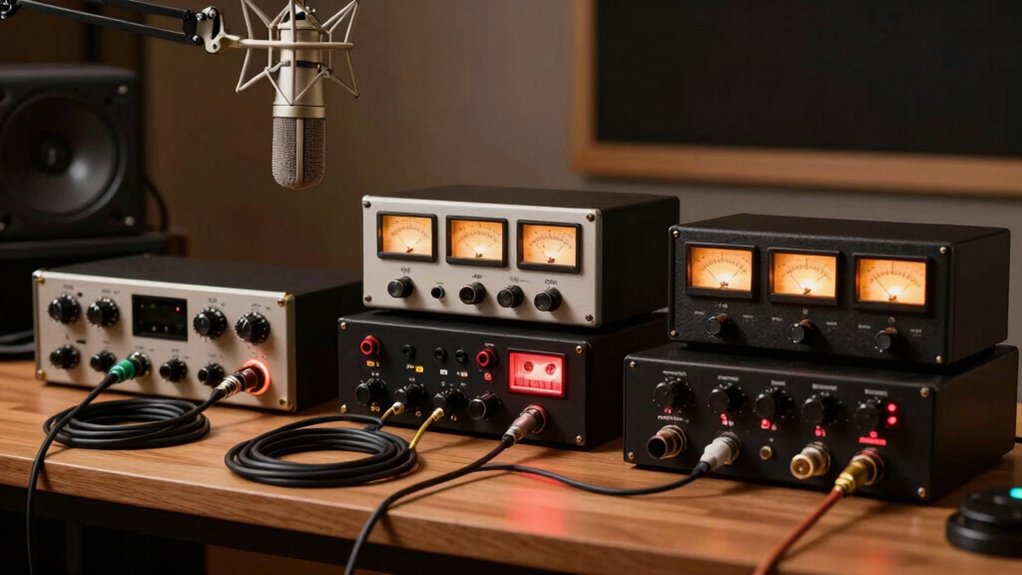
You’ll need to evaluate five key factors before selecting a microphone preamp for your home studio: microphone type compatibility (ensure the preamp works with your condenser, dynamic, or ribbon mic), gain and noise performance (check the gain range and noise floor specifications to avoid distortion or unwanted hum), phantom power requirements (verify whether your microphones need 48V power and confirm the preamp supplies it), input and output connectivity (match your XLR, USB, or other connection types to your existing equipment), and portability and form factor (decide if you need a compact unit for mobile recording or a larger desktop model for permanent setup).
Microphone Type Compatibility
How do you match a preamp to your microphone? First, identify your mic type. Dynamic and ribbon microphones need preamps without phantom power passthrough, while condensers require 48V phantom power. Second, check the preamp’s gain range. Fixed-gain preamps (20–29 dB) work for low-output dynamics, but wide-range preamps (0–72 dB) accommodate multiple mic types and source strengths. Third, verify impedance compatibility. Mic inputs have lower impedance optimized for microphones, while high-Z inputs (around 1 MΩ) suit instruments better. Fourth, confirm phantom power availability if you’re using condensers. Finally, ensure the preamp’s power supply fits your setup—USB-C powered units work well for portable home studios. Matching these factors prevents signal problems and ensures clean amplification.
Gain And Noise Performance
Once you’ve matched your microphone type to the preamp’s specifications, you’ll need to evaluate how well that preamp amplifies your signal without introducing unwanted noise. Check the preamp’s gain range—typically +20 dB to +75 dB—to ensure it covers your needs. Review the EIN (Equivalent Input Noise) rating; lower values like -120 dB indicate cleaner amplification. Examine THD+N (Total Harmonic Distortion plus Noise) to confirm the preamp maintains signal integrity without distortion. Set your gain conservatively, using only what’s necessary to reach proper recording levels while preserving headroom. This approach minimizes noise coloration and prevents saturation. Test with your specific microphone and phantom power settings, as real-world performance varies. Balancing gain and noise ensures clean, professional recordings in your home studio.
Phantom Power Requirements
Does your preamp actually send phantom power to your condenser microphone, or does it only use that power for its own circuitry? Check your preamp’s specifications to determine whether it passes +48V phantom power directly to the microphone or reserves it solely for internal operation. Some preamps require phantom power but don’t transmit it to the mic. In these cases, you’ll need to power your condenser microphone through your audio interface or an external power supply instead. Before purchasing, verify whether the preamp supports 48V phantom power and clarifies its routing. Review the manual to confirm if phantom power reaches your microphone connector. This distinction determines whether you can operate condenser mics directly from the preamp or must use alternative power sources.
Input And Output Connectivity
What connector types does your preamp use, and will they match your existing studio gear? Most preamps feature XLR inputs for microphones and XLR outputs to send signal to interfaces, mixers, or DI boxes. Check whether your preamp offers additional outputs like TRS 1/4” line outputs or 3.5 mm jacks for flexible routing options. Verify that your cables and destination devices support these connectors. Keep mic-to-preamp cables short to minimize noise, then use longer cables from the preamp to your mixer or interface. If you need to process multiple microphones simultaneously, choose a dual- or multi-channel preamp rather than single-channel models. Match all connectors before purchasing to avoid compatibility issues and ensure seamless signal flow through your setup.
Portability And Form Factor
Your preamp’s physical design directly affects how you’ll use it across different recording environments and studio layouts. Compact, lightweight aluminum housings fit easily into portable rigs for on-the-go recording or home studios with limited space. USB-C powered units eliminate the need for external adapters, making them ideal for mobile setups. Consider whether you need a single-channel desktop booster or a multi-channel in-line preamp that consolidates multiple inputs into one device, reducing cables and footprint. Rack-mount options work well for fixed studio installations, while compact formats serve flexible arrangements. Check phantom power compatibility carefully—some units deliver 48V to microphones, while others don’t, affecting your microphone choices. Evaluate your typical recording locations and workflow to determine which form factor best supports your actual needs.
Build Quality And Durability
How much wear and tear can your preamp withstand in a working studio? Build quality directly impacts longevity and performance reliability. Look for rugged metal housings with EMI shielding to reduce interference and hum in your setup. Check that connectors—XLR, TRS, and TS—are protected and that cables are shielded for long-term dependability. Verify the preamp houses built-in features like 48V phantom power in a sturdy chassis to prevent voltage fluctuations. Select fanless or low-heat designs to minimize mechanical wear and operational noise. Compact, lightweight enclosures around 63 x 52 x 22 mm enhance portability while maintaining structural integrity. These construction elements work together to ensure your preamp survives daily studio use without degradation.
Warranty And Technical Support
When you’re investing in a microphone preamp for your home studio, you’ll want to understand the warranty coverage and support options that come with it. Check whether the manufacturer offers 1-year, 2-year, or 5-year warranties, as these timeframes directly affect your protection against defects. Review the specific coverage details—some include free replacements for quality issues, while others cover only repairs. Examine the technical support channels available, such as email or live chat, and confirm response times like 12-hour or 24/7 availability. Look for after-sales policies including 30-day return windows or extended support beyond Amazon’s standard window. Compare resolution rates, targeting manufacturers claiming 90% issue resolution within 12 hours. These factors ensure you receive adequate guidance and troubleshooting throughout your preamp’s lifespan.
Final Thoughts
You’ll select the right preamp by matching your needs to these key specs: gain range (20-72 dB), phantom power support (48V), and output type (XLR). Consider your microphone type—dynamic or condenser—and recording environment. Evaluate portability versus rack mounting based on your setup. Compare noise levels and headroom across models. Test compatibility with your existing equipment before purchasing. This systematic approach guarantees you get professional sound quality for vocals, podcasts, and instruments in your home studio.

Meet Ry, “TechGuru,” a 36-year-old technology enthusiast with a deep passion for tech innovations. With extensive experience, he specializes in gaming hardware and software, and has expertise in gadgets, custom PCs, and audio.
Besides writing about tech and reviewing new products, he enjoys traveling, hiking, and photography. Committed to keeping up with the latest industry trends, he aims to guide readers in making informed tech decisions.