
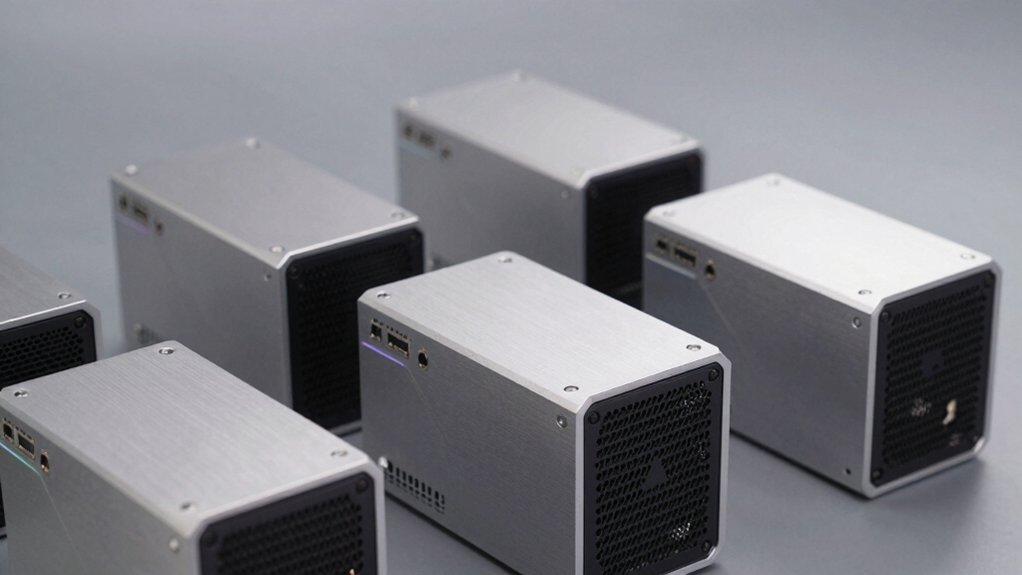

You’re looking for a compact PC that doesn’t sacrifice performance. Mini PCs with NVIDIA GPUs deliver desktop-level graphics in a fraction of the space, making them ideal for gaming, content creation, or professional work. They combine powerful processors, efficient cooling systems, and upgrade-friendly designs—all in a 3–4 liter package. But which model suits your specific needs and budget? Let’s break down your best options.
| ROG NUC 2025 Gaming Mini PC Intel Core Ultra 7 |

| Best Gaming Performance | GPU: NVIDIA GeForce RTX 50-Series mobile | CPU: Intel Core Ultra (Series 2) ARL-HX | RAM: Not specified | VIEW LATEST PRICE | Read Our Analysis |
| Mini Gaming PC Intel Core i7-8750H GTX1050 |

| Best Value | GPU: NVIDIA GeForce GTX 1050 3GB GDDR5 | CPU: Intel Core i7-8750H | RAM: 16GB DDR4 (upgradable to 64GB) | VIEW LATEST PRICE | Read Our Analysis |
| ROG NUC 2025 Gaming Mini PC with RTX 5070 |
| Editor’s Choice | GPU: NVIDIA GeForce RTX 50-Series mobile | CPU: Intel Core Ultra (Series 2) | RAM: Not specified | VIEW LATEST PRICE | Read Our Analysis |
| GMKtec AI Mini PC Ultra 9 285H 96GB DDR5 |

| Best for AI Tasks | GPU: Intel ARC 140T (not NVIDIA) | CPU: Intel Core Ultra 9 285H | RAM: 96GB DDR5 | VIEW LATEST PRICE | Read Our Analysis |
| MINISFORUM G1 Pro Gaming Mini PC (Ryzen 9 8945HX) |

| Best Professional Workstation | GPU: Desktop RTX 5060 (8GB GDDR7) | CPU: Ryzen 9 8945HX | RAM: Up to 96GB DDR5 | VIEW LATEST PRICE | Read Our Analysis |
More Details on Our Top Picks
ROG NUC 2025 Gaming Mini PC Intel Core Ultra 7
Why should you consider the ROG NUC 2025 if you’re seeking powerful gaming performance in a compact package? This mini PC combines an Intel Core Ultra Series 2 processor with an NVIDIA GeForce RTX 50-Series GPU, delivering over 200 Platform TOPS for demanding games and AI tasks. The QuietFlow cooling system with three fans and dual vapor chamber keeps temperatures managed without excessive noise. You’ll upgrade memory and storage easily using thumb screws in the compact 3L chassis. DLSS technology enhances visual quality, while Aura Sync RGB lighting customizes your setup’s appearance. The top-mounted power button provides convenient access during gameplay sessions.
- GPU:NVIDIA GeForce RTX 50-Series mobile
- CPU:Intel Core Ultra (Series 2) ARL-HX
- RAM:Not specified
- Storage:Not specified
- Cooling System:QuietFlow (3 fans, dual vapor chamber)
- Display Outputs:Not specified
- Additional Feature:Aura Sync RGB lighting
- Additional Feature:Thumb screw quick upgrades
- Additional Feature:QuietFlow dual vapor chamber
Mini Gaming PC Intel Core i7-8750H GTX1050
If you’re looking for a compact system that handles office work, video editing, and casual gaming without consuming much desk space, the Sinbun X800 mini PC delivers solid performance in a footprint roughly one-quarter the size of a traditional desktop. The Intel Core i7-8750H processor with six cores and 12 threads runs at speeds up to 4.1 GHz, while the dedicated GTX 1050 GPU manages graphics tasks independently. You’ll get 16 GB of DDR4 RAM and 512 GB of NVMe SSD storage, both upgradable. The system supports triple 4K displays and operates quietly below 38 dB. Windows 11 Pro comes pre-installed, and you’re covered by lifetime technical support.
- GPU:NVIDIA GeForce GTX 1050 3GB GDDR5
- CPU:Intel Core i7-8750H
- RAM:16GB DDR4 (upgradable to 64GB)
- Storage:512GB M.2 NVMe PCIe 3.0 SSD + 2.5″ SATA slot
- Cooling System:Twin turbo smart fans with copper heat spreader
- Display Outputs:Dual HDMI + Type-C (4K@60Hz triple display)
- Additional Feature:WiFi 6 802.11ax connectivity
- Additional Feature:Windows 11 Pro pre-installed
- Additional Feature:Lifetime technical support included
ROG NUC 2025 Gaming Mini PC with RTX 5070
Looking for a compact gaming system that doesn’t sacrifice performance? The ROG NUC 2025 delivers desktop-class power in a 3-liter frame. You’ll get an Intel Core Ultra Series 2 processor with 200+ Platform TOPS and an NVIDIA RTX 50-Series mobile GPU, providing up to 18% generation-over-generation improvements. The system uses QuietFlow cooling with three fans and a dual vapor chamber for silent operation. You can upgrade memory and storage quickly using thumb screws for tool-free access. Premium ROG aesthetics include ARGB lighting with Aura Sync compatibility, while Thunderbolt 4 connectivity ensures fast data transfer. This mini PC combines efficient cooling, easy upgrades, and powerful AI-driven graphics for serious gaming in minimal space.
- GPU:NVIDIA GeForce RTX 50-Series mobile
- CPU:Intel Core Ultra (Series 2)
- RAM:Not specified
- Storage:Not specified
- Cooling System:QuietFlow (3 fans, dual vapor chamber)
- Display Outputs:Thunderbolt 4 (implied)
- Additional Feature:Thunderbolt 4 connectivity
- Additional Feature:Premium ROG aesthetics design
- Additional Feature:Top-mounted power button
GMKtec AI Mini PC Ultra 9 285H 96GB DDR5
The GMKtec AI Mini PC Ultra 9 285H delivers exceptional value for professionals and power users who need AI acceleration, advanced graphics, and expandable storage in a compact form factor. You’ll get 16 cores with turbo speeds to 5.4 GHz, plus Intel’s AI NPU reaching 13 TOPS for machine learning tasks. The Intel ARC 140T GPU handles 8K/4K displays across four outputs simultaneously. Start with 96GB DDR5 RAM for demanding multitasking. Add up to 12TB total storage using three M.2 expansion slots. Connect external GPUs via the Oculink port, or use the 2.5GbE Ethernet and WiFi 6 for networking.
- GPU:Intel ARC 140T (not NVIDIA)
- CPU:Intel Core Ultra 9 285H
- RAM:96GB DDR5
- Storage:2TB PCIe 4.0 SSD (3x M.2 slots, up to 12TB max)
- Cooling System:Not specified
- Display Outputs:HDMI 2.1, DisplayPort 1.4, USB-C (quad 8K/4K support)
- Additional Feature:Intel AI Boost NPU
- Additional Feature:Oculink eGPU expansion port
- Additional Feature:2.5GbE Ethernet networking
MINISFORUM G1 Pro Gaming Mini PC (Ryzen 9 8945HX)
Want a mini PC that doesn’t compromise on processing power or graphics performance? The MINISFORUM G1 Pro delivers with its Ryzen 9 8945HX processor featuring 16 cores and 32 threads running up to 5.4 GHz. You’ll get a desktop RTX 5060 GPU with 3840 CUDA cores and 8 GB GDDR7 memory for demanding games and creative work. The system handles up to 96 GB DDR5 RAM and dual M.2 SSD slots supporting 8 TB storage. Its 3rd-Gen Glacier Cooling System manages 245 W total performance output through five copper heat pipes and dual-side exhaust. Connect up to five displays across three DisplayPort and two HDMI outputs. Wi-Fi 7 and 5 Gb Ethernet provide fast networking in this compact 3.8 L chassis.
- GPU:Desktop RTX 5060 (8GB GDDR7)
- CPU:Ryzen 9 8945HX
- RAM:Up to 96GB DDR5
- Storage:Dual M.2 SSD expansion up to 8TB
- Cooling System:3rd-Gen Glacier Cooling (5 copper heat pipes, dual exhaust)
- Display Outputs:3x DisplayPort + 2x HDMI (quad 4K support)
- Additional Feature:DLSS 4 Multi Frame
- Additional Feature:130+ AI creative applications
- Additional Feature:3rd-Gen Glacier Cooling System
Factors to Consider When Choosing a Mini PC With Nvidia GPU
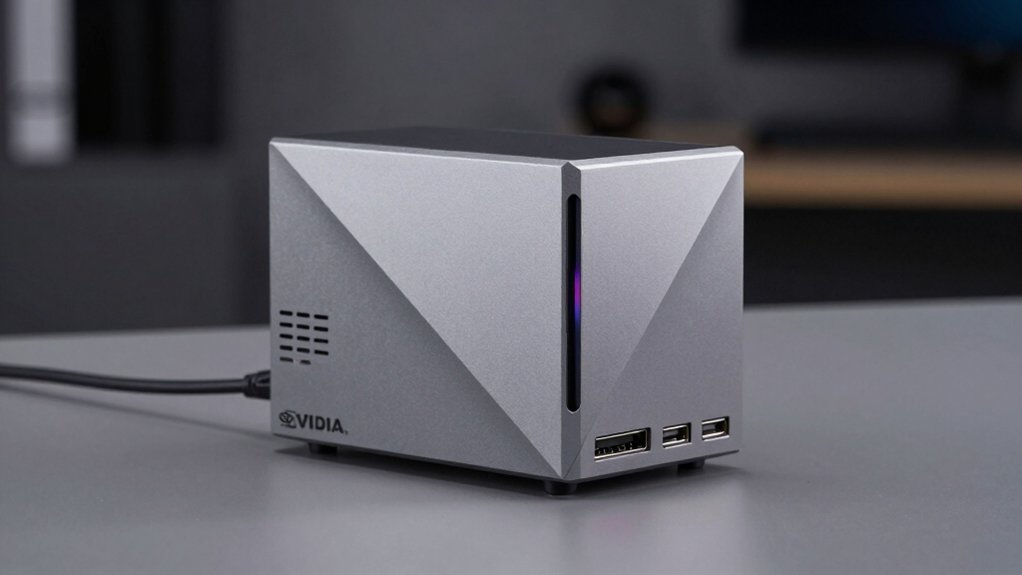
Before you purchase a mini PC with an NVIDIA GPU, you’ll need to evaluate your performance requirements based on your gaming needs and the types of applications you’ll run, then check the GPU memory and VRAM specifications to ensure they match your workload demands. Next, examine the cooling and thermal management systems, verify the display connectivity options available on the device, and confirm whether the unit offers upgradability and expansion slots for future improvements. These five factors work together to determine whether a mini PC will deliver the power you need while remaining reliable and adaptable to your changing requirements.
Performance And Gaming Needs
When you’re choosing a mini PC with an Nvidia GPU, you’ll want to evaluate several key performance factors that directly affect your gaming experience and system longevity. First, identify your target resolution and frame rate. RTX 50-series or RTX 5060-class GPUs deliver strong 1080p to 1440p performance suited for most compact systems. Next, examine cooling solutions like three-fan designs with dual vapor chambers to prevent throttling during extended gaming sessions. Check CPU specifications, particularly Core Ultra processors with 200+ Platform TOPS for AI acceleration that enhances in-game responsiveness. Finally, verify upgrade paths for memory and storage, ensuring you can expand capabilities without replacing the entire unit. These factors work together to sustain gaming performance over time.
GPU Memory And VRAM
How much VRAM does your mini PC actually need? Your choice matters because mini PC GPUs have fixed memory—you can’t upgrade it later. Start by matching VRAM to your resolution. For 1440p and 4K gaming, you’ll want 8GB or more to store textures locally and reduce stuttering. At 1080p, 4GB suffices for most games. Next, check your GPU’s memory type: GDDR6 and GDDR7 offer faster data transfer than older GDDR5, improving performance during graphics-heavy tasks. Finally, consider your system memory and CPU together. Insufficient RAM or weak processors create bottlenecks that VRAM alone won’t fix. Review game requirements before purchasing—this determines whether your mini PC handles your gaming needs smoothly.
Cooling And Thermal Management
The challenge of heat management defines performance in compact mini PC designs. You’ll find that three-fan configurations with dual vapor chamber cooling dissipate GPU heat more effectively than standard setups. Look for models featuring copper heat spreaders and multi-zone airflow systems that manage CPU and GPU temperatures simultaneously. These advanced designs maintain noise levels around 38 dB or lower during idle and moderate gaming, keeping your workspace quiet. Upgraded cooling systems enable higher sustained Boost clocks, reducing thermal throttling during extended gaming sessions. In tight 3L–4L enclosures, efficient thermal design is essential for consistent GPU performance under load. Verify that your chosen mini PC includes robust cooling before purchasing to ensure reliable operation during demanding tasks.
Display Connectivity Options
Once you’ve confirmed your mini PC has solid cooling to handle sustained GPU workloads, you’ll want to examine its display outputs to support your monitor setup. Check whether the unit offers HDMI 2.1, DisplayPort, or USB-C with DisplayPort Alt Mode. HDMI 2.1 handles 4K at 120Hz or 8K at 60Hz, while DisplayPort provides similar high-bandwidth capacity. Count the total output ports available—dual or triple display support is common. Verify which combinations your specific model supports, such as 4K across three outputs or mixed HDMI/DisplayPort configurations. If you’re using Thunderbolt 4, confirm daisy-chaining capability for external displays. Match your monitor count and resolution requirements against these specifications before purchasing to ensure your setup works without compromise.
Upgradability And Expansion Slots
What separates a mini PC that’ll serve you for years from one that’ll become obsolete quickly? Upgradability and expansion slots. Check for accessible memory slots with thumb screws for quick RAM upgrades. Look for multiple M.2 slots—three 2280 slots give you significant NVMe storage expansion capacity. Verify whether the unit supports 2.5″ SATA HDD slots for additional traditional storage beyond M.2 options. Examine connectivity options like Oculink PCIe x4 ports, which enable external GPU upgrades for better graphics performance. Confirm Thunderbolt 4 or USB-C with DisplayPort and Power Delivery support for future peripheral compatibility. These expansion features directly determine how long your mini PC remains relevant as your needs evolve.
Power Consumption And Efficiency
Beyond choosing components that’ll last, you’ll want to understand how much power your mini PC actually consumes, since this affects both your electricity bills and the system’s ability to maintain performance without overheating. Mini PCs with Nvidia GPUs draw between 30–50 W when idle and over 200 W under load, depending on your GPU model. Check the GPU’s TGP (Thermal Design Power) rating—higher TGPs demand better cooling and power delivery. Look for systems with dual vapor chambers and multiple fans to maintain safe temperatures. If you run AI or DLSS-enabled applications, these hardware-accelerated workloads reduce energy consumption per task. Compare total power draw specifications across models to balance performance needs against operational costs and heat management requirements.
Form Factor And Portability
How you’ll actually use your mini PC should drive your form factor choice, since compact designs (typically 3L to 4L cases) offer space efficiency and desktop replacement power but require careful consideration of cooling and upgrade potential.
If you need portability, choose thinner models that sacrifice some upgradeability for lighter weight and easier transport. For stationary setups, prioritize models with dual or triple-fan cooling systems and vapor chamber designs to maintain performance in confined spaces.
Check for tool-less access panels or thumb screws—these enable quick memory and storage upgrades without additional equipment. Verify I/O connectivity options like Thunderbolt 4, HDMI, DisplayPort, and USB-C to maximize peripheral and display support within the compact chassis. These specifications directly impact usability for your specific deployment scenario.
Budget And Long-Term Value
Once you’ve settled on a form factor that fits your workspace, you’ll need to balance your initial spending against how long you’ll actually use the system without replacing it. Higher upfront costs typically deliver more powerful GPUs and better future-proofing for demanding games and AI tasks. Systems with 96 GB DDR5 RAM and advanced cooling extend usable lifespans, justifying premium pricing through reduced replacement frequency. Check whether your chosen model supports RAM and SSD upgrades—upgrade-friendly designs delay full system replacement and lower total ownership costs. Verify driver update availability for your specific GPU model, as software support directly impacts longevity and resale value. Calculate power consumption against your budget; advanced GPUs increase electricity expenses over time.
Final Thoughts
You’ve reviewed five mini PCs combining powerful NVIDIA GPUs with compact designs. To choose yours, identify your primary use—gaming, creative work, or AI tasks. Check your budget against performance tiers. Verify cooling capacity matches your workload. Compare connectivity options for your peripherals. Confirm upgrade paths for future expansions. Evaluate warranty and support terms. Match these factors to your specific needs before purchasing.

Meet Ry, “TechGuru,” a 36-year-old technology enthusiast with a deep passion for tech innovations. With extensive experience, he specializes in gaming hardware and software, and has expertise in gadgets, custom PCs, and audio.
Besides writing about tech and reviewing new products, he enjoys traveling, hiking, and photography. Committed to keeping up with the latest industry trends, he aims to guide readers in making informed tech decisions.