
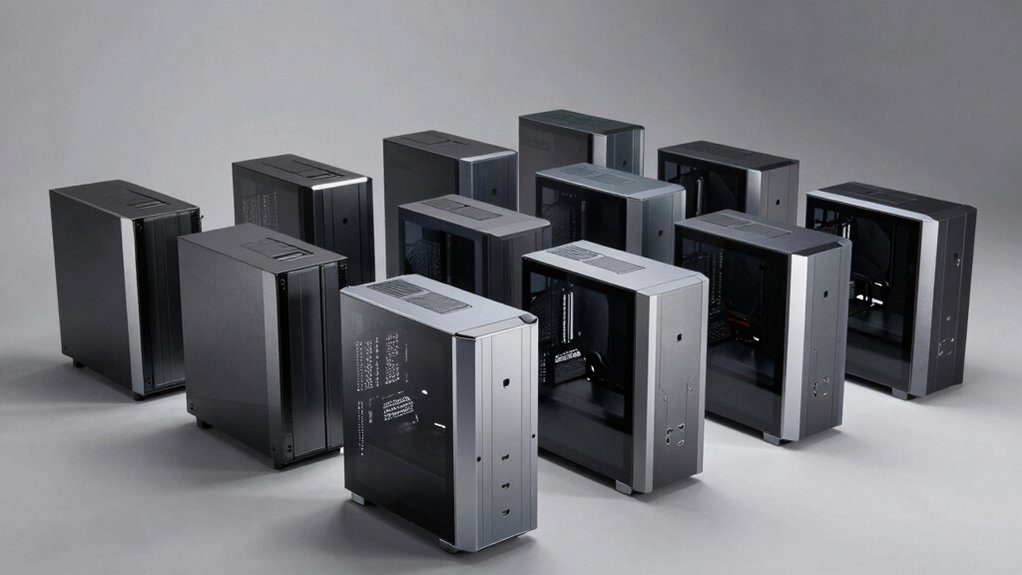

When you’re building a high-performance PC, you need a case that delivers front USB-C access without sacrificing cooling performance. You’ll want to evaluate radiator support, airflow design, and GPU clearance simultaneously. The cases highlighted here—from the DARKROCK EC2 to the MUSETEX NN8—each solve this balance differently. But which one actually fits your specific build requirements? Let’s examine what separates the contenders.
| DARKROCK EC2 ATX Mid Tower PC Case with Tempered Glass |
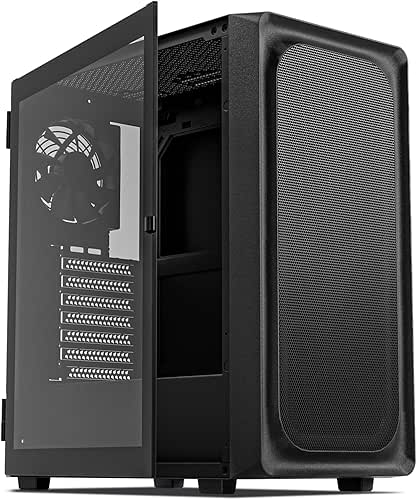
| Sleek & Compact | Pre-Installed Fans: 1 x 120mm fan | Max GPU Length Support: Up to 340mm | Motherboard Compatibility: ATX, Micro-ATX, Mini-ITX | VIEW LATEST PRICE | Read Our Analysis |
| SAMA S40 Mid Tower ATX PC Gaming Case |

| Airflow Powerhouse | Pre-Installed Fans: 4 x 120mm ARGB fans | Max GPU Length Support: Up to 415mm | Motherboard Compatibility: ATX, Micro-ATX, Mini-ITX | VIEW LATEST PRICE | Read Our Analysis |
| NZXT H5 Flow Compact ATX Gaming Case |

| GPU-Focused Cooling | Pre-Installed Fans: 2 x 120mm fans | Max GPU Length Support: Not specified | Motherboard Compatibility: E-ATX, ATX, Micro-ATX, Mini-ITX | VIEW LATEST PRICE | Read Our Analysis |
| CORSAIR 4000D RS ARGB Modular Mid-Tower ATX PC Case |

| Most Customizable | Pre-Installed Fans: 3 x RS ARGB fans | Max GPU Length Support: Supports high-end GPUs | Motherboard Compatibility: ATX, Micro-ATX, Mini-ITX | VIEW LATEST PRICE | Read Our Analysis |
| PC Case Mid-Tower Gaming with ARGB Fans (G8) |

| RGB Enthusiast Pick | Pre-Installed Fans: 6 x 120mm PWM ARGB fans | Max GPU Length Support: Up to 440mm | Motherboard Compatibility: ATX, Micro-ATX, Mini-ITX | VIEW LATEST PRICE | Read Our Analysis |
| MUSETEX ATX PC Case with ARGB Fans (Y6) |

| Premium Dual Glass | Pre-Installed Fans: 6 x PWM ARGB fans | Max GPU Length Support: Up to 400mm | Motherboard Compatibility: ATX, Micro-ATX, Mini-ITX | VIEW LATEST PRICE | Read Our Analysis |
| RUIX OV303 ATX Mid-Tower PC Gaming Case |

| High-Capacity Build | Pre-Installed Fans: 4 x 120mm ARGB fans | Max GPU Length Support: Up to 420mm | Motherboard Compatibility: ATX (primary), supports ATX builds | VIEW LATEST PRICE | Read Our Analysis |
| Cooler Master QUBE 540 ATX Mid-Tower PC Case |

| Ultimate Flexibility | Pre-Installed Fans: 1 x SickleFlow 120mm fan | Max GPU Length Support: Up to 415mm | Motherboard Compatibility: ATX, Micro-ATX, Mini-ITX, E-ATX up to 11″ wide | VIEW LATEST PRICE | Read Our Analysis |
| FOIFKIN M1 ATX Mid-Tower Gaming PC Case |

| Aesthetic Statement | Pre-Installed Fans: 4 x PWM ARGB fans | Max GPU Length Support: Up to 320mm | Motherboard Compatibility: ATX, Micro-ATX, Mini-ITX | VIEW LATEST PRICE | Read Our Analysis |
| MUSETEX ATX PC Case with ARGB Fans (NN8) |

| Best Side Access | Pre-Installed Fans: 6 x 120mm PWM ARGB fans | Max GPU Length Support: Supports multiple installation methods | Motherboard Compatibility: ATX, Micro-ATX, Mini-ITX | VIEW LATEST PRICE | Read Our Analysis |
More Details on Our Top Picks
DARKROCK EC2 ATX Mid Tower PC Case with Tempered Glass
If you’re building a mid-range PC that requires front USB-C connectivity without sacrificing airflow or expandability, the DARKROCK EC2 delivers what you’re looking for. This ATX mid-tower supports three motherboard sizes: ATX, Micro-ATX, and Mini-ITX. You’ll get a mesh front panel that accommodates up to eight 120mm fans or one 360mm radiator, ensuring efficient cooling. The case holds graphics cards up to 340mm long and power supplies up to 200mm. With seven expansion slots and three internal bays, you’ll have room for storage drives and components. Magnetic dust filters on top and bottom protect your hardware. The tempered glass side panel displays your build while the Type-C port and USB 3.0 port provide convenient connectivity.
- Pre-Installed Fans:1 x 120mm fan
- Max GPU Length Support:Up to 340mm
- Motherboard Compatibility:ATX, Micro-ATX, Mini-ITX
- Top Radiator Support:Up to 360mm
- Tempered Glass Panel:Yes, side panel
- Case Dimensions (Height):17.6 inches
- Additional Feature:Magnetic dust filters (top/bottom)
- Additional Feature:Supports up to 8x120mm fans
- Additional Feature:Type-C connectivity ready
SAMA S40 Mid Tower ATX PC Gaming Case
The SAMA S40 Mid Tower ATX PC Gaming Case delivers front USB-C connectivity alongside robust cooling capabilities, making it an excellent choice for builders who need both modern I/O standards and thermal performance in a mid-tower form factor. You’ll appreciate the two USB 3.0 ports and USB Type-C port on the front panel for quick device connections. The case supports up to 12 fans total with four 120mm ARGB PWM fans pre-installed, and you can mount a 360mm radiator on top for enhanced cooling. You can fit GPUs up to 415mm long, including high-end NVIDIA RTX 40 series cards. Configure storage with up to three HDDs, three SSDs, or hybrid combinations like two HDDs plus two SSDs to balance speed and capacity for gaming or creative work.
- Pre-Installed Fans:4 x 120mm ARGB fans
- Max GPU Length Support:Up to 415mm
- Motherboard Compatibility:ATX, Micro-ATX, Mini-ITX
- Top Radiator Support:Up to 360mm
- Tempered Glass Panel:Yes, side panel
- Case Dimensions (Height):483mm (19 inches)
- Additional Feature:Four pre-installed ARGB fans
- Additional Feature:Flexible storage (HDD/SSD hybrid)
- Additional Feature:HD audio jacks included
NZXT H5 Flow Compact ATX Gaming Case
Looking for a mid-tower case that prioritizes GPU cooling and radiator flexibility? The NZXT H5 Flow delivers both through its perforated PSU shroud, which pulls air intake from two 120mm fans positioned below your graphics card. You’ll support radiators up to 360mm in front and 240mm on top, giving you substantial cooling options. The case includes two pre-installed 120mm fans and features ultra-fine mesh panels on top, front, and side for maximum airflow and dust filtration. It fits ATX and Micro-ATX motherboards with seven expansion slots and four internal bays. Cable management relies on wide channels, hooks, and straps for organized routing.
- Pre-Installed Fans:2 x 120mm fans
- Max GPU Length Support:Not specified
- Motherboard Compatibility:E-ATX, ATX, Micro-ATX, Mini-ITX
- Top Radiator Support:Up to 240mm
- Tempered Glass Panel:Yes, mesh panels with fine filtration
- Case Dimensions (Height):18.31 inches
- Additional Feature:Perforated PSU shroud design
- Additional Feature:Ultra-fine mesh panels
- Additional Feature:Wide cable management channels
CORSAIR 4000D RS ARGB Modular Mid-Tower ATX PC Case
Want a case that adapts to your specific build without forcing you into preset configurations? The CORSAIR 4000D RS ARGB delivers customization through its FRAME Modular System. You can swap the motherboard tray, front I/O panel, or other internal components to match your needs. The InfiniRail mounting system lets you position fans and radiators flexibly—mount up to 200mm fans on the front or 140mm fans on the roof. You’ll get three pre-installed RS ARGB fans with daisy-chainable connectors. The case supports ATX, mATX, and ITX motherboards, dual 360mm radiators, and powerful GPUs. Internal dimensions accommodate most standard components without restriction.
- Pre-Installed Fans:3 x RS ARGB fans
- Max GPU Length Support:Supports high-end GPUs
- Motherboard Compatibility:ATX, Micro-ATX, Mini-ITX
- Top Radiator Support:Dual 360mm radiator capable
- Tempered Glass Panel:Yes, modular design option
- Case Dimensions (Height):19.13 inches
- Additional Feature:FRAME modular case system
- Additional Feature:InfiniRail fan mounting system
- Additional Feature:Supports dual 360mm radiators
PC Case Mid-Tower Gaming with ARGB Fans (G8)
If you’re building a gaming PC and need front USB-C connectivity without sacrificing cooling performance or aesthetics, ANSAITE’s G8 mid-tower case delivers both. The case includes six pre-installed PWM ARGB fans arranged strategically: one rear, three bottom, and two side panel fans. You’ll support graphics cards up to 440mm and CPU coolers up to 180mm tall. The panoramic 270° tempered glass panel displays your components clearly. Connect the ARGB fans directly to your motherboard’s +5V header—no separate controller required. Front I/O includes USB 3.2 Gen 2 Type-C, USB 3.0, and USB 2.0 ports for device connectivity and data transfer.
- Pre-Installed Fans:6 x 120mm PWM ARGB fans
- Max GPU Length Support:Up to 440mm
- Motherboard Compatibility:ATX, Micro-ATX, Mini-ITX
- Top Radiator Support:Up to 360mm
- Tempered Glass Panel:Yes, 270° panoramic side panel
- Case Dimensions (Height):19.29 inches
- Additional Feature:Panoramic 270° tempered glass
- Additional Feature:Horizontal/vertical dual-channel airflow
- Additional Feature:Back-connect cable management design
MUSETEX ATX PC Case with ARGB Fans (Y6)
The MUSETEX Y6 delivers maximum visibility and cooling capacity for builders who prioritize airflow and customizable lighting in a mid-tower footprint. This white case features dual tempered glass panels that showcase your build while supporting GPUs up to 400mm and CPU coolers up to 176mm. Six pre-installed PWM ARGB fans with anti-vortex blades manage temperatures through an innovative air duct design. Control lighting and fan speed directly via your motherboard software. The front USB 3.2 Type-C port enables fast data transfer alongside standard USB 3.0 and 2.0 options. Four internal bays accommodate various storage drives. Its 10-year warranty covers manufacturing defects. Compatible with ATX, Micro-ATX, and Mini-ITX motherboards, the Y6 suits both air and water cooling setups.
- Pre-Installed Fans:6 x PWM ARGB fans
- Max GPU Length Support:Up to 400mm
- Motherboard Compatibility:ATX, Micro-ATX, Mini-ITX
- Top Radiator Support:Up to 360mm
- Tempered Glass Panel:Yes, dual 270° side panels
- Case Dimensions (Height):14.49 inches
- Additional Feature:Dual tempered glass panels
- Additional Feature:Reverse blade design fans
- Additional Feature:Anti-vortex blade technology
RUIX OV303 ATX Mid-Tower PC Gaming Case
Building a high-airflow gaming setup that doesn’t compromise on modern connectivity? The RUIX OV303 delivers both. You’ll get front USB 3.0 and Type-C ports for fast data transfer and device charging. The case supports up to 10 fans or a 360mm AIO cooler, giving you extensive cooling options. Install your ATX motherboard in the spacious interior, mount your GPU up to 420mm with the built-in support bracket, and utilize the two 3.5″ and one 2.5″ drive bays. Panoramic tempered glass panels let you showcase your build while four pre-installed 120mm ARGB fans provide immediate cooling. Magnetic dust filters on top and bottom keep components clean during extended gaming sessions.
- Pre-Installed Fans:4 x 120mm ARGB fans
- Max GPU Length Support:Up to 420mm
- Motherboard Compatibility:ATX (primary), supports ATX builds
- Top Radiator Support:Up to 360mm
- Tempered Glass Panel:Yes, front and side panels
- Case Dimensions (Height):16.3 inches
- Additional Feature:Built-in GPU support bracket
- Additional Feature:420mm GPU compatibility maximum
- Additional Feature:Four pre-installed ARGB fans
Cooler Master QUBE 540 ATX Mid-Tower PC Case
Want a case that adapts to your building preferences rather than forcing you into one setup? The Cooler Master QUBE 540 delivers exactly that flexibility. You’ll appreciate its reversible I/O panel and movable handles, which let you customize your layout for better accessibility. The case supports ATX, Micro-ATX, Mini-ITX, and E-ATX motherboards up to 11″ wide, so you’re covered regardless of your board size. Its front USB 3.2 Gen2 Type-C port connects modern peripherals directly. The 415mm GPU clearance accommodates full-size graphics cards like the RTX 5090. You can mount radiators up to 360mm, and the mesh-optimized airflow panel keeps temperatures controlled. The tempered glass panel displays your components while the stainless steel frame ensures durability.
- Pre-Installed Fans:1 x SickleFlow 120mm fan
- Max GPU Length Support:Up to 415mm
- Motherboard Compatibility:ATX, Micro-ATX, Mini-ITX, E-ATX up to 11″ wide
- Top Radiator Support:Up to 360mm
- Tempered Glass Panel:Yes, tempered glass panel
- Case Dimensions (Height):19.37 inches
- Additional Feature:Flexible horizontal/vertical orientation
- Additional Feature:Reversible movable I/O panel
- Additional Feature:Portable carrying handles included
FOIFKIN M1 ATX Mid-Tower Gaming PC Case
If you’re building a system that demands both aesthetic appeal and practical cooling performance, the FOIFKIN M1 offers a distinctive wood-and-metal design paired with solid hardware support. The case accommodates ATX, Micro-ATX, and ITX motherboards with a 320mm GPU length limit and 174mm CPU cooler height clearance. You’ll find the front USB-C 3.0 port alongside USB 3.0 and USB 2.0 connections for peripherals. Four pre-installed PWM ARGB fans handle airflow, and you can add up to eight 120mm fans across front, rear, top, and bottom mounts. Storage flexibility includes two HDD and two SSD bays. The tempered glass side panel removes tool-free for easy access during builds.
- Pre-Installed Fans:4 x PWM ARGB fans
- Max GPU Length Support:Up to 320mm
- Motherboard Compatibility:ATX, Micro-ATX, Mini-ITX
- Top Radiator Support:Up to 280/240/120mm
- Tempered Glass Panel:Yes, side panel
- Case Dimensions (Height):17.7 inches
- Additional Feature:Walnut wood front panel
- Additional Feature:Tool-free glass panel removal
- Additional Feature:280/240/120mm radiator options
MUSETEX ATX PC Case with ARGB Fans (NN8)
You’ll want the MUSETEX NN8 if you’re building a mid-tower system that needs both strong cooling performance and customizable lighting without purchasing additional fans. The case arrives with six pre-installed 120mm PWM ARGB fans, offering 76% cooling improvement over standard mid-tower designs. Connect the fans to your motherboard’s 3PIN RGB header to access 16.8 million color options through software. The tempered glass side panel provides visibility and airflow. You can mount a 280mm radiator at the top, install your graphics card vertically, and store up to five SSDs plus one HDD. Cable management remains straightforward thanks to the spacious interior.
- Pre-Installed Fans:6 x 120mm PWM ARGB fans
- Max GPU Length Support:Supports multiple installation methods
- Motherboard Compatibility:ATX, Micro-ATX, Mini-ITX
- Top Radiator Support:Up to 280mm
- Tempered Glass Panel:Yes, opening side panel with magnetic/pull-ring
- Case Dimensions (Height):18.98 inches
- Additional Feature:Opening tempered glass side door
- Additional Feature:Vertical GPU installation option
- Additional Feature:16.8 million color ARGB
Factors to Consider When Choosing a PC Case With Front USB-C
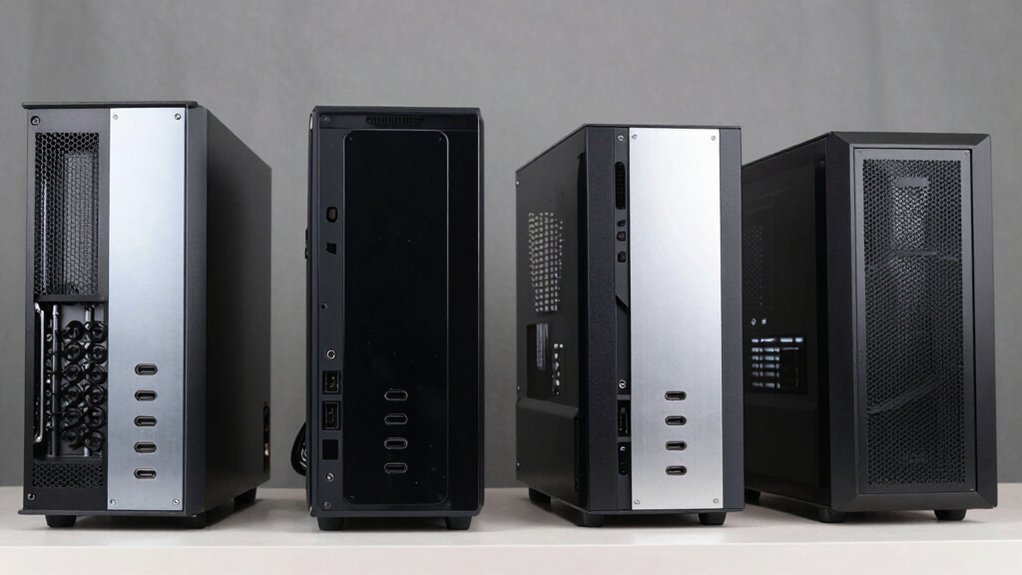
When you’re selecting a PC case with front USB-C, you’ll need to evaluate five key factors: the physical placement of the USB-C port on the front panel, whether it supports USB 3.1 or USB 3.2 data transfer standards, how much power delivery wattage it can handle for charging devices, whether the internal header matches your motherboard’s connector type, and how the case routes cables to keep them organized. Check your motherboard’s manual first to confirm which USB-C header it has—either a 19-pin or 20-pin connector—since this determines compatibility before you purchase a case. Review the case specifications for port location, speed ratings, and power specs so you can confirm it meets your needs for device charging and data transfer speeds.
USB-C Port Placement
Where’s the USB-C port located on your case? You’ll find three common placement options. First, front I/O panels position USB-C directly on the front for immediate access during builds and daily use. Second, top-mounted designs place the port on the case’s upper surface, useful if your desk setup allows overhead access. Third, rear I/O areas locate USB-C near other motherboard connections, requiring longer cable runs. Evaluate your workspace layout and usage patterns before choosing. Front placement offers convenience but demands careful cable management in compact cases. Top positioning provides accessibility without rear clutter. Rear placement simplifies internal routing but reduces quick-access functionality. Check your case’s internal clearance to ensure your chosen placement won’t obstruct components or airflow.
Data Transfer Speed Standards
How fast can your front USB-C port actually transfer data? You’ll encounter three main standards: USB 3.2 Gen 1 delivers 5 Gbps, Gen 2 reaches 10 Gbps, and USB4 supports up to 40 Gbps. Your actual speed depends on three factors. First, verify your motherboard has a compatible USB-C header—not all boards include one. Second, confirm your front panel cable supports 10 Gbps or higher; cheaper cables limit performance. Third, recognize that real-world speeds fall below theoretical maximums due to drive type, CPU implementation, and controller limitations. An external SSD on Gen 2 might achieve 400–800 Mbps instead of the full 10 Gbps. Check your case specifications and motherboard manual to match components properly.
Power Delivery Capabilities
Do you need to charge a laptop or power high-draw peripherals through your case’s front USB-C port? Check your case’s product documentation for the specific power delivery wattage it supports—typically 15–20W for standard USB-C or 60–90W for higher-profile PD. Verify your motherboard has a USB-C header that supports power delivery negotiation, since the case alone can’t deliver PD without it. Match your power needs to the case’s capability: a 15W port won’t charge a gaming laptop requiring 65W. Purchase cases that explicitly state PD compatibility rather than assuming front USB-C automatically supports high wattage. Review internal wiring specifications to confirm adequate power delivery infrastructure. Confirm both case and motherboard alignment before committing to your build.
Motherboard Header Compatibility
Beyond confirming your case’s power delivery specs, you’ll need to verify that your motherboard can actually support the front USB-C port you’re planning to install. Check your motherboard’s manual for a USB 3.1 or USB 3.2 Gen 2 Type-C header. This header is essential for front USB-C functionality. If your motherboard lacks this header, your front USB-C port won’t work, even if your case includes it. Some motherboards offer USB-C headers; others don’t. Review your specific model’s specifications before purchasing a case with front USB-C. If compatibility issues arise, you can use an internal USB-C bridge adapter, though this adds complexity. Matching your case’s front panel ports to your motherboard’s available headers ensures seamless integration and full functionality.
Cable Management Design
What’s the point of having a front USB-C port if you can’t route its cables cleanly to your motherboard? You’ll want to examine the case’s internal layout carefully. Look for dedicated cable channels that guide wires behind the motherboard tray, keeping them hidden from view. Check whether the case includes rubber grommets around cable cutouts—these prevent sharp edges from damaging your cables. Removable drive bays create additional routing space when you don’t need them. Bottom-mounted power supplies help too, since they reduce PSU cable visibility in front areas. Finally, inspect for integrated cable management hooks and Velcro straps that secure loose wires. These features combined create organized pathways that make installation straightforward and maintain clean aesthetics throughout your build.
Additional Front I/O Options
When you’re selecting a PC case with front USB-C, you’ll want to evaluate the complete front panel layout—not just the Type-C port itself. Check whether the case includes USB-A 3.0 ports alongside the USB-C connection, as this combination gives you flexibility for different peripherals. Verify that audio jacks are present if you use headphones or microphones frequently. Review the power and reset button placement to ensure they’re accessible and logically positioned. Confirm the case provides the necessary internal headers to connect these front I/O options to your motherboard. Some cases include USB-C hubs or dedicated headers that support both data transfer and power delivery. Cross-reference your motherboard’s available headers with the case’s front panel connections before purchasing to avoid compatibility issues.
Build Quality And Durability
Durability in a case’s front USB-C implementation hinges on how well it’s constructed and mounted. Look for cases using metal or reinforced plastic materials with solid internal bracing that supports the I/O panel. Check that the USB-C port aligns properly with your motherboard’s front header—misalignment causes loose connections and premature wear. Examine how cables route through the case; they should use dedicated channels or grommets to prevent strain on the port. Verify the case includes dust and moisture protection around the front I/O area, which preserves connector reliability over time. Quality construction minimizes flex and movement when you plug in devices, reducing mechanical stress that degrades performance and longevity.
Cooling Airflow Impact
Evaluate how your case’s front USB-C design affects internal airflow before making a purchase. Check whether the front panel includes mesh sections or perforated areas that allow air intake without obstruction. Cases with multiple pre-installed fans—typically four to six ARGB units—create positive pressure that balances GPU and CPU cooling better than models with one or two fans. Examine front radiator support capacity, as 360 mm radiators boost cooling when positioned at intake. Verify that magnetic dust filters are removable and easy to clean, preventing airflow restriction over time. Review interior cable routing and dedicated air ducts that guide front intake toward critical components. These design features directly determine whether your system maintains optimal temperatures during intensive workloads.
Final Thoughts
You’ve reviewed ten cases that deliver front USB-C connectivity without sacrificing cooling performance. Prioritize your specific needs: determine your motherboard size, GPU length, and radiator requirements. Compare each case’s airflow design, fan support, and dust filter accessibility. Check your budget constraints and aesthetic preferences. Select the case that matches your hardware specifications and build priorities, then verify all compatibility details before purchasing.

Meet Ry, “TechGuru,” a 36-year-old technology enthusiast with a deep passion for tech innovations. With extensive experience, he specializes in gaming hardware and software, and has expertise in gadgets, custom PCs, and audio.
Besides writing about tech and reviewing new products, he enjoys traveling, hiking, and photography. Committed to keeping up with the latest industry trends, he aims to guide readers in making informed tech decisions.