
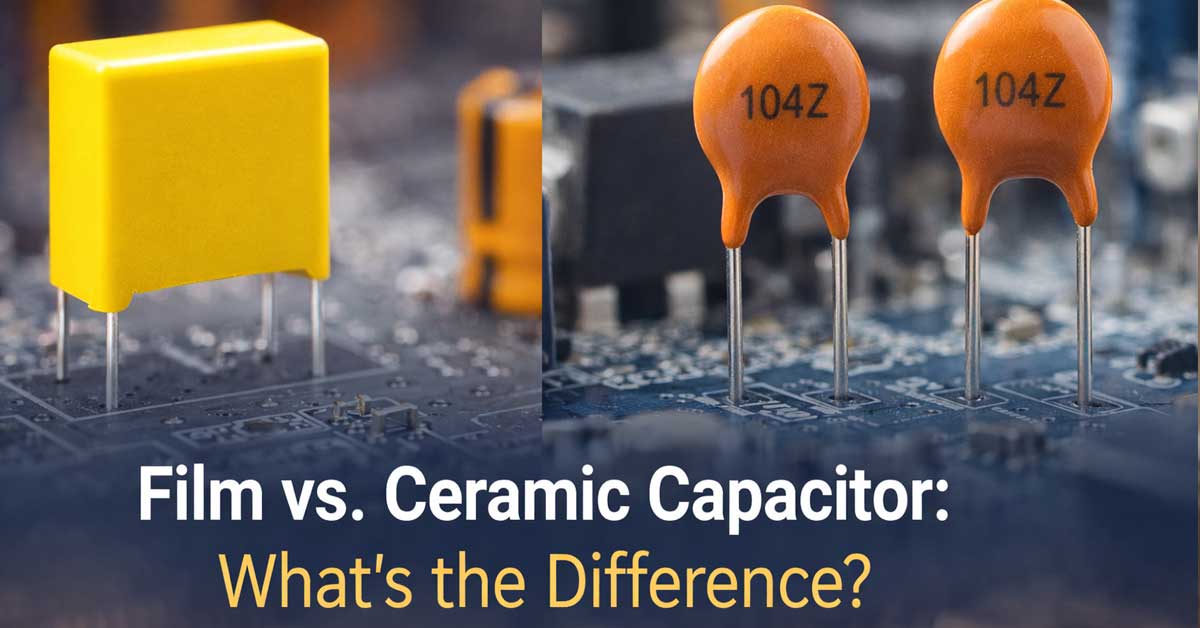

Two of the most common capacitor types — and they’re not interchangeable
If you’ve spent any time working with electronics — whether repairing audio gear, building circuits, or just replacing components on a PCB — you’ve run into both film and ceramic capacitors. They look different, they’re priced differently, and they show up in different parts of a schematic for good reason. Understanding what separates them helps you choose the right one and avoid substituting one where the other belongs.
What They Are
Both film and ceramic capacitors store and release electrical charge — that’s what all capacitors do. The difference is in what material sits between the two conductive plates, which is what gives each type its distinct electrical personality.
Film capacitors use a thin plastic film as the dielectric — the insulating layer between the plates. Common film materials include polyester (also called Mylar), polypropylene, and polystyrene. The type of plastic used determines the capacitor’s characteristics.
Ceramic capacitors use a ceramic material as the dielectric. They’re manufactured in two broad classes — Class 1 (such as C0G/NP0) and Class 2 (such as X5R, X7R, Y5V) — which behave quite differently from each other, a distinction that trips up a lot of people.


BOJACK High Quality CBB22 Metallized Polypropylene Film Capacitors Assortment Kit

High quality Polyester Film Capacitors Assortment Kit.
Physical Appearance
The easiest way to tell them apart in the real world is by how they look.
Film capacitors are typically larger, often rectangular or cylindrical, and come in a through-hole format with two leads. They have a solid, slightly waxy or plastic appearance and are usually yellow, orange, green, or blue depending on the manufacturer and type. In audio equipment and older electronics, they’re easy to spot.
Ceramic capacitors are much smaller. Through-hole versions are the classic small disc shape — a flat, grey or brown coin with two wire leads. Surface-mount ceramic capacitors (MLCCs) are tiny rectangular chips, often too small to read markings on, and dominate modern PCB designs. When you look at a modern circuit board and see rows of tiny identical rectangular components, most of them are ceramic capacitors.
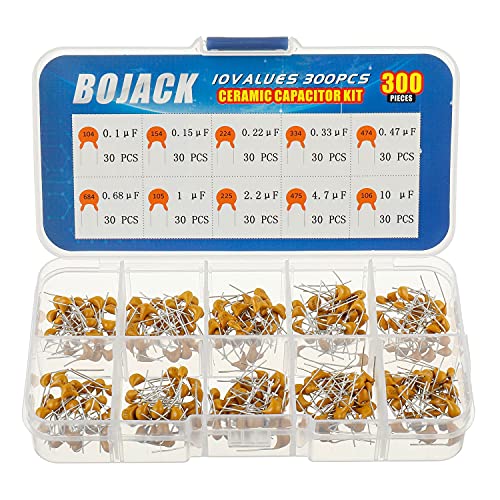
BOJACK High Quality Multilayer Monolithic Ceramic Capacitor Assortment Kit.

BOJACK High Quality Multilayer Monolithic Ceramic Capacitor Assortment Kit.

Ceramic Capacitor Assortment Kit DIP 2PF-0.1UF 30 Values Each 10pcs in Separate Bag 300pcsc
Capacitance Range
Ceramic capacitors cover a huge range — from as small as 1 picofarad all the way up to tens of microfarads for Class 2 types. This flexibility makes them ubiquitous on modern boards.
Film capacitors are most commonly found in the nanofarad to low microfarad range — typically between about 1nF and 10µF. Getting above that in a film capacitor means a physically large and expensive component, which is why electrolytic capacitors take over at higher values instead.
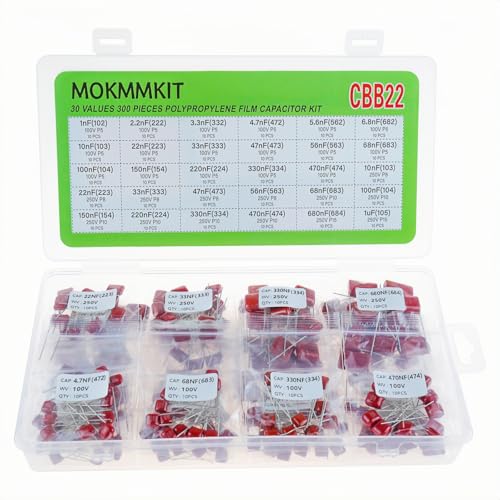
Model No: CBB22; Rated Voltage: 100V/250V; Type: Radial Lead; High-quality Polyester Film Capacitors Assortment Kit

Product Name : Metallized Polypropylene Film Capacitor;Model No. : CBB22;Type : Radial Lead

Product specifications: Model No. : CBB22; Type: Radial Lead, 400V 335J 3.3UF. High-quality Polyester Film Capacitors Assortment Kit.
Where They Excel — and Where They Don’t
This is the part that actually matters when choosing between them.
Accuracy and Stability
Film capacitors are significantly more accurate and stable. Tolerance ratings of 1% or 2% are common, and some polypropylene types hit 0.5%. Their capacitance value doesn’t drift much with temperature, age, or voltage.
Class 1 ceramic capacitors (C0G/NP0) are also highly stable and accurate — comparable to good film types — making them suitable for timing circuits and filters where precision matters.
Class 2 ceramic capacitors (X7R, X5R, Y5V) are where stability becomes a real concern. Their capacitance value can change dramatically with temperature, applied voltage, and age. An X7R capacitor rated at 10µF might measure closer to 5µF or less under typical operating conditions once voltage is applied. This is a known and significant issue that catches a lot of builders off guard.
High-Frequency Performance
Ceramic capacitors generally outperform film at very high frequencies. Their low equivalent series resistance (ESR) and low equivalent series inductance (ESL) make them the go-to choice for decoupling and bypassing on digital circuits — filtering out noise right at the power pins of ICs.
Film capacitors are excellent at audio frequencies and in applications up to a few hundred kilohertz, but their larger physical size introduces more parasitic inductance, which limits their performance at RF frequencies.
Voltage Handling
Film capacitors tend to handle high voltages well — it’s common to find film caps rated at 250V, 400V, or higher. They’re regularly used in power supplies, motor run circuits, and anywhere mains voltage is involved.
Ceramic capacitors can be made for high voltage too, but Class 2 types have a well-documented issue: their capacitance drops significantly as voltage increases. A capacitor that measures correctly at low voltage may be performing well below its rated value in actual use.
Self-Healing
One underappreciated advantage of film capacitors is self-healing. If a small defect in the film causes a momentary breakdown, the energy of the arc vaporizes the thin metal coating locally, isolating the defect and restoring the capacitor’s function. Ceramic capacitors don’t do this — a breakdown failure tends to be permanent and can result in a short circuit.
Audio Circuits: Why Film Dominates
In audio applications, film capacitors are strongly preferred — particularly polypropylene types. The reasons are both measurable and debated.
Measurably, film capacitors introduce less distortion in signal paths. Ceramic capacitors — especially Class 2 types — exhibit piezoelectric behavior, meaning they can generate a small voltage when mechanically stressed and can physically vibrate when an AC signal is applied. In sensitive audio circuits, this is audible as microphony or distortion.
Whether the difference is audible in practice depends on where in the circuit the capacitor sits, the signal levels involved, and how resolving the rest of the system is. But in coupling capacitors, filter networks, and anywhere a capacitor is directly in the signal path, most engineers and experienced builders reach for film without much debate.
Common Applications at a Glance
Film capacitors are typically found in:
- Audio signal paths and crossovers
- Power supply filtering and snubber circuits
- Motor run and motor start applications
- Timing circuits requiring precision
- High-voltage applications
Ceramic capacitors are typically found in:
- Decoupling and bypass capacitors on digital ICs
- RF and high-frequency circuits
- Small coupling and filtering tasks at low signal levels
- Surface-mount designs where space is critical
- General-purpose blocking and bypass
Can You Substitute One for the Other?
Sometimes — but not always, and not without thinking it through.
Replacing a ceramic bypass capacitor with a film type is usually fine electrically, but the size difference often makes it impractical on a modern board.
Replacing a film capacitor with a ceramic in an audio signal path is generally a bad idea. The piezoelectric effect and Class 2 stability issues make ceramic a poor substitute where the original designer chose film for a reason.
Replacing a Class 2 ceramic with a Class 1 (C0G/NP0) ceramic is often a good move where stability matters — though Class 1 types aren’t available at high capacitance values, so it’s only practical in the picofarad to low nanofarad range.
The safest rule: when in doubt, match the original type. The designer chose it for a reason, and capacitor type is one of those decisions that’s rarely arbitrary in a well-designed circuit.
The Bottom Line
Film capacitors are stable, accurate, self-healing, and well-suited for audio, high-voltage, and precision timing work. They’re larger and more expensive per unit but deliver predictable, consistent performance.
Ceramic capacitors are small, cheap, abundant, and excellent at high-frequency decoupling. Class 1 types are stable and precise. Class 2 types are convenient but come with real limitations around voltage and temperature that matter in anything beyond general-purpose bypassing.
Knowing which class of ceramic you’re working with is just as important as knowing you’re working with a ceramic. A C0G and a Y5V are both ceramic capacitors in the same way a Pinto and a Porsche are both cars — the category label doesn’t tell you much about the performance.
The right capacitor is the one that behaves the way the circuit needs it to — not just the one that fits the footprint.

Product Information: Ceramic capacitor type: multilayer monolithic ceramic capacitor, Capacitance Tolerance: ±10%(Due to process limitations, large-capacity capacitors (>2.2µF) generally have higher errors than smaller ones. See details page.), Voltage: 50V, Temperature range ℃: -55℃~150℃, Installation type: Direct plug


Meet Ry, “TechGuru,” a 36-year-old technology enthusiast with a deep passion for tech innovations. With extensive experience, he specializes in gaming hardware and software, and has expertise in gadgets, custom PCs, and audio.
Besides writing about tech and reviewing new products, he enjoys traveling, hiking, and photography. Committed to keeping up with the latest industry trends, he aims to guide readers in making informed tech decisions.