

For seven top apochromatic refractors, start with SVBONY 80ED F6 for compact, low‑vibration imaging and 87 mm back focus; follow with SV550 122mm F7 for travel and balance up to 300 mm dovetail, plus 2.5″ dual‑speed focuser. Add Askar 71F for flat fields, Sky-Watcher EvoGuide 50DX for guiding, and SV550 80ED F6 kits for field flattener compatibility. Consider SV550 80mm Triplet kit and Evolux 82ED for options. You’ll gain practical steps and concrete examples as you proceed.
| SVBONY 80ED F6 Apochromatic Refractor Telescope |
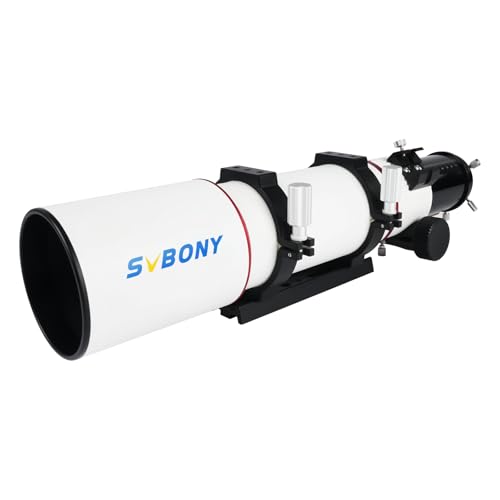
| Best Overall | Type: Apochromatic refractor OTA | Aperture: 80mm | Focal length / ratio: f/6 (80ED) | VIEW LATEST PRICE | Read Our Analysis |
| SVBONY SV550 122mm F7 ED Refractor Telescope |

| Professional-Grade Reach | Type: Apochromatic refractor OTA | Aperture: 122mm | Focal length / ratio: f/7 (122mm) | VIEW LATEST PRICE | Read Our Analysis |
| Askar 71F Flat-Field APO Refractor Telescope |

| Portable Field Master | Type: Flat-field APO refractor OTA | Aperture: 71mm | Focal length / ratio: f/6.9 (71mm) | VIEW LATEST PRICE | Read Our Analysis |
| Sky-Watcher EvoGuide 50DX Guide Scope APO Doublet |

| Guiding Specialty | Type: Guide scope APO doublet | Aperture: 50mm | Focal length / ratio: f/4.8 (50mm) | VIEW LATEST PRICE | Read Our Analysis |
| SVBONY SV550 80ED F6 Apochromatic Refractor Telescope |

| Field-Flat Performance | Type: Apochromatic refractor telescope | Aperture: 80mm | Focal length / ratio: not explicitly stated beyond 80mm class; implied fast/APO targets | VIEW LATEST PRICE | Read Our Analysis |
| SVBONY SV550 80mm Triplet Apochromatic Refractor Telescope Kit |
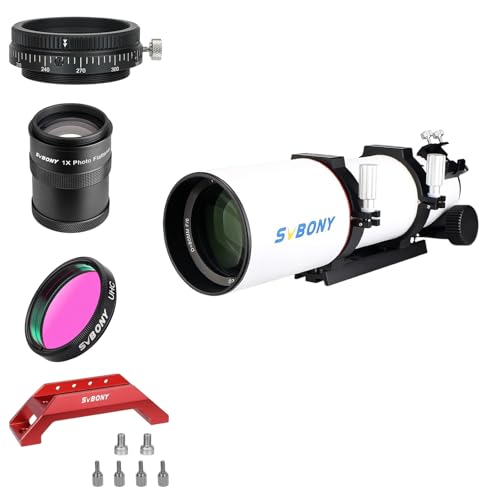
| Versatile Bundle | Type: Apochromatic refractor telescope kit | Aperture: 80mm | Focal length / ratio: not explicitly stated beyond 80mm triplet class | VIEW LATEST PRICE | Read Our Analysis |
| Sky-Watcher Evolux 82ED Refractor Telescope S11310 |

| Compact Wide-Field Performer | Type: Apochromatic refractor telescope | Aperture: 82mm | Focal length / ratio: 530mm (82ED) | VIEW LATEST PRICE | Read Our Analysis |
More Details on Our Top Picks
SVBONY 80ED F6 Apochromatic Refractor Telescope
The SVBONY 80ED F6 Apochromatic Refractor is a solid choice when you need a portable, capable scope for both visual observing and deep-sky astrophotography. You’ll use the 80ED F6 triplet to reduce chromatic aberration, enabling bright, high-contrast images. Start by noting the optical design: one S-FPL51 ED glass element plus two correction glasses. Next, check the 2.5″ micro-reduction rack-and-pinion focus with 1:10 double speed for precise focusing. Ensure back focus is about 87 mm. For beginners, plan visualization targets like M42 or M45 and verify compatibility for deep-sky imaging and visual use. Finally, confirm warranty and model number.
- Type:Apochromatic refractor OTA
- Aperture:80mm
- Focal length / ratio:f/6 (80ED)
- Optical design type:Triplet apochromat
- Mounting / mechanical access:2.5″ dual-speed focus (1:10)
- Intended use:Deep-sky astrophotography and visual
- Additional Feature:Back focus distance: 87mm
- Additional Feature:2.5″ dual-speed focuser
- Additional Feature:Four internal extinction barriers
SVBONY SV550 122mm F7 ED Refractor Telescope
If you want a portable, high-precision refractor for deep-sky imaging and visual work, the SVBONY SV550 122mm F7 ED Refractor delivers a strong balance of performance and practicality. You will note its 122 mm aperture, f/7, and 854 mm focal length, giving clear, sharp results with reduced chromatic aberration. Use the 2.5″ dual-speed focuser with a 1:10 gear ratio to dial in focus precisely, travel 87 mm, and stabilize balance with a dovetail up to 300 mm. This lightweight OTA (~14 lb) fits travel cases; apply care in setup and alignment for best results.
- Type:Apochromatic refractor OTA
- Aperture:122mm
- Focal length / ratio:f/7 (122mm)
- Optical design type:Triplet APO
- Mounting / mechanical access:2.5″ dual-speed focuser (1:10)
- Intended use:Deep-sky astrophotography and visual
- Additional Feature:87 mm focus travel
- Additional Feature:854 mm focal length
- Additional Feature:Dovetail up to 300 mm
Askar 71F Flat-Field APO Refractor Telescope
Askar 71F Flat-Field APO Refractor Telescope stands out for deep-sky work and imaging with its 71mm aperture and quadruplet air-spaced APO design, delivering sharp, flat fields across the frame. You assess the specs: 71mm aperture, F6.9, quadruplet design, 230mm Vixen dovetail. You confirm build details: CNC lens barrel, matte interior, 2.5 kg body, total 3 kg with accessories. You plan use: visual with 1.25-inch erecting prism, photography with included 8mm and 20mm eyepieces. You note portability, ease of use, and compatibility for deep-sky imaging and observing, then decide on setup steps and handling.
- Type:Flat-field APO refractor OTA
- Aperture:71mm
- Focal length / ratio:f/6.9 (71mm)
- Optical design type:Quadruplet APO
- Mounting / mechanical access:1.25″ focus/accessories; rotating focus
- Intended use:Deep-sky astrophotography and visual
- Additional Feature:Quadruplet air-Spaced APO
- Additional Feature:360-degree rotating focus
- Additional Feature:1.25-inch 45-degree erecting prism
Sky-Watcher EvoGuide 50DX Guide Scope APO Doublet
For professionals seeking a lightweight guiding solution with sharp, contrast-rich views, the Sky-Watcher EvoGuide 50DX Guide Scope APO Doublet stands out. You mount this 50mm APO doublet as a guidescope, then attach it to compatible brackets or a Vixen-style plate. It features a 242mm f/4.8 optical path and a 1.25” helical focuser for quick focus. Use the built-in finder stalk with Sky-Watcher brackets, or swap to a V-style rail for different setups. Consider optional T-thread adapters for astrograph use, or skip them if you only guide. This scope emphasizes contrast and simplicity in guiding routines.
- Type:Guide scope APO doublet
- Aperture:50mm
- Focal length / ratio:f/4.8 (50mm)
- Optical design type:Doublet ED (guide scope)
- Mounting / mechanical access:V-style mounting rail, finder stalk
- Intended use:Guiding/astro-photography support
- Additional Feature:1.25” helical focuser
- Additional Feature:V-style mounting rail
- Additional Feature:T-threads via optional adapter
SVBONY SV550 80ED F6 Apochromatic Refractor Telescope
The SVBONY SV550 80ED F6 Apochromatic Refractor is a strong choice when you need sharp, color-clean images for deep-sky work without complex setup. You set up a triplet apochromat with S-FPL51 glass and two correction pieces to minimize chromatic aberration. Use the 2.5-inch dual-speed focus, 1:10, to reduce vignetting on full-frame cameras. Attach the SV209 field flattener to improve fringe field curvature while preserving focal length. Connect the M63 extension tube and M48 adapter ring for 55 mm back focus. Install the CAA rotator for 360-degree angle adjustments. Target Messier objects like M42 and M45.
- Type:Apochromatic refractor telescope
- Aperture:80mm
- Focal length / ratio:not explicitly stated beyond 80mm class; implied fast/APO targets
- Optical design type:Triplet APO
- Mounting / mechanical access:CAA rotator and field flattener options
- Intended use:Deep-sky astrophotography
- Additional Feature:SV209 field flattener compatible
- Additional Feature:Back focal length 55mm standard
- Additional Feature:CAA 360-degree rotator
SVBONY SV550 80mm Triplet Apochromatic Refractor Telescope Kit
The SVBONY SV550 80mm Triplet Apochromatic Refractor Telescope Kit stands out for its triplet APO optics and lightweight build, making it a solid choice if you need true-to-life color and high contrast in a portable package. You compare to other kits by checking the 80mm aperture and triplet design, then confirm the low-dispersion ED glass plus two correction glasses. Use the SV209 1.0x Flattener for astrophotography, ensuring focal length stays the same. Attach SV210 360-degree rotator for camera angle, adjust, and shoot. Observe Moon, planets, and Messier targets, then review results for field curvature improvements.
- Type:Apochromatic refractor telescope kit
- Aperture:80mm
- Focal length / ratio:not explicitly stated beyond 80mm triplet class
- Optical design type:Triplet APO
- Mounting / mechanical access:SV209 flattener and SV210 CAA rotator
- Intended use:Moon, planets, deep-sky, Messier targets
- Additional Feature:SV209 1.0x Flattener
- Additional Feature:SV210 CAA 360-degree rotator
- Additional Feature:Simple, lightweight kit design
Sky-Watcher Evolux 82ED Refractor Telescope S11310
If you need a compact, lightweight APERTURE-optimized scope for wide-field astrophotography, the Sky-Watcher Evolux 82ED Refractor (S11310) fits the bill with its 82mm aperture and 530mm f/6.5 focal length. You get a new ED doublet apochromatic design with metallic high-transmission coatings on all ED glass elements. Use the 2.4-inch dual-speed focuser for precise focus. Consider the optional reducer/corrector to change field size. The dew shield helps reduce stray light and condensation. Packaged in a foam-lined case, it ships with clamshell rings, a V-style dovetail, and dual finderscope brackets. Warranty is available on request.
- Type:Apochromatic refractor telescope
- Aperture:82mm
- Focal length / ratio:530mm (82ED)
- Optical design type:Doublet APO
- Mounting / mechanical access:2.4″ dual-speed focuser
- Intended use:Wide-field astrophotography and visual
- Additional Feature:MHTC coatings on all elements
- Additional Feature:2.4-inch dual-speed focuser
- Additional Feature:Clamshell ring and case included
Factors to Consider When Choosing Apochromatic Refractors
When choosing apochromatic refractors, start by weighing optical design tradeoffs to match your observing goals and budget. Consider aperture versus f-ratio to balance light gathering with field sharpness, then check field flatness is consistent across the eyepiece and camera you’ll use. Finally, review glass types, weight, and balance, and confirm the tube and mount can handle the load while maintaining steady tracking.
Optical Design Tradeoffs
Consider how optical design tradeoffs affect performance, and outline your options step by step. You evaluate triplet APOs versus other designs. First, note triplets use three elements to correct chromatic aberration across a wide spectrum, which improves color fidelity and edge sharpness. Next, assess air-spaced designs, which minimize glass-to-air contact and reduce reflections, boosting contrast. Then compare to doublets, recognizing triplets generally offer better color correction and crisper edge images, but weigh the added weight and length. Also factor in low-dispersion ED glass, such as S-FPL51, that reduces blue-violet and red-tail errors for overall fidelity. Finally, consider field flatteners or flattener adapters, which keep a flat focal plane for wide-field imaging and edge-to-edge sharpness.
Aperture vs F-Ratio
Aperture and f-ratio work together to shape the performance of apochromatic refractors, so start by matching your observing or imaging goals to these basics. First, decide on light gathering and detail: larger aperture increases both, revealing fainter objects and finer detail, but adds weight and longer focal length. Next, choose a suitable f-ratio: lower f/ratios like f/4–f/6 give a faster system and wider fields, ideal for wide-field imaging or guiding visible detail; higher f/ratios like f/7–f/12 give a smaller, flatter field, better for high-fidelity planetary work. For a fixed aperture, slower ratios ease alignment and reduce correction complexity across the field. Weigh trade-offs: bigger aperture improves performance but may require sturdier mounts and longer focal lengths. Select your combination based on target type and mount capability.
Field Flatness Matters
Field flatness matters because edge sharpness affects your entire image, not just the center. You assess field flatness by using flat-field accessories that preserve focal length and keep the focal plane fixed while correcting curvature. Consider an APO triplet paired with a flattening element to minimize edge aberrations and maintain uniform sharpness from center to edge. If you plan wide-field or full-frame imaging, add a field flattener like those used with SV209 to reduce fringe curvature and distortions across the frame. The goal is consistent star shapes, minimal edge distortion, and no time-consuming refocusing. Evaluate how well a design preserves the focal plane position during rotation and tracking, and confirm compatibility with your camera size and sensor. This ensures uniform color correction across the field.
Glass Types Highlighted
Apochromatic refractors use low-dispersion ED glass, especially elements like S-FPL51, to reduce chromatic aberration across the spectrum. You choose glass type by evaluating color correction needs and budget. Triplet designs combine one ED element with two correction glasses to further enhance color correction compared to single-ED designs, so determine if true APO performance justifies the cost. Consider air-spaced optics to minimize internal reflections and maintain sharp, high-contrast images; verify build quality and alignment. Blue-edge chromatic aberration is reduced relative to single-ED configurations, improving performance on bright stars and galaxies, so test with bright targets. Field correction accessories, such as field flatteners, preserve flat field and image quality across the frame, and should be planned for your imaging setup.
Weight and Balance
Balance begins with how you mount and size your refractor. Heavier scopes need sturdier mounts to maintain balance; weight distribution becomes critical as aperture increases, affecting tracking and guiding accuracy. Start by checking tube length versus mount capacity, and plan counterweights accordingly. A shorter telescope with a heavier eyepiece can shift the center of gravity forward, so add counterweights or switch to adjustable mounts for proper balance. Note that dual-speed focusers add weight near the focuser end, influencing moment balance and risking tube sag if unsupported. Dovetail and mounting rail length, plus accessory placement (camera, flattener, prism), determine weight distribution along the mount. Proper balance reduces motor strain, improves imaging stability, and minimizes field rotation during long exposures.
Focuser Quality
A good focuser choice starts with the diameter and gearing, because these determine how smoothly you reach precise focus and how much light reaches your camera. Start by selecting a dual-speed focuser, usually a 1:10 gear ratio, for finer, more precise focusing across frames. This helps keep sharpness consistent in astrophotography sequences. Next, consider the diameter: a 2.5-inch or larger focuser reduces vignetting on full-frame sensors and supports heavier image trains without sagging. Decide between rack-and-pinion for smooth, repeatable movement, or a helical/single-speed option if you value compactness; note that the latter can cause coarser adjustments and potential image shift. Finally, check for integrated field flatteners or adapters that offset focal plane movement and preserve edge-to-edge sharpness across the field.
Mount Compatibility
Start by checking the mount’s compatibility with standard OTA dimensions and weights. Confirm the dovetail size matches your mount’s rail and balance range, such as 230 mm Vixen-style or up to 300 mm maximums. Check the OTA’s listed weight and length limits, and compare them to the mount’s load rating and counterweight capacity. Ensure the focuser’s backspacing won’t collide with the mount’s clearance; dual-speed or large 2.5-inch focusers require extra room for tracking accuracy. Inspect finder stalks, clamshell rings, and dovetail bars for direct compatibility with your rail spacing and attachment points, avoiding adapters that disturb balance. For astrophotography, verify back focus and any field-flattening accessories fit without overstressing the mounting system. Choose a setup that maintains stable, smooth tracking.
Practical Use Scenarios
If you’re selecting an apochromatic refractor for practical use, start by matching your observing or imaging goals to the instrument’s design and accessories. Consider color performance first: ED glass and extra corrective elements minimize chromatic aberration, improving color accuracy for deep-sky imaging and visual viewing. If you target faint targets, prefer triplet designs with air-spaced optics to reduce lateral color and achieve brighter, high-contrast images of galaxies and nebulae. Ensure field flatteners or extension tubes maintain edge-to-edge sharpness for flat-field imaging on full-frame sensors. Check back focus and travel specs, such as 87 mm, to position cameras and automate focusing. Verify compatibility: mounting, weight, balance, dovetail length, and dual-speed focusers for steady guiding and accurate exposures.
Final Thoughts
To choose an apochromatic refractor, compare focal lengths, apertures, and price. If you need portability, pick a short tube like 80mm; for wide-field work, a longer, fast doublet helps. For imaging, prioritize flat-field design and accurate color correction. Consider kit options with mounting hardware for quick setup. Check compatibility with your mount, camera, and guidescope. Decide on budget first, then test practical use: balance, weight, and ease of transport. Finish with a short, clear purchase list.

Meet Ry, “TechGuru,” a 36-year-old technology enthusiast with a deep passion for tech innovations. With extensive experience, he specializes in gaming hardware and software, and has expertise in gadgets, custom PCs, and audio.
Besides writing about tech and reviewing new products, he enjoys traveling, hiking, and photography. Committed to keeping up with the latest industry trends, he aims to guide readers in making informed tech decisions.