
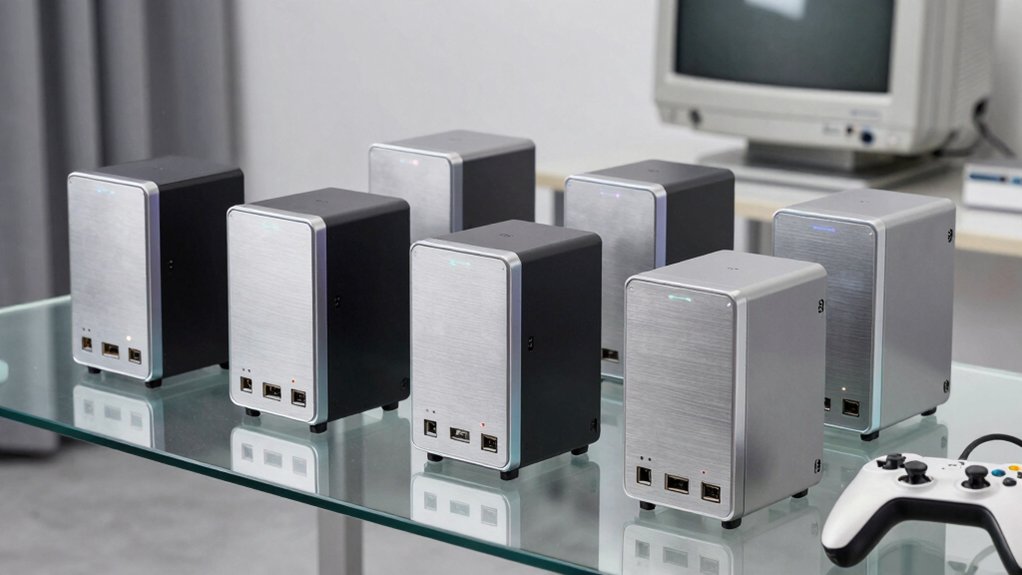

Pick a mini PC that balances 4K multi-monitor support, ample RAM, and fast storage for emulation. Start with KAMRUI Pinova P1 or P2 for Ryzen 4300U, 16GB RAM, and up to 4TB total storage; use HDMI 2.0/DP 1.4 and USB-C DP Alt Mode for stable 4K layouts. If you need more GPU headroom, choose GMKtec Ryzen 5 3500U with Vega 8 and triple display outputs. S7 Stick offers compact setup with Wake-on-LAN. Each option pairs solid cooling for long sessions; more tips await.
| KAMRUI Pinova P1 Mini PC with Ryzen 4300U |

| Best for Media/ multitasking | CPU family: AMD Ryzen 4300U | RAM capacity: 16 GB | Storage capacity (included): 256 GB SSD | VIEW LATEST PRICE | Read Our Analysis |
| ACEMAGIC Mini PC: Ryzen 4300U 16GB RAM 512GB SSD |

| Pro-Grade Portable | CPU family: AMD Ryzen 4300U | RAM capacity: 16 GB | Storage capacity (included): 512 GB SSD | VIEW LATEST PRICE | Read Our Analysis |
| KAMRUI Pinova P2 Mini PC with Ryzen 4300U |

| Solid All-Rounder | CPU family: AMD Ryzen 4300U | RAM capacity: 16 GB | Storage capacity (included): 512 GB SSD | VIEW LATEST PRICE | Read Our Analysis |
| GMKtec Mini PC Ryzen 5 3500U 1TB NVMe SSD |

| Power-User Workhorse | CPU family: AMD Ryzen 5 3500U | RAM capacity: 16 GB | Storage capacity (included): 1 TB NVMe SSD | VIEW LATEST PRICE | Read Our Analysis |
| S7 Mini PC Stick with Windows 11 Pro |

| Compact Signage/IoT Ready | CPU family: Intel Celeron J4105 | RAM capacity: 8 GB | Storage capacity (included): 128 GB SSD | VIEW LATEST PRICE | Read Our Analysis |
More Details on Our Top Picks
KAMRUI Pinova P1 Mini PC with Ryzen 4300U
The KAMRUI Pinova P1 Mini PC with Ryzen 4300U stands out for emulation because its Ryzen 4300U CPU delivers solid cores and threads for legacy games without bottlenecks. You work with it by noting it has 4 cores and 4 threads, base 2.7GHz, boost 3.7GHz, and Radeon graphics up to 1.4GHz. Check RAM and storage: 16GB DDR4, 256GB SSD, with two M.2 slots for expansion. For emulation, keep the system in 64GB RAM when upgrading and add more SSD space up to 4TB. Use HDMI 2.0 or DP 1.4 for 4K multi-monitor setups. Enable Wake-on-LAN for remote control.
- CPU family:AMD Ryzen 4300U
- RAM capacity:16 GB
- Storage capacity (included):256 GB SSD
- Video output options:HDMI 2.0 / DP 1.4 / USB-C DP
- Network connectivity:Gigabit Ethernet + Wi-Fi 5
- Intended use/role:Home/media Center / light server
- Additional Feature:7×24 operation readiness
- Additional Feature:Auto Power-On feature
- Additional Feature:Triple 4K output support
ACEMAGIC Mini PC: Ryzen 4300U 16GB RAM 512GB SSD
ACEMAGIC Mini PC stands out for emulation-ready performance in a compact package, thanks to its Ryzen 4300U processor paired with 16GB RAM and a fast 512GB SSD. You get Windows 11 Pro, 16GB RAM, and a 512GB NVMe SSD, plus 28W power and 4K display support via HDMI 2.0, DP 1.4, and USB-C. Set up the system, install emulation software, and test with classic titles. Use the 16GB RAM for multitasking, add up to 2TB SSD if needed, and connect via USB-C or Ethernet. Enable Wake on LAN, verify drivers, and monitor temperature during long sessions.
- CPU family:AMD Ryzen 4300U
- RAM capacity:16 GB
- Storage capacity (included):512 GB SSD
- Video output options:HDMI 2.0 / DP 1.4 / USB-C DP
- Network connectivity:Gigabit Ethernet + Wi-Fi 5
- Intended use/role:Home/office/education
- Additional Feature:Windows 11 Pro included
- Additional Feature:10/100/1000 Ethernet
- Additional Feature:64GB storage expansion support
KAMRUI Pinova P2 Mini PC with Ryzen 4300U
If you’re building a compact setup for retro emulation, the KAMRUI Pinova P2 stands out for its Ryzen 4300U power and flexible I/O, making it a strong choice for running classic games without a bulky desktop. You get 16GB DDR4 RAM and a 512GB M.2 SSD, with dual SO-DIMM slots for up to 64GB total. It supports two storage slots and up to 4TB total capacity. Use the 4K triple display outputs—HDMI 2.0, DP 1.4, and USB-C—for multi-monitor setups. Rely onGigabit LAN, WiFi, and Bluetooth for connectivity, and mount via VESA or place on a desk.
- CPU family:AMD Ryzen 4300U
- RAM capacity:16 GB
- Storage capacity (included):512 GB SSD
- Video output options:HDMI 2.0 / DP 1.4 / USB-C DP
- Network connectivity:Gigabit Ethernet + Wi-Fi
- Intended use/role:Home/office/education
- Additional Feature:Dual SO-DIMM slots
- Additional Feature:4K triple display
- Additional Feature:VESA mounting option
GMKtec Mini PC Ryzen 5 3500U 1TB NVMe SSD
Consider the GMKtec Mini PC Ryzen 5 3500U with 1 TB NVMe SSD when you need solid emulation performance in a compact form. You have a Ryzen 5 3500U, 16 GB RAM, and 1 TB NVMe SSD, plus dual M.2 slots for expansion. Use 2.5 GbE for fast networks and triple display support for multitasking. Install emulation software, ensure GPU is Vega 8, and set TDP to suit workload. Add up to 64 GB RAM if needed. Connect HDMI 2.1, DP, and USB-C for displays and peripherals. Verify Proxmox or pfSense compatibility if used as a small server.
- CPU family:AMD Ryzen 5 3500U
- RAM capacity:16 GB
- Storage capacity (included):1 TB NVMe SSD
- Video output options:HDMI 2.1 / DP 1.4 / USB-C DP
- Network connectivity:2.5 GbE + Wi-Fi 5
- Intended use/role:Office/HTPC/Proxmox-like server
- Additional Feature:2.5 GbE Ethernet
- Additional Feature:HDMI 2.1 output
- Additional Feature:Proxmox/pfSense compatibility
S7 Mini PC Stick with Windows 11 Pro
The S7 Mini PC Stick with Windows 11 Pro is a practical choice for emulation on a compact device, thanks to its replaceable SSD and solid hardware basics. You get 8GB RAM, 128GB SSD, and a 4-core Intel J4105 CPU with integrated graphics. Install Windows 11 Pro or Linux (Ubuntu, Debian) and use the replaceable SSD to expand storage. Use the auto-adjusting cooling fan to manage temps during extended sessions. Connect via HDMI, USB, or LAN for stable ports and network. Enable LAN wake-up, then run emulation software and verify performance across displays and peripherals.
- CPU family:Intel Celeron J4105
- RAM capacity:8 GB
- Storage capacity (included):128 GB SSD
- Video output options:HDMI / (HDMI extension mentioned)
- Network connectivity:Gigabit LAN + Wi-Fi 5
- Intended use/role:Digital signage/IoT travel/business
- Additional Feature:Windows 11 Pro ready
- Additional Feature:Replaceable SSD
- Additional Feature:2.5 GHz CPU speed
Factors to Consider When Choosing Mini PC for Emulation
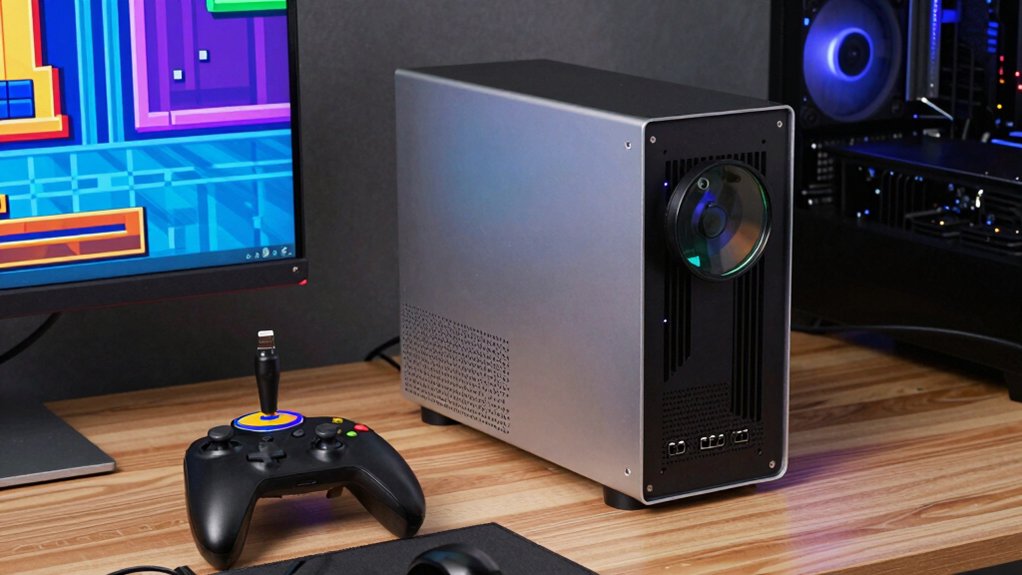
Start by evaluating CPU power and cores to ensure smooth emulation, then compare GPU performance for graphics-heavy titles and rendering. Check RAM capacity and speed to match your target systems, and verify storage space for ROMs, ISOs, and system images. Finally, assess heat and cooling solutions to prevent throttling during longer play sessions, and look for practical upgrade options for future needs.
CPU Power And Cores
Here’s how to assess CPU power and cores when choosing a mini PC for emulation. Start with core count: opt for quad-core (4C/4T) or higher to improve multitasking and parallel emulation workloads. If budget limits you to dual-core, expect weaker performance in modern titles and multitasking. Next, check base and boost clocks, aiming for up to 3.7 GHz to boost single-threaded emulation performance and reduce frame drops. Look for a modern CPU with Zen 2 or newer for better instruction efficiency during translation and dynamic recompilation. Evaluate power envelope, favor devices in the 28W–35W TDP range for steadier throughput under load. Finally, consider integrated GPU alongside core count, since combined capability impacts smoothness on demanding retro or modern titles.
GPU Performance For Emulation
Pairing the right GPU with your CPU matters for emulation, so start by evaluating GPU power alongside core counts from the previous section. Look for a GPU with higher core/compute units and clock speeds, such as a 5-core Radeon GPU up to 1400 MHz, to boost synthetic and real-time emulation tasks versus lower-end integrated options. Ensure the mini PC supports 4K display and multiple outputs (HDMI 2.0/2.1, DP 1.4, USB-C DP) to offload rendering and smooth high-resolution sessions. Note that integrated graphics typically offer modest gaming-grade performance, which may limit demanding emulation cores or accuracy features. Pair 16–32 GB RAM in dual-channel configuration to improve texture rendering and frame buffering, and verify cooling to sustain GPU clocks during long runs.
RAM Capacity And Speed
RAM capacity and speed directly affect emulation performance, so choose a setup that matches your workload. Start with RAM size: 16GB handles light to moderate emulation; 32GB or more supports multi-ROM setups and heavier titles. If you run several emulated systems at once, aim for 64GB. Next, consider memory channeling: dual-channel RAM improves bandwidth and reduces bottlenecks compared to single-channel. Verify the mini PC supports a dual-channel configuration and populate both channels with matched modules. Then check RAM type and speed: DDR4, 2400–3200 MHz, lower CAS latency is better for responsiveness. Balance this with CPU and GPU capabilities to avoid bottlenecks. If you upgrade, go from 16GB to 32GB or 64GB for tangible gains in cache-heavy games and large texture packs. Match modules to maximize compatibility and stability.
Storage Space Availability
Storage space determines how many emulated systems you can keep on hand without relying on external drives. You should evaluate local capacity first, noting you can store more games with larger drives. M.2 NVMe SSDs deliver noticeably faster load times than SATA HDDs, improving overall performance. Look for mini PCs that ship with 256GB to 1TB NVMe, then check expansion paths. Dual M.2 slots allow adding drives without removing existing ones, and some models support additional SATA/NVMe storage. Built-in expandable paths via M.2 slots and PCIe enable increasing space while preserving compact form factors. Plan growth by identifying upgrade steps: add a second NVMe, swap to 1TB drives, or enable a PCIe add-in card if supported. Verify maximum supported totals for future planning.
Heat And Cooling
Good cooling is essential for stable emulation, so start by choosing a mini PC with effective active cooling and ample airflow. Ensure the unit has a dedicated fan to sustain CPUBoost and prevent thermal throttling during long sessions. Look for larger heatsinks and proven airflow paths; these lower CPU temperatures and support sustained performance under load. Be aware that 4K multimedia workloads can raise GPU and CPU temperatures, so pick a design with robust cooling capacity to maintain consistent frame rates. Prefer systems with adjustable or TJMax-aware cooling profiles to balance fan noise and thermals for quiet, long-duration use. Dual-heat-pipe or enhanced ventilation designs correlate with better thermal margins for CPU/GPU-intensive emulation tasks.
Display Output Capabilities
To support multiple emulation screens, start by checking display output capabilities across ports. Look for mini PCs that offer triple 4K output via HDMI 2.0/2.1, DisplayPort 1.4, and USB-C with DisplayPort Alt Mode. Ensure the USB-C port includes DisplayPort 1.4 support for high-resolution, high-refresh-rate displays without adapters. Verify dedicated video outputs exist for each port combination, maximizing monitor diversity and layout options. Confirm 4K output capability meets practical emulation needs, with stable performance and accurate color across all connected displays. Review integrated GPU specs, noting cores and clock speed, and confirm memory bandwidth supports smooth rendering when running multiple emulated environments. Check driver support for multi-monitor configurations and verify firmware stability before purchase.
I/O And Expansion
Begin by confirming you have enough USB ports for peripherals, storage, and displays. Check that the mini PC offers multiple USB ports, preferably USB 3.0/3.2, plus at least one USB-C with DisplayPort support. This lets you connect game controllers, external drives, and monitors for emulation tasks. Look for triple display outputs—HDMI, DisplayPort, and USB-C with DP Alt Mode—so you can run several emulators across screens. Verify dual M.2 slots (NVMe and SATA/NVMe) to expand ROM libraries, ISOs, and emulator caches without external drives. Confirm Gigabit Ethernet and Wi‑Fi 5/6 for stable online features and updates. Ensure Auto Power-On, Wake-on-LAN, and robust cooling/fan systems are present to support long sessions and continuous operation. Plan ports layout and cooling for your specific setup.
Power Efficiency And Noise
Start by evaluating the power and heat you’ll tolerate during emulation. Look at processor TDP data; models with 15–28W tend to use less power and stay cooler, which means less fan activity and longer idle stability. Check cooling design: passive cooling stays quiet but can heat up under heavy load, while active cooling with axial or internal fans keeps temperatures down but may increase noise as load rises. Ensure the system has enough cooling headroom to avoid thermal throttling, which hurts performance and frame timing. If you plan dual or triple displays, expect higher power draw and more cooling needs. Real-world noise depends on fan curves and case airflow; prefer models with variable-speed fans tuned to temps.
Final Thoughts
Pick the right mini PC by matching your emulator needs to the specs. If you prioritize core performance and speed, choose a Ryzen 4300U-based model like the KAMRUI Pinova P1/P2 or ACEMAGIC Mini PC, and add RAM up to 16GB if possible. For heavier emulation, consider the GMKtec Ryzen 5 3500U with a 1TB SSD. If portability matters, use the S7 Mini PC Stick. Follow setup steps: install OS, update drivers, test with target titles, adjust settings for stability.

Meet Ry, “TechGuru,” a 36-year-old technology enthusiast with a deep passion for tech innovations. With extensive experience, he specializes in gaming hardware and software, and has expertise in gadgets, custom PCs, and audio.
Besides writing about tech and reviewing new products, he enjoys traveling, hiking, and photography. Committed to keeping up with the latest industry trends, he aims to guide readers in making informed tech decisions.