
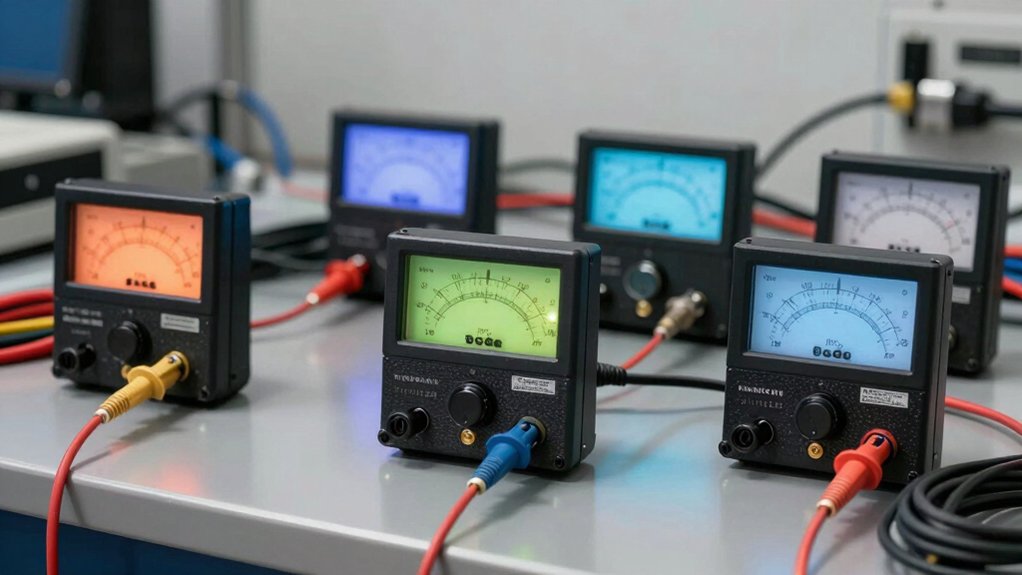

You want the five best megohmmeters that deliver results. Start with Klein Tools ET600 for up to 1000V, 4000 MΩ, auto-range, and backlit display. Look at Fluke 1507 for 50–1000 V, auto-discharge, CAT IV 600 V, and PI/DAR calculations. Consider a Digital Megohmmeter up to 100 GΩ for wide ranges and auto-discharge. Compare UEi 2 GΩ at 50–1000 V and T6125’s 2500 V and 0.01 MΩ–200 GΩ. Use these steps to choose; more specifics follow.
| Klein Tools ET600 Insulation Tester Multimeter with Auto-Ranging |

| Best Auto-Ranging | Voltage range: 125–1000 V DC | Insulation resistance range: up to 4000 MΩ | Auto discharge / capacitor protection: Auto-discharge not specified | VIEW LATEST PRICE | Read Our Analysis |
| Fluke 1507 Insulation Resistance Tester with Voltages |

| Industrial Standard | Voltage range: 50–1000 V | Insulation resistance range: up to 1000 MΩ | Auto discharge / capacitor protection: Auto-discharge of capacitive voltage | VIEW LATEST PRICE | Read Our Analysis |
| Digital Megohmmeter Insulation Resistance Tester (up to 100GΩ) |

| High-Resistance Power | Voltage range: 50–1000 V | Insulation resistance range: up to 100 GΩ | Auto discharge / capacitor protection: Auto discharge for capacitive loads | VIEW LATEST PRICE | Read Our Analysis |
| UEi Insulation Resistance Tester 1000V 2GΩ |

| Durable Field Pro | Voltage range: 50–1000 V | Insulation resistance range: up to 2 GΩ | Auto discharge / capacitor protection: Auto polarization index (PI) and DAR calculations (implies capacitive handling) | VIEW LATEST PRICE | Read Our Analysis |
| T6125 Digital Insulation Resistance Tester (2500V) |

| High-Voltage Specialist | Voltage range: 250–2500 V | Insulation resistance range: up to 200 GΩ | Auto discharge / capacitor protection: Auto shutdown (battery saver) (capacitive handling implied) | VIEW LATEST PRICE | Read Our Analysis |
More Details on Our Top Picks
Klein Tools ET600 Insulation Tester Multimeter with Auto-Ranging
The Klein Tools ET600 Insulation Tester Multimeter with Auto-Ranging is ideal for those who need a single tool that tests insulation while also measuring voltage, resistance, and continuity. You use it for insulation resistance testing up to 4000 MΩ at 125V, 250V, 500V, and 1000V DC, with a Megohmmeter test button and a lock button for hands-free operation. Check voltage with the built-in warning alarm and high voltage icon. Measure up to 1000V AC/DC, resistance, and continuity, using TRMS automatic ranging for accuracy. Read the backlit display, note icons, and monitor the low battery indicator for maintenance.
- Voltage range:125–1000 V DC
- Insulation resistance range:up to 4000 MΩ
- Auto discharge / capacitor protection:Auto-discharge not specified
- PI/DAR capability:Not listed
- CAT safety rating:CAT III/IV not specified
- Display type:Backlit display with bar graph
- Additional Feature:Backlit display with bar graph
- Additional Feature:Auto-power off indicator
- Additional Feature:High voltage warning icon
Fluke 1507 Insulation Resistance Tester with Voltages
If you need a robust insulation tester for industrial use, the Fluke 1507 stands out for its multiple test voltages, from 50 to 1000 V, and its ability to auto-discharge and prevent testing on live circuits. You’ll find a large backlit display and a remote probe for hands-free testing. Use it with CAT IV 600 V protection and live circuit detection that stops testing above 30 V. The unit arrives calibrated and ready, with PI and DAR calculations, plus a Pass/Fail compare function. It tests up to 1000 insulation tests, and measures earth bonds when batteries are fresh.
- Voltage range:50–1000 V
- Insulation resistance range:up to 1000 MΩ
- Auto discharge / capacitor protection:Auto-discharge of capacitive voltage
- PI/DAR capability:Automatic calculation of PI and DAR
- CAT safety rating:CAT IV 600 V
- Display type:Large, backlit display
- Additional Feature:Remote test probe included
- Additional Feature:Polarization Index (PI) and DAR calculations
- Additional Feature:Pass/Fail comparison function
Digital Megohmmeter Insulation Resistance Tester (up to 100GΩ)
Choose this digital megohmmeter when you need an all-in-one insulation tester that goes up to 100 GΩ and combines insulation resistance with multimeter functions. You get a Digital Megohmmeter, Insulation Resistance Tester capable of 50V, 100V, 250V, 500V, and 1000V. It measures insulation resistance up to 100 GΩ and includes frequency measurement. Use the test voltages to check transformers, motors, cables, and other equipment. It provides PI and DAR assessments, auto discharge, and a compare function for accuracy. Safety includes EN61010-1 and CATIII 600V. Pack includes leads, clips, batteries, and a manual for guidance.
- Voltage range:50–1000 V
- Insulation resistance range:up to 100 GΩ
- Auto discharge / capacitor protection:Auto discharge for capacitive loads
- PI/DAR capability:PI and DAR
- CAT safety rating:CAT III 600 V
- Display type:Large LCD style display
- Additional Feature:Frequency measurement capability
- Additional Feature:PI and DAR testing
- Additional Feature:Auto discharge for capacitive loads
UEi Insulation Resistance Tester 1000V 2GΩ
UEi Insulation Resistance Tester 1000V, 2GΩ offers a high-capacity insulation test up to 2 GΩ, making it ideal when you need to verify insulation integrity on larger equipment or in demanding environments. You power on the tester, select 50V, 100V, 250V, 500V, or 1000V as needed, and connect silicone leads with alligator clips. Readings show on the backlit LCD, with hold, zero, lock, and compare options available. Use the auto PI and DAR calculations for quick checks, and review results against device specs. Kit includes thermocouple, boot, case, and batteries for ready testing.
- Voltage range:50–1000 V
- Insulation resistance range:up to 2 GΩ
- Auto discharge / capacitor protection:Auto polarization index (PI) and DAR calculations (implies capacitive handling)
- PI/DAR capability:Auto polarization index (PI) and dielectric absorption ratio (DAR)
- CAT safety rating:CAT IV up to 600 V; CAT III up to 1000 V
- Display type:Easy to read LCD display with backlight
- Additional Feature:Auto polarization index (PI) and DAR calculations
- Additional Feature:Kickstand-enabled rubber boot
- Additional Feature:Test lead holders on boot
T6125 Digital Insulation Resistance Tester (2500V)
The T6125 Digital Insulation Resistance Tester (2500V) is ideal for technicians needing a high-voltage megohmmeter with a wide resistance range and multiple test voltages. You select output voltages of 250 V, 500 V, 1000 V, or 2500 V, then set the insulation range from 0.01 MΩ to 200 GΩ. Use 250 V or 500 V for smaller parts, and 1000 V or 2500 V for transformers or motors. Readings are held with data hold, and alarms warn if you exceed capacity. The unit measures AC input from 10 V to 600 V and includes a protective case for harsh environments.
- Voltage range:250–2500 V
- Insulation resistance range:up to 200 GΩ
- Auto discharge / capacitor protection:Auto shutdown (battery saver) (capacitive handling implied)
- PI/DAR capability:Alarm and measurement features (PI/DAR not listed)
- CAT safety rating:Certification/ratings not specified
- Display type:Large LCD with gray-white backlighting
- Additional Feature:Large LCD with backlight
- Additional Feature:Data hold function
- Additional Feature:Over-range alarm
Factors to Consider When Choosing Megohmmeter Insulation Resistance Testers
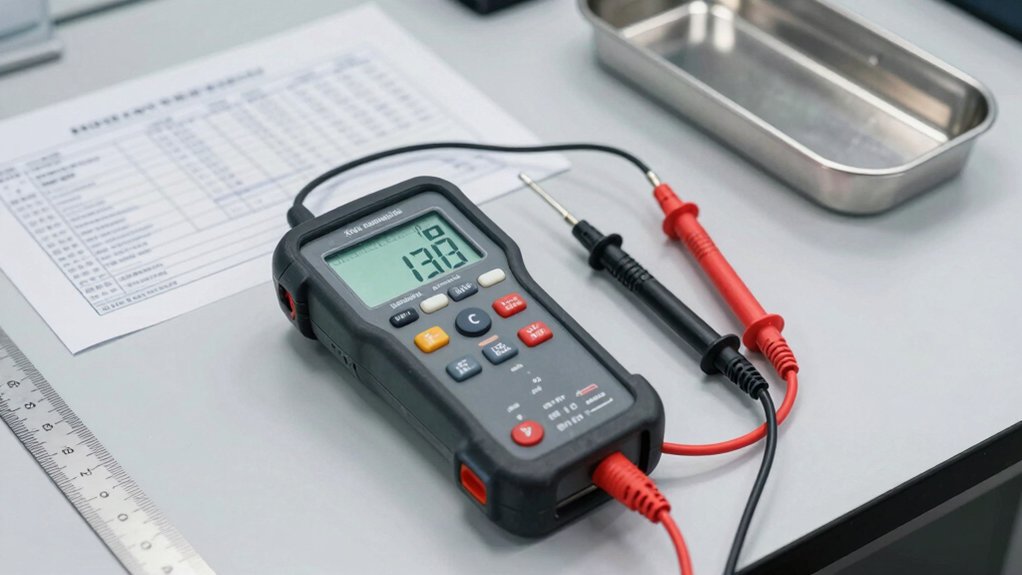
When selecting a megohmmeter, start by matching your voltage range options to the equipment you test and the environment you work in, then verify the insulation resistance range you’ll typically measure. Check safety certifications and rating standards to ensure compliance, and review the display and readouts so you can read results clearly in your workspace. Finally, assess test voltage versatility, including whether the unit supports multiple test voltages and how easy it is to switch between them, with concrete examples from your projects.
Voltage Range Options
Choosing the right voltage range is essential for accurate insulation testing and equipment safety. You select a test voltage that matches the device under test and relevant codes. Common options include 50 V, 100 V, 250 V, 500 V, 1000 V, and some models offer 2500 V for high‑voltage work. Decide based on insulation class and safety requirements. Lower voltages reveal minor weaknesses, while higher voltages expose deeper faults in transformers, motors, and power cables. Some meters provide automatic voltage selection; others require manual choice. Verify that the meter’s range covers the device’s rated insulation voltage and CAT ratings. After testing, note the voltage used and follow any automatic discharge features to minimize residual charge. Match the chosen range to the test scenario for reliable results.
Insulation Resistance Range
Inspect insulation resistance ranges by matching them to your equipment’s needs and test goals. You select a range from very low ohms to very high megohms or gigohms to detect insulation integrity or leaks. Start with the maximum voltage you’ll apply, then choose a matching resistance range. For general checks, use 0.01 MΩ up to 200 GΩ to cover both leakage and insulation health. If you need precision on high-impedance circuits, consider testers offering up to 4000 MΩ (4 GΩ) or more. Confirm the range aligns with your equipment’s expected resistance and required Pass/Fail sensitivity. Use the lowest range that still reveals faults to improve accuracy and reduce test time. Document measured values for maintenance records and trend analysis.
Safety Certifications
Safety certifications matter most when selecting megohmmeter insulation testers. Look for EN61010-1 or IEC/EN 61010-1 compliance to confirm safety groundwork. Check CAT ratings, such as CAT III 600 V or CAT IV 600 V, to know where the device can be used safely. Verify live circuit detection is built in and that auto-discharge features are tested and documented for user protection during insulation testing. Review ANSI/ISA 82.02.01 (61010-1) 2004 and CAN/CSA-C22.2 No. 61010-1-04 validation claims to gauge electrical safety credibility. Expect NIST-traceable calibration certificates or references that ensure measurement accuracy aligns with safety standards. Compare how each certification is described, then select testers with the strongest, clearly documented safety assurances.
Display And Readouts
Backlit displays are essential for reading results in dim rooms or cluttered panels. You’ll start by confirming the display is backlit, so measurements stay readable in tight spaces. Look for automatic PI and DAR indicators; these help assess insulation condition without extra steps. Check that the readouts show insulation resistance across multiple voltages, from 50 to 1000 V, and in units like MΩ, to match your typical test setup. Verify a clear pass/fail or comparison function, so you can interpret results quickly. Ensure the display includes accuracy indicators or error bars, plus digits and max/min Hold readouts for trend tracking. If a device offers these features, document where each reading appears and how to switch modes for reproducible results.
Test Voltage Versatility
Test voltage versatility is essential for matching insulation scenarios. You look for testers that offer a range of test voltages, such as 50 V, 100 V, 250 V, 500 V, and 1000 V, to cover different insulation needs. Higher voltage options, up to 1000 V or more, allow testing of high-voltage equipment and insulation under stress. Some models provide dual voltage testing, AC and DC, to fit various insulation standards and measurement methods. A broader voltage range supports both insulation resistance testing and safety-critical dielectric testing in one instrument. The presence of higher voltage settings often comes with enhanced protection features, like live circuit detection, to ensure safe operation during voltage application. Choose a model that matches your equipment and safety requirements.
Built In Features
Built-in features substantially shape how you use a megohmmeter. You start by checking insulation resistance ranges, ensuring the device covers at least 2 GΩ and voltages from 50 V to 1000 V, with some models going up to 2500 V for special tests. Next, verify automatic calculations like PI and DAR, so you can judge insulation condition without manual math. Look for auto-discharge to safely remove charge after tests, and note if remote test probes are available for hard-to-reach points. Examine displays for backlighting and data hold or pass/fail functions to simplify repetitive work. Confirm power options such as auto power-off and battery indicators, and assess rugged enclosures with protective boots for field durability. Match features to your typical test scenarios and maintenance needs.
Calibration And Warranty
Calibration and warranty are critical when selecting megohmmeter insulation testers. You verify the presence of a calibrated calibration certificate (NIST-traceable if available) and note the required re-calibration interval from the manufacturer. Check whether the instrument ships with pre-calibration data or a recent calibration notice and record the last calibration date. Confirm warranty terms, including duration, coverage scope, and whether test leads and accessories are included; identify maintenance tasks that void the warranty. Ensure factory or authorized-service center calibration options exist and obtain estimated turnaround times for recalibration. Look for automatic self-test features or internal diagnostics that verify accuracy between external calibrations, and document how to trigger any self-test for routine checks.
Final Thoughts
To pick the right megohmmeter, compare range, accuracy, and safety features. If you need high voltage testing, choose the 2500V model with solid insulation resistance up to 2GΩ. For general use, a 1000V unit with 2–3GΩ is enough. Check auto-ranging, display readability, and test leads. Follow steps: define voltage needs, list candidates, verify certifications, confirm warranty, and plan calibration. Choose Klein, Fluke, or UEi based on budget and required ranges, then proceed with setup and test protocols.

Meet Ry, “TechGuru,” a 36-year-old technology enthusiast with a deep passion for tech innovations. With extensive experience, he specializes in gaming hardware and software, and has expertise in gadgets, custom PCs, and audio.
Besides writing about tech and reviewing new products, he enjoys traveling, hiking, and photography. Committed to keeping up with the latest industry trends, he aims to guide readers in making informed tech decisions.